INVES TING IN FAMILIES INVES TING IN FAMILIES OUR W ORK S - - PowerPoint PPT Presentation

inves ting in families inves ting in families
SMART_READER_LITE
LIVE PREVIEW

INVES TING IN FAMILIES INVES TING IN FAMILIES OUR W ORK S - - PowerPoint PPT Presentation

INVES TING IN FAMILIES INVES TING IN FAMILIES OUR W ORK S UPPORTS AND EXPANDS COMMUNITY S ERVICES THAT ENABLE FAMILIES TO W ORK AND BUILD ECONOMIC S TABILITY CHILDREN, YOUTH AND FAMILIES National Economic Development and Law Center


slide-1
SLIDE 1

National Economic Development and Law Center

INVES TING IN FAMILIES INVES TING IN FAMILIES

OUR W ORK S UPPORTS AND EXPANDS COMMUNITY S ERVICES THAT ENABLE FAMILIES TO W ORK AND BUILD ECONOMIC S TABILITY
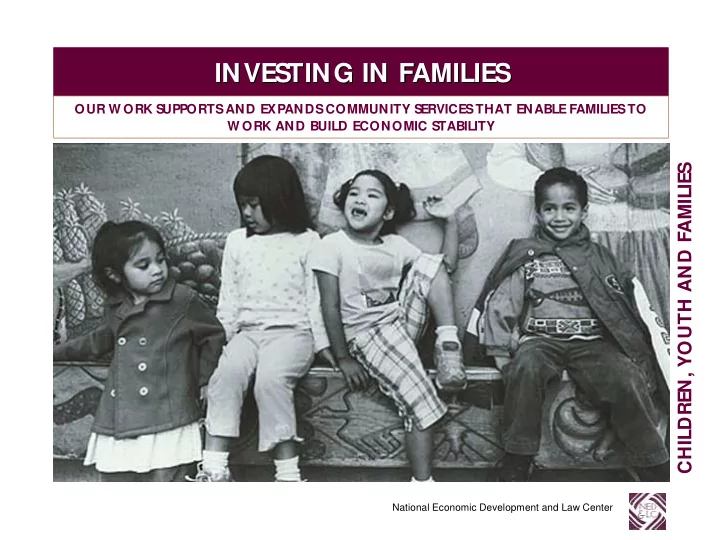
CHILDREN, YOUTH AND FAMILIES

slide-2
SLIDE 2

National Economic Development and Law Center

INVES TING IN FAMILIES INVES TING IN FAMILIES

National Economic Development and Law Center (NEDLC)

! Children, Youth and Families (CYF) Division The CYF division aims to assist community-based

  • rganizations that serve children, youth and families in

low-income communities to have a greater impact on employment and economic development opportunities available to their constituency. Further, this division works with community economic development (CED)

  • rganizations to integrate enterprises, services and

programs that directly benefit children, youth and families into their overall community revitalization plans. CYF has two key programs: Child Care and Family Support.

slide-3
SLIDE 3

National Economic Development and Law Center

INVES TING IN FAMILIES INVES TING IN FAMILIES

NEDLC Child Care Program

! NEDLC's Child Care Program goal is to increase the availability, sustainability and quality of child care across the country. ! NEDLC believes that creating access to affordable, quality child care is a key strategy in building sustainable local economies.

slide-4
SLIDE 4

National Economic Development and Law Center

INVES TING IN FAMILIES INVES TING IN FAMILIES

NEDLC Child Care Program Current Projects

1. Child Care Economic Impact Reports (CCEIRs):

CCEIRs demonstrate that the child care sector is a fundamental social and economic infrastructure, critical to a state or community’s overall economic vitality and quality of life.

2. Local Investment in Child Care (LINCC) Project:

To increase the capacity of local child care leaders to take on economic development issues, investigate and analyze the gaps in facilities and business development, and to build partnerships with the community economic development and financial fields to address those needs.

3. The Building Child Care Project:

To provide a centralized clearinghouse of information and services designed to improve and increase child care providers’ access to financial resources for facilities development projects in California. Building the child care field’s capacity to build capacity.

slide-5
SLIDE 5

National Economic Development and Law Center

INVES TING IN FAMILIES INVES TING IN FAMILIES

Child Care Through an Economic Lens

CHILD CARE IS GOOD FOR BUSINESS

  • Nationally, businesses lose $3 billion annually in absenteeism due

directly to child care

  • 52% percent of parents reported that the problems of finding

child care affect their ability to do their job well

  • 43% of parents indicate that a lack of acceptable child care

prevents either them or their spouse from taking a job they want

  • Two-thirds of employers report that benefits of child care

programs exceed costs or are cost-neutral

slide-6
SLIDE 6

National Economic Development and Law Center

INVES TING IN FAMILIES INVES TING IN FAMILIES

The Economic Impact of the Child Care Industry Example: California

CHILD CARE INDUSTRY EARNINGS

  • Licensed child care in California generates between $4.7 and

$5.4 billion in gross receipts

CHILD CARE INDUSTRY EMPLOYMENT

  • Approximately 209,000 jobs are created and sustained by the

child care industry in California

" 123,000 directly employed by licensed child care establishments " 86,000 indirectly employed through child care’s support of other industries (e.g. food service, child care supplies, and other vendors)

slide-7
SLIDE 7

National Economic Development and Law Center

INVES TING IN FAMILIES INVES TING IN FAMILIES

Using the EIRs: LINCC Strategies

1.

Support Facilities Development and Improvement

2.

Integrate Child Care into Economic Development

3.

Influence Land Use Policy

4.

Enhance Business Skills of Child Care Providers

slide-8
SLIDE 8

National Economic Development and Law Center

INVES TING IN FAMILIES INVES TING IN FAMILIES

! Purpose: To provide a centralized clearinghouse of information

and services designed to improve and increase child care providers’ access to financial resources for facilities development projects in California.

! Who: National Economic Development and Law Center, Child

Care Facilities Fund of the Low Income Investment Fund, Child Development Policy Institute Education Fund, and the California Child Care Resource and Referral Network

! Funded by: the California Department of Education, Child

Development Division, and designed as the State’s response to the need to bring resources together on a centralized statewide level.

The Building Child Care (BCC) Project

slide-9
SLIDE 9

National Economic Development and Law Center

INVES TING IN FAMILIES INVES TING IN FAMILIES

Child Care Facilities Development and Financing in California

– Renovation or Expansion to a child care center or family child care home – Build or Purchase a facility to be used as a child care center or family child care home

slide-10
SLIDE 10

National Economic Development and Law Center

INVES TING IN FAMILIES INVES TING IN FAMILIES

Overarching Problems: Growth and Sustainability of Child Care Facilities

! Facilities Development Challenges:

– Limited purchasing power means that ECE providers typically rent and use below market spaces to meet their need for facilities. – Few providers have the skills and knowledge to find their way through the confusing maze of codes, regulations, building requirements and construction challenges. – It can be very difficult to identify technical assistance and expert assistance (i.e. Architects, Contractors, Project Managers) to help with these issues.

! Financial Challenges:

– Facilities development projects are costly and require a range of funds. – Child care programs typically have limited cash flow and present weak collateral. – Planning and predevelopment processes require funding other than debt. – With other financial strains to address, facilities development projects are not always a priority for child care programs. – Providers often don’t understand when and how to use debt and equity. – Providers often lack the business skills required to operate sustainable programs. – Identifying and accessing available and appropriate financial resources and technical assistance to help in the financing process can be very challenging.

slide-11
SLIDE 11

National Economic Development and Law Center

INVES TING IN FAMILIES INVES TING IN FAMILIES

Who’s Involved in Child Care Facilities Development and Financing in California?

Child Care

  • Local Technical Assistance: Resource and Referral Agencies, Regional Resource

Centers, Local Child Care Planning Councils, Child Care Advocate Program, Prop 10/First 5 Commissions, Family Child Care Associations

  • Statewide Technical Assistance: Child Care Law Center, California Child Care Resource

and Referral Network, California Association for the Education of Young Children, California Association for Family Child Care, Building Child Care Collaborative

Facilities Development

  • Specialists: Architects, Contractors, Project Managers, Realtors, Developers
  • Licensing: Community Care Licensing, Planning Departments, Fire Departments

Financing

  • Lenders: Conventional Lenders, Community Development Financial Institutions, Foundations

(PRI’s), National Financial Intermediaries, Federal, State, and Local government programs.

  • Grant-makers: Private, community, and corporate foundations, government programs, First

5 (Prop 10) Commissions

  • Business Development Assistance:

SBA Programs, Community Development and Small Business Lenders, Other Business TA Programs

slide-12
SLIDE 12

National Economic Development and Law Center

INVES TING IN FAMILIES INVES TING IN FAMILIES

! In California, there has never been a central place linking child care facilities development and financing resources on a statewide level… The Building Child Care (BCC) Project takes the first step in establishing such a place. What Does BCC do to Connect These Resources?

slide-13
SLIDE 13

National Economic Development and Law Center

INVES TING IN FAMILIES INVES TING IN FAMILIES

1. Identifies resources available to help California’s ECE Providers and Advocates with facilities development and financing issues:

  • Technical assistance,
  • Financial resources, and
  • Publications.

2. Improves access to these resources through statewide technical assistance:

  • Project website: www.buildingchildcare.org,
  • Toll free line (888-411-3535),
  • “Training the Trainers” workshops,
  • Trainings for providers, and
  • Focus groups of those who work with providers locally.

3. Expands existing resources and fosters the development of new ones to meet identified gaps in what is available for ECE facilities development and financing in the following areas:

  • Financial,
  • Technical Assistance, and
  • Written Materials.

The Building Child Care (BCC) Project

slide-14
SLIDE 14

National Economic Development and Law Center

INVES TING IN FAMILIES INVES TING IN FAMILIES

– Continue to build the field’s understanding and appropriate use of debt financing for facilities development projects. – Ensure that projects are well-planned and sustainable. Help ECE providers in the early stages of facilities development. – Continue to develop and provide sector-specific TA on a Statewide level to providers and TA Intermediaries. – Develop local child care specific one-on-one TA for providers who are well-positioned to move forward with the facilities development process. – Expand the number and availability of financial resources targeted at child care businesses. – Coordinate ECE facilities with other facilities in the community to make the most of existing and developing resources (e.g housing developments). – Ensure that available resources (financial, TA, other) are connected to child care providers in a strategic and targeted way. – Ensure that intermediaries, lenders, grant makers and others in the field are connected to one another locally and statewide.

Strategies to Further the Field of Child Care Facilities Development and Financing