INVESTOR PRESENTATION MARCH 2017 Residences at Bella Terra | Orange - - PDF document

investor presentation
SMART_READER_LITE
LIVE PREVIEW

INVESTOR PRESENTATION MARCH 2017 Residences at Bella Terra | Orange - - PDF document

INVESTOR PRESENTATION MARCH 2017 Residences at Bella Terra | Orange County, CA 3033 Wilshire | Los Angeles, CA UDR, Inc. (NYSE: UDR) has a demonstrated Chief Financial Officer: history of successfully managing, buying, selling, Joe Fisher |


slide-1
SLIDE 1

INVESTOR PRESENTATION

MARCH 2017

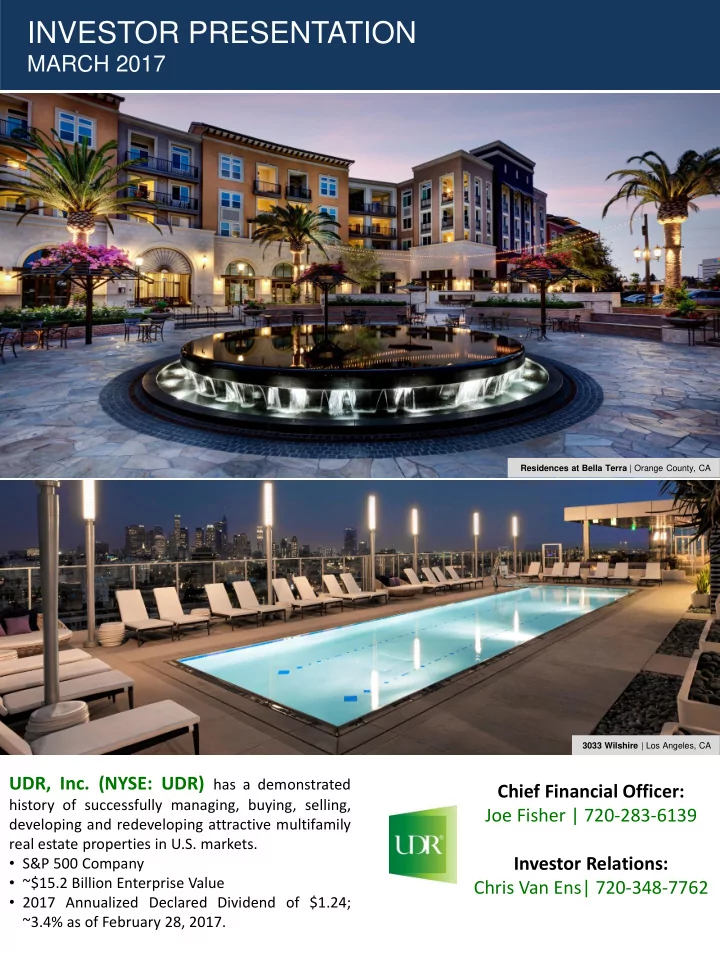
Residences at Bella Terra | Orange County, CA

UDR, Inc. (NYSE: UDR) has a demonstrated

history of successfully managing, buying, selling, developing and redeveloping attractive multifamily real estate properties in U.S. markets.

  • S&P 500 Company
  • ~$15.2 Billion Enterprise Value
  • 2017 Annualized Declared Dividend of $1.24;

~3.4% as of February 28, 2017.

Chief Financial Officer: Joe Fisher | 720-283-6139 Investor Relations: Chris Van Ens| 720-348-7762

3033 Wilshire | Los Angeles, CA

slide-2
SLIDE 2

TABLE OF CONTENTS

PAGE

UDR at a Glance 3 Why Invest in UDR? 4-6 Operating Excellence 7-8 Portfolio Diversification 9 Accretive Capital Allocation 10-12 Balance Sheet Strength 13 Components of Long-Term AFFO per Share Growth 14 Operating Trends Update 15-16 2017 Same-Store Market Revenue Growth Expectations 17 2017 Guidance 18 Appendix: Apartment Demographics and Fundamentals 20-25

2

Fiori on Vitruvian Park | Addison, TX

slide-3
SLIDE 3

UDR AT A GLANCE

UDR is a multifaceted apartment REIT that owns, operates, develops and redevelops a diversified portfolio of apartment homes across various major U.S. markets. UDR AT A GLANCE(1)

  • Established in 1972
  • 20 Markets
  • 165 Communities
  • 49,907 Homes
  • Same-Store Revenue per Occupied Home: $1,981
  • Total Portfolio Revenue per Occupied Home (inclusive of JVs): $2,090
  • $15.2 Billion Enterprise Value(2)
  • S&P 500 Company
  • Investment Grade Rated
  • $1.1 Billion Development Pipeline (7% of Enterprise Value, 29% of Dev. is in Lease-Up)
  • 177 Consecutive Quarters Paying a Dividend
  • 3.4% Dividend Yield(2)
  • Avg. Age of Communities: 16 years
  • # of UDR Associates: ~1,600

Austin Baltimore Metro Washington, D.C. Richmond Boston New York Dallas Nashville Monterey Peninsula Los Angeles O.C. Orlando Tampa San Francisco San Diego Seattle Inland Empire Portland Denver Philadelphia West Coast:

% of SS NOI: 44% % of Total NOI: 41% Development: $734M

Southwest:

% of SS NOI: 5% % of Total NOI: 6% Development: $30M

Southeast:

% of SS NOI: 15% % of Total NOI: 11%

Northeast

% of SS NOI: 18% % of Total NOI: 19% Development: $367M

Mid-Atlantic

% of SS NOI: 19% % of Total NOI: 23%

UDR’S MARKET COMPOSITION(1)

(1) As of December 31, 2016. Development includes wholly-owned homes and MetLife joint ventures at UDR’s pro-rata ownership interest. (2) As of February 28, 2017. Source: Company documents.

3 2.5%-5.0% Total NOI > 5.0% of Total Portfolio NOI < 2.5% Total NOI

slide-4
SLIDE 4

Our overall strategic direction is driven by the interplay between our

  • perating, portfolio diversification, capital allocation and balance sheet
  • strategies. These strategies make UDR a full-cycle investment, drive high-

quality, predictable Adjusted Funds From Operations (“AFFO”), dividend and net asset value (“NAV”) per share growth, and should result in above- average, long-term total shareholder return (“TSR”).

WHY INVEST IN UDR?

4

OPERATING EXCELLENCE

  • Maximize revenue growth and consistently

enhance operating margins via revenue- generating/expense-reducing initiatives that drive NOI growth.

PORTFOLIO DIVERSIFICATION

  • Maintain a diversified portfolio to reduce

market-concentration risk and appeal to a wide renter and investor audience.

BALANCE SHEET STRENGTH

  • Maintain a safe and liquid balance sheet

that can fully fund our internal and external needs throughout the real estate cycle.

Total Shareholder Return

ACCRETIVE CAPITAL ALLOCATION

  • Invest in accretive internal and external
  • pportunities that better position our

portfolio to maximize long-term returns.

slide-5
SLIDE 5

UDR IS A FULL-CYCLE INVESTMENT

5

Full-cycle investments generate better-than-average risk-adjusted growth versus peers over multi-cycle periods. Our best-in-class operating platform has driven our long-term, same-store growth alpha.

164 157 90 100 110 120 130 140 150 160 170 2000 2004 2008 2012 2016

SS Revenue Growth (indexed at 100 in 2000)(1)

UDR

  • Apt. REIT Peer Avg.

Average annual compounded SS revenue growth 25 bps above our peer group. (6)% (4)% (2)% 0% 2% 4% 6% 8% 2000 2004 2008 2012 2016

SS Revenue Growth Over Multiple Cycles(1)

UDR

  • Apt. REIT Peer Avg.

Operating Excellence + Diversified Portfolio = Better Risk-Adjusted Growth …While our highly diversified portfolio has contributed to our lower long- term, same-store growth volatility.

(1) Peer average includes AIV, AVB, CPT, EQR, ESS and MAA. Source: Company/Peer REIT documents and forecasts and SNL.

  • Coeffic. of Variation:

UDR: 0.88 Peer Avg.: 1.17 170 154 90 100 110 120 130 140 150 160 170 2000 2004 2008 2012 2016

SS NOI Growth (indexed at 100 in 2000)(1)

UDR

  • Apt. REIT Peer Avg.

Average annual compounded SS NOI growth 60 bps above our peer group. (10)% (5)% 0% 5% 10% 2000 2004 2008 2012 2016

SS NOI Growth Over Multiple Cycles(1)

UDR

  • Apt. REIT Peer Avg.
  • Coeffic. of Variation:

UDR: 1.14 Peer Avg.: 1.65

slide-6
SLIDE 6

We have executed well on all aspects of our business since our initial Strategic Outlook was published in February 2013. This has translated into strong AFFO, dividend and NAV per share growth over time.

UDR’S PERFORMANCE OVER TIME

6 144 141 143 90 100 110 120 130 140 150 2012 2013 2014 2015 2016 2017E

UDR Per Share Growth (indexed at 100 at YE 2012)(1)

AFFO/sh Growth Dividend/sh Growth NAV/sh Growth

7.6% AFFO/sh CAGR 7.1% Dividend/sh growth CAGR 9.4% NAV/sh CAGR

(1) 2017 AFFO/sh estimate represents mid-point of UDR’s guidance. (2) Data as of February 28, 2017. Source: Company documents and forecasts, Green Street Advisors and NAREIT.

176 147 156 90 110 130 150 170 190 2012 2013 2014 2015 2016 UDR NAREIT Equity Index S&P 500

And has led to robust total shareholder return(2).

14.5% UDR TSR CAGR 11.3% S&P 500 Index TSR CAGR 9.7% NAREIT Equity Index TSR CAGR (Indexed at 100 in February 2013)

slide-7
SLIDE 7

OPERATING EXCELLENCE

Our long-term, same-store growth alpha is primarily driven by our robust

  • perating platform. Its strength is founded on accurate forecasting, efficient

execution and continuous innovation.

7

“Winning” individual markets showcases an enterprise’s ability to execute and its overall operating acumen as it is agnostic to portfolio-level geographic concentration and price point exposure. We “win” more than

  • ur fair share of markets.

36% 42% 53% 50% 34% 41% 43% 42% 30% 35% 40% 45% 50% 55% FY SS Revenue FY SS NOI FY SS Revenue FY SS NOI

% of Quarters Since 4Q 2007 Where Guidance Was Raised or Maintained(1)

UDR

  • Apt. REIT Peer Avg.

UDR and our peers raise full-year SS guidance expectations at similar rates over time. But, we maintain our full-year SS guidance expectations at significantly higher rates.

(1) Based on full-year SS guidance updates provided on a quarterly basis from 4Q 2007 to 4Q 2016. Peer average includes AIV, AVB, CPT, EQR, ESS and MAA. (2) Winning a market is defined as ranking first among MF peers in year-over-year same-store revenue growth in a quarter. Source: Company and Peer REIT documents and SNL.

49% 44% 34% 29% 31% 40% 32% 21% 36% 14% 18% 12% 23% 20% 15% 20% 20% 22% 0% 10% 20% 30% 40% 50% 60% 2008 2009 2010 2011 2012 2013 2014 2015 2016

% of UDR’s Markets Where UDR Produced the Highest SS Revenue Growth(2)

UDR

  • Apt. REIT Peer Avg.
slide-8
SLIDE 8

OPERATING EXCELLENCE

Market revenue and expense growth serve as governors on how quickly we can grow. Beating market growth demands continuous innovation in the form

  • f

implementing revenue-enhancing

  • r

expense-constraining

  • perating initiatives throughout our platform. For ideas we listen to

customers/associates and utilize best practices from a variety of industries.

8

Continuous innovation, coupled with an improving portfolio, have contributed to significant margin expansion over time and enhanced our status as a best-in-class operator.

Source: Company documents.

A SAMPLING OF SUCCESSFUL OPERATING INITIATIVES

Initiative Date Implemented

  • Rev. Generating

/ Exp. Reducing Cumulative Achievement to-Date Further Improvement? Reduce Avg. Days Vacant 2012 Expense 6 day reduction since ’12, ~$6.6M in additional NOI Yes R&M Efficiencies 2012 Expense R&M costs 10% lower than trend since YE ’12, ~$3.2M in additional NOI Yes Package Lockers 2015 Revenue / Expense Resident amenity and reduced site-level hours worked, ~$400K in additional NOI Yes Parking 2016 Revenue ~$1.3M in additional NOI Yes

68.9% 66.2% 71.4% 65% 66% 67% 68% 69% 70% 71% 72% 2007 2008 2009 2010 2011 2012 2013 2014 2015 2016

Historical UDR Operating Margin

Current operating margin is 250 bps higher than prior peak, due to an improved portfolio and operating initiatives.

slide-9
SLIDE 9

Our diversified portfolio is a differentiating factor versus peers, appeals to a wide renter and investor audience, lessens market-concentration risk and reduces volatility in our long-term, same-store growth. Diversification is a key component of being a full-cycle investment.

(1) Data as of December 31, 2016. (2) Price point differential equals the percentage difference between 1st and 3rd quartile rent levels across each REIT’s portfolio. (3) A-quality is defined as having average community rent > 120% of market average rent. B-Quality = > 80% and < 120%. Source: Company and Peer REIT documents and AxioMetrics.

PORTFOLIO DIVERSIFICATION

9 38% 54% 57% 58% 65% 66% 69% 85% 94% 30% 55% 80% 105% MAA CPT AIV UDR Peer Avg. More AVB EQR ESS

% of SS Revenue in Five Largest Markets(1)

UDR’s Diversified Portfolio (1)

Markets: 20 Communities: 165 Total Homes: 49,907 SS Homes: 32,265 SS Rev. per Occupied Home: $1,981 Total Rev. per Occupied Home: $2,090 A/B and Urban/Suburban Mix: ~50%/50%

UDR’S FIVE LARGEST SS MARKETS(1)

MARKET % OF SS REV # OF SS HOMES SS REV. /

  • OCCUP. HOME

A / B QUALITY(3) URBAN / SUBURBAN Washington, D.C. 14% 4,824 $1,977 40%/60% 45%/55% Orange County 13% 3,367 $2,276 45%/55% 20%/80% New York City 13% 1,945 $4,236 40%/60% 100%/0% SF Bay Area 12% 2,230 $3,301 65%/35% 70%/30% Seattle 7% 2,014 $2,048 85%/15% 45%/55%

31% 33% 39% 43% 44% 45% 50% 68% 73% 15% 35% 55% 75% 95% MAA CPT AVB MORE ESS Peer Avg. EQR UDR AIV

Portfolio-Wide Rental Rate Differential (1,2)
slide-10
SLIDE 10

ACCRETIVE CAPITAL ALLOCATION

Source: Company documents.

10

We create value for our shareholders in a variety of ways through accretive capital allocation. Below is a sampling of recent, innovative capital uses. ACQUISITIONS PREFERRED EQUITY PARTICIPATING LOANS

Steele Creek

Entered: Dec. 2013 Location: Denver Homes: 218 Size ($M): $94 ** Provided construction financing for a well-located, high-end community in the Cherry Creek area of Denver. Receive 6.5% return on our loan and 50% of the upside versus construction cost upon sale.

West Coast Development Joint Venture

Entered: May 2015 Location: Seattle & California Homes: 1,533 Size ($M): $559 ** Invested in 5 differentiated, under-construction communities in major West Coast markets. Receive 6.5% preferred return on our investment and fixed price purchase options. Recently purchased one of the assets, CityLine, at a 5.3% AFFO cap rate.

Home Properties Portfolio

Completed:

  • Oct. 2015

Location: Washington, D.C. Homes: 3,246 Size ($M): $901 ** Purchased 6 high-quality assets in a bottoming market with accretive equity priced at a premium to NAV, resulting in FFO accretion and deleveraging.

1200 East West | Washington, D.C. 8th and Republican | Seattle Steele Creek | Denver

slide-11
SLIDE 11

LEASE-UP PROGRESS – CONTINUING TO PERFORM WELL

  • In general, lease-up velocities are in-line with or ahead of original underwritten forecasts

with gross rents ahead of expectations.

ACCRETIVE CAPITAL ALLOCATION

We utilize development to augment our organic operating growth and to refresh our portfolio. It has been our primary external growth tool since emerging from the Great Recession.

Dallas

  • 1 underway asset, $30M
  • 2 land parcels, 2 entitled

Boston

  • 1 underway asset, $367M
  • 1 land parcel, 1 entitled

Orange County

  • 2 underway assets, $405M

San Francisco

  • 1 underway asset, $50M
  • 1 completed asset, $163M
  • 1 land parcel

Los Angeles

  • 1 underway assets, $63M
  • 1 completed asset, $54M

UNDERWAY DEVELOPMENT PIPELINE (AS OF 12/31/2016)(1)

(1) Excludes preferred equity investments and participating loans. Size data is presented at UDR’s pro-rata share. Source: Company documents.

Size: $1.1B # of Homes: 2,807 % of Enterprise: 7%

11

PROJECT MARKET # OF HOMES SIZE AT 100% ($M) QTR OF INIT. OCCUPANCY % LEASED AS OF 2/28/17 DEVELOPMENT

399 Fremont San Francisco, CA 447 $319 1Q 2016 92.8% 3033 Wilshire Los Angeles, CA 190 $108 4Q 2016 40.5% Residences on Jamboree Irvine, CA 381 $125 4Q 2016 47.5% Verve Mountain View Mountain View, CA 155 $99 1Q 2017 20.7% The Residences at Pacific City Huntington Beach, CA 516 $342 2Q 2017 10.5%

WEST COAST DEVELOPMENT JV

Katella Grand I Orange County 399 $138 4Q 2015 97.0% 8th & Republican Seattle, WA 211 $97 2Q 2016 97.2% OLIVE DTLA Los Angeles, CA 293 $129 4Q 2016 33.1%

slide-12
SLIDE 12

ACCRETIVE CAPITAL ALLOCATION

Over the past five years, our developments have generated over $580 million of cumulative NAV and 1-2% of incremental annual AFFO per share

  • n $1.3 billion of total investment.

12

The expected NAV and AFFO creation from our $913 million under- construction pipeline looks similarly robust.

Source: Company documents and forecasts.

$400 $0 $100 $200 $300 $400 2017E-2019E Completions

Forecast Stabilized NAV Creation ($M)

$0.05 $2.15 $0.53 $0.78 $0.43 $0.36 $0.00 $0.50 $1.00 $1.50 $2.00 $2.50 2012 2013 2014 2015 2016 Total

Estimated Stabilized NAV per Share Creation

Completions 1 4 5 1 2 13 Total Cost ($M) $41 $361 $476 $226 $217 $1,321

  • Est. NAV

Creation ($M) $12/30% $139/38% $206/43% $120/53% $106/49% $583/44% $19 $0 $4 $8 $12 $16 $20 2017E-2019E Completions

Forecast Stabilized AFFO Creation ($M)

COMPLETIONS TOTAL COST ($M) FUNDED THROUGH 4Q16 ($M)

  • EST. NAV CREATION ($M)

2017E-2019E 6 $913 $470 $400/40%-45%

slide-13
SLIDE 13

BALANCE SHEET STRENGTH

13

Our balance sheet is safe, liquid and flexible, allowing our credit metrics to fluctuate with the real estate cycle. We are comfortable with our metrics and the efficient pricing they provide.

Source: Company documents.

YE 2016 UDR BALANCE SHEET STATS

Debt-to-Gross Asset Value 32.1% Net Debt-to-EBITDA 5.1x Fixed Charge Coverage 4.8x % of NOI Unencumbered 77.3%

  • Avg. Debt Duration (Yrs)

5.3 % of Debt Maturing in Next 3 Yrs. 26.4% S&P Unsecured Rating BBB+ Moody’s Unsecured Rating Baa1 Translates into efficient pricing Well laddered maturity schedule Safely investment grade

Flexibility emanates from our access to a wide variety of capital sources through which we can fund our business and growth opportunities.

Common Equity JV Capital Preferred Equity Unsecured Debt Secured Debt Line of Credit Commercial Paper Asset Dispositions

Not Attractively Attractively Yes No

UDR’S CAPITAL SOURCES

Development Redevelopment Revenue Enhancing Cap Ex Acquisitions Preferred Equity Land Acquisition Joint Venture

Low High Large Small

UDR’S CAPITAL USES

Source in Size Priced Return Investment Opportunity

slide-14
SLIDE 14

When we consider UDR’s long-term earnings growth potential, we target AFFO per share growth ~450 basis points above the national apartment rent index. This target is driven by our historical operating performance,

  • ur diversified portfolio, our capital structure and our accretive external

growth, but can be impacted positively or negatively by a variety of factors.

0.8% 0.2% 1.4% 2.0% National Avg. Growth LT UDR Outperformance

  • vs. National Avg.

LT NOI Spread to Revenue Leverage Effect LT Dev./Redev Contribution LT Targeted Range

COMPONENTS OF LT AFFO/SH GROWTH

14

Source: Company documents and forecasts.

10% 5%

Primary factors that can drive growth outside of our LT targeted range:

  • Better/worse SS growth
  • More/less development/redevelopment coming on-line
  • Below-the-line items
  • Capital sourcing decisions and/or cost of financing
  • Nat. Avg. +200bps
  • Nat. Avg. +700bps

Operations + Diversified Portfolio

Capital Structure

External Growth

When supported by prudent disclosure, the combination of these attributes should result in strong AFFO, NAV and dividend per share growth as well as above-average, relative total shareholder return over time.

slide-15
SLIDE 15

(1) January 1, 2017 through February 28, 2017. Includes markets > 3% of SS NOI. (2) Coastal Markets: Seattle, Portland, SF Bay Area, Monterey Peninsula, Los Angeles, Orange County, Other SoCal, Boston, New York, Metro Washington, D.C. and Baltimore. Sunbelt Markets: Dallas, Austin, Nashville, Richmond, Orlando, Tampa and Other FL. (3) A-quality is defined as having average community rent > 120% of market average rent. B-Quality = > 80% and < 120%. Source: Company documents.

% Total NOI % SS NOI Effective YOY Blended Rate Growth Effective YOY New Lease Rate Growth Effective YOY Renewal Lease Rate Growth Annualized SS Turnover as of February 28th Market 4Q16 4Q16 SS QTD 1Q17(1) SS QTD 1Q16(1) SS QTD 1Q17(1) SS QTD 1Q16(1) SS QTD 1Q17(1) SS QTD 1Q16(1) YTD 2017 YTD 2016 Washington, D.C. 19.3% 14.4% 2.0% 2.9% (0.7)% 1.6% 4.6% 4.2% 34.1% 36.8% Orange County 12.0% 12.8% 3.2% 5.2% 1.7% 4.3% 5.1% 6.3% 43.4% 42.1% San Francisco Bay Area 11.8% 12.1% 0.5% 6.5% (2.3)% 5.1% 3.5% 8.0% 40.0% 45.9% New York 11.6% 12.7% 2.3% 5.5% (0.0)% 4.1% 3.6% 6.2% 19.7% 17.5% Seattle 7.1% 6.6% 2.8% 6.6% (0.4)% 4.3% 6.2% 8.6% 43.2% 42.6% Boston 6.9% 4.8% 1.8% 5.3% (1.6)% 1.0% 6.1% 8.6% 31.0% 29.5% Los Angeles 4.1% 5.1% 2.9% 5.9% 1.5% 4.7% 4.1% 7.6% 39.7% 48.2% Dallas 3.8% 3.3% 4.9% 5.6% 4.1% 5.1% 5.6% 6.1% 40.6% 46.5% Orlando 3.3% 4.6% 3.2% 7.5% 0.1% 5.6% 6.6% 9.2% 42.8% 40.9% Nashville 3.2% 4.5% 3.3% 7.1% 1.5% 7.0% 4.9% 7.2% 42.5% 45.8% Tampa 3.1% 4.3% 2.3% 7.7% (0.8)% 7.5% 5.8% 7.9% 47.6% 44.7% Monterey Peninsula 2.9% 4.0% 4.6% 9.3% 1.5% 7.7% 8.6% 12.1% 37.3% 51.3%

Total / SS

  • Wtd. Avg.

100.0%

2.2% 5.1% (0.4)% 3.5% 4.9% 6.8% 38.5% 40.9% Coastal(2) 78.0% 2.1% 4.9% (0.4)% 3.3% 4.8% 6.7% Sunbelt(2) 22.0% 2.6% 5.6% (0.3)% 4.2% 5.3% 7.0% A-Quality(3) 50.0% 1.7% 4.2% (0.9)% 2.4% 4.3% 6.1% B-Quality(3) 50.0% 2.8% 6.0% 0.1% 4.5% 5.5% 7.5% Urban 50.0% 1.5% 4.8% (0.9)% 3.3% 3.9% 6.2% Suburban 50.0% 2.7% 5.3% (0.1)% 3.6% 5.6% 7.1%

OPERATING TRENDS UPDATE(1)

15

Note: Blended lease rate growth does not equal revenue growth. Intra-quarter, YOY

new and renewal lease rate growth updates can lead to inaccurate conclusions regarding a market’s ability to perform due to small leasing sample sizes and a lack of transparency into market-level fee income growth and occupancy changes. In the 1st two months of 2017 we repriced 12% of our SS homes.

SEE PAGE 16 FOR MARKET-LEVEL COMMENTARY ON THE BELOW DATA

slide-16
SLIDE 16

OTHER OPERATING UPDATES

Source: Company documents.

16

Below is a property clock that outlines where we believe growth is trending in our major-market, same-store portfolios at this point in the real estate

  • cycle. Note that markets can move clockwise and counter clockwise.

Peaking Market Decelerating Market Bottoming Market Accelerating Market

San Francisco Bay Area Washington, D.C.

MAJOR MARKET LEASING COMMENTARY

New York, NY Los Angeles Orange County Seattle Boston / Dallas Nashville Orlando

UDR

Tampa

  • New lease rate growth in our same-store portfolio continues to be impacted by
  • ur occupancy push. Occupancy in the first two months of 2017 averaged 96.7%

versus 96.3% in the prior year period. QTD blended lease rate growth is similar to 4Q16 results.

  • Washington, D.C. QTD new lease rate growth is a bit light, but strong QTD renewal

rate growth is making up for it.

  • San Francisco Bay Area and New York have stabilized somewhat since 4Q16 with

significantly improved QTD new lease rate growth and no degradation in QTD renewal rate growth.

  • Seattle’s QTD new lease rate growth is weaker than expected, but is beginning to
  • strengthen. QTD occupancy is 30 bps higher YOY.
  • Los Angeles is steadily gaining pricing power as we enter the start of peak leasing

and put 2016’s supply pressures further in the rearview mirror.

  • Florida and Nashville continue to generate solid QTD blended lease rate growth,

but are beginning to feel some pressure from new supply.

slide-17
SLIDE 17

Austin Baltimore Metro Washington, D.C. Richmond New York Dallas Nashville Monterey Peninsula Los Angeles O.C. Orlando Tampa San Francisco Other Southern CA Seattle

3.0% to 4.0% Revenue Growth < 3.0% Revenue Growth

UDR Same-Store Market-Level Revenue Growth Expectations(1)

Boston

West Coast:

% of SS NOI: 44% % of Total NOI: 41%

Southwest:

% of SS NOI: 5% % of Total NOI: 6%

Northeast

% of SS NOI: 18% % of Total NOI: 19%

Mid-Atlantic

% of SS NOI: 19% % of Total NOI: 23%

Southeast:

% of SS NOI: 15% % of Total NOI: 11%

Portland

(1) Revenue growth based on UDR’s current 2017 market-level forecast. Source: Company documents.

Market % of 4Q16 Total NOI % of 4Q16 SS NOI Market % of 4Q16 Total NOI % of 4Q16 SS NOI Market % of 4Q16 Total NOI % of 4Q16 SS NOI Metro Wash., D.C. 19.3% 14.4% Los Angeles 4.1% 5.1% Other Southern CA 2.4% 2.2% O.C. 12.0% 12.8% Dallas 3.8% 3.3% Austin 2.0% 1.6% SF Bay Area 11.8% 12.1% Orlando 3.3% 4.6% Richmond 1.9% 2.7% New York 11.6% 12.7% Nashville 3.2% 4.5% Baltimore 1.8% 1.9% Seattle 7.1% 6.6% Tampa 3.1% 4.3% Portland 0.8% 1.1% Boston 6.9% 4.8% Monterey Peninsula 2.9% 4.0% TOTAL 98.0% 98.7% > 4.0% Revenue Growth

2017 MARKET REV. GROWTH EXPECTATIONS

17

slide-18
SLIDE 18

EARNINGS PER SHARE GUIDANCE 1Q 2017E FULL-YEAR 2017E

FFO per common share and unit $0.44 to $0.46 $1.83 to $1.87 FFO as Adjusted per common share and unit $0.44 to $0.46 $1.83 to $1.87 AFFO per common share and unit $0.42 to $0.44 $1.68 to $1.72 Annualized Dividend per common share and unit $1.24

SAME-STORE GUIDANCE FULL-YEAR 2017E

Revenue growth 3.00% to 4.00% Expense growth 2.50% to 3.50% NOI growth 3.25% to 4.25% Physical occupancy 96.7%

SOURCES OF FUNDS ($M) FULL-YEAR 2017E

Sales proceeds and debt and equity issuances $300 to $500 Construction loan proceeds $50 to $75 AFFO in excess of dividends $136 to $148

USES OF FUNDS ($M) FULL-YEAR 2017E

Debt maturities $(51) Development, redevelopment and land acquisition $(350) to $(450) Acquisitions $(66) to $(200) Revenue enhancing capex and K&Bs $(40) to $(50)

2017 GUIDANCE(1)

(1) As of December 31, 2016. Source: Company documents.

Barton Creek Landing | Austin, TX

18

slide-19
SLIDE 19

APPENDIX: APARTMENT DEMOGRAPHICS AND FUNDAMENTALS

Acoma | Denver, CO

slide-20
SLIDE 20

Positive demographic trends in the largest (Millennials) and second largest (Baby Boomers) population age cohorts signal continued sustainable and elevated demand for rental housing.

Source: U.S. Census Bureau.

RENTAL HOUSING DEMOGRAPHICS

20 10 12 14 16 18 20 22 24 5-9 10-14 15-19 20-24 25-29 30-34 35-39 40-44 45-49 50-54 55-59 60-64

U.S. Population by Age Cohort (M)

Non-Foreign Born Foreign Born The Pig in the Python: Younger age cohorts are sizeable and will continue to grow via immigration. Strong LT trend for renter growth. Baby Boomers: Increasingly renting and moving urban. Millennials: Primary renter cohort.

In addition to robust population growth trends, propensity to rent has increased meaningfully across all age cohorts since the single-family housing downturn in the mid-2000s.

78.1% 69.1% 54.6% 44.7% 38.0% 33.3% 28.4% 26.0% 23.9% 34.0% 384 1,089 1,199 1,130 998 952 665 719 625 753 200 400 600 800 1,000 1,200 1,400 10% 20% 30% 40% 50% 60% 70% 80% < 25 25-29 30-34 35-39 40-44 45-49 50-54 55-59 60-64 Weighted Avg.

Propensity to Rent by Age Cohort

2016 (lt. axis) Increase Since Peak H.O. Rate (bps, rt. axis) Millennials were hit hard. Years Old: Years Old:

slide-21
SLIDE 21

The combination of strong population growth in primary renter age cohorts, rising propensity to rent across all age cohorts and a variety of

  • ther factors has resulted in renter household formation outpacing owner

formation since the mid-2000s.

Source: U.S. Census Bureau, Green Street Advisors, New York Federal Reserve and AxioMetrics.

(1,000) (500) 500 1,000 1,500 2,000 2007 2008 2009 2010 2011 2012 2013 2014 2015 2016 2017E 2018E

Household Growth by Type (000s)

YOY Owner HH Formation YOY Renter HH Formation

Renter demographic demand drivers look resilient in the years ahead. Changes in lifestyle preferences are long-cycle and amplified when factors limiting homeownership, such as rising student debt balances, are added to the equation. Unbundling Millennial households should also help.

Peak home-buying age  to 33 from 29 in the 1970s.

  • Avg. age of marriage

 to 28 from 26 in 2002. Millennials are

  • transient. Avg. job

tenure is 3.2 years. $0.2 $1.1 27% 32% $0.0 $0.2 $0.4 $0.6 $0.8 $1.0 $1.2 25% 26% 27% 28% 29% 30% 31% 32% 33% 2005 2007 2009 2011 2013 2015 Total Student Debt Outstanding (rt. axis) % of 18-34 Y.O. Living with Parents (lt. axis) LT Avg. 18-34 Y.O. Living with Parents (lt. axis) Returning to the LT average of 28% equates to 1.8 million additional households. LT Avg.: 28%

RENTAL HOUSING DEMOGRAPHICS

21

slide-22
SLIDE 22

(1) High-quality = Information, Financial Activities, Professional/Business Services and Education and Health Services. Low-Quality = Mining and Logging, Construction, Manufacturing, Trade, Transportation and Utilities, Leisure and Hospitality, Other Services and Government. Source: U.S. Census Bureau, AxioMetrics, Moody’s and Bureau of Labor Statistics.

Demographic drivers have and will continue to provide a beneficial tailwind to apartments. But, employment growth typically drives near- term demand. The overall employment outlook remains solid.

2.3% (6)% (5)% (4)% (3)% (2)% (1)% 0% 1% 2% 3% 2007 2008 2009 2010 2011 2012 2013 2014 2015 2016 2017E 2018E

Employment Growth

Total Employment Growth Millennial Employment Growth

  • Total employment growth is expected to remain robust through

at least 2018.

  • Millennial job growth continues to improve.

The quality of jobs being created is as important to apartment demand as the absolute number of formations. Higher quality, higher paying job creation remains strong and has served as the backbone of the employment recovery following the Great Recession.

NEAR-TERM RENTAL DRIVERS

26.5% 27.0% 27.5% 28.0% 28.5% (6,000) (4,000) (2,000) 2,000 4,000 2007 2008 2009 2010 2011 2012 2013 2014 2015 2016

Job Creation by Quality (000s)(1)

High-Quality (lt. axis) Low-Quality (lt. axis) % of High-Quality Jobs in UDR Markets (rt. axis) Lower quality jobs faired far worse during the Great Recession. Higher quality jobs continue to drive demand for apartments. 22

slide-23
SLIDE 23

(1) As of December 31, 2016. (2) High-quality = Information, Financial Activities, Professional/Business Services and Education and Health Services. Low-Quality = Mining and Logging, Construction, Manufacturing, Trade, Transportation and Utilities, Leisure and Hospitality, Other Services and Government. Source: Bureau of Labor Statistics, AxioMetrics and Moody’s..

Employment growth in UDR’s same-store portfolio is expected to decelerate slightly from 2.1% in 2016 to 1.8% in 2017. Market-level forecasts are more varied, but still point to generally solid employment growth moving forward.

NEAR-TERM RENTAL DRIVERS

MARKET % OF 4Q16 SS NOI 2017E JOB GROWTH

  • VS. 2016 JOB

GROWTH 2016 VS. 2015 JOB QUALITY(2)

Washington, D.C. 14.4% 1.9%   Orange County 12.8% 1.7%   New York 12.7% 1.1%   SF Bay Area 12.1% 1.9%   Seattle 6.6% 2.1%   Los Angeles 5.1% 1.5%   Boston 4.8% 1.4%   Orlando 4.6% 3.2%   Nashville 4.5% 1.8%   Tampa 4.3% 2.1%   Monterey Peninsula 4.0% 1.6%   Dallas 3.3% 2.7%   SS Total 100.0% 1.8%  /

UDR’S MARKET-LEVEL EMPLOYMENT OVERVIEW(1)

Job Growth Legend:  = >50 bps Above 2016  = Within 50 bps of 2016  = <50 bps Below 2016 Job Quality Legend:  = Better than 2016  = In-Line with 2016  = Worse than 2016

23

slide-24
SLIDE 24

. (1) Top-7 markets include Washington, D.C., New York, San Francisco Bay Area, Orange County, Seattle, Los Angeles and Boston. Source: U.S. Census Bureau and AxioMetrics.

Working to counteract the strong employment environment is elevated new apartment supply. 2015 through 2018E deliveries have been, or are forecasted to be, at or above long-term trend. Deflating deliveries by household growth makes for more useful new supply comparisons over time. UDR will be exposed to a small subset of expected 2017 national apartment deliveries.

100 150 200 250 300 350 400 450 500 1997 2000 2003 2006 2009 2012 2015 2018E

U.S. Multifamily Real Completions (000s)

LT Real Avg.: 335 After severely underbuilding apartments from 2009-2014, 2016 and 2017 real supply growth looks elevated versus the LT avg. After 2017, supply growth is expected to moderate back toward LT trend as construction lending tightens.

NEAR TERM RENTAL DRIVERS

24

National: 368K homes UDR’s Markets: 175K homes/ 47%

  • f National

UDR’s Submarkets: 48K / 13% of National 2017E New Apartment Supply Overview UDR’s Top-7 Markets (~70% of SS NOI)(1): 92K homes / 25% of National UDR’s Submarkets within Top-7 Markets: 26K homes/ 7% of National Within 1 Mile of a UDR Property in Top- 7 Markets: 14K / 4% of National

slide-25
SLIDE 25

Seattle

2017E Submarket Deliveries: 2,768 1H17 vs. 1H16:  2H17 vs. 2H16:  % of Deliveries in 1H17: 77%

2017 UDR SAME-STORE SUBMARKET APARTMENT DELIVERY EXPECTATIONS

Source: Company documents and AxioMetrics.

Year-over-year forecast apartment supply growth in UDR’s same-store submarkets varies widely by MSA. On a total same-store basis, the majority of competing supply should be delivered in the first half of 2017.

NEAR-TERM RENTAL DRIVERS

25

Orange County

2017E Submarket Deliveries: 2,809 1H17 vs. 1H16:  2H17 vs. 2H16:  % of Deliveries in 1H17: 46%

Dallas

2017E Submarket Deliveries: 7,239 1H17 vs. 1H16:  2H17 vs. 2H16:  % of Deliveries in 1H17: 65%

San Francisco Bay Area

2017E Submarket Deliveries: 4,470 1H17 vs. 1H16:  2H17 vs. 2H16:  % of Deliveries in 1H17: 57%

Los Angeles

2017E Submarket Deliveries: 842 1H17 vs. 1H16:  2H17 vs. 2H16:  % of Deliveries in 1H17: 17%

Boston

2017E Submarket Deliveries: 3,051 1H17 vs. 1H16:  2H17 vs. 2H16:  % of Deliveries in 1H17: 44%

New York

2017E Submarket Deliveries: 4,699 1H17 vs. 1H16:  2H17 vs. 2H16:  % of Deliveries in 1H17: 51%

Metro Washington, D.C.

2017E Submarket Deliveries: 7,592 1H17 vs. 1H16:  2H17 vs. 2H16:  % of Deliveries in 1H17: 43%

Florida and Nashville

2017E Submarket Deliveries: 9,625 1H17 vs. 1H16:  2H17 vs. 2H16:  % of Deliveries in 1H17: 55%

TOTAL DELIVERIES 1H17 VS. 1H16 2H17 VS. 2H16 % OF DELIVERIES IN 1H17 Total UDR SS Submarkets 48,407   53% Legend:  = YOY Decline > 5%  = YOY Change within 5%  = YOY Increase > 5%

** Color of market name indicates whether 2017 UDR submarket supply is forecast to grow in excess of market supply on a YOY basis: Green = Lower Growth in UDR Submarkets, Black = Similar Growth, Red = Higher Growth

slide-26
SLIDE 26

NOTES

26

slide-27
SLIDE 27

Forward Looking Statements

Certain statements made in this presentation may constitute “forward-looking statements.” Words such as “expects,” “intends,” “believes,” “anticipates,” “plans,” “likely,” “will,” “seeks,” “estimates” and variations of such words and similar expressions are intended to identify such forward-looking statements. Forward-looking statements, by their nature, involve estimates, projections, goals, forecasts and assumptions and are subject to risks and uncertainties that could cause actual results or outcomes to differ materially from those expressed in a forward-looking statement, due to a number of factors, which include, but are not limited to, unfavorable changes in the apartment market, changing economic conditions, the impact

  • f inflation/deflation on rental rates and property operating expenses, expectations concerning availability of capital and the

stabilization of the capital markets, the impact of competition and competitive pricing, acquisitions, developments and redevelopments not achieving anticipated results, delays in completing developments, redevelopments and lease-ups on schedule, expectations on job growth, home affordability and demand/supply ratio for multifamily housing, expectations concerning development and redevelopment activities, expectations on occupancy levels and rental rates, expectations concerning the joint ventures with third parties, expectations that automation will help grow net operating income, expectations on annualized net operating income and other risk factors discussed in documents filed by the Company with the Securities and Exchange Commission from time to time, including the Company's Annual Report on Form 10-K and the Company's Quarterly Reports on Form 10-Q. Actual results may differ materially from those described in the forward-looking

  • statements. These forward-looking statements and such risks, uncertainties and other factors speak only as of the date of this

presentation, and the Company expressly disclaims any obligation or undertaking to update or revise any forward-looking statement contained herein, to reflect any change in the Company's expectations with regard thereto, or any other change in events, conditions or circumstances on which any such statement is based, except to the extent otherwise required under the U.S. securities laws. Definitions and reconciliations can be found in the attached appendix and on UDR’s investor relations website at http://ir.udr.com/ under the News and Presentations heading.

FORWARD LOOKING STATEMENTS

27

slide-28
SLIDE 28

Investor Relations Contact: Chris Van Ens cvanens@udr.com 720.348.7762