
SLIDE 1
Investor Presentation
Fiscal Year 2019 Summary
June 27, 2019
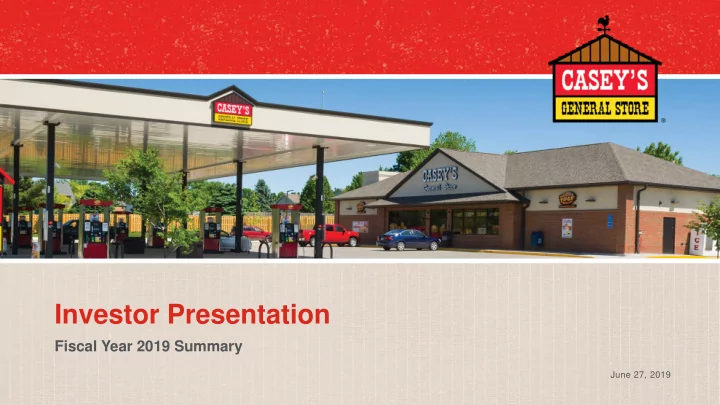
Investor Presentation Fiscal Year 2019 Summary June 27, 2019 Safe - - PowerPoint PPT Presentation
Investor Presentation Fiscal Year 2019 Summary June 27, 2019 Safe Harbor Statements This presentation is dated as of June 27, 2019 and speaks as of that date. Forward-Looking Statements This presentation contains statements that may constitute
June 27, 2019
2
This presentation is dated as of June 27, 2019 and speaks as of that date. Forward-Looking Statements This presentation contains statements that may constitute forward-looking statements within the meaning of the Private Securities Litigation Reform Act of 1995. These forward-looking statements include any statements relating to our possible or assumed future results of operations, business strategies, growth opportunities, and performance improvements at our
implied by those forward-looking statements, including our ability to execute our value creation plan or to realize benefits therefrom, as well as other risks, uncertainties and factors which are described in our most recent annual report on Form 10-K and quarterly reports on Form 10-Q, as filed with the Securities and Exchange Commission and available on our
disclaims any intention or obligation to update this presentation or revise any forward-looking statements attached in this presentation whether as a result of new information, future events, or otherwise. Use of Non-GAAP Measures This presentation includes refers to "EBITDA," which we define as net income before net interest expense, depreciation and amortization, and income taxes. EBITDA is not presented in accordance with accounting principles generally accepted in the United States ("GAAP"). We believe EBITDA is useful to investors in evaluating our operating performance because securities analysts and other interested parties use such calculations as a measure of financial performance and debt service capabilities, and it is regularly used by management for internal purposes including our capital budgeting process, evaluating acquisition targets, and assessing store performance. EBITDA is not a recognized term under GAAP and should not be considered a substitute for net income, cash flows from operating activities or other income or cash flow statement data. EBITDA has limitations as an analytical tool, and should not be considered in isolation or as a substitute for analysis of our results as reported under GAAP. We strongly encourage investors to review our financial statements and publicly filed reports in their entirety and not to rely on any single financial measure. Because non-GAAP financial measures are not standardized, EBITDA, as defined by us, may not be comparable to similarly titled measures reported by other companies. It therefore may not be possible to compare our use of this non-GAAP financial measure with those used by other
3
Total Enterprise Value
Locations in 16 States
Total Employees
Customers/Year Stock Information2
NASDAQ: CASY Common Shares: 37.0 million Market Cap: $5.7 billion Avg Daily Volume: 317,304 shares Investor Relations Contact Bill Walljasper, CFO (515) 965-6505 bwalljasper@caseys.com
Positive ◊ Polite ◊ Professional ◊ Proud
LTM Growth
1 By number of stores in North America 2 As of close June 27, 2019
4
1 2
1 - Ankeny, IA
1 2
Distribution Infrastructure
2 – Terre Haute, IN 500 Mile Distribution Radius Fuel Distribution
5
State Total2 With Casey’s Without Casey’s Arkansas 171 22 149
45 11 34 Oklahoma 200 20 180 Kentucky 189 11 178 Tennessee 197 11 186 Ohio 447 7 440 Michigan 298 1 297 Subtotal – Newer 1,547 83 1,464 State Total2 With Casey’s Without Casey’s Iowa 252 230 22 Illinois 547 301 246 Missouri 306 185 121 Kansas 172 101 71 Minnesota 300 109 191 Nebraska 96 58 38 Indiana 262 80 182
59 26 33 Wisconsin 317 21 296 Subtotal - Core 2,311 1,111 1,200
56% 14% 12% 18%
Under 5,000 5,000 to 10,000 10,000 to 20,000 Over 20,000
Core States New States1 Stores by Population
1 States new to Casey’s within the last 10 years 2 Total cities. Source: http://factfinder.census.gov; Estimated 2018 Pop.
All States 3,858 1,194 2,664
6
Revenue Gross Profit
63% 25% 11% 1%
Fuel Grocery & Other Merchandise Prepared Food & Fountain Other
24% 39% 34% 3%
Fuel Grocery & Other Merchandise Prepared Food & Fountain Other
$9.35 Billion $1.95 Billion
7
Same-store sales benefit in FY 2020; growing impact as year progresses
Expected to drive increased in-store traffic and fuel sales within FY 2020
Continuing to drive efficiencies through enhanced cost initiatives
Disciplined approach to capital allocation to increase shareholder value
Continued success providing increased dividends; new share repurchase authorization through 2020
Early benefits in FY 2019 with expected improvement in FY 2020 and further gains FY 2021+
8
Digital Journey
Identify and Understand Customers Provide Seamless Convenience for Customers Implement Personalized Marketing and Rewards
Same-Store Sales expected to continue growth as FY 2020 progresses
Digital Strategy
Website enhancement design phase
Enterprise and services integration
In-store technology design, build and pilot
Integrated commerce platform
Partnered with Deloitte Digital team to develop detailed business case and roadmap
New CMO who will lead digital implementation
FY 2019 FY 2020 - 2021
Objectives
» Seamless: A frictionless e-commerce experience across all customer facing touchpoints » Agile: Exceed customer expectations through technology and organizational capabilities » Intelligent: Know every one of our customers (through CRM analytics) » Proactive: Acquire and continually delight our customer (through CRM analytics, loyalty, digital marketing)
Enhanced customer analytics and digital engagement
Mobile app redesign and pilot
Mobile app launch
Loyalty program
In-store technology integration
Expansion of online products and services Design Build Pilot Implement Enhance Digital Transformation
FY 2018
9
Customer Data Increased Fuel Sales Higher In-store Sales Repeat Purchases and Customer Loyalty
» Through the end of FY 2019, over 1,300 new accounts and 7,200 new cards issued since program launch in late October 2018 » Casey’s locations and prepared food offerings are ideally aligned with third party study of fleet driver preferences » Assumptions for incremental fuel volumes and in-store sales were benchmarked off of industry best practices and initial results are inline with our original assumptions » Building out a more robust strategy with other fleet card providers has shown significant upside as universal growth has supplemented gallon growth as the Casey’s Business MasterCard grows
Led by a team with relevant implementation and execution experience, the Fleet Card program is expected to increase fuel sales and drive traffic within stores
10
Q3 FY 2018 Q4 FY 2018 Q4 FY 2019 Q4 FY 2019 Q4 FY 2019 Q1 FY 2020 Q1 FY 2020 Q1 FY 2020 Q2 FY 2020
Established roadmap for implementation Vendors selected: PriceAdvantage for fuel and Dunnhumby
for inside categories
Models developed for key categories Fuel optimization staffing complete and 80% of sites live on
PriceAdvantage
All sites live on PriceAdvantage fuel software Next Steps
Begin to integrate fuel software with Point of Sale
Begin to integrate fuel software with Digital Price Signs
Begin first round of inside pricing changes
Begin second round of inside category price changes
Centralized fuel pricing strategy driven by local market dynamics
Fuel
Price Optimization provides visibility and precision to drive our pricing and promotion strategy
In-Store
Optimized product pricing and assortment across all categories
Transforming our Marketing Process Through New Technology
» Rules Based Pricing / Everyday Optimization » Promotion Optimization
Price Optimization Roadmap
11
Cost Reduction Measures Operating Expenses at Unchanged Stores
% growth in store-level operating expenses for open stores not impacted by recent growth programs
3.7% 5.7% 6.6% 4.2% 2.2% FY 2015 FY 2016 FY 2017 FY 2018 FY 2019
» Adjusted Shift Differential Hours/Limit Shift Overlap Q3 FY 2018 » Completed Pizza Delivery Actions and Enhanced System for Ongoing Review Q3 FY 2018 » 24-Hour Store Hours Adjustment and Enhanced System for Ongoing Review Q4 FY 2018 » New Fleet Management System Q3/Q4 FY 2018 (for Fuel and Grocery) » Adjusted Merit Pay Budget Q1 FY 2019 » Enhanced Budgeted Hours Process to Better Align with Customer Demand Q2 FY 2019 » Evaluation of Alternatives to Optimize Distribution FY 2020 » Time-in-Motion Study to Further Refine Store Labor Hours FY 2020
12 7% 21% 26% 34% 39% 45% 53% 61% 69% 71%
5% 15% 25% 35% 45% 55% 65% 75%
250 500 750 1,000 1,250 1,500 1,750
# of Stores
New Stores Acquisitions Replacements Remodels % of Total Store Count
» Reduced capital requirements for store upgrades – Our store base continues to grow and has been significantly upgraded, addressing targeted locations – Based on a holistic analysis of market and store characteristics, future capital requirements for replacements and remodels will be limited
Capital Allocation Priorities
» Invest in high return growth and profitability initiatives – Digital Engagement – Price Optimization » Disciplined store growth » Strategic acquisition opportunities » Return capital to shareholders
Disciplined Approach to Capital FY2020 Budget ($,MM)
New Store Construction & Acquisitions $ 294 Replacements 59 Transportation & Distribution1 43 Information Technology 29 Maintenance & Remodels2 91 Total Capital Expenditures $ 516
1 Includes: distribution center #3 ($22M)
2
Includes: general maintenance, corporate expansion ($17M), and other initiatives
~71% of total stores have been replaced, remodeled, acquired, or newly constructed since FY 2009
13
$0.80 $0.88 $0.96 $1.04 $1.16
FY 2015 FY 2016 FY 2017 FY 2018 FY 2019
Share Repurchases Dividends
» Completed Initial $300 Million Authorization in May 2018 » New $300 Million Authorization Through FY 2020 » 19 Consecutive Years of Dividend Increases » Board Approved a Quarterly Dividend Increase to $0.32 Per Share at June 2019 Meeting
1,878 1,931 1,978 2,073 2,146 FY 2015 FY 2016 FY 2017 FY 2018 FY 2019
Store Growth
FY 2015 FY 2016 FY 2017 FY 2018 FY 2019 New Stores 45 51 48 85 56 Acquired Stores 36 5 22 26 24 » Fiscal 2020 Guidance: 60 New Stores, 25 Acquired Stores
Unit Growth by Year
10% CAGR 3% CAGR
Note: CAGR is based off of FY2014 through FY2019
14
$781 $881 $953 $1,006 $1,074 FY 2015 FY 2016 FY 2017 FY 2018 FY 2019 59.7% 62.5% 62.3% 61.0% 62.2% FY 2015 FY 2016 FY 2017 FY 2018 FY 2019 $466 $550 $594 $614 $669 FY 2015 FY 2016 FY 2017 FY 2018 FY 2019
Revenue (in Millions) Gross Profit Dollars (in Millions) Gross Profit Margin %
10% CAGR 11% CAGR
15
$1,795 $1,974 $2,087 $2,184 $2,370 FY 2015 FY 2016 FY 2017 FY 2018 FY 2019 32.1% 31.9% 31.5% 31.8% 32.1% FY 2015 FY 2016 FY 2017 FY 2018 FY 2019 $576 $629 $657 $694 $760 FY 2015 FY 2016 FY 2017 FY 2018 FY 2019
Revenue (in Millions) Gross Profit Dollars (in Millions) Gross Profit Margin %
8% CAGR 8% CAGR
16
1,817 1,952 2,062 2,199 2,296 FY 2015 FY 2016 FY 2017 FY 2018 FY 2019 19.3 19.6 18.4 18.5 20.3 FY 2015 FY 2016 FY 2017 FY 2018 FY 2019 $351 $382 $378 $407 $466 FY 2015 FY 2016 FY 2017 FY 2018 FY 2019
Gallons Sold (in Millions) Gross Profit Dollars (in Millions) Gross Profit Margin (cents per gallon excl CC Fees)
7% CAGR 12% CAGR
17
1 Fuel cents per gallon excluding credit card fees
Fiscal Year Fuel Gallons Grocery & Other Merchandise Prepared Food & Fountain 2020 Guidance (0.5%) - 1.0% 2.5% - 4.0% 3.0% - 6.0% 2019 (1.7%) 3.6% 1.9% 2018 2.3% 1.9% 1.7% 2017 2.1% 2.9% 4.8% 2016 3.0% 7.1% 8.4% 2015 2.6% 7.8% 12.4%
Same-Store Sales Average Margin
Fiscal Year Fuel Cents per Gallon 1 Grocery & Other Merchandise Prepared Food & Fountain 2020 Guidance 20.5 - 22.5 32.0% - 33.0% 61.0% - 63.0% 2019 20.3 32.1% 62.2% 2018 18.5 31.8% 61.0% 2017 18.4 31.5% 62.3% 2016 19.6 31.9% 62.5% 2015 19.3 32.1% 59.7%
18
1 Fuel cents per gallon excluding credit card fees
9.9 11.5 10.2 10.6 10.5 9.8 11.1 9.6 10.9 10.1 10.7 11.5 10.4 13.9 12.9 13.9 15.2 15.1 14.4 16.1 19.3 19.6 18.418.5 20.3 8.0 10.0 12.0 14.0 16.0 18.0 20.0 22.0 1995 1996 1997 1998 1999 2000 2001 2002 2003 2004 2005 2006 2007 2008 2009 2010 2011 2012 2013 2014 2015 2016 2017 2018 2019 Cents Per Gallon 1 Fiscal Year
FY 1995 through FY 2007 Average ~10.5 CPG Since FY 2007 Annual Margins Trending Higher
19
$4.62 $5.73 $4.48 $3.81 $5.51 FY 2015 FY 2016 FY 2017 FY 2018 FY 2019
EBITDA (in Millions) Diluted EPS
$479 $560 $509 $486 $563 FY 2015 FY 2016 FY 2017 FY 2018 FY 2019
9% CAGR 11% CAGR
Note: FY 2018 figures exclude one-time benefit from Tax Cuts and Jobs Act.