Iodine Detection in the Lower Stratosphere Prof. Rainer Volkamer - - PowerPoint PPT Presentation

iodine detection in the lower stratosphere
SMART_READER_LITE
LIVE PREVIEW

Iodine Detection in the Lower Stratosphere Prof. Rainer Volkamer - - PowerPoint PPT Presentation

Iodine Detection in the Lower Stratosphere Prof. Rainer Volkamer Theodore K. Koenig, Alfonso Saiz-Lopez, Pedro Campuzano-Jost, Benjamin A. Nault, Jose L. Jimenez Atmospheric iodine WMO 2014, 2018 First detection of IO in TTL Recent aircraft


slide-1
SLIDE 1

Iodine Detection in the Lower Stratosphere

  • Prof. Rainer Volkamer

Theodore K. Koenig, Alfonso Saiz-Lopez, Pedro Campuzano-Jost, Benjamin A. Nault, Jose L. Jimenez

Solomon et al. 1994 JGR: “We speculate that iodine chemistry… may also be a factor in determining the widespread current depletion of lower stratospheric ozone.”

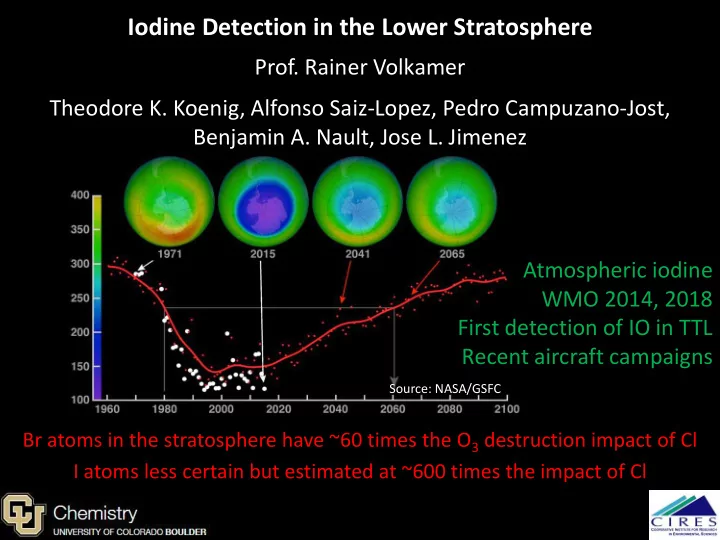
Br atoms in the stratosphere have ~60 times the O3 destruction impact of Cl I atoms less certain but estimated at ~600 times the impact of Cl

Atmospheric iodine WMO 2014, 2018 First detection of IO in TTL Recent aircraft campaigns

Source: NASA/GSFC

slide-2
SLIDE 2

Atmospheric Chemistry of Iodine

Source Emitted species Global flux Lifetime Organic VSLI CH3I (6.8%), CH2I2 (2.8%), CH2IX(6%) 0.6 Tg I yr-1 mins - days Inorganic Iy HOI (76%), I2 (8.4%) 3.23 Tg I yr-1 seconds - mins Total source: Inorganic Iy (~85%), VSLI (~15%) 3.83 Tg I yr-1 Iy,gas = I, IO, OIO, HOI, I2, HI, INOx, IxOy Iy,part = I-, IO3

  • Sherwen et al. 2016; 2017

Saiz-Lopez et al. 2015

! ?

Tropospheric O3

  • loss rate: 748 Tg OX yr-1
  • O3 burden: - 9%
  • HOI photolysis (78%)
  • OIO photolysis (21%)
  • Global OH: + 1.8%
  • Halogens lower RFTO3
  • 0.030 W m-2 (I)
  • 0.087 W m-2 (Cl,Br,I)

New particle formation Stratospheric O3 (Cl,Br)

  • RFSt-O3 ~ 0.05 W m-2
  • Iodine ?

Release atomic I

slide-3
SLIDE 3

WMO perspective on iodine in the LS

  • Iodine Oxide (IO): <0.1ppt, twilight conditions

(Butz et al. 2009; Boesch et al 2003; Pundt et. al 1998; Wennberg et al 1997)

  • Methyl iodide (CH3I): <0.05 ppt

(Tegtmeier et al 2013; Saiz Lopez et al 2015)

  • Particle Iodine has qualitatively been detected

in LS aerosols, but not yet been quantified

(Murphy and Thomson, 2000; Murphy et. al 2006, 2014) Halogen Xy (pptv) O3 eff. (a.u.) Xy * O3

  • eff. (a.u.)

Chlorine 115 1 115 Bromine 5 60 300 IodineWMO2014 <0.15 600 <90 IodineWMO2018 0 - 0.8 600 0 - 540

WMO 2018: Revised Iy estimate

Volkamer et al., 2015; Saiz-Lopez et al. 2015

slide-4
SLIDE 4

Passive remote sensing column observations Trace gases and aerosols

First IO detection in daytime TTL (Volkamer et al 2015)

CU AMAX-DOAS HARP 2DC CDP VCSEL MTP UHSAS TOGA WCN(2x) HSRL DOAS RGM

Volkamer et al., 2015 AMT Wang et al., 2015 PNAS Saiz-Lopez et al., 2015 GRL Sherwen et al., 2016 ACP Schmidt et al., 2016 JGR Dix et al., 2016 AMT Koenig et al., 2017 ACP Wales et al., 2018 JGR Badia et al., 2019 ACP Zhu et al., 2019 ACP

Telescope pylon

slide-5
SLIDE 5

0.13-0.15 pptv IO in the Tropical Transition Layer (both hemispheres) “Our understanding of the chemical processes involving halogens and

  • rganic carbon species in the tropics seems incomplete.”

Volkamer et al. 2015 AMT Wang et al. 2015 PNAS

First IO detection in daytime TTL (Volkamer et al 2015)

Dix et al., 2016 AMT

Dix et al. 2016 AMT

slide-6
SLIDE 6

Stratospheric Iy injection inferred from TTL-IO

Daytime TTL-IO suggests 0.25 to 0.70 pptv Iy are injected into the LS Previous measurements had found <0.1 pptv IO at twilight in the LS (Butz et al. 2009; Wennberg et al 1997). There is no previous daytime detection of IO in the LS.

Saiz Lopez et al. 2015 GRL

slide-7
SLIDE 7

CONTRAST RF15: Bromine injection to the stratosphere

We have re-visited this case study to measure iodine oxide radicals

Koenig et al., 2017 Wales et al., 2018

Bry injection = 5 ± 2 pptv WMO 2018 ~5 pptv WMO 2014 (confirmed) SGI = ~3 pptv Bry based on VSLBr observations PGI = 2-4 pptv Bry inferred from BrO observations Good consistency for Bry in LS, incl. several recent aircraft datasets (i.e., TORERO, CONTRAST, ATTREX)

  • Fig. 1.11, WMO 2018

CONTRAST ATTREX TORERO

Theodore K. Koenig

slide-8
SLIDE 8

CONTRAST RF15: Jet crossing into NH mid latitude LS

Iy,gas decreases from ~0.6 pptv in UT to ~0.1 pptv in LS 0.055 pptv IO in the daytime LS is compatible with previous upper limits (twilight)

slide-9
SLIDE 9

Iodine

Iodine in the UTLS – a global perspective

First IO detection in daytime LS. First quantitative Iy,part detection in the UTLS.

slide-10
SLIDE 10

Heterogeneous O3 loss due to the I- + O3 reaction

Altitude (km) Iy,gas (ppt) Iy,part (ppt) I-/Iy,part (%) [I-] (mmol/kg) γ 11.7 0.64 0.13 50 14.7 9.2e-6 13.7 0.25 0.52 30 10.7 5.7e-6 15.5 0.09 0.68 12 9.19 4.9e-6

Iy,gas = f(H2O/O3)

Iy,part = f(I-,IO3

  • ) lab calib.
slide-11
SLIDE 11

Model comparison and LS O3 loss

Iy vertical distribution LS O3 loss: Iy >= Bry & Cly Measurements support Iy injection >0.6 pptv; rapid conversion to Iy,part (Compare WMO 2018: 0 – 0.8 pptv Iy), but Iy,gas remains detectable O3 loss: Iy,part is competitive with Iy,gas. Iy is comparable to Bry, Cly

slide-12
SLIDE 12

Conclusions

  • TORERO: First IO detection in the daytime TTL (Volkamer et al., 2015) suggested

0.25 to 0.70 pptv Iy are injected into the LS (Saiz Lopez et. al 2015). Revised WMO2018 estimate of 0 to 0.8 pptv Iy injection to LS inferred from TTL.

  • CONTRAST: First IO detection in the daytime LS. The values are low (0.06 pptv IO)

and compatible with previous IO upper limits measured at twilight.

  • ATom-1 & ATom-2: First quantification of aerosol iodine in the LS. The fraction I-

/Iy,part decreases in the LS, but is non-zero, suggesting heterogeneous re-cycling.

  • Our measurements support 0.76 ± 0.15 pptv Iy are injected into the LS

Acknowledgements: NSF AGS 1620530, 1261740, 1104104 NASA doi: 10.3334/ORNLDAAC/1581 TORERO, CONTRAST, Atom-1, Atom-2 science teams Halogen Xy (pptv) O3 eff. (a.u.) Xy * O3

  • eff. (a.u.)

O3 loss (%) Chlorine 115 1 115 16% Bromine 5 60 300 43% Iodine 0 - 0.8 ~600 0 - 540 Total Iy

  • Gas
  • Particle

0.76 0.11 0.65 375 960 280 285 105 180 41%

  • LS-O3 loss: Br ~ I >> Cl
  • Gas-phase more efficient than

particulate iodine at destroying O3

  • Heterogeneous O3 loss dominates
  • ver gas-phase, and is responsible

for >60% of iodine O3 loss in LS.