Solving Problems Using Problem Solving Concrete operational: - - PDF document

solving problems using problem solving
SMART_READER_LITE
LIVE PREVIEW

Solving Problems Using Problem Solving Concrete operational: - - PDF document

Piagetian Development: Solving Problems Using Problem Solving Concrete operational: Formal operational: classification control of variables Dr. David C. Stone conservation combinatorial reasoning Department of Chemistry decentering


slide-1
SLIDE 1
  • Dr. David C. Stone, Department of Chemistry, University of Toronto

Solving Problems Using Problem Solving

  • Dr. David C. Stone

Department of Chemistry University of Toronto

TDSB Eureka Conference, February 2011

dstone@chem.utoronto.ca http://www.chem.utoronto.ca/~dstone/teachers/

1 Friday, February 25, 2011

  • Dr. David C. Stone, Department of Chemistry, University of Toronto

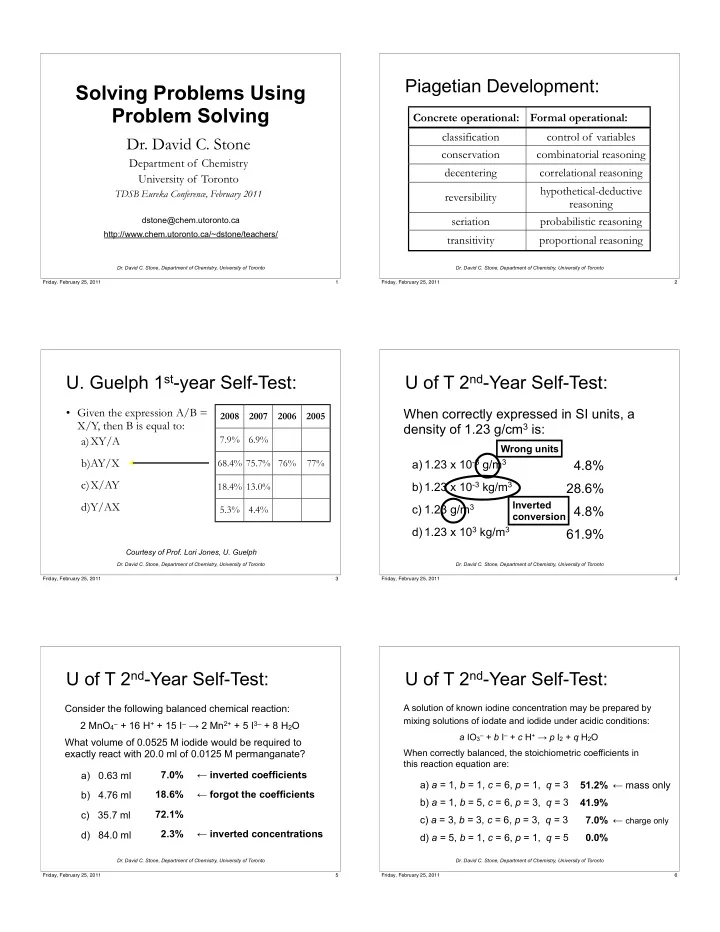
Piagetian Development:

Concrete operational: Formal operational: classification control of variables conservation combinatorial reasoning decentering correlational reasoning reversibility hypothetical-deductive reasoning seriation probabilistic reasoning transitivity proportional reasoning

2 Friday, February 25, 2011

  • Dr. David C. Stone, Department of Chemistry, University of Toronto
  • U. Guelph 1st-year Self-Test:
  • Given the expression A/B =

X/Y, then B is equal to: a)XY/A b)AY/X c)X/AY d)Y/AX

2008 2007 2006 2005 7.9% 6.9% 68.4% 75.7% 76% 77% 18.4% 13.0% 5.3% 4.4%

Courtesy of Prof. Lori Jones, U. Guelph

3 Friday, February 25, 2011

  • Dr. David C. Stone, Department of Chemistry, University of Toronto

U of T 2nd-Year Self-Test:

When correctly expressed in SI units, a density of 1.23 g/cm3 is:

a) 1.23 x 10⁻³ g/m3 b) 1.23 x 10⁻³ kg/m3 c) 1.23 g/m3 d) 1.23 x 10³ kg/m3

4.8% 28.6% 4.8% 61.9%

Wrong units Inverted conversion

4 Friday, February 25, 2011

  • Dr. David C. Stone, Department of Chemistry, University of Toronto

U of T 2nd-Year Self-Test:

Consider the following balanced chemical reaction: 2 MnO4– + 16 H+ + 15 I– 2 Mn2+ + 5 I3– + 8 H2O What volume of 0.0525 M iodide would be required to exactly react with 20.0 ml of 0.0125 M permanganate? a) 0.63 ml b) 4.76 ml c) 35.7 ml d) 84.0 ml 7.0% 18.6% 72.1% 2.3% inverted coefficients forgot the coefficients inverted concentrations

5 Friday, February 25, 2011

  • Dr. David C. Stone, Department of Chemistry, University of Toronto

U of T 2nd-Year Self-Test:

A solution of known iodine concentration may be prepared by mixing solutions of iodate and iodide under acidic conditions: a IO3– + b I– + c H+ p I2 + q H2O When correctly balanced, the stoichiometric coefficients in this reaction equation are:

a) a = 1, b = 1, c = 6, p = 1, q = 3 b) a = 1, b = 5, c = 6, p = 3, q = 3 c) a = 3, b = 3, c = 6, p = 3, q = 3 d) a = 5, b = 1, c = 6, p = 1, q = 5 51.2% 41.9% 7.0% 0.0% mass only charge only

6 Friday, February 25, 2011

slide-2
SLIDE 2
  • Dr. David C. Stone, Department of Chemistry, University of Toronto
  • U. Guelph 1st-year Self-Test:
  • The geometry of a water

molecule is:

a)angular or bent b)linear c)pyramidal d)tetrahedral

2008 2007 2006 2005 88.8% 85.2% 85% 85% 4.5% 5.7% 4.6% 5.9% 2.1% 3.2%

Courtesy of Prof. Lori Jones, U. Guelph

7 Friday, February 25, 2011

  • Dr. David C. Stone, Department of Chemistry, University of Toronto
  • U. Guelph 1st-year Self-Test:
  • The geometry of molecule

in which the central atom is bonded to 2 H atoms and has 2 lone pairs is: a)tetrahedral b)angular or bent c)linear d)pyramidal

2008 2007 2006 2005 15.9% 16.4% 53.0% 52.8% 54% 54% 13.9% 12.8% 17.2% 18.1%

Courtesy of Prof. Lori Jones, U. Guelph

8 Friday, February 25, 2011

  • Dr. David C. Stone, Department of Chemistry, University of Toronto

Threshold Concepts

  • Jan Meyer & Ray Land:

“[Are] akin to a portal, opening up a new and previously inaccessible way of thinking ... without which the learner cannot progress”

in Overcoming Barriers to Student Learning, chapter 1, emphasis added

  • moles & stoichiometry
  • heat & temperature
  • atoms & properties
  • chemical bonds
  • molecular geometry
  • particles & kinetic theory
  • equilibrium processes
  • reaction kinetics

9 Friday, February 25, 2011

  • Dr. David C. Stone, Department of Chemistry, University of Toronto

Equals vs. Equivalent?

There are six times as many students as professors at a particular university. This can be expressed mathematically as:

a) 6S = P b) S = 6P

At a particular university there are six times as many students as professors. This fact is represented by the equation S = 6P. What does the letter S stand for?

Equivalent “units” of students & professors Calculation of students from professors

10 Friday, February 25, 2011

  • Dr. David C. Stone, Department of Chemistry, University of Toronto

Equals vs. Equivalent?

  • Stoichiometry:

a A + b B c C + d D

  • mass is conserved
  • compounds have definite proportions of elements

stoichiometric reaction requires definite ratios of compounds

nA nB = a b nA = nB a moles of A b moles of B

11 Friday, February 25, 2011

  • Dr. David C. Stone, Department of Chemistry, University of Toronto

Alternate Concepts

  • What do the following symbols indicate?

HH2H+

12 Friday, February 25, 2011

slide-3
SLIDE 3
  • Dr. David C. Stone, Department of Chemistry, University of Toronto

Alternate Concepts

  • Balance the following equation for the

production of ammonia:

N2 + H2 NH3

  • Represent the balanced reaction using circles

with letters in the centre to depict the atoms:

N N H H H H H H N N H H H H H H

13 Friday, February 25, 2011

  • Dr. David C. Stone, Department of Chemistry, University of Toronto

Alternate Concepts

  • A metallic wire has the following properties:

a)conducts electricity b)brown colour c)density of 8.93 g/cm3 d)malleable & ductile e)expands on heating Suppose you could isolate one single atom from the metallic wire: which of the above properties would it have?

14 Friday, February 25, 2011

  • Dr. David C. Stone, Department of Chemistry, University of Toronto

Alternate Concepts

  • The wire is heated in an evacuated vessel until it

completely evaporates. The resulting gas has the following properties: a)compressible b)expands on heating c)pungent odour d)yellow colour e)attacks plastics Suppose you could isolate one single atom from this gas: which of the above properties would it have?

15 Friday, February 25, 2011

  • Dr. David C. Stone, Department of Chemistry, University of Toronto

Alternate Conceptions:

All at sea...

  • Bonding and Properties

– metallic bonding poorly understood

Keith S. Taber, Science Education, 2003, 87(5), 732-758

16 Friday, February 25, 2011

  • Dr. David C. Stone, Department of Chemistry, University of Toronto

Conceptual Problems

  • Individual 0.200 g samples of each of the following

gases were placed in four separate 1.00 L stoppered flasks at 298 K. In which flask do you expect the gas to exert more pressure? Explain your answer. Flask: A B C D Gas: CH4 Ne N2 CO2 Mm (g/mol) 16.0 20.2 28.0 44.0

17 Friday, February 25, 2011

  • Dr. David C. Stone, Department of Chemistry, University of Toronto

Conceptual Problems

  • Four identical sealed containers are filled with a

different gas as indicated below until each contains exactly the same mass. If all four are held at the same temperature, which flask contains gas at the greatest pressure? Flask: A B C D Gas: CH4 Ne N2 CO2 Mm (g/mol) 16.0 20.2 28.0 44.0

18 Friday, February 25, 2011

slide-4
SLIDE 4
  • Dr. David C. Stone, Department of Chemistry, University of Toronto

Algorithmic & Conceptual

  • The following diagram represents a cross-

sectional view of a rigid sealed tank...

19 Friday, February 25, 2011

  • Dr. David C. Stone, Department of Chemistry, University of Toronto

Problem-Solving

  • G. H. Wheatley:

“What you do, when you don’t know what to do”

as cited by Bodner, U. Chem. Ed. 2003

Routine exercise Novel problem Algebraic/ numeric Conceptual (non-numeric)

20 Friday, February 25, 2011

  • Dr. David C. Stone, Department of Chemistry, University of Toronto

Problem-Solving Activities

  • Groups of ~ 3–4 people
  • Appoint an observer to record the process!
  • Solve a problem (10 minutes):

– The Waterfall Problem – The Pizza Problem – The Water and Wine Problem – The Xenon Fluoride Problem

21 Friday, February 25, 2011