SLIDE 1 2018-09-24 1
The Need for Integrated Management of Canada’s Flammable Forest Landscapes
Fire Management Systems Laboratory Faculty of Forestry University of Toronto http://www.firelab.utoronto.ca
David L. Martell Faculty of Forestry University of Toronto Canadian Institute of Forestry Annual Conference Grande Prairie Alberta September 19, 2018
SLK 35 2011 Ontario Ministry of Natural Resources
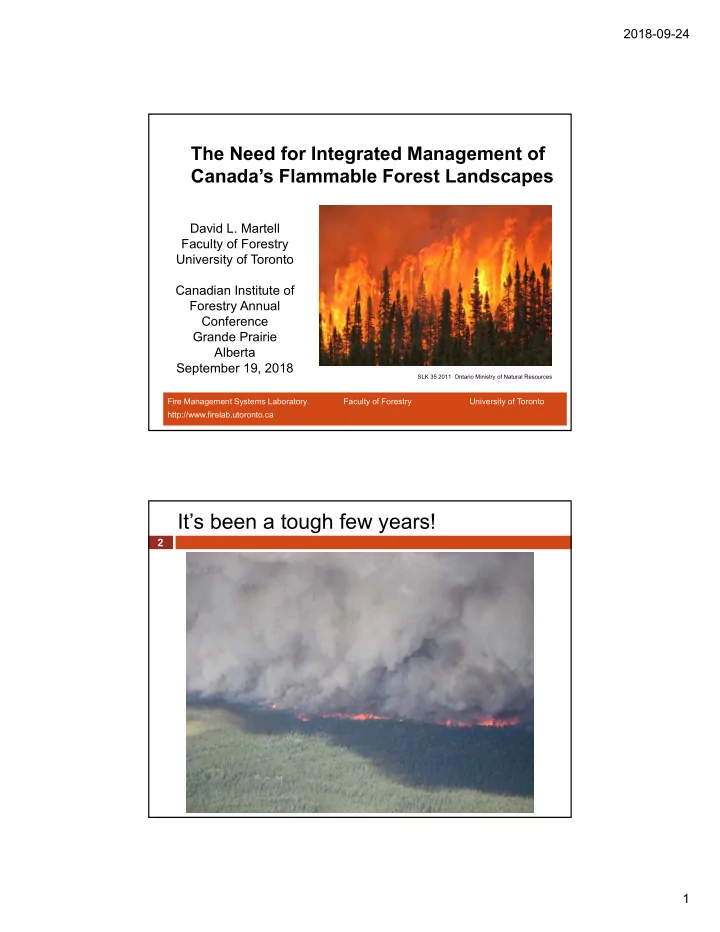
It’s been a tough few years!
2
SLIDE 2
2018-09-24 2
Some important drivers
1) How we manage our forests and how we manage fire in our forested and other wildland areas 2) Changes in the many ways we use our forest and wildland landscapes for residential, recreation and industrial purposes 3) Climate change 4) Natural ecosystem processes that have no doubt been influenced by 1, 2 & 3
3
Important to remember
Fire impacts and the factors that influence them are complex and site specific The kinds of challenges we’ve faced in the last few years will not materialize to the extent they have recently every year, but this “problem” is not going to go away anytime soon
4
SLIDE 3
2018-09-24 3
Outline
Some of the many things that I think we should do to mitigate the social, economic and ecological impact of fire. Some of the applied science and technology in which I think we should invest to make it possible for us to do so.
5
A shopping list
1. Reduce CO2 emissions 2. Reduce the flammability of our extensive forest landscapes 3. Reduce the flammability of the WUI, WII and WIF FireSmart both those communities and the structures within those communities 4. FireSmart both those communities and the structures within those communities 5. Enhance our fire management organizations so they can deliver cost-effective fire prevention, detection, initial attack and large fire management programs 6. Develop social support programs for people that are most impacted by fire (e.g., evacuees, those that lose their homes etc.)
6
SLIDE 4 2018-09-24 4
Two (of many) specific needs
More predictive and prescriptive analytics research that can be used to develop decision support systems that fire and land managers can use to help decide how best to allocate the many hundreds of millions of dollars they will be investing in fire management in Canada in the coming years and Integrated research and investment to ensure we reap the greatest benefit from our limited resources.
7
Need for predictive fuel management analytics Recent BC Announcement
8
Johnston, LM, Flannigan, MD (2018) Mapping Canadian wildland fire interface areas. International Journal of Wildland Fire 27, 1-14.
SLIDE 5
2018-09-24 5
A need to decide when and where to treat fuels
One of the difficult tasks will be to identify potential fuel management projects and rank them according to some criteria based upon their; 1) Values at risk, 2) opportunity to reduce risk and 3) cost of doing so.
9
A VERY simple decision-making problem
10 A home is located at the eastern end of a ribbon forest that contains many forest stands that vary with respect to their age, forest type and flammability. A fire MIGHT be ignited in one of the many forest stands next summer. Which of the forest stands will you treat with what techniques this year?
SLIDE 6 2018-09-24 6
Simple example cont’d
Suppose there are three possibilities for each cell (one of which is do nothing) and consider treating
- nly the three cells closest to the community
33 = 27 treatment options
11
Factors to consider for each of the 27 options
Probability a fire will ignite in each cell Possible sizes at detection Initial attack resources dispatched and their on-site arrival times Probability any fires that occur are contained by the initial attack force Probably any fires that escape initial attack will threaten the community Probability escaped fires will rain embers onto buildings in the community Probability those embers will ignite those buildings Probability structural fire fighters can save the buildings that are ignited Expected cost plus loss of each treatment option in the community
How will they deal with 100 or more communities?
12
SLIDE 7
2018-09-24 7
Cost-effectiveness of current fuel treatments?
2017 media report that Regional Municipality of Whistler was working on a 20-year plan to FireSmart their community. “The Resort Municipality of Whistler has been conducting fuel thinning projects on Crown and municipal lands around the community since 2004 with the purpose of creating fuel breaks to reduce the impact of catastrophic wildfires.” https://www.whistler.ca/services/emergency/fire/wil dfire-protection-strategy/Fuel-Thinning-Projects
13
Regional Municipality of Whistler cont’d
Also found: Wildfire Protection Strategy aims to avert disaster before it strikes RMOW looks to double prevention measures with potential $16M effort By Braden Dupuis https://www.piquenewsmagazine.com/whistler/wild fire-protection-strategy-aims-to-avert-disaster- before-it-strikes/Content?oid=2875263 “After a presentation from staff, Coun. xxxxxxxx asked to what degree the proposed actions would reduce Whistler's risk.
14
SLIDE 8
2018-09-24 8
The response
The effect is hard to quantify in terms of percentages, said environmental stewardship manager yyyyyy. "The areas where we're doing the work are all rated high or extreme, and after we've done the thinning it drops it down to moderate," yyyyyy said.
15
Also found
Assessing Wildfire Hazard in the Wildland-Urban Interface Within British Columbia: A Case Study of the St. Mary’s Indian Reserve in Southeastern British Columbia. By Robert Gray and Tom Hobby (date?) http://www.scrmanagement.com/wp- content/uploads/2013/08/JEM_Assessing_wildfire_hazards .pdf In which they say: “there is a wide gap between the predicted PSTA [Provincial Strategic Threat Assessment] fuel hazards, and ground- based fuel hazard assessments within the study area”.
16
SLIDE 9 2018-09-24 9
Hello?
How can we expect people to invest in fuel management to reduce the flammability of
- ur forest landscapes and FireSmart the WUI
if we don’t know how to cost-effectively FireSmart the WUI? Clearly an urgent need for some/more applied science to develop and evaluate the cost- effectiveness of site specific fuel treatments with respect their potential impact on our social, economic and ecological objectives.
17
Addressing the need for predictive analytics
Short term Goal: Predictive models that can be used to predict the cost of implementing treatments w on sites x, y and z and their impact on fire behaviour and the expected reduction in fire costs and risk to communities. Need to estimate the cost of fuel treatments, the predicted behaviour of any fires that occur in or near those treatment sites and the impact of the treatments on subsequent fire behaviour and impact.
18
SLIDE 10 2018-09-24 10
Need for a national approach to data collection
1) When and where what fuel treatments are implemented. 2) Their impact on both fire occurrence and the behaviour of fires that do subsequently occur. 3) What initial attack resources were brought to bear
- n those fires under what fire weather conditions.
4) The impact of the suppression resources. 5) The realized threat to the community. A clear and urgent need for a collaborative national interagency research commitment
19
Cost-effectiveness measures not enough
A province or fire management agency with a limited fuel treatment budget has many communities at risk. Must decide when what treatments will be implemented on what sites around which communities. Many many possible alternatives. Which alternative or alternatives will maximize their “bang for the buck” Complicated by uncertainty about when and where fires will occur and how they will behave.
20
SLIDE 11 2018-09-24 11
We know how to FireSmart industrial forests
Fuel treatment of the WUI for community protection shares much in common with the type
- f FireSmart forest management suggested by
Kelvin Hirsch and his colleagues
A long time ago
21
Mill Cutover Burn Roads Regeneration Strategic Landscape Fragmentation
FireSmart forest management
22
SLIDE 12 2018-09-24 12
Darker colours represent higher Protection Values
Application to Miller Western Forest Products
23
How well can we FireSmart communities?
Really not much more difficult than FireSmarting forest management units Somewhat more complicated because one has to consider more than just traditional forest harvesting and silvicultural treatments Problem 1: Miller Western project was spear- headed by two Chilean graduate students Problem 2: New improved approach being spear-headed by two Chilean graduate students and a Spanish post doctoral fellow
24
SLIDE 13
2018-09-24 13
Academics have some/many bad habits
My abstract stated that I would describe: “…some of the many complex fire-related landscape management decision-making problems … [and] some of the research that should be carried out” And I did discuss ONE What about: and “the integrated decision support systems that I think should be developed …” to inform fire management planning processes.
25
Investing in detection and initial attack capacity? Detection systems designed to find fire “while they’re small” Initial attack systems designed to initiate suppression action of fires “while they’re small” Limited budgets
26
SLIDE 14
2018-09-24 14
Seeking an appropriate balance
The more spent on detection, the smaller the fires delivered to the initial attack system but the diminished initial attack resources they are to deal with them. The more they invest in initial attack the less money they have to invest in detection so the larger the fires the enhanced initial attack has to deal with. We don’t have independent detection and initial attack systems - we have INTEGRATED initial RESPONSE systems.
27
Returning to the big picture
How much should we invest in fuel management, prevention, detection, initial attack. large fire management, post-burn rehabilitation and to support the people impacted by fire?
Welcome to the real world!
28
SLIDE 15
2018-09-24 15
Closing remarks
29
1. Reduce CO2 emissions, 2. Reduce the flammability of our extensive forest landscapes, 3. Reduce the flammability of the WUI, WII and WIF FireSmart both those communities and the structures within those communities, 4. FireSmart both those communities and the structures within those communities, 5. Enhance our fire management organizations so they can deliver cost-effective fire prevention, detection, initial attack and large fire management programs, 6. Develop social support programs for people that are most impacted by fire (e.g., evacuees, those that lose their homes etc.)
Acknowledgements
Natural Sciences and Engineering Research Council of Canada Ontario Ministry of Natural Resources & Forestry
30
SLIDE 16 2018-09-24 16
31
A definition of analytics: Analytics Society of INFORMS
Descriptive analytics Prepare and analyze historical fire data Identify patterns from samples for reporting of trends Predictive analytics Predict future burn probabilities and trends given specified fuel treatments Find relationships in the data that may not be readily apparent with descriptive analysis Prescriptive analytics Evaluate and determine new ways to operate Target business objectives Balance all constraints
https://www.informs.org/Community/Analytics, Accessed September 26, 2016
32 Historical fire scar maps Burn probability maps Spatial fuel management decision support systems