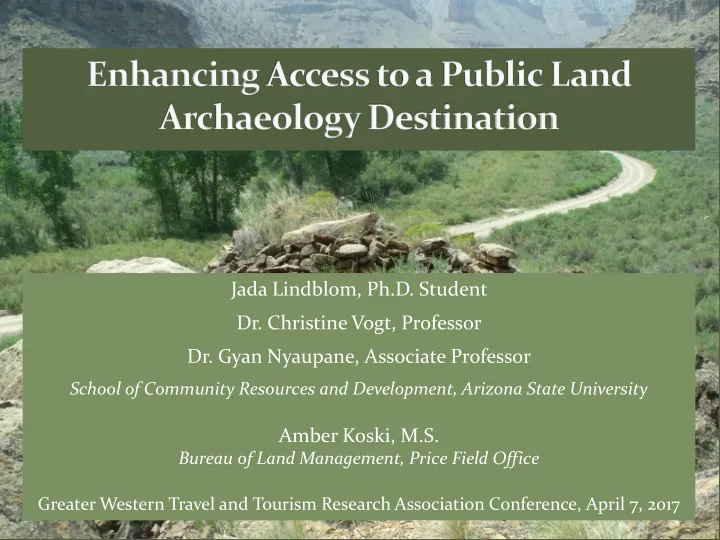
SLIDE 1 Jada Lindblom, Ph.D. Student
- Dr. Christine Vogt, Professor
- Dr. Gyan Nyaupane, Associate Professor
School of Community Resources and Development, Arizona State University
Amber Koski, M.S.
Bureau of Land Management, Price Field Office Greater Western Travel and Tourism Research Association Conference, April 7, 2017
SLIDE 2
Bureau of Land Management (BLM) Nine Mile Canyon, Utah Archaeological significance Public engagement in public lands Local volunteers (especially tribal youth) Scientific and anthropological discovery
SLIDE 3
Public land in Utah
Yellow = BLM Nine Mile Canyon: Carbon County, UT Desert/semi-desert
Map source: https://www.ut.blm.gov/LandRecords /search_plats.cfm
SLIDE 4
SLIDE 5
Fremont culture – 2,000 to 700 years ago Much is still unknown and scholars don’t all agree Term may not refer to just one distinct group of people Generally, it is thought that they were a partially agricultural society,
but social system is still mostly a mystery
It is not completely understood why/how they “disappeared”
SLIDE 6
- Nine Mile Canyon is thought to be one of the best areas for
Fremont archaeology; many sites are still unexcavated
- Nicknamed “The World’s Longest Art Gallery”
SLIDE 7 The Nine Mile Canyon area isn’t currently as popular for
- utdoor recreation purposes as other Utah destinations
in-depth recreation plan for the area has been underway
Local mining activity led to recent road improvements Location not far off of US-191 is advantageous for tourism
development
Carbon County Office of Tourism has a growing online presence Not many other Utah destinations have this amount of
accessible archaeological sites
SLIDE 8
Sometimes called “community archaeology” Involves engaging people in archaeological processes who
are from outside of the profession
Has been a topic and practice of growing interest and
popularity in the last couple of decades
(Source: Society for American Archaeology, 2016)
SLIDE 9
Creating a unique, hands-on educational experience Excavating at least one major pit structure Analyzing, synthesizing, and interpreting archaeological
data for public benefit and scientific advancement
Housing collection of artifacts at the Prehistoric Museum
for public and scholarly access
Archaeology, history and science:
SLIDE 10
Conservation, stewardship and community:
Involving the community in a way that generates
stewardship ethics, sense of place, pride in community
Generating greater interest in Nine Mile Canyon as a visitor
destination
Introducing more people to native history, public lands,
and outdoor experiences
Building a sense of trust and appreciation for public land
managers
SLIDE 11
SLIDE 12
Management approach of creating a joint venture
(Huxham & Vangen, 2005) adds multidimensionality to what could be a more singular
project Already established in the region:
BLM – Price Field Office Prehistoric Museum (Utah State University – Eastern) Colorado Plateau Archaeological Alliance (CPAA) (nonprofit,
expert staff)
Montgomery Archaeological Consultants (previous work)
ASU - New to Nine Mile but brings other strengths
SLIDE 13
1 – 5 year project
TBD based on program success and funding factors Currently in Year 1
Current focus: volunteer outreach
Particular attention on involving tribal youth from
Uintah-Ouray communities
Applied, place-based, experiential STEM experience Excavation begins Fall 2017
SLIDE 14
Volunteer Website
http://ninemilevolunteer.weebly.com/
SLIDE 15
Other local community members engaged through
volunteer and leadership opportunities, local events
Next phase: work with BLM and partners on site-specific
recreation, interpretive, and tourism planning to reach a wider group of people longer term
Improved on-site signage, availability of info materials Recommendations for long-term visitor management
SLIDE 16
Developing appropriate plans for outreach and site management How do we successfully work with such a diverse range of stakeholders?
General local community
Economic interests – tourism, mining
Preservationists
Concerns about overuse, vandalism
Recreationists
Local/regional/national/international
SLIDE 17 ➢ Appreciative Inquiry approach
(Cooperrider, & Srivastva, 1987; Cooperrider & Whitney, 2005; Nyaupane & Poudel, 2012; )
Identifying the strengths that already exist in the community Stakeholder meetings to assess needs, values, and desired
Understanding the many facets of the region and project Making sure stakeholders have a forum to be heard and feel
incorporated
This is a primarily a community engagement project
SLIDE 18 Members from all project partners present, along with representatives from:
- State Historic Preservation
Office
- Nine Mile Canyon Settlers
Association
- Nine Mile Canyon Coalition
- Neighboring landowners
Aim: collaborative conservation to incorporate different perspectives into land management and better understand the different ways people use and value public lands (Leong, Emmerson, & Byron, 2011)
SLIDE 19
Project Evaluation Qualitative
On-site visitor interviews and/or surveys Interviews with key officials
City representatives Tribal officials Tourism offices
Quantitative
Event participant and volunteer tracking Site visitation and road counts
SLIDE 20
Managing youth involvement Camping with teens Might be most meaningful to students who are not
necessarily the “first in line” or the easiest to work with
Handling public preconceived notions about BLM/public
land management
Creating and maintaining lines of communication with
tribal community
Balancing preservation, visitation and education
SLIDE 21
Locational & logistical inconveniences We’re in AZ; site is remote Coordination between several key and crucial parties Newly-formed collaborations Funding constraints; establishing time lines and priorities Consensus regarding land use and public land management
can be difficult to achieve (Rudeen, Fernandez-Gimenez, Thompson, & Meiman, 2012)
Federal funding
SLIDE 22
Many stakeholders exist in the region. Starting point: investigate
who is/has been involved and identify areas of consensus to help bridge groups. Continue to analyze stakeholders’ social networks, knowledge(s), and positions throughout collaborative process (Ramirez, 1999).
Be considerate of how the presence of multiple land managers in
the area and proximity of property boundaries should be taken into consideration in project planning (Bergmann & Bliss, 2004).
What ASU can bring to the table: intentionality and a voice for
how tourism and conservation can fit into the collaborative planning process and desired outcomes (Jamal & Stronza, 2009)
SLIDE 23
Thank you