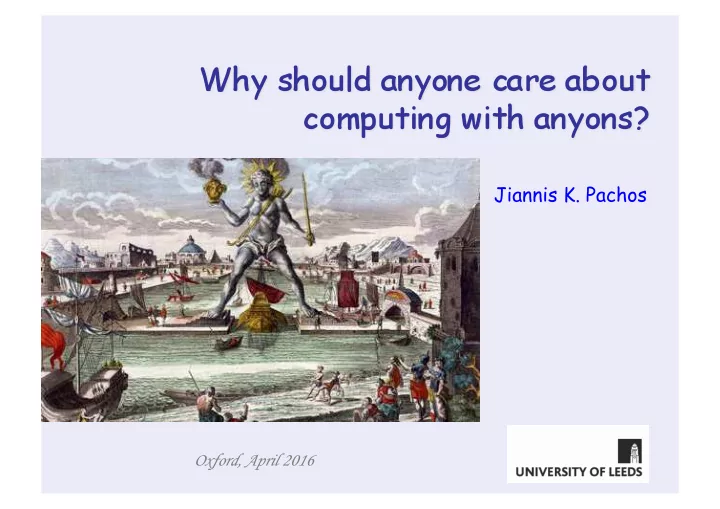
SLIDE 1
Jiannis K. Pachos
Oxford, April 2016
SLIDE 2
Antikythera mechanism
Computers
Analogue computer Digital computer: 0 & 1 Robotron Z 9001
SLIDE 3
- Problems solved in:
- poly time (easy)
- exp time (hard) ...with input size.
- Classical computers:
P: polynomially fast to solve NP: polynomially fast to verify solution
BQP: polynomially easy to solve with QC Factoring, searching, quantum simulations, ….
Computational complexity
Errors during QC are too catastrophic
SLIDE 4
Topology promises to solve the problem of errors in quantum computers…
Topological quantum computation
…and it is lots of fun :-)
SLIDE 5
– Local properties of object
– Global properties of object
Geometry – Topology
geom. topo.
SLIDE 6 Are two knots equivalent?
Topology of knots
topo.
- Algorithmically hard problem…(‘60s)
- Common problem (speech recognition, …)
- Jones polynomials recognise if two knots are
not equivalent.
- Solve:“Λύνω”: disentangle: Alexander and Phrygia
SLIDE 7 Topological quantum effects
Aharonov-Bohm effect Magnetic flux and charge
The phase is a function
Topological effect: is the integer number
SLIDE 8
Particle statistics
Exchange two identical particles: Statistical symmetry: Local physics stays the same… …but could change!
SLIDE 9
Particle statistics
Bosons Fermions Anyons 3D 2D
Anyons: vortices with flux & charge (fractional). Aharonov-Bohm effect Berry Phase.
SLIDE 10 Anyonic properties can be found in 2-dimensional topological physical systems:
- Fractional quantum Hall liquids
- Topological insulators & SC
- 2D Lattice systems
Anyons and physical systems
[FQHE, Lattice models: QD, LW, KHoney, TI & TSC…]
is purely 2D.
SLIDE 11
Statistics and Berry phase
Berry phase Statistics
:position of anyons (classical)
Excited state
SLIDE 12
Anyons and entanglement entropy
Entropy Ground state
Quantum dimension
SLIDE 13
Anyons and entanglement entropy
:position of anyons (classical)
Entropy Excited state
Quantum dimension
SLIDE 14 Anyons and knots
time Initiate: Pair creation of anyons Measure: do they fuse to the vacuum? Braiding
SLIDE 15
Anyons and knots
SLIDE 16 The Reidemeister moves
Theorem: Two knots can be deformed continuously
- ne into the other iff
- ne knot can be
transformed into the
SLIDE 17
Skein relations
SLIDE 18
Skein and Reidemeister
Reidemeister move (II) is satisfied. Similarly (III).
SLIDE 19
Kauffman bracket
The Skein relations give rise to the Kauffman bracket: Skein( )=
SLIDE 20
Jones polynomials
The Skein relations give rise to the Kauffman bracket: Skein( )= To satisfy move (I) one needs to define Jones polynomial:
SLIDE 21
- If two links have different Jones polynomials
then they are not equivalent => use it to distinguish links
- Jones polynomials keep:
- nly topological information, no geometrical
Jones polynomials
SLIDE 22 Jones polynomial from anyons
Braiding evolutions of anyonic states:
- Simulate the knot with braiding
anyons
- Translate it to circuit model:
<=> find trace of matrices
SLIDE 23
Jones polynomial from QC
[Freedman, Kitaev, Larsen, Wang (2002); Aharonov, Jones, Landau (2005); et al. Glaser (2009); Kuperberg (2009)]
Evaluating Jones polynomials is a #P-hard problem. With quantum computers it is polynomially easy to approximate with additive error. Belongs to BQP class.
SLIDE 24 Conclusions
- Fundamental properties of
anyons provide resilient QC.
- Encrypt quantum info
- Quantum money
- Quantum Anonymous
Broadcasting Anyonic systems are currently engineered...
www.theory.leeds.ac.uk/jiannis
SLIDE 25
Topological physics
SLIDE 26
Letter from Faraday to Whewell (1834)