Kubota Corporation Result Briefing for the 1 st half of FY2018 ending - - PDF document

kubota corporation result briefing for the 1 st half of
SMART_READER_LITE
LIVE PREVIEW

Kubota Corporation Result Briefing for the 1 st half of FY2018 ending - - PDF document

Kubota Corporation Result Briefing for the 1 st half of FY2018 ending December 31, 2018 Q & A Session Tokyo, August 8, 2018 Q. Additional explanation about analysis of operating profit compared with the prior year. A. With respect to


slide-1
SLIDE 1

1 / 4

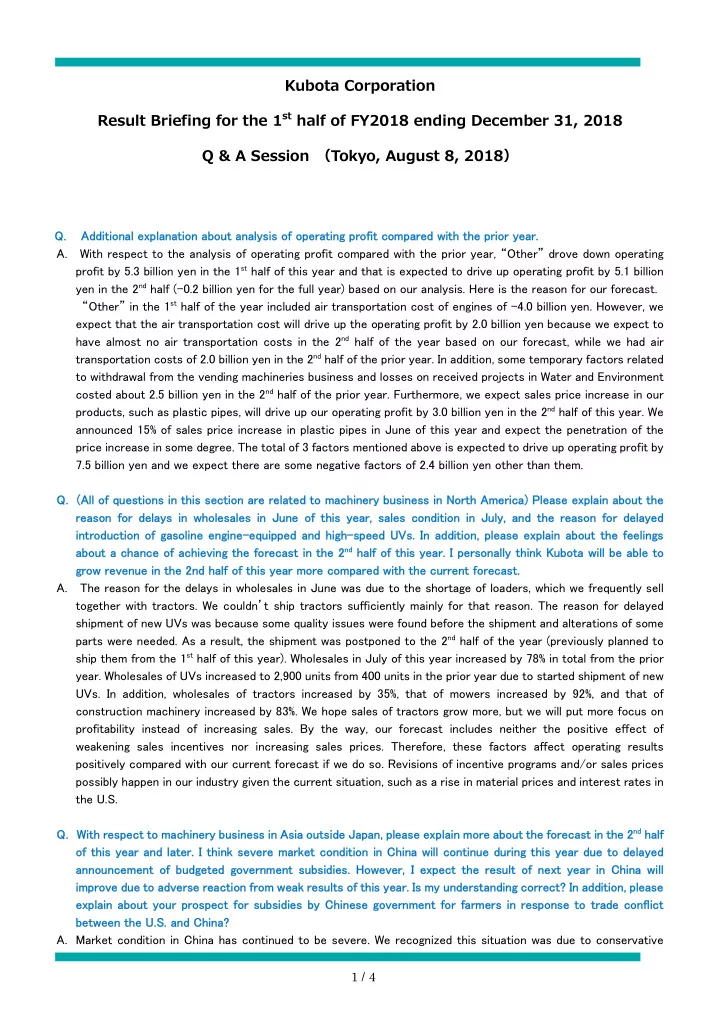
Kubota Corporation Result Briefing for the 1st half of FY2018 ending December 31, 2018 Q & A Session (Tokyo, August 8, 2018)

  • Q. Additional explanation about analysis of operating profit compared with the prior year.
  • A. With respect to the analysis of operating profit compared with the prior year, “Other” drove down operating

profit by 5.3 billion yen in the 1st half of this year and that is expected to drive up operating profit by 5.1 billion yen in the 2nd half (-0.2 billion yen for the full year) based on our analysis. Here is the reason for our forecast. “Other” in the 1st half of the year included air transportation cost of engines of -4.0 billion yen. However, we expect that the air transportation cost will drive up the operating profit by 2.0 billion yen because we expect to have almost no air transportation costs in the 2nd half of the year based on our forecast, while we had air transportation costs of 2.0 billion yen in the 2nd half of the prior year. In addition, some temporary factors related to withdrawal from the vending machineries business and losses on received projects in Water and Environment costed about 2.5 billion yen in the 2nd half of the prior year. Furthermore, we expect sales price increase in our products, such as plastic pipes, will drive up our operating profit by 3.0 billion yen in the 2nd half of this year. We announced 15% of sales price increase in plastic pipes in June of this year and expect the penetration of the price increase in some degree. The total of 3 factors mentioned above is expected to drive up operating profit by 7.5 billion yen and we expect there are some negative factors of 2.4 billion yen other than them.

  • Q. (All of questions in this section are related to machinery business in North America) Please explain about the

reason for delays in wholesales in June of this year, sales condition in July, and the reason for delayed introduction of gasoline engine-equipped and high-speed UVs. In addition, please explain about the feelings about a chance of achieving the forecast in the 2nd half of this year. I personally think Kubota will be able to grow revenue in the 2nd half of this year more compared with the current forecast.

  • A. The reason for the delays in wholesales in June was due to the shortage of loaders, which we frequently sell

together with tractors. We couldn’t ship tractors sufficiently mainly for that reason. The reason for delayed shipment of new UVs was because some quality issues were found before the shipment and alterations of some parts were needed. As a result, the shipment was postponed to the 2nd half of the year (previously planned to ship them from the 1st half of this year). Wholesales in July of this year increased by 78% in total from the prior

  • year. Wholesales of UVs increased to 2,900 units from 400 units in the prior year due to started shipment of new
  • UVs. In addition, wholesales of tractors increased by 35%, that of mowers increased by 92%, and that of

construction machinery increased by 83%. We hope sales of tractors grow more, but we will put more focus on profitability instead of increasing sales. By the way, our forecast includes neither the positive effect of weakening sales incentives nor increasing sales prices. Therefore, these factors affect operating results positively compared with our current forecast if we do so. Revisions of incentive programs and/or sales prices possibly happen in our industry given the current situation, such as a rise in material prices and interest rates in the U.S.

  • Q. With respect to machinery business in Asia outside Japan, please explain more about the forecast in the 2nd half
  • f this year and later. I think severe market condition in China will continue during this year due to delayed

announcement of budgeted government subsidies. However, I expect the result of next year in China will improve due to adverse reaction from weak results of this year. Is my understanding correct? In addition, please explain about your prospect for subsidies by Chinese government for farmers in response to trade conflict between the U.S. and China?

  • A. Market condition in China has continued to be severe. We recognized this situation was due to conservative
slide-2
SLIDE 2

2 / 4 buying resulting from delayed announcement of budgeted government subsidies as of the end of the 1st quarter

  • f this year. However, there were more reasons for this severe situation. Retail sales in May increased from the

prior year in response to the announcement of the subsidies in April. However, retail sales in June and July decreased significantly and market condition continued to be very severe. In China, revenue of 1st half is usually more than 2nd half of the year. Therefore, it’s inevitable to suppose revenue in China of this year will decrease significantly from the prior year. We should plan to suppose market conditions will continue to be severe in the next year and our dealer in China had the same prospect as we do. Farm machinery market in China continued to grow constantly for recent 10 years and we think it’s natural that some adjustments of demand happen. We consider farm machinery market in China mainly for contractors got saturated once due to rapidly increased entry of contractors. We think that it’s too optimistic to suppose this situation will be recovered in a year, while the agricultural policy of Chinese government is unclear. We have just started our 2nd factory in China and this will increase our fixed costs. It made our situation severer. We will prevent from excess production and cut fixed costs given that severe situation will continue. It was unlucky that farm machinery market in China started shrinking amid the situation that there are some negative factors, such as a rise in interest rates in the U.S. and material prices. However, we think recent negative factors, such as shrink of farm machinery market in China, severe incentive competition in the U.S. and a rise in material prices, will never last so long and will be resolved

  • soon. We think this is the time to put up with these burdens mainly in China.
  • Q. Please tell me if there is a sign that businesses in India and Myanmar will contribute to your consolidated

results in the future. I heard that revenue in India doubled from the prior year.

  • A. Sales in India continue to increase significantly. Sales of multi-purpose tractors tripled from the prior year.

Market volume of tractors in India was 0.6 million units in the prior year. However, the market will reach 0.7 million units in this year and exceed 1.0 million units roughly in 5 years based on the information from the

  • industry. We’ve introduced multi-purpose tractors, which are tailored to Indian market, since the prior year.

These products started penetrating the market on a full scale and that introduction ignited a boom of sales. The production of 4WD model of multi-purpose tractors is currently below the demand for them in particular and we expect sales of tractors will exceed 10 thousand units in this year. In addition, sales of combines and rice transplanters increased and continue to be strong. However, this business will have little contribution on our

  • profit. We manufacture these tractors in Thailand and export them to India, so it’s difficult to generate large

profit from this business. We need to start local production in India to generate profit. We need some degree of sales volume to start local production, and recognize our sales have almost reached the required volume to start. With respect to Myanmar, we suppose demand for farm equipment should increase more. We don’t take

  • ptimistic view from the perspective of politics. However, we expect more growth because we established local

sales subsidiary only in Myanmar among the 3 neighboring countries of Thailand and we allocate resources to increase the business.

  • Q. How do you take into consideration the negative effect of a rise in interests rate and steel prices when you

created your forecast?

  • A. With respect to incentive cost, we supposed 2 times of interest rate hikes in this year as of the beginning of this
  • year. However, we changed our view and supposed more than 3 times of hikes will be inevitable. We changed our

forecast of incentive programs little, so additional cost is attributable to changes of our view about a rise in interest rates. The cost of incentive programs will increase in the next year if interest rate will rise and we will maintain our incentive program, such as 7 years 0% program. However, we suppose interest rate will not increase so much, otherwise some competitors will weaken their incentive programs. With respect to price of steel material, we heard our competitors started to increase their sales prices in response to a rise in steel prices and we suppose increase in sales prices will penetrate our industry anytime soon. We do not take into account the increase in sales prices and changes of sales incentives because we plan to change them viewing competitors’

  • actions. If some actions will be taken in the 4th quarter, they will have a little bit positive effects on our result of
  • perations in this year. However, the positive effect will affect our result in the next year mainly.
slide-3
SLIDE 3

3 / 4

  • Q. With respect to profitability of each region in Farm and Machinery, I heard that the businesses in North America

and Asia outside Japan have high profitability and these in Japan and Europe have modest level. However, there were some information about severe incentive competition in North America and a decrease in profitability in

  • China. Are there any significant changes about the order of profitability in each region?
  • A. The highest profitability in North America remains as used to be and profitability level has not been changed so
  • much. There were some negative factors on profitability, but a positive effect of increased sales compensated

for these negative factors in some degree. There was a big change of profitability in Asia outside Japan. Profitability in Thailand increased in some degree, but profitability in Asia outside Japan decreased due to significant decrease in sales of farm machinery in China. There wasn’t a big change of profitability in Europe due to increased sales of construction machinery and engines. However, we will take more time to generate profit from large-scale tractor business. As a result, there weren’t big changes about the order of profitability in each region.

  • Q. This year, demand for engines is increasing due to rush demand related to engine emission regulations (Stage

V) , but profit contribution from increased sales is limited due to an increase in air transportation costs. Next year, adverse reaction to the rush demand is expected, but air transportation will not be necessary any more. How do you expect the profit of engine businesses next year?

  • A. We have not reviewed the business plan for next year, yet. Basically, we expect higher revenue but lower income

year on year in 2018 and lower revenue but higher income year on year in 2019. This year, demand for engines is increasing due to rush demand related to engine emission regulations (Stage V), and we cannot avoid transportation of engines by air to meet our customers’ delivery deadline. But, we don’t need that next year. We consider that one reason for the increased air transportation costs in the 1st half of this year was that the negotiations with our customers were insufficient. We probably tried to respond to the wishes of the customers too thoroughly, because the business volume per one customer was too large, which was several thousand or several tens of thousands of units. Sales of engines will return to normal level without rush demand since next

  • year. On the other hand, we have a rush demand just in Europe this year, and the demand for engines is growing

more and more also in other areas such as the U.S. We originally started to produce engines used for our farm machinery, and we have increased the sales of engines to external customers gradually, and now more than 60%

  • f our engines are sold to external customers. In the past, our engines were recognized as just one component by
  • ur customers, but the importance of the engines has been growing in relation to tighter exhaust emission

regulations and the profitability of our engine businesses has been improving. Shipment volume of engines was record-high last year, and it will increase more this year. We have a lot of business chances such as development

  • f new customers. Almost all the investment in a long-term perspective for expansion of production is related to

engines recently. We expect construction machinery and engines to improve margin, because tractors are struggling to obtain return from investment in a long-term perspective such as large-scale tractors, tractors for Indian market, automatic operation, and IoT. Performance of engine businesses meets the expectations now, and we have high expectations for them continuously.

  • Q. How much are you able to offset the negative impact of a rise in steel prices by supply chain management and

cost reduction through VA and VE?

  • A. We are working to reduce costs, but it’s difficult to offset the impact of steel prices which rose 30 to 40%. It

affects not only us but also competitors, so there are no changes in competition environments. Rather, our procurement of components from China probably less than that of competitors. Cost reduction through VA and VE at the manufacturing subsidiaries in the U.S. is not enough to offset the negative impact of a significant rise in steel prices, so we cannot help but increase in product prices. Recently, we have many factors causing deterioration in operating profit margin, but these negative factors such as material prices, incentive costs, air transportation costs, and deterioration in farm machinery market in China will be resolved eventually.

slide-4
SLIDE 4

4 / 4 Cautionary Statements with Respect to Forward-Looking Statements This document may contain forward-looking statements that are based on management’s expectations, estimates, projections and assumptions as of August 8, 2018 (result briefing for the 1st half of FY2018 ending December 31, 2018). These statements are not guarantees of future performance and involve certain risks and uncertainties, which are difficult to predict. Therefore, actual future results may differ materially from what is forecast in forward-looking statements due to a variety of factors.