Land Use Classification and Deforestation Detection in Southwestern - - PowerPoint PPT Presentation

land use classification and
SMART_READER_LITE
LIVE PREVIEW

Land Use Classification and Deforestation Detection in Southwestern - - PowerPoint PPT Presentation

Land Use Classification and Deforestation Detection in Southwestern Nicaragua B Y : C A S S A N D R A R I V A S , O P H E L I A W A N G , A N D B O S T E V E N S N O R T H E R N A R I Z O N A U N I V E R S I T Y Introduction/Background


slide-1
SLIDE 1

B Y : C A S S A N D R A R I V A S , O P H E L I A W A N G , A N D B O S T E V E N S N O R T H E R N A R I Z O N A U N I V E R S I T Y
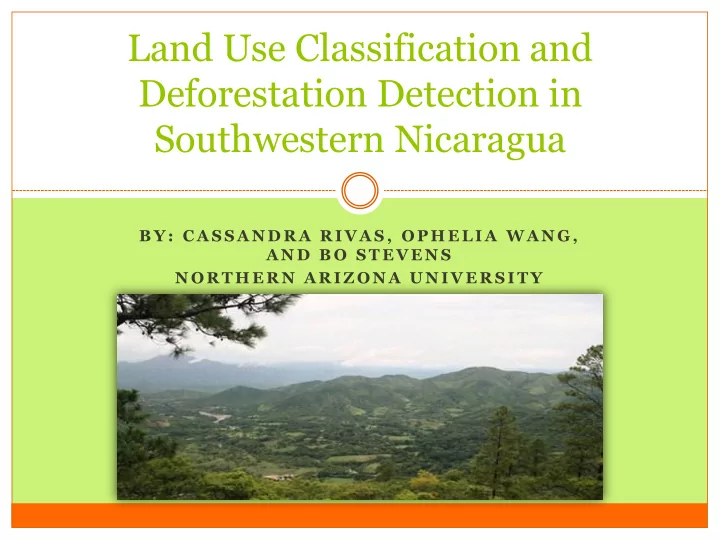
Land Use Classification and Deforestation Detection in Southwestern Nicaragua

slide-2
SLIDE 2

Introduction/Background

 Rapid land use change in the tropics

 Deforestation  Fragmentation  Environmental degradation

 Determining current land use and temporal change

is important

 Sustainable conservation and restoration planning

slide-3
SLIDE 3

Research Objectives and Questions

 Objective: To delineate areas of vulnerability to

change in SW Nicaragua, specifically areas of deforestation and natural regeneration between the years of 2000-2009 in order to inform future conservation and restoration efforts in the region.

 What are the land use patterns revealed in the land

use/cover classification?

 How have the land use patterns changed since the

year 2000?

 What are the current vulnerable areas of change?

slide-4
SLIDE 4

Methods: Study Area

 Rivas Isthmus  Paso del Istmo  Ecosystems include:

Dry-tropical forests, moist forested areas, and coastal mangroves

 Other land cover types

include: Pasture, plantation, crops, and urban

(Map sources: ArcMap 10.1; Paso Pacifico.org)

slide-5
SLIDE 5

Methods: Field Data Collection & Classification

 Ground Referencing Data

Collection

 Digitize roads and access

points

 398 data points collected;

assessed cover data at each point

Imagery SPOT, collected Jan-Feb 2009 Classification Manual training polygons ENVI 4.7 RuleGen (Quest) Final Classes:

  • Wetland
  • Urban
  • Crop
  • Pasture
  • Plantation
  • Young Regrowth
  • Old Regrowth
  • Young Secondary Forest
  • Old Secondary Forest

Accuracies and Kappa statistics

slide-6
SLIDE 6

Methods: Change Detection & Cluster Analysis

 Land-use/cover classification

2000 (Sesnie et al. 2008)

 Post-classification change

detection in ENVI

 Classification preparation for

change detection analysis

 Plantation

 Hotspots/cold spots of change

 Cluster and Outlier Analysis

using Moran’s I

 Neighborhood clustering score

slide-7
SLIDE 7

Final 2009 Classification

  • Over all accuracy is 87.68%
  • Producers accuracies range

76.16-95.63%

  • Users accuracies range

76.34 - 95.52 %

  • Khat scores– overall and all

individual classes except for wetland-mixed and old regrowth are in strong agreement

slide-8
SLIDE 8

Forest Change (2000-2009)

10 20 30 40 50 60 Crop Pasture Regrowth Plantation Forest Change (%) Class Type

Forest Change

No Change

slide-9
SLIDE 9

Forest to Pasture

  • Hotspots of change occur in the

Northcentral part of the isthmus

  • Also in the southern region where

last large tracks of forest occur despite rugged terrain

  • Cold spots occur throughout region
slide-10
SLIDE 10

Forest to Regrowth

  • Hot spots occur in pockets along

the rugged Pacific mountains

  • Cold spots occur in throughout

the intense topography

  • At some point this forest was

converted into another class and now regrowing

slide-11
SLIDE 11

Forest to Plantation

  • Hotspots occur in a few pockets to

the north and in the agricultural lake side area

  • Cold spots occur in the southern

area where old secondary forest remain*

slide-12
SLIDE 12

Regrowth Change (2000-2009)

5 10 15 20 25 30 35 40 45 50 Crop Pasture Regrowth Plantation Forest Change (%) Class Type

Regrowth Change

No Change

slide-13
SLIDE 13

Regrowth to Pasture

  • Change is scattered throughout

and is prolific

  • Reveals the strong influence of

this class in the area

  • Hot spots are specifically located

in the north central region

slide-14
SLIDE 14

Regrowth to Forest

  • Hotspots are taking place in the

southern part of the isthmus

  • Important for increasing forest

near other older forest

  • Reveals the change in the area

despite rugged topography

slide-15
SLIDE 15

Discussion

 Change Detection

 50% of the secondary forest was converted into other classes  Deforestation is still occurring at a high rate approximately

5.6% per year

 Regrowth is converted mainly to pasture (prevailing force)  However, is also maturing into secondary forest (23%)

slide-16
SLIDE 16

Conclusions

 Future conservation efforts should utilize this data for a more

comprehensive conservation assessment

 Deforestation and rapid land use change is continuing to

  • ccur throughout this dynamic landscape

 Conservation and restoration efforts must be efficient given

limitations

 Cluster (hotspot/coldspot) analysis helped in defining specific areas of

change

 This study is a unique example of leveraging resources and

collaboration to assess land use change for practical conservation

slide-17
SLIDE 17

Thank you

 NAU & the Lab of Landscape Ecology and

Conservation Biology

 My advisors Ophelia Wang and Tom Sisk  Paso Pacifico  My volunteers and Nicaraguan field guides