SLIDE 1
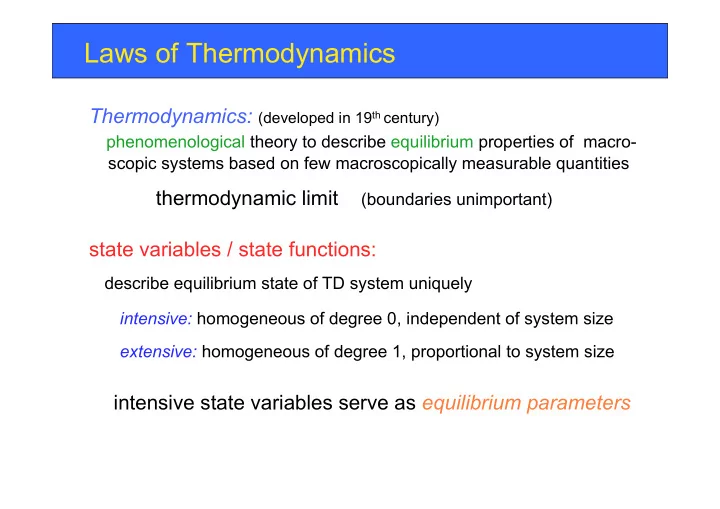
Laws of Thermodynamics
Thermodynamics: (developed in 19th century) phenomenological theory to describe equilibrium properties of macro-
scopic systems based on few macroscopically measurable quantities
thermodynamic limit (boundaries unimportant) state variables / state functions:
describe equilibrium state of TD system uniquely intensive: homogeneous of degree 0, independent of system size extensive: homogeneous of degree 1, proportional to system size
intensive state variables serve as equilibrium parameters
SLIDE 2
Laws of Thermodynamics
state variables / state functions: intensive extensive T temperature p pressure H magnetic field E electric field
µ chemical potential
S entropy V volume M magnetization P dielectric polarization N particle number conjugate state variable: combine together to an energy
T S, pV, HM, EP, µN
unit [energy]
SLIDE 3
Laws of Thermodynamics
state variable: Z(X,Y) Z: exact differential
SLIDE 4 Laws of Thermodynamics
Equilibrium parameters:
intensive state variables can serve as equilibrium parameters
Temperature (existence: 0th law of thermodynamics ) T1 T2
colder characterizes state of TD systems warmer
„bridge“ heat flow
Fick‘s law
heat current temperature gradient
T1 < T2
SLIDE 5 Laws of Thermodynamics
Equilibrium parameters:
intensive state variables can serve as equilibrium parameters
Temperature (existence: 0th law of thermodynamics ) T1 T2
colder characterizes state of TD systems warmer
„bridge“ heat flow
T T
„bridge“
equilibrium
T1 < T < T2
Fick‘s law
heat current temperature gradient
no heat flow
SLIDE 6 Laws of Thermodynamics
Equilibrium parameters:
intensive state variables can serve as equilibrium parameters
Temperature (existence: 0th law of thermodynamics ) T1 T2
colder characterizes state of TD systems warmer
„bridge“ heat flow
T T
„bridge“
equilibrium
- ther equilibrium parameters:
pressure p chemical potential µ
no heat flow
equilibrium parameter constant everywhere in TD system
SLIDE 7 Laws of Thermodynamics
Equations of state:
consider TD system described by state variables
subspace of equilibrium states:
equation of state (EOS)
Ideal gas:
Boltzmann constant
thermodynamic EOS
SLIDE 8 Laws of Thermodynamics
Equations of state:
consider TD system described by state variables
subspace of equilibrium states:
equation of state (EOS)
Ideal gas:
Boltzmann constant
thermodynamic EOS
response functions
isobar thermal expansion coefficient isothermal compressibility reaction of TD system to change
SLIDE 9 Laws of Thermodynamics
1st law of thermodynamics
„heat is like work a form of energy“
heat work
specific heat
CV : constant V Cp : constant p
gas paramagnet
force displacement
internal energy U
isolated TD system
J.R. Mayer, J.P. Joule & H. von Helmhotz
~1850
SLIDE 10
Laws of Thermodynamics 1st law
internal energy ideal gas (single atomic):
(equipartition)
Specific heat:
constant V
caloric EOS
SLIDE 11
Laws of Thermodynamics 1st law
internal energy ideal gas (single atomic): Specific heat:
constant p
(equipartition)
caloric EOS
SLIDE 12 Laws of Thermodynamics 1st law
internal energy ideal gas (single atomic): Specific heat:
ideal gas: and
(equipartition)
caloric EOS
SLIDE 13 Laws of Thermodynamics
2nd law of thermodynamics
two equivalent formulations
- R. Clausius: there is no cyclic process whose only effect is to transfer heat
from a reservoir of lower temperature to one with higher temperature
T1
~
T2
heat flow heat flow
T1 < T2
- W. Thomson (Lord Kelvin): there is no cyclic process whose effect is to take heat
from a reservoir and transform it completely into work; there is no perpetuum mobile of the 2nd kind Q Q
T1
~
heat flow
work
Q
W
SLIDE 14 Laws of Thermodynamics 2nd law
Carnot engine
T2 T1
~
Q1 Q2 W=Q1-Q2
reversible Carnot process
definition of absolute temperature T
irreversible process
entropy as new state variable
Clausius‘ theorem cyclic process reversible cyclic process irreversible
SLIDE 15
Laws of Thermodynamics 2nd law
entropy
ideal gas: V1 V2 V1 V2
reversible isothermal process dU=0
p A B
coupled to work reservoir
irreversible process increase of entropy waste of potential energy
A B
SLIDE 16
Laws of Thermodynamics 2nd law
application to gas:
dS exact differential S(U,V)
caloric EOS thermodynamic EOS
SLIDE 17 Laws of Thermodynamics
Thermodynamic potentials
natural state variables convenient simple relations
and
response functions: specific heat adiabatic compressibility dS=0
internal energy (gas)
U(S,V)
SLIDE 18 Laws of Thermodynamics
Thermodynamic potentials
internal energy (gas)
U(S,V)
natural state variables convenient simple relations
and
Maxwell relations:
dU exact differential
SLIDE 19 Laws of Thermodynamics
Thermodynamic potentials
natural state variables convenient simple relations
(S,V) (T,V) Helmholtz free energy (gas)
F(T,V)
Legendre transformation
response functions
specific heat isothermal compressibility
SLIDE 20 Laws of Thermodynamics
Thermodynamic potentials
natural state variables convenient simple relations
(S,V) (T,V) Helmholtz free energy (gas)
F(T,V)
Legendre transformation
Maxwell relation
SLIDE 21
Laws of Thermodynamics
Thermodynamic potentials
natural state variables convenient simple relations
Enthalpy (gas)
H(S,p)
Maxwell relation
Gibbs free energy (gas)
G(T,p)
Maxwell relation
SLIDE 22
Laws of Thermodynamics
Equilibrium condition
entropy:
general in equilibrium
S maximal
closed system: dU=dV=0
U,V fixed variables fixed variables
T,V F minimal T,p G minimal S,V U minimal S,p H minimal
potential
SLIDE 23 Laws of Thermodynamics
3rd law of thermodynamics
Nernst 1905
S = S(T,q,…)
entropy e.g.: independent of T, q, … Planck:
S0 = 0
- nly within quantum statistical physics