LeanCP: Terascale Car-Parrinello ab initio molecular dynamics using - - PowerPoint PPT Presentation

leancp terascale car parrinello ab initio molecular
SMART_READER_LITE
LIVE PREVIEW

LeanCP: Terascale Car-Parrinello ab initio molecular dynamics using - - PowerPoint PPT Presentation

LeanCP: Terascale Car-Parrinello ab initio molecular dynamics using charm++ Application Team Glenn J. Martyna, Physical Sciences Division, IBM Research Jason Crain, School of Physics, Edinburgh University Susan Allison, School of Physics,


slide-1
SLIDE 1

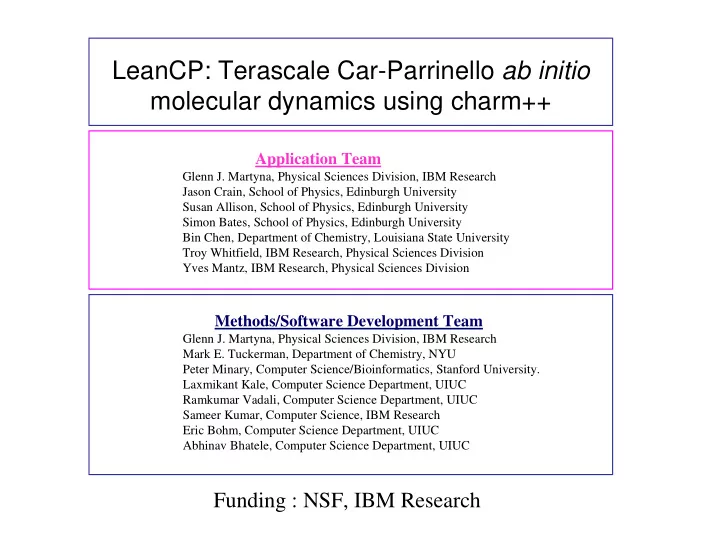
LeanCP: Terascale Car-Parrinello ab initio molecular dynamics using charm++

Application Team

Glenn J. Martyna, Physical Sciences Division, IBM Research Jason Crain, School of Physics, Edinburgh University Susan Allison, School of Physics, Edinburgh University Simon Bates, School of Physics, Edinburgh University Bin Chen, Department of Chemistry, Louisiana State University Troy Whitfield, IBM Research, Physical Sciences Division Yves Mantz, IBM Research, Physical Sciences Division

Methods/Software Development Team

Glenn J. Martyna, Physical Sciences Division, IBM Research Mark E. Tuckerman, Department of Chemistry, NYU Peter Minary, Computer Science/Bioinformatics, Stanford University. Laxmikant Kale, Computer Science Department, UIUC Ramkumar Vadali, Computer Science Department, UIUC Sameer Kumar, Computer Science, IBM Research Eric Bohm, Computer Science Department, UIUC Abhinav Bhatele, Computer Science Department, UIUC

Funding : NSF, IBM Research

slide-2
SLIDE 2

IBM’s Blue Gene/L network torus supercomputer

The worlds fastest supercomputer!

slide-3
SLIDE 3

Goal : The accurate treatment of complex heterogeneous systems to gain physical insight.

medium

soft under-layer (SUL) write head read head bit

slide-4
SLIDE 4

Characteristics of current models

Empirical Models: Fixed charge, non-polarizable, pair dispersion. Ab Initio Models: GGA-DFT, Self interaction present, Dispersion absent.

slide-5
SLIDE 5

Problems with current models (empirical)

Dipole Polarizability : Including dipole polarizability changes solvation shells of ions and drives them to the surface. Higher Polarizabilities: Quadrupolar and octapolar polarizabilities are NOT SMALL. All Manybody Dispersion terms: Surface tensions and bulk properties determined using accurate pair potentials are

  • incorrect. Surface tensions and bulk properties are both

recovered using manybody dispersion and an accurate pair

  • potential. An effective pair potential destroys surface

properties but reproduces the bulk. The force fields cannot treat chemical reactions:

slide-6
SLIDE 6

Problems with current models (DFT)

  • Incorrect treatment of self-interaction/exchange:

Errors in electron affinity, band gaps …

  • Incorrect treatment of correlation: Problematic

treatment of spin states. The ground state of transition metals (Ti, V, Co) and spin splitting in Ni are in error. Ni oxide incorrectly predicted to be metallic when magnetic long-range order is absent.

  • Incorrect treatment of dispersion : Both exchange

and correlation contribute.

  • KS states are NOT physical objects : The bands of the

exact DFT are problematic. TDDFT with a frequency dependent functional (exact) is required to treat excitations even within the Born-Oppenheimer approximation.

slide-7
SLIDE 7

Conclusion : Current Models

  • Simulations are likely to provide semi-quantitative

accuracy/agreement with experiment.

  • Simulations are best used to obtain insight and examine

physics .e.g. to promote understanding.

Nonetheless, in order to provide truthful solutions of the models, simulations must be performed to long time scales!

slide-8
SLIDE 8

Goal : The accurate treatment of complex heterogeneous systems to gain physical insight.

medium

soft under-layer (SUL) write head read head bit

slide-9
SLIDE 9

Evolving the model systems in time:

  • Classical Molecular Dynamics : Solve Newton's

equations or a modified set numerically to yield averages in alternative ensembles (NVT or NPT as opposed to NVE)

  • n an empirical parameterized potential surface.
  • Path Integral Molecular Dynamics : Solve a set of

equations of motion numerically on an empirical potential surface that yields canonical averages of a classical ring polymer system isomorphic to a finite temperature quantum system.

  • Ab Initio Molecular Dynamics : Solve Newton's

equations or a modified set numerically to yield averages in alternative ensembles (NVT or NPT as opposed to NVE) on a potential surface obtained from an ab initio calculation.

  • Path Integral ab initio Molecular Dynamics : Solve a

set of equations of motion numerically on an ab initio potential surface to yield canonical averages of a classical ring polymer system isomorphic to a finite temperature quantum system.

slide-10
SLIDE 10

Reaching longer time scales : Recent efforts

  • Increase the time step 100x from 1fs to 100fs in numerical

solutions of empirical model MD simulations.

  • Reduce the scaling of non-local pseudopotential

computations in plane wave based DFT with the number of atoms in the system, N, from N3 to N2.

  • Increasing the stability of Car-Parrinello ab initio MD

under extreme conditions for studying metals and chemical reactions.

  • Naturally extend the plane-wave basis sets to treat

clusters, surfaces and wires.

G.J. Martyna et al Phys. Rev. Lett. 93, 150201 (2004).

  • Chem. Phys. Phys. Chem. 6, 1827 (2005).
  • J. Chem. Phys. 118, 2527 (2003).
  • J. Chem. Phys. 121, 11949 (2004).
slide-11
SLIDE 11

Improving Molecular Dynamics

Based on the Statistical Theory of Non-Hamiltonian Systems of Martyna and Tuckerman (Euro. Phys. Lett. 2001).

slide-12
SLIDE 12

Improving ab initio MD : Improving ab initio MD : 2x1 Reconstruction of Si (100) 2x1 Reconstruction of Si (100)

slide-13
SLIDE 13

Unified Treatment of Long Range Forces: Point Particles and Continuous Charge Densities. Clusters : Wires: Surfaces: 3D-Solids/Liquids:

slide-14
SLIDE 14

Limitations of Limitations of ab initio ab initio MD MD ( (despite our efforts/improvements!

despite our efforts/improvements!) )

  • Limited to small systems (100

Limited to small systems (100-

  • 1000 atoms)

1000 atoms)* *. .

  • Limited to short time dynamics and/or sampling

Limited to short time dynamics and/or sampling times. times.

  • Parallel scaling only achieved for

Parallel scaling only achieved for # processors <= # electronic states # processors <= # electronic states until recent efforts by ourselves and others. until recent efforts by ourselves and others.

*The methodology employed herein scales as O(N3) with system size due to the orthogonality constraint, only.

slide-15
SLIDE 15

Solution: Fine grained Parallelization of CPAIMD. Solution: Fine grained Parallelization of CPAIMD. Scale small systems to 10 Scale small systems to 105

5 processors!!

processors!! Study long time scale phenomena!! Study long time scale phenomena!!

(The charm++ QM/MM application is work in progress.)

slide-16
SLIDE 16

IBM’s Blue Gene/L network torus supercomputer

The worlds fastest supercomputer! Its low power architecture requires fine grain parallel algorithms/software to achieve optimal performance.

slide-17
SLIDE 17

Density Functional Theory : DFT Density Functional Theory : DFT

slide-18
SLIDE 18

Electronic states/orbitals of water

Removed by introducing a non-local electron-ion interaction.

slide-19
SLIDE 19

Plane Wave Basis Set: Plane Wave Basis Set:

slide-20
SLIDE 20

Plane Wave Basis Set: Plane Wave Basis Set: Two Spherical cutoffs in G Two Spherical cutoffs in G-

  • space

space

gx gy gz

ψ(g)

ψ(g) : radius gcut gx gy n(g) n(g) : radius 2gcut g-space is a discrete regular grid due to finite size of sys gz

slide-21
SLIDE 21

Plane Wave Basis Set: Plane Wave Basis Set:

The dense discrete real space mesh. The dense discrete real space mesh.

x y z

ψ(r)

ψ(r) = 3D-FFT{ ψ(g)} x y n(r) n(r) = Σk|ψk(r)|2 n(g) = 3D-IFFT{n(r)} exactly! z

Although r-space is discrete dense mesh, n(g) is generated exactly!

slide-22
SLIDE 22

Simple Flow Chart : Scalar Ops Simple Flow Chart : Scalar Ops

slide-23
SLIDE 23

Flow Chart : Data Structures Flow Chart : Data Structures

slide-24
SLIDE 24

Effective Parallel Strategy: Effective Parallel Strategy:

  • The problem must be finely discretized.

The problem must be finely discretized.

  • The discretizations must be deftly chosen to

The discretizations must be deftly chosen to – –Minimize the communication between Minimize the communication between processors. processors. – –Maximize the computational load on the Maximize the computational load on the processors. processors. NOTE , PROCESSOR AND DISCRETIZATION NOTE , PROCESSOR AND DISCRETIZATION ARE ARE SEPARATE CONCEPTS!!!! SEPARATE CONCEPTS!!!!

slide-25
SLIDE 25

Ineffective Parallel Strategy Ineffective Parallel Strategy

  • The discretization size is controlled by the

The discretization size is controlled by the number of physical processors. number of physical processors.

  • The size of data to be communicated at a given

The size of data to be communicated at a given step is controlled by the number of physical step is controlled by the number of physical processors. processors.

  • For the above paradigm :

For the above paradigm : – –Parallel scaling is limited to # Parallel scaling is limited to # processors=coarse grained parameter in the processors=coarse grained parameter in the model. model. THIS APPROACH IS TOO LIMITED TO THIS APPROACH IS TOO LIMITED TO ACHIEVE FINE GRAINED PARALLEL ACHIEVE FINE GRAINED PARALLEL SCALING. SCALING.

slide-26
SLIDE 26

Virtualization and Charm++ Virtualization and Charm++

  • Discretize the problem into a large number of

Discretize the problem into a large number of very fine grained parts. very fine grained parts.

  • Each discretization is associated with some

Each discretization is associated with some amount of computational work and amount of computational work and communication. communication.

  • Each discretization is assigned to a light weight

Each discretization is assigned to a light weight thread or a ``virtual processor'' (VP). thread or a ``virtual processor'' (VP).

  • VPs are rolled into and out of physical processors

VPs are rolled into and out of physical processors as physical processors become available. as physical processors become available.

  • The Charm++ middleware

The Charm++ middleware provides the data provides the data structures and controls required to choreograph structures and controls required to choreograph this complex dance. this complex dance.

slide-27
SLIDE 27

Charm++ and CPAIMD Charm++ and CPAIMD

  • The DFT based

The DFT based ab initio ab initio MD science modules or MD science modules or components are invoked by a component driver components are invoked by a component driver called Lean called Lean-

  • CP written using Charm++.

CP written using Charm++.

  • Lean

Lean-

  • CP consists of arrays of VPs that control

CP consists of arrays of VPs that control various aspects of the calculation. various aspects of the calculation.

  • Anyone's ``plane wave GGA

Anyone's ``plane wave GGA-

  • DFT'' science

DFT'' science modules can be plugged into Lean modules can be plugged into Lean-

  • CP.

CP.

  • Lean

Lean-

  • CP and the current science components,

CP and the current science components, Open Open-

  • Atom, will be released as Open

Atom, will be released as Open-

  • Source

Source Code under the CPL. Code under the CPL.

slide-28
SLIDE 28

Parallelization under charm++ Parallelization under charm++

slide-29
SLIDE 29

Challenges to scaling: Challenges to scaling:

Multiple concurrent 3D-FFTs to generate the states in real space require AllToAll communication patterns. Reduction of states (~N2 data points) to the density (~N data points) in real space. Multicast of the KS potential computed from the density (~N points) back to the states in real space (~N copies). Applying the orthogonality constraint requires N3 operations. Mapping the chare arrays/VPs to BG/L processors in a topologically aware fashion. Bottlenecks due to non-local and local electron-ion interactions removed by the introduction of new methods!

slide-30
SLIDE 30

The orthogonality computation

The application of the orthogonality constraint to the states requires matrix multiplications of size (Ns x Ng) x (Ng x Ns) to generate required

  • verlap matrices and multiplications of size (Ns x Ns) x (Ns x Ng) to

generate forces and states on the surface of constraint.

slide-31
SLIDE 31

Topologically aware mapping for CPAIMD

  • The states are confined to rectangular prisms cut from the torus to

minimize 3D-FFT communication.

  • The density placement is optimized to reduced its 3D-FFT

communication and the multicast/reduction operations.

(~N) (~N1/3)

slide-32
SLIDE 32

Parallel scaling of liquid water* as a function of system size

  • n the Blue Gene/L installation at YKT:
  • Weak scaling is observed!
  • Strong scaling on processor numbers up to ~60x the number of states!

*Liquid water has 4 states per molecule.

slide-33
SLIDE 33

Scaling Water on Blue Gene/L

slide-34
SLIDE 34

Software : Summary and future work Software : Summary and future work

  • Fine grained parallelization

Fine grained parallelization of the Car

  • f the Car-
  • Parrinello

Parrinello ab ab initio initio MD method demonstrated on thousands of MD method demonstrated on thousands of processors : processors : # processors >> # electronic states # processors >> # electronic states. .

  • Long time simulations of small systems are now

Long time simulations of small systems are now possible on large massively parallel possible on large massively parallel supercomputers. supercomputers.

  • Future Work :

Future Work : – –Utilize software to perform computations on Utilize software to perform computations on BG/L. BG/L. – –Expand functionality of the Lean Expand functionality of the Lean-

  • CP driver.

CP driver. – –Couple to NAMD for QM/MM. Couple to NAMD for QM/MM.

slide-35
SLIDE 35

Carbon Nanotube Transistors?

slide-36
SLIDE 36

Ab initio MD studies of the Mott transition in SWCNT

  • The ambipolar behavior of SWCNT FETs is undesirable.
  • Doping SWCNTs is difficult due to geometric constraints. Rydberg states are

strongly bound, unlike 3D systems, necessitating specific chemical dopants.

  • Excess doping of 3D semiconductors leads to a Mott transition. Is LSDA

given its SIC to treat a Mott transition?

  • In order to generate useful basic SWCNT science, a study of the doped SWCNT

, in collaboration with D. Newns, P. Avouris and J. Chen Mott Transition in SWCNT? Chen et al (IEDM) Metal Insulator Transition in Metal Ammonia: Martyna et al (PRL)

10MPM 4MPM 2MPM

slide-37
SLIDE 37

Sodium doped SWCNT

6 Carbon atoms per Sodium T=400K

slide-38
SLIDE 38

Maximally localized Wannier Function Analysis :

Charge Transfer from sodium atoms to the tube observed!

slide-39
SLIDE 39

Sodium doped SWCNT

3 Carbon atoms per Sodium T=400K

slide-40
SLIDE 40

Conclusions

  • Important physical insight can be gleaned from

high quality, large scale computer simulation studies.

  • The parallel algorithm development required

necessitates cutting edge computer science.

  • New methods must be developed hand-in-hand

with new parallel paradigms.

  • Using clever hardware with better methods and

parallel algorithms shows great promise to impact science and technology.

slide-41
SLIDE 41

IBM’s Blue Gene/L network torus supercomputer

Running on the worlds fastest supercomputer is fun!