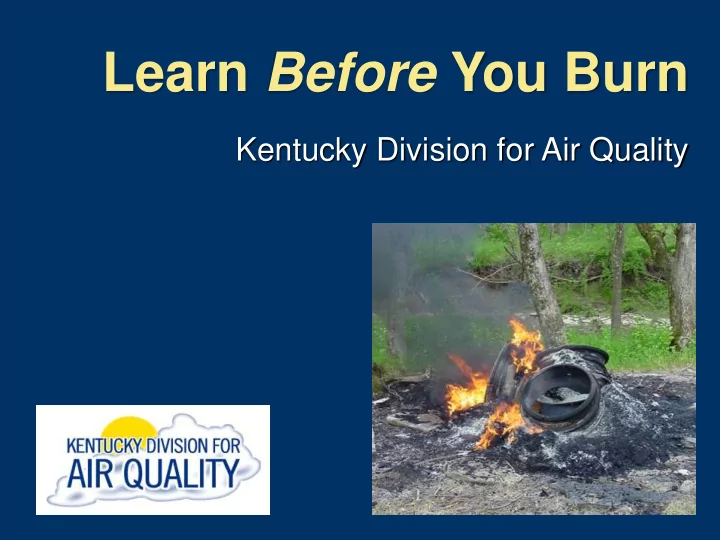
Learn Before You Burn Kentucky Division for Air Quality Our Mission - - PowerPoint PPT Presentation
Learn Before You Burn Kentucky Division for Air Quality Our Mission To protect human health and the environment by achieving and maintaining acceptable air quality through: Air monitoring Creating partnerships Public information
Our Mission
To protect human health and the environment by achieving and maintaining acceptable air quality through:
- Air monitoring
- Creating partnerships
- Public information
- Permitting and
compliance
Open Burning in Kentucky
- What is it?
- Why be concerned?
- Legal or Illegal?
- Restrictions
- How you can help
What is Open Burning?
Outdoor burning of any material without an approved burn chamber, stack, or chimney with control devices approved by the KY Division for Air Quality. Open burning is regulated under KY Title 401 KAR 63:005.
Open Burning Creates Fire and Safety Hazards
The Kentucky Division of Forestry estimates that 35 to 40 percent of wildfires in Kentucky start when open burning gets out of control.
Open Burning Impacts Air Quality
- Makes it harder for
areas to meet air quality standards
- Can’t always tell
where or when open burning is occurring, making it challenging to control
Open Burning Impacts Soil & Water
Chemicals and heavy metals from open burning settle out of the air and into soil and water.
Open Burning Harms Human Health
Smoke from open burning:
- Depresses the
central nervous system
- Is especially harmful
to children, the elderly, and adults with respiratory diseases
Where there’s smoke …
- Dioxins
- Furans
- Benzene
- Arsenic
- Carbon monoxide
- Lead
- Mercury
- Hydrogen chloride
- Hydrogen cyanide
In just one year, a single backyard burn barrel can produce more dioxins than a municipal trash incinerator.
>
Backyard Burn Barrels:
Largest single source of airborne dioxins in U.S. (U.S. EPA)
- A family of chlorinated organic chemicals
- Includes the main chemical ingredient in
“Agent Orange”
- Found in plastics, bleached paper products
- Extremely toxic
- Highly persistent in the environment
- Accumulate in fatty tissues
Dioxins & Furans
Dioxins move through the food chain
Illegal open burning in Kentucky continues to be a problem
How Do We Respond?
- Receive complaint
- Need an address where the burning happened in
- rder to investigate
- Enter information into complaints database
- Site visit generally within 3-5 working days
- Inspection of burn site
- Depending on the outcome of the investigation, a
Letter of Warning or Notice of Violation may be issued
It is not necessary for an inspector to witness the actual burn; evidence may be obtained from debris and ash piles, photos, etc.
What, when, where, and how a material is burned determines if the burning is legal or illegal.
Legal, or Illegal?
Call 502-782-6592 to learn before you burn.
Legal, or Illegal?
Local county and municipal ordinances may have more stringent rules than the state regulation described in this presentation.
Legal Burning Activities
- Fires set for recreational
- r ceremonial purposes
(camp fires, bonfires)
- Small fires set for comfort
heat at construction sites (only when air temp. is below 50˚)
- Fires set for cooking
(camp fires)
Legal Burning Activities
Burning of:
- Natural growth
disturbed as part of land clearing activities (development sites, etc.)
- Trees and tree limbs,
felled by storms
Ozone season exceptions: Jefferson, Boone, Kenton, Campbell, Boyd, Bullitt, Oldham, and Lawrence (partial)
Fires set for recognized agricultural, silvicultural, range,
- r wildlife
management practices.
Legal Burning Activities
Fires set for the purpose of instruction and training of firefighters.
- Contact the State Fire
Commission for more information.
- Materials likely to produce
toxic emissions must be removed prior to burn.
- Additional restrictions apply.
Generally only in cities with < 8,000 population (check local ordinance) The following counties are not allowed to burn leaves during
- zone season, May - September:
Jefferson, Boone, Kenton, Campbell, Boyd, Bullitt, Oldham, and Lawrence (partial)
Legal Burning Activities
Leaf burning, with some restrictions
Iowa DNR
Uncoated Household Paper Products
Check local ordinances
Office paper Plain cardboard Newspaper
What About Trash?
- Plastic
- Coated paper and cardboard
- Food
- Foam insulation
- Styrofoam
- Metal & glass
- Aerosol cans
- Rubber
- Painted products
- Diapers, clothing
Nearly everything found in household trash is illegal to burn.
Today’s Trash is Different
Yesterday’s trash Today’s trash
What’s in that trash?
Dioxin Benzene Toluene Acrolein Acetaldehyde Xylene Furan Mercury Lead
Prohibited Burn Items…
- Tires
- Plastic
- Rubber
- Coated wire
- Insulated wire
- Foam insulation
- Used oil
Prohibited Burn Items: Agricultural
- Bedding material
- Muck piles
- Mulch
- Hay
- Treated, stained, or painted lumber
- Fence posts & wood pallets
- Grass clippings produce
excessive smoke
- Grass clippings are “yard
waste”, which is not permitted to be burned according to 401 KAR 63:005
Prohibited Burn Items
Grass clippings
Prohibited Burn Items…
- Agricultural
chemical containers
- Household
chemical containers
Prohibited Burn Items: Buildings
- Buildings may not be disposed of by burning.
- Buildings may be demolished and buried onsite.
Prohibited Burn Items: Construction/Demolition Debris
- Asbestos materials
- Construction debris
- Demolition debris
- Drywall
- Shingles
Prohibited Burn Items:
Waste from businesses, schools & churches
- Other than land clearing
for development, businesses may not dispose of any waste by burning.
- Debris from private
businesses may not be transported for burning elsewhere.
Disposing of Storm Debris
County or municipal governments only, with approval
- May be legally burned (observe
fire hazard season restrictions & county burn bans).
- Large piles should be divided
and burned incrementally over time.
- Care should be taken to locate
burn piles away from residences and areas that could be impacted by smoke.
Contact the Division for Air Quality before burning large stockpiles of debris.
Disposing of Storm Debris
Demolition debris may not be burned. Debris may contain asbestos and other hazardous materials. Demolition debris piles should be kept wet until final disposal in a landfill.
During fire hazard season, burning within 150 feet of any woodland or brushland area is allowed only during evening hours between 6 p.m. & 6 a.m.
- Oct. 1 – Dec. 15 and
- Feb. 15 – April 30
Restrictions During Fire Hazard Season
- Only in Boone, Boyd, Bullitt,
Campbell, Jefferson, Kenton, Lawrence, & Oldham counties
- No open burning for land
clearing permitted
- Other restrictions apply
Restrictions during
- zone season:
May – September
Burn Bans
- Can be declared by county Judge Executive or Governor
- Generally during extreme risk of wildfire hazard
- Check Division of Forestry’s County Burn Bans page
- Use common sense to locate
fires away from nearby residences
- r businesses.
- Do not locate fires near streams,
sinkholes, or under/over utility lines.
- Check to make sure local
city/county ordinances allow burning.
Where Can You Burn Approved Materials?
Illegal burning could result in fines up to $25,000 per day per violation.
In addition to Division for Air Quality rules,
- ther state and
local regulations may apply.
Most Open Burning is Not Necessary
- Brush could be
composted, piled up for wildlife, or simply left to decay.
- Recycling is
available in most counties.
- Debris that is not
recyclable should be landfilled.
Spread the Word
- Contact the Division for Air
Quality for posters and
- brochures. Email your
request to Roberta.Burnes@ky.gov .
- Report illegal burning by
calling 502-782-6592.
Ashland Karen Deskins (606) 929-5285 Bowling Green Troy Tabor (270) 746-7475 Florence Clay Redmond (859) 525-4923 Frankfort Natasha Parker (502) 564-3358 Hazard Steve Hall (606) 435-6022 London Pete Rayburn (606) 330-2080 Owensboro Mac Cann (270) 687-7304 Paducah Beth Lents (270) 898-8468