Learning across a lifespan Fossils, photovoltaics and - - PowerPoint PPT Presentation

learning across a lifespan
SMART_READER_LITE
LIVE PREVIEW

Learning across a lifespan Fossils, photovoltaics and - - PowerPoint PPT Presentation

Learning across a lifespan Fossils, photovoltaics and misconceptions: The challenges of learning (and teaching) Only 14% of a students time is spent in the classroom. science beyond the classroom (About 33% is spent sleeping.) Jim Kisiel ,


slide-1
SLIDE 1

Fossils, photovoltaics and misconceptions:

The challenges of learning (and teaching) science beyond the classroom

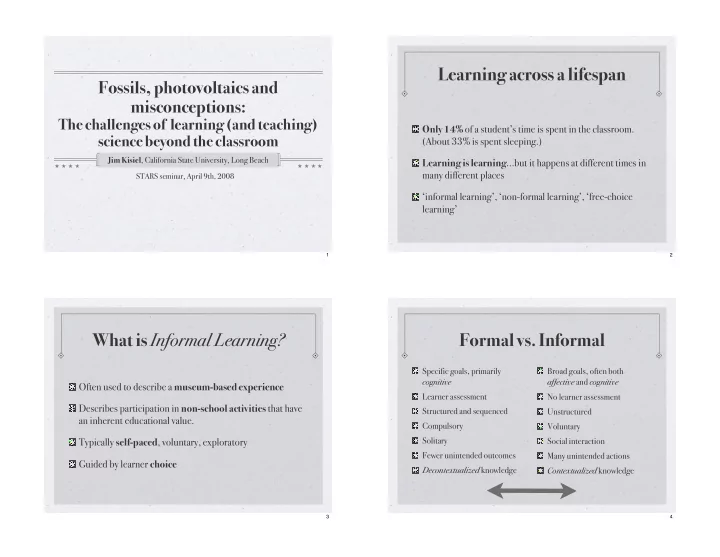
Jim Kisiel, California State University, Long Beach STARS seminar, April 9th, 2008

1

Learning across a lifespan

Only 14% of a student’s time is spent in the classroom. (About 33% is spent sleeping.) Learning is learning...but it happens at different times in many different places ‘informal learning’, ‘non-formal learning’, ‘free-choice learning’

2

What is Informal Learning?

Often used to describe a museum-based experience Describes participation in non-school activities that have an inherent educational value. Typically self-paced, voluntary, exploratory Guided by learner choice

3

Formal vs. Informal

Specific goals, primarily cognitive Learner assessment Structured and sequenced Compulsory Solitary Fewer unintended outcomes Decontextualized knowledge Broad goals, often both affective and cognitive No learner assessment Unstructured Voluntary Social interaction Many unintended actions Contextualized knowledge

4

slide-2
SLIDE 2

How do people ‘use’ museums?

Some typical visitor behaviors: A typical exhibit stop may last 10-40 seconds Visitor time within an exhibition space is measured in minutes (10-15 min, on average) Visitors tend to turn right, when given the opportunity Visitors tend to stick to the sides, and follow the main path Research and evaluation studies link observed behaviors to likelihood of learning

5

IF the goal of an exhibition is to inform, to show, to teach... THEN, you must consider the learner--the visitor. A visitor’s (learning) experience is shaped by different contexts: Physical Sociocultural Personal

6

personal sociocultural physical

motivations and expectations prior knowledge choice and control within-group interaction interaction with others

  • rientation

design reinforcing experiences

Contextual Model of Learning

7

Exploring the personal context

Understanding what the visitor brings is important if educators or designers wish to facilitate a learning experience (not unlike the classroom!) Must consider choice, motivations & prior knowledge

8

slide-3
SLIDE 3

What do they do? The role of choice

9

Why go to a museum? The role of motivation

People visit museums for a variety of reasons: education is usually part of the rationale, but may not be the most important (social, lifespan, convenience, etc.). Studies have shown that visitors with strong ‘education’ agendas OR strong ‘entertainment’ agendas are more likely to demonstrate learning as an outcome of their experience. education entertainment education entertainment

10

Why go to a museum? The role of motivation

Visitor Identities influence learning Explorers: Curiosity-driven, seek to learn more about whatever they

might encounter

Facilitators: Focused primarily on enabling the experience and

learning of others in their group

Professionals/Hobbyists: Feel a close tie between the institution’s

content and their profession/hobbies

Experience seekers: Get satisfaction from the idea of visiting this

particular site

Spiritual pilgrims: Seek a contemplative and/or restorative

experiences

11

What do they already know? The role of prior knowledge

Constructivist perspective--understanding builds on prior knowledge. Learning outcomes depend on where the learner starts There are very few published studies have looked at museum visitors’ prior knowledge of science concepts. These are sometimes done as part of front-end evaluation, but findings are often left unpublished or deemed ‘ungeneralizable’

12

slide-4
SLIDE 4

Science Center Visitors' Understanding of Renewable Energy

13

Research Questions

1.To what extent do visitors feel knowledgeable about renewable energy, including solar energy? 2.To what extent to visitors understand how solar (photovoltaic) panels work? 3.To what extent do visitors see solar energy as a viable alternative to traditional energy sources (fossil fuels) and what rationale do they use to support their decision?

So why THESE questions?

14

In June 2007, a solar portico was installed. The science center was interested in knowing how visitors would react to these efforts. What were visitor attitudes toward renewable energy? What did they know? Did they think renewable energy had a place in Northern Ohio? The Science Center became involved in a project advocating the use of wind energy in northern

  • Ohio. They received funding to

install a wind turbine and create exhibits related to this technology. The turbine was installed in May 2006.

15

Methodology

Phase 1. Visitor interviews at the Great Lakes Science Center Phases 2 and 3. Online survey. Open and closed ended questions, informed by Phase 1 2 populations: Science Center members (N=441) & local teachers (N=125) 88% white; 87% with college degrees or higher; 70% ages 36-55

16

slide-5
SLIDE 5

‘How much do you feel you know about energy issues and problems?’

The results for this study resembled those reported by NEETF (2002) in their study of over 1500 adults. The NEETF report suggested that adults overestimate their understanding of basic energy concepts, as participants scored poorly on a test of energy knowledge.

A lot 10% A fair amount 45% Only a little 32% Practically nothing 13%

17

‘How would you describe your understanding of how we get electricity from each of these sources?’

2.5 5.0 Knowledge Rating 3.95 4.03 3.69 3.32 3.67 3.17 2.86 Wind energy Solar energy Hydroelectric energy Geothermal energy Nuclear energy Bio-fuels and bio-diesel Hydrogen fuel cells

Respondents were asked to rate their knowledge on a scale of 1 (low) to 5 (high). Results suggest higher comfort levels with wind and solar energy.

[Only members were asked this question; N=441]

18

‘What comes to mind when you think of solar energy?’

Category Description

Frequency (N=566)

Examples panels, houses, road signs, calculators, yard lighting, spacecraft 41% Cost expensive, money-saving in long-term 19% Brief description or definition energy from the sun’, ‘converting the sun’s energy to generate electricity’ 16% Explanation ‘sun rays beat down on solar panels and transfers it into energy’ 16% Local feasibility why it might or might not work in Cleveland 14%

Locale or climate conditions

good for certain places, used on rooftops, in the Southwest 13% General benefits ‘we need to explore this’, underutilized resource 13% Efficiency/reliability included both positive and negative comments 9% Environment benefits to environment, concerns over materials needed 5% Political issues incentives or obstacles to using more solar energy 3%

19

‘Is Cleveland a good place to generate energy from the sun?’

definitely 12% possibly 53% probably not 28% definitely not 4% not sure 3%

20

slide-6
SLIDE 6

‘Is Cleveland a good place to generate energy from the sun?’

evidence-based responses (73%)

It's cloudy in Cleveland a lot of the time, so generating solar energy may not be worthwhile.

23.1%

The days are too short in Cleveland during the winters, so generating solar energy in this area may not be worthwhile.

6.3%

I'm not sure how much sunlight is really needed to make generating energy worthwhile.

27.1%

Using the sun as an energy source is just not cost-effective compared to the traditional energy sources we use now.

2.7%

You don't need a lot of sun to generate energy, so Cleveland is as good a place as any.

3.4%

There's enough sun in Cleveland to make solar energy a good alternative.

10.3% need-based responses (23%)

We need to explore alternatives to traditional energy sources to better care for the environment.

15.6%

We need to explore alternatives to traditional energy sources to reduce our dependence on foreign oil.

6.9%

21

Cleveland

22

‘How are solar panels, like the one shown here, able to harness the sun’s energy?’

This image accompanied the survey question. 550 people responded to this open ended question

video

23

Only 14% of respondents were able to give a complete or at least partial explanation of how a solar panel/cell worked (e.g. converting light energy into electricity). This increases to 21% if explanations that describe ‘the energy from the sun’ being converted to electricity are included. Several misconceptions regarding the function of solar panels also emerged.

Findings: Misconceptions related to solar panels

24

slide-7
SLIDE 7

Light transformed to electricity 14.4% detailed 2.9%

The absorption of light energy by semiconductor materials causes the excitement of electrons. Electrons that escape their shells are then directed together to create a flow of electrons. #409

general 11.5%

The panels transfer the light into electrical energy. #480

Energy transformed to electricity 6.3%

They save the energy from the sun & convert is to electricity. #224

Heat absorbed and transferred 8.7%

The radiant heat is collected on the panels and is used to heat water. The water circulates through the area to be heated and gives off heat. #358 The panels heat up from the sun and emit heat to the inside of the building #438

Mechanisms reported for solar panels

25

Heat transformation 8.7%

The panels and the wire grids in the panels heat up and turn solar energy into

  • electricity. #354

They absorb heat from the sun, and it is somehow converted into energy. #60

Energy collected and/or stored without transformation 19.6%

The sun heats the panel which collects the energy and stores it in batteries to be used at a later point. #326

No response or don’t know 30.9%

Mechanisms reported for solar panels

26

Did visitors overestimate their ‘energy knowledge’?

How much do you know about energy issues and problems?

total responses (N=550) % describing a photovoltaic mechanism

A lot 64 36% A fair amount 276 26% Only a little 196 9% Practically nothing 23 4%

27

Emerging Misconception: Storing energy

About 1/5 of the respondents made mention of storing energy

  • r batteries as part of their solar panel explanation.

Nearly half of these respondents (or about 10% of the total population studied) suggested that the sun's energy was stored within the solar cell or solar panel itself. Take in the sun's energy and store it in solar cells. #447 Sun hits panels, cells in the panels store energy, energy is collected (not sure how) from the cells. #128

28

slide-8
SLIDE 8

So What?

29

The results of this study suggest that science center visitors and teachers: may overestimate their understanding of energy and energy technologies have a wide range of perceptions and attitudes related to solar energy may have underlying misconceptions about how solar panels work, which may affect their ability to make informed decisions regarding the implementation of such technology. may rely on intuitive or common-sense understanding when determining the utility of alternative energy sources.

Challenges

30

Advocating the use of solar or other forms of renewable energy will require helping learners or consumers to reexamine or validate their assumptions about usefulness (e.g. too cloudy in Cleveland for solar energy). Advocating the use of solar or other forms of renewable energy will require addressing possible misconceptions that may be informing their decision-making The results here suggest that solar energy has different personal meanings for different learners. In order to better understand the apparent misconceptions related to solar cells and the use of solar energy, in-depth interviews should be used to clarify the learner’s understanding.

Implications

31

Uncovering Visitor Conceptions of Fossils and the Fossil Record

32

slide-9
SLIDE 9

The natural history museum and evolution project

In 2003, the University of Florida began multi-site investigation of natural history museum visitors’ understanding

  • f evolution. (NSF ISE 0138030)

Six natural history museums of varying sizes and locations within the U.S. were used as data collection sites. Goal: To gather information related to visitors notions of evolution and related concepts as a way to inform exhibit development.

33

Methodology

Visitors to the natural history museums had been asked to complete a short interview (10-20 minutes) consisting of three sets of questions that prompted individuals’ explanations of fossils, the fossil record, and concepts related to evolution. Interviews were recorded via audiotape and later transcribed. The six original sites: Natural History Museum of Los Angeles Country, the Page Museum & La Brea Tar Pits, Denver Museum of Nature and Science, University of Kansas Natural History Museum, Florida Museum of Natural History (UF), National Museum of Natural History (Smithsonian) Visitors ages 8 and up were interviewed.

34

Findings

From that investigation, MacFadden et al. (2007) reported only 30% of visitors ages 15 and up were able to explain the process

  • f evolution using a natural selection mechanism. (via a cheetah

word problem) Visitors responses varied by age: high school < seniors(55+) < 35-55 < 19-34 Most visitors (89%) accepted evolution, although this varied slightly according to site (e.g. 80% at KU, 94% at NHMLAC)

35

Revisiting the data

A secondary analysis was conducted Examined a portion of the data set--specifically visitor comments related to characteristics of fossils and their interpretation of fossil evidence Data from two of the six original sites was used in this study: the Natural History Museum of Los Angeles Country and the Page Museum & La Brea Tar Pits Responses were examined qualitatively for recurring concepts. Categories were established based on the data; response frequencies were also established.

36

slide-10
SLIDE 10

Interview questions used for this analysis

If you were to explain to someone what a fossil is, what would you tell them? From this poster, can you tell me which of the fossils in general are the oldest and which are the youngest? Some fossils found in the lower layers are not found in the upper ones. How might scientists explain this finding? Some fossils found in the upper layers are not found in the lower ones. How might scientists explain this finding?

37

Research Questions

1.To what extent are natural history museum visitors able to describe the characteristics of a fossil? 2.To what extent are these visitors able to interpret fossil evidence? More specifically, how do visitors explain fossil discoveries using a diagram of rock formations and strata?

So why THESE research questions?

38

Why fossils?

Fossils (and fossil-based exhibits) make up sizable portions of most natural history museum collections. Fossils help scientists make sense of the past and serve as critical evidence for evolutionary theory. ‘Fossil’ is a common term with which many people are familiar--it is conceivable, however, that definitions vary and may or may not correspond with a ‘scientific’ definition. How much visitor prior knowledge can we take for granted? How ‘accurate’ is that knowledge? (e.g. cladistics)

39

‘How would you explain what a fossil is?’

Six concept categories were established based on visitors’ definitions of a fossil.

Intrinsic properties -references to the origin and composition of a fossil Process - references to the processes involved in fossil formation Time - references to fossil age and/or to the length of time required for a fossil to form Location - references to locations where fossils are often found Type – references to specific types of fossil Value & Function – references to the use of fossils in science and history

40

slide-11
SLIDE 11

I would describe them as the remains of life of living things uh from long ago – the remains have been um turned into [rock]

  • r something else that has survived all

these years, uh and that if you are lucky you can still dig ‘em up today and find out about those old dead things.

  • 1. Intrinsic Properties (1.1 –

Comes from an organism: general organism)

  • 2. Process (2.2

Process of change + 2.3 Mineralization/ Replacement)

  • 6. Value & Function (6.1 Discover

more about the past)

  • 3. Time (3.1 General descriptive)
  • 1. Intrinsic

Properties (1.2 Composition)

  • 4. Location (4.3 – Process of

being recovered from a location)

Example of coding process

41

Visitor-generated characteristics of fossils

42

Frequencies of conceptual categories

90% 67% 50% 47% 36% 8%

0% 20% 40% 60% 80% 100% Intrinsic Properties Process Type Time Location Value & Function Concept Categories Concept Categories Percentage of visitors (%) Percentage of visitors (%)

43

Intrinsic Properties Process Type Time Location Value & Function Concept Categories Concept Categories

Frequencies of conceptual categories

On average, visitors mentioned 3 of these 6 categories in their definition

  • f fossil--whether adult or

child. Adults were more likely to mention process related to fossil formation--in particular a change process ( 2(1, N=159) = 5.46, p<0.05)

44

slide-12
SLIDE 12

Fossils as Process

Category % (N=159) Process of burial 32% Process of change 52% preserved 17% mineralization 31%

Overall, 2/3 of visitors mentioned some kind of process when describing a fossil Over half mentioned some kind

  • f change (preserved,

mineralization, hardening, etc.) Adults were more likely to mention mineralization; 2(1, N=159) = 6.23, p<0.05).

45

How do visitors interpret the fossil record?

the law of superposition refers to the idea that over time, newer layers of sedimentary rock will build up

  • n older layers

46

How do visitors interpret the fossil record? Which are oldest and which are newest?

most visitors (87% of 169) were able to identify older layers as lower layers about 35% made specific reference to organisms depicted to help them answer

  • f the 22 visitors who did not

recognize that older fossils were in deeper layers, all but two used images to help decide

47

Why are fossils in lower layers not found in upper layers?

Response category Example

% (N=169)

Extinction They've gone extinct and are not living anymore. (PM46)

57%

Environmental Change They couldn't keep up with the demands of their environment. Something grew to eat them. (PM75)

33%

Evolution or Organism Change Because they evolved. They transformed and changed. (PM40)

23%

Fossil Movement Could be something that got stuck somewhere and just got shoved

  • down. (NHM4)

12%

Unable to Survive in Different Layers These look like water animals, so there was probably water right here, but no water up here, so you couldn't find them up there. (NHM22)

10%

Don’t know/other

8%

Organism Migration They weren't there because they didn't live at the other times…they could have lived later, but lived somewhere else. (PM57)

4%

No Fossilization Maybe the environment was such that they couldn't be preserved? (NHM27)

1%

48

slide-13
SLIDE 13

Why are fossils in upper layers not found in lower layers?

Response category Example % (N=169) Evolution or Organism Change The ones in the upper layers look like they've evolved into growing teeth and eating specific types of food and in the lower levels look like fish or animals of the sea. (PM20)

36%

Organism Appearance A tortoise is more of an evolved animal than (those) from this period…. They weren't around at the time. (PM75)

32%

Environmental Change A lot of different things changed--climate, whether they were on land or in ocean. (PM13)

22%

Don’t know/other

10%

Unable to Survive in Different Layers Some tortoises lived on land most of the time. And sometimes they would go in water, but mostly they go on land. (NHM50)

8%

Migration They weren't indigenous and may have migrated. (PM32)

6%

Extinction Couldn't survive then so they died out (PM 45)

3%

Fossil Movement …These are later than these, so over time, maybe over time the rocks would have pushed these down (NHM38)

2%

No Fossilization They never became fossilized back then could have had something to do with what they were made of and what their decomposing bodies were subject to. (PM73)

1%

49

visitors used a variety of different reasons, and often invoked more than one. different patterns of reasons depended on question (bottom-up vs. top-down)

  • nly about 1/3 (or less)

made reference to organism changes to account for fossil absence

How do visitors interpret the fossil record?

50

Object- vs. Process-based Explanations

Explain why fossils in lower layers are not found in upper layers (N=169) Explain why fossils in upper layers are not found in lower layers (N=169) Object-based explanation 12% 2% Process: Organism-based explanation 59% 64% Process: Environment-based explanation 46% 34%

Note that some visitors used both organism- and environment-based

  • explanations. In these cases, they often invoked a causal relationship:

environment change organism change

51

So What?

52

slide-14
SLIDE 14

Challenge: Missing Pieces

Breadth of visitor responses seems consistent with the varying ways that ‘fossil’ is defined by different sources. It suggests that visitors do indeed have some ideas regarding what a fossil is. However... Visitors made very little mention of the rarity of fossils (i.e. conditions needed to be just right for fossils to occur; therefore many organisms were not fossilized.) Only 8% made any mention of the value of fossils

That's how we find out about things long ago, that's how we know about things before humans were even on this earth.(NHM91)

53

Challenge: Visual Cues

Diagram as scaffold

about 1/3 used images to confirm their ideas about superposition some led to scientifically accurate response, some not (e.g. dinosaurs are

  • ldest)

Diagram as source of cognitive conflict

54

Challenge: Species Change

Many of the reasons given for fossil absence were...reasonable

  • used a process-based explantation
  • went extinct, environment changed so animals left, animal didn’t

exist yet

  • only about 1/3 used species change explanations (23% for

bottom-up; 35% for top-down)

Organism appearance explanations--may mask creationist reasoning

55

Implications

Visitors have a broad and varied conception of fossils-- potentially many entry points for different learners Consider a focus on process--a salient feature, but not necessarily well understood. Especially important for children. Consider emphasizing the value of fossils as a scientific tool

56

slide-15
SLIDE 15

Strata representation may be a useful way to convey time-- yet visitors may still interpret this in terms of existing notions

  • f geologic time and animal
  • rigins

Consider how such displays and fossil specimens might be used to move visitors from intuitive reasoning to evidence-based reasoning.

Implications

57

Only part of the puzzle...

What will they do after? Does the exhibit catch their eye? Can they find their way? Who are they with? Are staff or volunteers present? visitor’s learning experience What do they know? Why are they there?

video 58