Lifespan De-Stigmatization 1 5/28/2013 Primary Research Conducted - - PDF document

▶
lifespan de stigmatization
SMART_READER_LITE
LIVE PREVIEW

Lifespan De-Stigmatization 1 5/28/2013 Primary Research Conducted - - PDF document

5/28/2013 Lifespan Stigma and Discrimination Reduction Research Results Scott Rose, Principal Norma Rivera, Social Marketing Director Runyon Saltzman & Einhorn Larry Bye, Senior Fellow, Public Health Research NORC Lifespan

slide-1
SLIDE 1

5/28/2013 1

Lifespan Stigma and Discrimination Reduction Research Results

Scott Rose, Principal Norma Rivera, Social Marketing Director

Runyon Saltzman & Einhorn

Larry Bye, Senior Fellow, Public Health Research

NORC

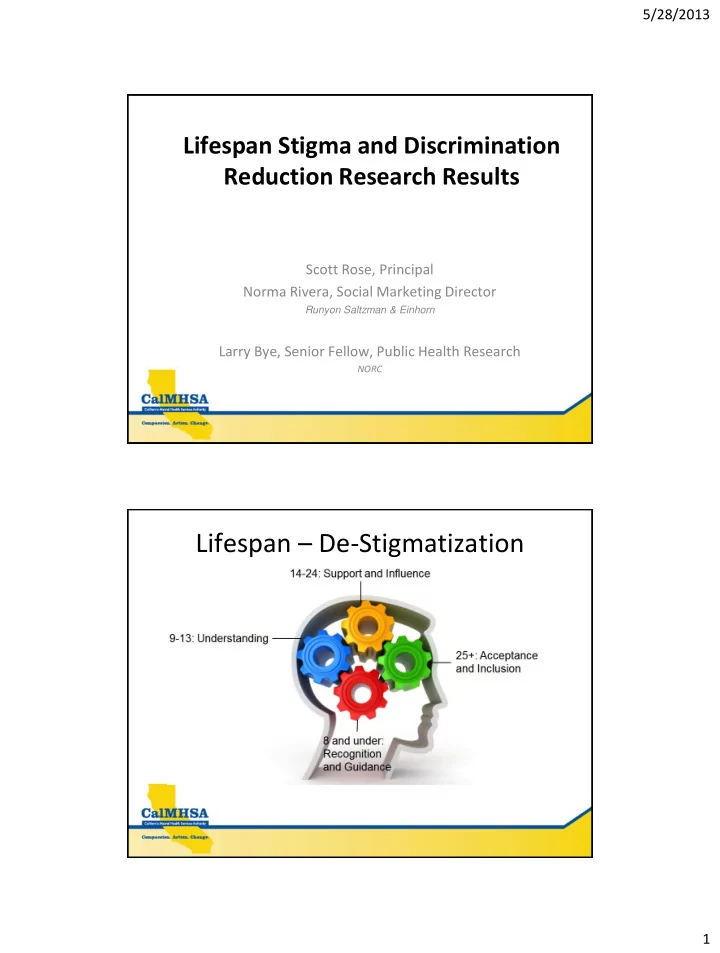
Lifespan – De-Stigmatization

slide-2
SLIDE 2

5/28/2013 2

Primary Research Conducted

  • 11-13 Year Olds (Inoculation):

– More than 600 middle school students responded to a 28- question survey (English and Spanish)

  • 14-24 Year Olds (Mobilization):

– ReachOut.com surveys fielded to ReachOut users

  • 25+ (Decision Makers):

– More than 1,000 decision-makers age 25 or older responded to a baseline survey (English and Spanish)

Survey of Children Aged 11-13

  • Objective:

– Assess baseline level of knowledge about mental illness and stigma/discrimination

slide-3
SLIDE 3

5/28/2013 3

Survey Methods

  • n=633 11-13 year-olds
  • One quarter African American, Hispanic, Asian/Pacific Islander, and

Non-Hispanic Whites/Others

  • Data were collected in shopping malls with parental consent
  • Locations and completed interviews roughly mirror California

population distribution (sites included: Greater LA, Bakersfield, Central Coast,

Fresno/Merced, Sacramento, Stockton, Modesto, etc.)

  • Data were collected in English and Spanish during February and

March 2012

  • Part of survey was self-administered and part interviewer-

administered

Common Points of Information

  • Determined 28 common points of information

to develop the survey

  • Consulted with:

– NAMI California – SAMHSA – Dr. Susan Keys – Dr. Sergio Aguilar-Gaxiola

slide-4
SLIDE 4

5/28/2013 4

Main Findings

  • Rather low knowledge level; lots of room for

improvement

  • Of 28 knowledge items, average number # of

correct responses was 48%

  • 12 year olds and Non-Hispanic Whites were

more likely to give correct answers

What Is Mental Illness? What is its Cause?

  • 86% agree that mental illness is a condition

that changes a person’s thinking, feelings and moods

  • 83% reject notion that it is caused by laziness

and selfishness

  • Only 45% know that causes are not fully

understood

slide-5
SLIDE 5

5/28/2013 5

The Behavior of People Experiencing a Mental Illness

  • 53% agree that people are more likely to hurt
  • thers
  • 76% believe people are more likely to act in

ways you don’t expect

  • Only 43% reject notion that people are not

likely to have children

Treatment

  • Only 50% agree that people often get better after

going to the doctor

  • About 60% reject the notion that people often get

better but only for a few weeks or months

  • 63% reject notion that women are more likely than

men to get better

  • 52% agree that people are required to take medicine

and get counseling for the rest of their lives

slide-6
SLIDE 6

5/28/2013 6

Post Treatment Success

  • About 60% reject notion that once treated,

people often get into trouble with the law

  • About 60 % agree that once treated, people

lead active, productive lives

  • Only 40% reject the idea that once treated,

people are required to live and work only in certain places

Stigma and Discrimination

  • 61% agree that mental illness is common in U.S
  • 67% disagree that people can be jailed
  • 80% agree that people should be able to have jobs, housing, and

education just like everyone else

  • Only 46% disagree that it is currently legal to deny housing to

people

  • Only 44% disagree that mental illness is more common in some

racial groups

  • 54% agree that people have to pass a mental health test before

that can work at some jobs

slide-7
SLIDE 7

5/28/2013 7

Survey of Teen/Young Adult Population (14-24 Year Olds)

  • Self-administered survey of CA

ReachOut.com users aged 13 and

  • lder
  • Conducted by Inspire USA

Foundation, March 2012

  • 2013 user survey is ongoing and will

be accompanied by NORC survey of household population

Objectives

  • Assess:

– Demographics of visitors – Frequency/patterns of use – Personal wellbeing, psychological distress – Help-seeking knowledge, preferences and behavior – Mental health literacy and stigma/discrimination KAB – Impressions of ReachOut.com

slide-8
SLIDE 8

5/28/2013 8

Survey Methods

  • Self-administered survey of CA ReachOut.com users
  • 50% were first time visitors; most of others had first

visit in last few months

  • Most common reason for visiting: seeking help but

also “checking out what’s new,” hearing stories, and looking for information

  • Significant number of frequent visitors and people

who spend a lot of time on the site

Findings

  • Vast majority self- assessed knowledge of mental

illness as very good (32%) or good (43%)

  • 83% agreed that anyone can experience a mental

illness

  • 51% would not want others to know if they

experienced a mental illness

  • 76% believe people can recover and lead successful

lives

slide-9
SLIDE 9

5/28/2013 9

Willingness to Interact with People Experiencing a Mental Illness

  • Make small talk with the person at a party: 5.42
  • Spend an evening hanging out with the person: 5.41
  • Make friends with that person: 5.57
  • Have person work closely with you on a school or work

assignment: 5.07

  • 1= totally unwilling; 7=totally willing

Survey of California Adult Influencers Aged 25+

  • Assessed knowledge, attitudes and behaviors related

to issues of stigma and discrimination

  • Conducted in the winter of 2012 as part of the Stigma

Discrimination Reduction Social Marketing Program

slide-10
SLIDE 10

5/28/2013 10

Survey Objectives

Goal

  • Assess knowledge, beliefs and behaviors prior to launch of SDR

campaign

Objectives

  • Assess:

– Stereotypes toward people experiencing mental illness – Basic attitudes: comfort talking to people, likelihood of feeling shame and rejection, existence of discrimination

Survey Objectives continued

  • Assess:

– Interest in learning more and being supportive – SDR actions in last 12 months – Willingness to engage on SDR issue – Willingness to accept in specific roles – Change in personal acceptance – Change in social norms

slide-11
SLIDE 11

5/28/2013 11

Survey Methods

  • The survey was fielded by Knowledge Networks
  • Panel members from California 25 years or older were invited to
  • participate. Everyone had to speak English or Spanish.
  • Panelists were screened to ensure that they were part of one or more of

the following groups:

  • A total of 1,067 surveys were completed
  • Landlords
  • People who work with patients

in a health care setting

  • People who work in any part of

the criminal justice system

  • Teachers
  • Managers who make hiring or firing

decisions

  • Caregivers to the elderly
  • Friends and family of persons

experiencing mental health challenges

Stereotypes About People Experiencing a Mental Health Challenge

  • Two thirds believe people diagnosed with a mental illness

can contribute to society, a positive finding

  • Majority are ambivalent about “once ill, always ill” idea –

don’t know what to believe; population as a whole leans toward disagreement (mean = 3.4)

  • Majority are ambivalent about the dangerous stereotype
  • Large numbers believe people with mental illness should

“just stop feeling sorry for themselves;” population as a whole leans toward disagreement (mean = 3.0)

slide-12
SLIDE 12

5/28/2013 12

Stereotypes About People Experiencing a Mental Health Challenge Stereotypes About People Experiencing a Mental Health Challenge

  • Almost 8 in 10 disagree that “people with a mental illness
  • nly have themselves to blame,” which is a positive finding
  • Another positive finding: Majority believe “anyone can

experience mental illness,” although more than one third are ambivalent

  • Large number are ambivalent about ability “to get

themselves under control” and whether “except for their illness, people with a mental illness are just like everyone else.”

slide-13
SLIDE 13

5/28/2013 13

Stereotypes About People Experiencing a Mental Health Challenge

Bottom Line About Stereotypes

  • They are prevalent

– On 5 of the 8 measures, majority either hold negative or ambivalent views

  • Ambivalence more prevalent than hardened

negative views

– The average across the 8 measures: 9% negative, 49% positive, 42% ambivalent

slide-14
SLIDE 14

5/28/2013 14

Attitudes Toward Mental Health Challenges

  • Only a bare majority accept that

discrimination exists

  • Most are comfortable talking to someone

experiencing mental illness

  • Large majority are not sure about shame and

rejection

Attitudes Toward Mental Health Challenges

slide-15
SLIDE 15

5/28/2013 15

Willingness to Accept in Specific Roles

  • Almost two-thirds were unwilling to accept people

experiencing schizophrenia in any role

  • „

Most were willing to accept people experiencing mental illness in some roles

  • „

Respondents were evenly split between accepting people ill with substance abuse – almost half were willing to accept them in some roles and almost half were unwilling to accept them in any role

Willingness to Accept in Specific Roles

slide-16
SLIDE 16

5/28/2013 16

Change in Personal Acceptance and Social Norms

  • Considerable ambivalence about whether change is

taking place; far more agree it is, however.

Behaviors: In the Last 12 Months, Have You Done Any of the Following?

  • Many report positive behaviors in the last 12

months on an aided basis

  • 49% reported taking one or more of these

actions

slide-17
SLIDE 17

5/28/2013 17

Behaviors: In the Last 12 Months, Have You Done Any of the Following? Willingness to Engage on Issue in the Future

  • The findings are generally positive with respect

to willingness to engage on the issue

  • Ambivalence is more the problem than

unwillingness

slide-18
SLIDE 18

5/28/2013 18

Willingness to Engage on Issue in the Future

Segmentation Analysis Looking Across All Study Measures

Main Finding: There are subtle differences in beliefs and behaviors across all the influencer audience segments

– Segments more likely to report positive beliefs and behaviors: those in close contact, Whites, African Americans – Close contact group is not a surprise given research pointing to the efficacy of contact as an attitude change strategy – Asian/Pacific Islanders are more likely to report negative beliefs and behaviors – There was no clear pattern with regard to the other race/ethnic, gender, age and educationally defined segments

slide-19
SLIDE 19

5/28/2013 19

Segmentation Analysis Looking at Those with Ambivalent Attitudes

  • Given large ratio of ambivalent to negative

influencers, campaign strategists made decision to target the ambivalent

  • Main Finding from Analysis: Ambivalence is fairly

evenly dispersed across audience segments

  • Only Real Differences: Asian/Pacific Islanders are

somewhat more likely to be ambivalent; Spanish speakers are least likely

Campaign Inputs

  • Primary & Secondary

Research

  • Counties
  • CalMHSA
  • Strategic Council
  • SDR Consortium
  • Consumers
  • Subcontractors
  • PEI Partners
  • California

Reducing Disparities Project

slide-20
SLIDE 20

5/28/2013 20

Applied Learnings

  • Parents & Caregivers (0-8 year olds):

– Developed Latino Family Forums – Media relations related to the Latino Family Forums – Developed a partnership with Univision – Working to develop a culturally and literacy-appropriate consumer- facing SDR resource that contains highly relevant and accessible information for parents of Latino children ages 0-8, such as personal stories, tips, challenges and advice. Example wellness resources include:

  • Fotonovela
  • Book or series of booklets/pamphlets
  • Newspaper inserts (La Opinión, Vida en el Valle and community newspapers)
  • Interactive website
slide-21
SLIDE 21

5/28/2013 21

Applied Learnings

  • Inoculation (9-13 year olds):

– Expanded target audience age from 11-13 year olds to 9-13 year olds – Included Spanish-language website and advertising – Developed educational interactive website instead of game – Integrated school-based performances – Engaged child development experts to review and vet all materials – Working to engage rural schools to review concepts and TETRIS trained schools to receive the school-based performances

Applied Learnings

  • Mobilization (14-24 year olds):

– Developed Spanish ReachOutHere forums – Refined messaging according to ad performance – Establish rural outreach activities – Developed ReachOutHere toolkits – Customized all materials for counties, partners, colleges and community based organization – Used Transition Age Youth for photo and voice talent

slide-22
SLIDE 22

5/28/2013 22

Applied Learnings

  • Decision-Makers (25+):

– Consortium guidance in the development of the documentary – Developed outreach plans for API, LGBTQI, African American, Native American and Latino communities – Speakers Bureau capacity building – Implemented a grant program aimed at reaching rural communities – Development of comprehensive website, EachMindMatters.org