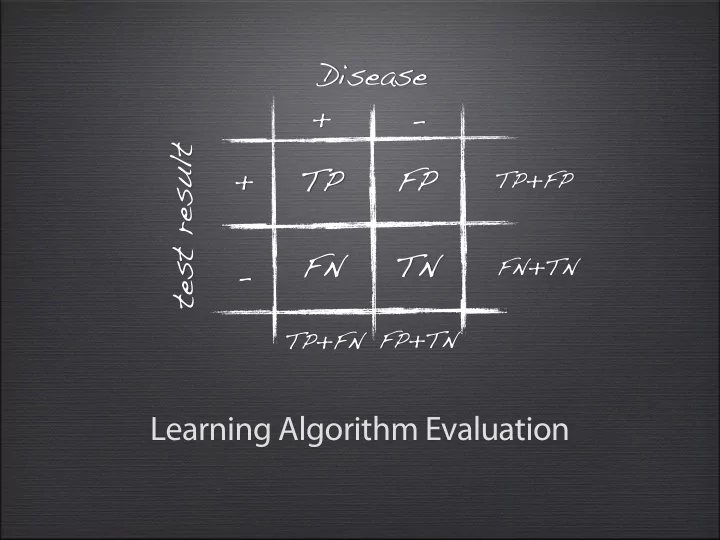
SLIDE 1 Learning Algorithm Evaluation
+
FN FP TN Disease t e s t r e s u l t
TP+FP FN+TN TP+FN FP+TN
SLIDE 2 Outline
Why?
How?
- Holdout vs Cross-validation
What?
Who wins?
SLIDE 3
Quiz
Is this a good model?
SLIDE 4
Overfitting
While it fits the training data perfectly, it may perform badly on unseen data. A simpler model may be better.
SLIDE 5 Outline
Why?
How?
- Holdout vs Cross-validation
What?
Who wins?
SLIDE 6 A first evaluation measure
- Predictive accuracy
- Success: instance’s class is predicted correctly
- Error: instance’s class is predicted incorrectly
- Error rate: #errors/#instances
- Predictive Accuracy: #successes/#instances
- Quiz
- 50 examples, 10 classified incorrectly
- Accuracy? Error rate?
SLIDE 7
Rule #1
SLIDE 8
Rule #1
Never evaluate on training data!
SLIDE 9
Holdout (Train and Test)
SLIDE 10
Holdout (Train and Test)
SLIDE 11
Holdout (Train and Test)
a.k.a. holdout set
SLIDE 12
Holdout (Train and Test)
a.k.a. holdout set
SLIDE 13
Holdout (Train and Test)
a.k.a. holdout set
SLIDE 14 Can I retry with other parameter settings?
Quiz
SLIDE 15
Rule #2
SLIDE 16
Rule #2
Never train/optimize on test data!
(that includes parameter selection)
SLIDE 17 You need a separate optimization set to tune parameters
Holdout (Train and Test)
OPTIMIZATION TESTING
SLIDE 18 Test data leakage
- Never use test data to create the classifier
- Can be tricky: e.g. social network
- Proper procedure uses three sets
- training set: train models
- ptimization/validation set: optimize algorithm
parameters
- test set: evaluate final model
SLIDE 19 Build final model on ALL data (more data, better model)
Holdout (Train and Test)
SLIDE 20 Making the most of data
- Once evaluation is complete, and algorithm/
parameters are selected, all the data can be used to build the final classifier
- Trade-off: performance <-> evaluation accuracy
- More training data, better model (but returns diminish)
- More test data, more accurate error estimate
SLIDE 21 Issues
- Small data sets
- Random test set can be quite different from training set
(different data distribution)
- Unbalanced class distributions
- One class can be overrepresented in test set
- Serious problem for some domains:
- medical diagnosis: 90% healthy, 10% disease
- eCommerce: 99% don’t buy, 1% buy
- Security: >99.99% of Americans are not terrorists
SLIDE 22 Balancing unbalanced data
Sample equal amounts from minority and majority class + ensure approximately equal proportions in train/test set
SLIDE 23 Stratified Sampling
Advanced class balancing: sample so that each class represented with approx. equal proportions in both subsets E.g. take a stratified sample of 50 instances:
SLIDE 24 Repeated holdout method
- Evaluation still biased by random test sample
- Solution: repeat and average results
- Random, stratified sampling, N times
- Final performance = average of all performances
SLIDE 25 Repeated holdout method
- Evaluation still biased by random test sample
- Solution: repeat and average results
- Random, stratified sampling, N times
- Final performance = average of all performances
SLIDE 26 Repeated holdout method
- Evaluation still biased by random test sample
- Solution: repeat and average results
- Random, stratified sampling, N times
- Final performance = average of all performances
TRAIN TEST TRAIN TEST TRAIN TEST
SLIDE 27 Repeated holdout method
- Evaluation still biased by random test sample
- Solution: repeat and average results
- Random, stratified sampling, N times
- Final performance = average of all performances
TRAIN TEST TRAIN TEST TRAIN TEST
0.86 0.74 0.8
SLIDE 28 Repeated holdout method
- Evaluation still biased by random test sample
- Solution: repeat and average results
- Random, stratified sampling, N times
- Final performance = average of all performances
TRAIN TEST TRAIN TEST TRAIN TEST
0.86 0.74 0.8 0.8
SLIDE 29 k-fold Cross-validation
Split data (stratified) in k-folds Use (k-1) for training, 1 for testing, repeat k times, average results
SLIDE 30 Cross-validation
- Standard method:
- stratified 10-fold cross-validation
- Experimentally determined. Removes most of
sampling bias
- Even better: repeated stratified cross-validation
- Popular: 10 x 10-fold CV, 2 x 3-fold CV
SLIDE 31 Leave-One-Out Cross-validation
- A particular form of cross-validation:
- #folds = #instances
- n instances, build classifier n times
- Makes best use of the data, no sampling bias
- Computationally very expensive
SLIDE 32 Outline
Why?
How?
- Holdout vs Cross-validation
What?
Who wins?
SLIDE 33 Some other Evaluation Measures
- ROC: Receiver-Operator Characteristic
- Precision and Recall
- Cost-sensitive learning
- Evaluation for numeric predictions
- MDL principle and Occam’s razor
SLIDE 34 ROC curves
- ROC curves
- Receiver Operating Characteristic
- From signal processing: tradeoff between hit rate and false
alarm rate over noisy channel
- Method:
- Plot True Positive rate against False Positive rate
SLIDE 35 Confusion Matrix
TPrate (sensitivity): FPrate (fall-out): +
FN FP TN actual p r e d i c t e d
TP+FN FP+TN
true positive false positive false negative true negative
SLIDE 36 ROC curves
- ROC curves
- Receiver Operating Characteristic
- From signal processing: tradeoff between hit rate and false
alarm rate over noisy channel
- Method:
- Plot True Positive rate against False Positive rate
- Collect many points by varying prediction threshold
- For probabilistic algorithms (probabilistic predictions)
- Non-probabilistic algorithms have single point
- Or, make cost sensitive and vary costs (see below)
SLIDE 37 ROC curves
inst P(+) actual
1 0.8 + 2 0.5
0.45 + 4 0.3
TP FP
actually positive actually negative
FP
SLIDE 38 ROC curves
0.3 0.45 0.5 0.8
+ + + +
+ +
+
inst P(+) actual
1 0.8 + 2 0.5
0.45 + 4 0.3
0.45 0.5 0.8
TPrate
1 1 1/2 1/2
FPrate
1 1/2 1/2
Predictions TP FP
actually positive actually negative
FP
SLIDE 39 ROC curves
0.3 0.45 0.5 0.8
+ + + +
+ +
+
inst P(+) actual
1 0.8 + 2 0.5
0.45 + 4 0.3
0.45 0.5 0.8
TPrate
1 1 1/2 1/2
FPrate
1 1/2 1/2
Predictions TP FP
actually positive actually negative
FP
SLIDE 40 ROC curves
0.3 0.45 0.5 0.8
+ + + +
+ +
+
inst P(+) actual
1 0.8 + 2 0.5
0.45 + 4 0.3
0.45 0.5 0.8
TPrate
1 1 1/2 1/2
FPrate
1 1/2 1/2
Predictions TP FP
actually positive actually negative
FP
SLIDE 41 ROC curves
0.3 0.45 0.5 0.8
+ + + +
+ +
+
inst P(+) actual
1 0.8 + 2 0.5
0.45 + 4 0.3
0.45 0.5 0.8
TPrate
1 1 1/2 1/2
FPrate
1 1/2 1/2
Predictions TP FP
actually positive actually negative
FP
SLIDE 42 ROC curves
0.3 0.45 0.5 0.8
+ + + +
+ +
+
inst P(+) actual
1 0.8 + 2 0.5
0.45 + 4 0.3
0.45 0.5 0.8
TPrate
1 1 1/2 1/2
FPrate
1 1/2 1/2
Predictions TP FP
actually positive actually negative
FP
SLIDE 43 ROC curves
0.3 0.45 0.5 0.8
+ + + +
+ +
+
inst P(+) actual
1 0.8 + 2 0.5
0.45 + 4 0.3
0.45 0.5 0.8
TPrate
1 1 1/2 1/2
FPrate
1 1/2 1/2
Predictions TP FP
actually positive actually negative
FP
SLIDE 44 ROC curves
0.3 0.45 0.5 0.8
+ + + +
+ +
+
inst P(+) actual
1 0.8 + 2 0.5
0.45 + 4 0.3
0.45 0.5 0.8
TPrate
1 1 1/2 1/2
FPrate
1 1/2 1/2
Predictions TP FP
actually positive actually negative
FP
SLIDE 45 ROC curves
0.3 0.45 0.5 0.8
+ + + +
+ +
+
inst P(+) actual
1 0.8 + 2 0.5
0.45 + 4 0.3
0.45 0.5 0.8
TPrate
1 1 1/2 1/2
FPrate
1 1/2 1/2
Predictions TP FP
actually positive actually negative
FP
SLIDE 46 ROC curves
0.3 0.45 0.5 0.8
+ + + +
+ +
+
inst P(+) actual
1 0.8 + 2 0.5
0.45 + 4 0.3
0.45 0.5 0.8
TPrate
1 1 1/2 1/2
FPrate
1 1/2 1/2
Predictions TP FP
actually positive actually negative
FP
SLIDE 47 ROC curves
0.3 0.45 0.5 0.8
+ + + +
+ +
+
inst P(+) actual
1 0.8 + 2 0.5
0.45 + 4 0.3
0.45 0.5 0.8
TPrate
1 1 1/2 1/2
FPrate
1 1/2 1/2
Predictions TP FP
actually positive actually negative
FP
SLIDE 48 ROC curves
0.3 0.45 0.5 0.8
+ + + +
+ +
+
inst P(+) actual
1 0.8 + 2 0.5
0.45 + 4 0.3
0.45 0.5 0.8
TPrate
1 1 1/2 1/2
FPrate
1 1/2 1/2
Predictions TP FP
actually positive actually negative
FP
SLIDE 49 ROC curves
0.3 0.45 0.5 0.8
+ + + +
+ +
+
inst P(+) actual
1 0.8 + 2 0.5
0.45 + 4 0.3
0.45 0.5 0.8
TPrate
1 1 1/2 1/2
FPrate
1 1/2 1/2
Predictions TP FP
actually positive actually negative
FP
SLIDE 50 inst P(+) actual
1 0.8 + 2 0.5
0.45 + 4 0.3
TP FP
- Rank probabilities, start curve in (0,0)
- Start curve in (0,0), move down probability list
- If next n are actually +: move up n, else move n right
ROC curves Alternative method
SLIDE 51 inst P(+) actual
1 0.8 + 2 0.5
0.45 + 4 0.3
TP FP
- Rank probabilities, start curve in (0,0)
- Start curve in (0,0), move down probability list
- If next n are actually +: move up n, else move n right
ROC curves Alternative method
SLIDE 52 inst P(+) actual
1 0.8 + 2 0.5
0.45 + 4 0.3
TP FP
- Rank probabilities, start curve in (0,0)
- Start curve in (0,0), move down probability list
- If next n are actually +: move up n, else move n right
ROC curves Alternative method
SLIDE 53 inst P(+) actual
1 0.8 + 2 0.5
0.45 + 4 0.3
TP FP
- Rank probabilities, start curve in (0,0)
- Start curve in (0,0), move down probability list
- If next n are actually +: move up n, else move n right
ROC curves Alternative method
SLIDE 54 inst P(+) actual
1 0.8 + 2 0.5
0.45 + 4 0.3
TP FP
- Rank probabilities, start curve in (0,0)
- Start curve in (0,0), move down probability list
- If next n are actually +: move up n, else move n right
ROC curves Alternative method
SLIDE 55 inst P(+) actual
1 0.8 + 2 0.5
0.45 + 4 0.3
TP FP
- Rank probabilities, start curve in (0,0)
- Start curve in (0,0), move down probability list
- If next n are actually +: move up n, else move n right
ROC curves Alternative method
SLIDE 56 inst P(+) actual
1 0.8 + 2 0.5
0.45 + 4 0.3
TP FP
- Rank probabilities, start curve in (0,0)
- Start curve in (0,0), move down probability list
- If next n are actually +: move up n, else move n right
ROC curves Alternative method
SLIDE 57 ROC curves Real Example
- Jagged curve—one set of test data
- Smooth curve—use cross-validation
SLIDE 58 Cross-validation and ROC curves
- Simple method of getting a ROC curve using cross-
validation:
- Collect probabilities for instances in test folds
- Sort instances according to probabilities
- a ROC curve for each fold, average afterwards
- This method is implemented in WEKA
- For n-class problems:
- make 1 class positive, others negative
- build ROC curve, repeat n times
- take weighted average (by class weight)
SLIDE 59 ROC curves Method selection
- Overall: use method with largest Area
Under ROC curve (AUROC)
- If you aim to cover just 40% of true
positives in a sample: use method A
- Large sample: use method B
- In between: choose between A and B with
appropriate probabilities
SLIDE 60 Precision and Recall
- Precision: TP/(TP+FP)
- Recall: TP/(TP+FN)
(= TPrate)
+
FN FP TN actual p r e d i c t e d
TP+FP TP+FN
true positive false positive false negative true negative
E.g. Google‘s 1st result page: Precision: % returned pages that are relevant Recall: % relevant pages that are returned
SLIDE 61 Precision and Recall
- Precision and recall constitute a trade-off
- Often aggregated:
- 3-point average: avg. precision at 20, 50, 80% recall
- F-measure: harmonic average of precision and recall:
(2×recall×precision)/(recall+precision)
- Area under precision-recall curve
SLIDE 62
Cost Sensitive Learning
SLIDE 63 Different Costs
- In practice, TP and FN errors incur different costs
- Examples:
- Medical diagnostic tests: does X have leukemia?
- Loan decisions: approve mortgage for X?
- Promotional mailing: will X buy the product?
- …
- Add cost matrix to evaluation that weighs TP,FP,...
pred + pred - actual +
cTP = 0 cFN = 100
actual -
cFP = 1 cTN = 0
SLIDE 64 Cost-sensitive classification
- Probabilistic algorithms: calculate costs afterwards
- Instead of predicting most likely class, predict the one that
has the smallest expected misclassification cost
- e.g. p+ = 0.8, p-= 0.2
- cost+: [p+,p-]x[cTP,cFP] = 1
- cost- : [p+,p-]x[cFN,cTN] = 0.8
- Non-probabilistic algorithms: introduce costs during
training:
- Re-sample instances according to costs: higher % of negatives: FP<FN
- Weight instances according to costs
pred + pred - actual +
cTP = 0 cFN = 1
actual -
cFP = 5 cTN = 0
SLIDE 65 Evaluating numeric prediction
- Numeric predictions:
- Actual target values: a1 a2 …an
- Predicted target values: p1 p2 … pn
- Mean-squared error:
- Root mean-squared error:
- Mean absolute error:
- Less sensitive to outliers
- Sometimes relative error values more appropriate
- e.g. 10% for an error of 50 when predicting 500
SLIDE 66 Correlation coefficient
- Measures the statistical correlation between the predicted
values and the actual values
- Scale independent, between –1 (inverse correlation) and
+1 (perfect correlation)
- Error: smaller is better, correlation: larger is better
SLIDE 67 Which measure?
A B C D Root mean-squared error 67.8 91.7 63.3 57.4 Mean absolute error 41.3 38.5 33.4 29.2 Root rel squared error 42.2% 57.2% 39.4% 35.8% Relative absolute error 43.1% 40.1% 34.8% 30.4% Correlation coefficient 0.88 0.88 0.89 0.91
D best C second-best A, B arguable
- Classification: depends on application
- e.g. information retrieval: precision/recall very important
- Results may vary, especially for multi-class problems
- Regression: best look at all of them
- Many outliers in data: avoid squared error measures
- Otherwise, relative scores don’t differ much:
SLIDE 68 The MDL principle
- MDL stands for minimum description length
- The description length is defined as:
L(H) : space required to describe a hypothesis + L(D|H) : space required by using the hypothesis
- Examples
- L(H): model, L(D|H): encoded data
- Classifier: L(H): classifier, L(D|H): mistakes on the training data
- Aim: we seek a classifier with minimal DL
- MDL principle is a model selection criterion
SLIDE 69 Model selection criteria
- Model selection criteria attempt to find a good
compromise between:
- The complexity of a model
- Its prediction accuracy on the training data
- Reasoning: a good model is a simple model that
achieves high accuracy on the given data
- Also known as Occam’s Razor :
the best theory is the smallest one that describes all the facts
William of Ockham, born in the village of Ockham in Surrey (England) around 1285, was the most influential philosopher of the 14th century and a controversial theologian.
SLIDE 70 Elegance vs. errors
- Theory 1: very simple, elegant theory that explains the
data almost perfectly
- Theory 2: significantly more complex theory that
reproduces the data without mistakes
- Theory 1 is probably preferable
- Classic example: Kepler’s three laws on planetary motion
- Less accurate than Copernicus’s latest refinement of the
Ptolemaic theory of epicycles
SLIDE 71 MDL and compression
- MDL principle relates to data compression:
- The best theory is the one that compresses the data the most
- I.e. to compress a dataset we generate a model and then store
the model and its mistakes
SLIDE 72 Discussion of MDL principle
- Advantage: makes full use of the training data when
selecting a model
- Disadvantage 1: appropriate coding scheme/prior
probabilities for theories are crucial
- Disadvantage 2: no guarantee that the MDL theory is the
- ne which minimizes the expected error
- Note: Occam’s Razor is an axiom!
- Epicurus’ principle of multiple explanations: keep all theories
that are consistent with the data
SLIDE 73 Outline
Why?
How?
- Holdout vs Cross-validation
What?
Who wins?
SLIDE 74 Comparing data mining schemes
- Which of two learning algorithms performs better?
- Note: this is domain/measure dependent!
- Obvious way: compare 10-fold CV estimates
- Problem: variance in estimate
- Different random sample, different estimate
- Variance can be reduced using repeated CV
- However, we still don’t know whether results are reliable
SLIDE 75 Significance tests
- Significance tests tell us how confident we can be that there
really is a difference
- Null hypothesis: there is no “real” difference (meanA=meanB)
- Alternative hypothesis: there is a difference
- A significance test measures how much evidence there is in favor
- f rejecting the null hypothesis
- E.g. 10 cross-validation scores: B better than A???
Algoritme A Algoritme B perf P(perf) mean A mean B
x x x xxxxx x x x x x xxxx x x x
SLIDE 76 Paired t-test
- No normal distribution: we need more than the means
- Student’s t-test tells whether the means of two samples (e.g.,
k cross-validation scores) are significantly different
- Use a paired t-test when individual samples are paired
- i.e., they use the same randomization
- Same CV folds are used for both algorithms
Algoritme A Algoritme B perf P(perf) mean A mean B
x x x xxxxx x x x x x xxxx x x x
Not a normal distribution (although it will be for large k,>100)
- > Student’s distribution with
k-1 degrees of freedom
SLIDE 77 Paired T-test
- Fix a significance level α
- Significant difference at α% level implies (100-α)% chance that there really
is a difference. For scientific work: 0,5% or smaller (>99,5% certainty)
- Divide α by two (two-tailed test)
- We do not know whether meanA>meanB or vice versa
- Look up the z-value corresponding to α/2:
- If t ≤ –z or t ≥ z: difference is significant
- null hypothesis can be rejected
α
z 0,1% 4.3 0,5% 3.25 1% 2.82 5% 1.83 10% 1.38 20% 0.88
Table of confidence intervals for Student’s distribution with 9 (10-1) degrees of freedom
- diff. of means
- diff. of variances
SLIDE 78 α
z 0,1% 4.3 0,5% 3.25 1% 2.82 5% 1.83 10% 1.38 20% 0.88
Paired T-test
SLIDE 79 Unpaired observations
- If CV estimates are from different randomizations
(different folds), they are no longer paired
- In general: comparing k-fold and j-fold CV results
- Use un-paired t-test with min(k , j) – 1 degrees of freedom
- The t-statistic becomes:
SLIDE 80 Summary
- Use holdout method for LARGE data
- Use Cross-validation for small data, with stratified
sampling
- Don’t use test data for parameter tuning - use
separate optimization/validation data
- Use appropriate evaluation measures
- Consider costs when appropriate
- Perform a statistical significance test to choose
between algorithm