
SLIDE 1
Learning
16
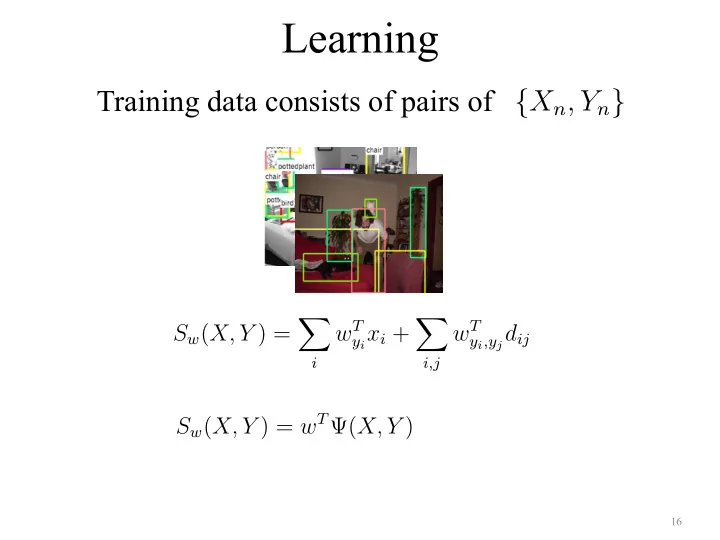
Training data consists of pairs of {Xn, Yn}
Sw(X, Y ) =
- i
wT
yixi +
- i,j
wT
yi,yjdij
Learning Training data consists of pairs of { X n , Y n } w T w T - - PowerPoint PPT Presentation
Learning Training data consists of pairs of { X n , Y n } w T w T S w ( X, Y ) = y i x i + y i ,y j d ij i i,j S w ( X, Y ) = w T ( X, Y ) 16 Learning with SVMs 1 2 w T w argmin w w T ( X n , Y n ) w T ( X n , H n )
16
yixi +
yi,yjdij
“Find a small w such that for each image, score of true label Yn dominates all other hypothesized labels Hn by at least 1 unit” Yn Hn
w
Only a tiny fraction of exponential number of constraints are necessary (i.e., support vectors)
Structured Prediction Tsochantaridis et al. ICML 04
18
1) We use PASCAL 2007 training and test data 20 classes, 5000 training images, 5000 test images 2) Baseline: Felzenswalb et al. PAMI 09 (with default NMS) 3) Local feature = [score of baseline detector 1] (We learn bias and offset for each local detector) 4) Pairwise feature + 50% overlap feature
Favor
because people sit on sofas
Inhibit
because local detectors confuse them
Default heuristics don’t work for Mutual Exclusion
Our model outperforms Felzenszwalb et al.’s baseline for most classes
Winning PASCAL07 score
Felzenszwalb et al. PAMI 09 code
Mutual Exclusion Our model
Default NMS heuristics
plane .262 0.278 0.270 0.288 bike .409 0.559 0.444 0.562 bird .098 0.014 0.015 0.032 boat .094 0.146 0.125 0.142 bottle .214 0.257 0.185 0.294 bus .393 0.381 0.299 0.387 car .432 0.470 0.466 0.487 cat .240 0.151 0.133 0.124 chair .128 0.163 0.145 0.160 cow .140 0.167 0.109 0.177 table .098 0.228 0.191 0.240 dog .162 0.111 0.091 0.117 horse .335 0.438 0.371 0.450 motbike .375 0.373 0.325 0.394 person .221 0.352 0.342 0.355 plant .120 0.140 0.091 0.152 sheep .175 0.169 0.091 0.161 sofa .147 0.193 0.188 0.201 train .334 0.319 0.318 0.342 TV .289 0.373 0.359 0.354
24
Building a ‘drinking detector’ requires finding people and bottles simultaneously Per-class AP’s don’t score this Under more appropriate scoring criteria, our model does significantly better (see paper)