? Lecture 4: Mechanisms part 2 I D H C G A J E B F F G - - PowerPoint PPT Presentation

lecture 4 mechanisms part 2 i d h c g a j e b f f g h i j
SMART_READER_LITE
LIVE PREVIEW

? Lecture 4: Mechanisms part 2 I D H C G A J E B F F G - - PowerPoint PPT Presentation

Lic.(Tech.) Marko Luoma (1/24) Lic.(Tech.) Marko Luoma (2/24) Scheduling Task of a scheduler is to decide the order of packets which are transmitted from the queue S38.180 Palvelunlaatu Internetiss S38.180 Quality of Service in


slide-1
SLIDE 1

Lic.(Tech.) Marko Luoma (1/24)

S−38.180 Palvelunlaatu Internetissä S−38.180 Quality of Service in Internet Luento 4: Mekanismit − osa 2 Lecture 4: Mechanisms − part 2

Lic.(Tech.) Marko Luoma (2/24)

Scheduling

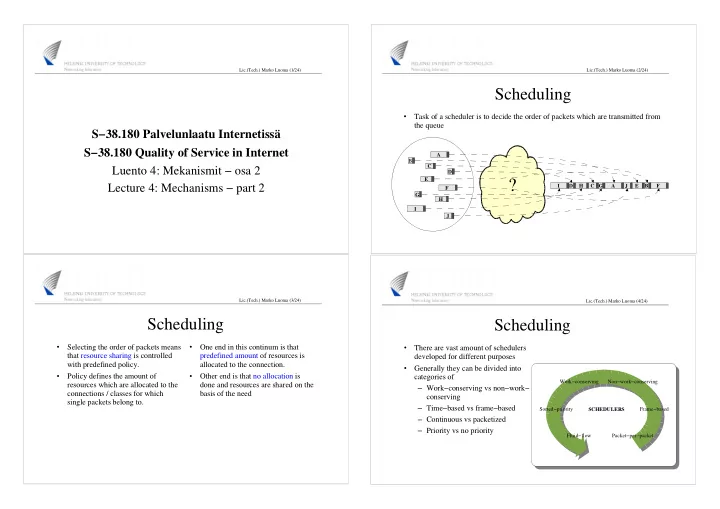
  • Task of a scheduler is to decide the order of packets which are transmitted from

the queue

E F G H C B D I A J F B E J A G C H D I

?

Lic.(Tech.) Marko Luoma (3/24)

Scheduling

  • Selecting the order of packets means

that resource sharing is controlled with predefined policy.

  • Policy defines the amount of

resources which are allocated to the connections / classes for which single packets belong to.

  • One end in this continum is that

predefined amount of resources is allocated to the connection.

  • Other end is that no allocation is

done and resources are shared on the basis of the need

Lic.(Tech.) Marko Luoma (4/24)

Scheduling

  • There are vast amount of schedulers

developed for different purposes

  • Generally they can be divided into

categories of Work−conserving vs non−work− conserving Time−based vs frame−based Continuous vs packetized Priority vs no priority

SCHEDULERS Work−conserving Non−work−conserving Fluid−flow Packet−per−packet Sorted−priority Frame−based

slide-2
SLIDE 2

Lic.(Tech.) Marko Luoma (5/24)

Scheduling

  • Conservation of work means that

scheduler is executing its task as long as it has some work to do.

  • Techinacally this means that there

are packets in the queue which has to be sent into the link before scheduler can take a break i.e. change to the idle state.

  • Non−work conserving scheduler can

idle even though it has packets in the queue.

  • Why we would want to have non−

work conserving scheduler ?

  • Conservation of work means that

packets are sent to the link even though for the receiving would prefere it to come a little bit later.

  • This can happen with real−time

applications which send packets with constant time intervals. However, network can multiplex them so that they form bursts. Non−work conserving scheduler may delay packets so that intervals structure is maintained throughout the network.

Lic.(Tech.) Marko Luoma (6/24)

Scheduling

  • Continuous time

Scheduling decissions and calculations are done based on continuous time units Fluid−Flow modeling − packets are infinitesimally small Assumes that number of packets could be served on same time (not possible)

  • Packetized

Scheduling decissions and calculations are based on packet per packet analysis Distorts fluid flow model

B B B A A A B B B A A A

Lic.(Tech.) Marko Luoma (7/24)

Scheduling

  • Time based scheduling

Uses either arrival time or finishing time as a criteria for

  • rdering

Time may be virtual or real−time depending on scheduler time Virtual time is usually finishing time in ideal scheduler i.e. Scheduler which is not packetized

  • Frame based scheduling

Uses fixed frame which is partitioned for scheduled items based on their weights. During rotation if partition and left overs from previous partition aggregate enough token for a item then it is served. If not tokens are added for next round. Number of packets may be served from a single class if frame is big.

Lic.(Tech.) Marko Luoma (8/24)

Scheduling

  • Scheduling can happen:

Within one queue, sorting packets inside queue to appropriate transmission

  • rder

Between several queues, dispatching head of line packets from different queues Hierarchically over several schedulers, combination of previous ones

  • Many of scheduling algorithms can be used to produce QoS in each of these

cases

slide-3
SLIDE 3

Lic.(Tech.) Marko Luoma (9/24)

Scheduling

  • First Come First Served (FCFS) is prevalent scheduling method in routers.
  • FCFS uses arrival time information as sorting criteria for packet dispatching.
  • FCFS is not able to offer any QoS as time is the only parameter that has

influence to the order of packets.

C1 C2 C1 C2 C3 C1 C3 C1 C2 C1 C2 C3 C1 C3

Departure time Scheduling time Arrival time

Class Arrival Time Service Time C1 1 C2 3 C1 3 1 C3 3 3 C2 3 2 C1 5 1 C3 7 3

Lic.(Tech.) Marko Luoma (10/24)

Scheduling

  • Simple priority scheduler extends FCFS to be able to distinguish between

more and less important traffic.

  • Packets are ordered first based on their priority and second on their arrival time.

C1 C2 C1 C2 C3 C1 C3 C1 C2 C1 C2 C3 C1 C3

Departure time Scheduling time Arrival time

Class Arrival Time Service Time C1 1 C2 3 C1 3 1 C3 3 3 C2 3 2 C1 5 1 C3 7 3

High priority Medium priority Low priority Lic.(Tech.) Marko Luoma (11/24)

Scheduling

  • Prioritized ordering may lead to starvation of resources in low priority classes if

traffic in high priority classes is not limited.

  • This can be accomplished by using

Connection admission control Over provisioning Rate control Modifying priority scheduler to take class rates into account (token based

  • peration)

High priority Low priority High priority Low priority

Lic.(Tech.) Marko Luoma (12/24)

Scheduling

  • Deadline based scheduling schemes (e.q. Earlies Due Date) are based on the

calculation of finishing time if packet would have been scheduled when it arrived to the queue.

  • Packets are transmitted on the order of finishing times.

Class Arrival Time Service Time C1 1 C2 3 C1 3 1 C3 3 3 C2 3 2 C1 5 1 C3 7 3 C1 C2 C1 C2 C3 C1 C3 C1 C2 C1 C2 C3 C1 C3

Departure time Scheduling time Arrival time

slide-4
SLIDE 4

Lic.(Tech.) Marko Luoma (13/24)

Scheduling

  • Generalized Processor Sharing is ideal fair queueing algorithm which is

based on fluid flow model.

  • GPS provides service to the individual connections based on their weights.
  • GPS is work conserving scheduler and thus distributes excess capacity to

connections which are able to utilize it.

C2 C1 C2 Class Arrival Time Service Time C1 1 C2 3 C1 3 1 C3 3 3 C2 3 2 C1 5 1 C3 7 3 C1 C2 C1 C2 C3 C1 C3 C1 C2 C3 C1 C3

Departure time Scheduling time Arrival time Weights are all equal Lic.(Tech.) Marko Luoma (14/24)

Scheduling

  • Disadvantages of GPS are:

Departures from GPS are colliding which makes the use of GPS based scheduler impossible However it may be used as backgroud scheduler if collisions are resolved in some manner Heavy calculation of departure times Departure time of every packet in scheduler changes whenever a packet arrives or departs the scheduler

Lic.(Tech.) Marko Luoma (15/24)

Scheduling

  • Advantages of GPS are:

Fairness which it provides for the sharing connections Strict delay bound caused by scheduling when traffic is constrained by a token bucket of token rate r and bucket depth b

Se r vi c e t , t ∆ t

i

Se r vi c e t , t ∆ t

j

≥ W e i g h t i W e i g h t j Se r v i c e r a t e f o r c o n n e c t i o n i : r i≥ W e i g h t i

j

W e i g h t h j ⋅ L i n k R a t e D e l a y f o r c o n n e c t i o n i : D i≤ b i r i

Remember these results were derived from the assumption that packets flow like fluid through the system i.e. there would be a dedicated link with capacity r between endpoints.

Lic.(Tech.) Marko Luoma (16/24)

Scheduling

  • Packetized Generalized Processor Sharing is packet per packet

approximation of GPS scheduling.

  • Most prevalent implementation of PGPS is weighted fair queueing (WFQ)
  • WFQ uses calculation of finishing time in corresponging GPS system as a

criteria for sorting the packets.

C1 C2 C1 C2 C3 C1 C3 C1 C2 C1 C2 C3 C1 C3

Departure time Scheduling time Arrival time

Class Arrival Time Service Time C1 1 C2 3 C1 3 1 C3 3 3 C2 3 2 C1 5 1 C3 7 3

Weights are all equal

slide-5
SLIDE 5

Lic.(Tech.) Marko Luoma (17/24)

Scheduling

  • Delay bound of WFQ system differs the one of GPS system with two extra

components:

  • which represents extra delay caused if packet arrives a

moment later it would have been served in corresponding GPS system. L is the maximum packet length and K is the number of hops.

  • which represents the fact that packets are served one by
  • ne. In backlogged system, packet must wait that

previous packet is served, before it gets to be scheduled.

D i≤ b i r i

  • K 1
  • L m a x

r i ∑

m = 1 K

L m a x R

m

K 1

  • L m a x

r i

m = 1 K

L m a x R

m

Lic.(Tech.) Marko Luoma (18/24)

Scheduling

  • WFQ scheduling has number of variant which aim:

Ease the calculation of finishing time in corresponding GPS system By replacing the idle time function with the finishing time of packet which was in service when backlogging packet arrived to the system. By replacing the time calculation with frame based operation Make the fairness packetized system as good as continuous system Allow hierarchical construction of service

WFQ WFQ W1 W2 WN WP

Lic.(Tech.) Marko Luoma (19/24)

Scheduling

  • Weighted Round Robin is popular implementation of frame based fair

queueing.

  • WRR uses a rotation where each individual connection is served in relation of

their weights.

  • Service is usually based on packets, which causes WRR to be not able to

distribute bandwidth fairly in systems which have variable packet lengths.

C1 C2 C1 C2 C3 C1 C3 C1 C2 C1 C2 C3 C1 C3

Departure time Scheduling time Arrival time

Class Arrival Time Service Time C1 1 C2 3 C1 3 1 C3 3 3 C2 3 2 C1 5 1 C3 7 3

Individual rotations Lic.(Tech.) Marko Luoma (20/24)

Scheduling

  • Deficit Round Robin is extention of WRR which takes account the packet size
  • DRR uses a rotation where a frame of N bits is divided to indivivual

connections in relation to their weights (quantums).

  • Quantums which individual connections receive serve packets

If the quantum is small, many rotations are required to serve backlogged connection If the quantum is big, many packets can be served on one rotation

  • DRR uses special counter for each backlogged connection which stores the

information of received bits. If connection gets to non backlogged state counter is cleared

slide-6
SLIDE 6

Lic.(Tech.) Marko Luoma (21/24)

Scheduling

  • Class Based Queueing is one form hierarchical scheduling

In CBQ scheduling is divided into two cases: Unregulated: When a class is scheduled by general scheduler Regulated: When a class is scheduled by link share scheduler Class is regulated in situations when network is persistently contended and class has run over its limits

  • Actual implementation of scheduling is uniform

Both schedulers manipulate HOL packets time to send information which is then examined by actual dispatcher.

  • CBQ uses different variants of round robin schedulers as a general scheduler
  • Link share scheduler is based on general rules supplied by user

Lic.(Tech.) Marko Luoma (22/24)

Scheduling

  • Advantage of CBQ is that scheduling during contention is easily manipulated to

produce outcome which is not only based on time and priority information

  • Disadvantage is that CBQ requires a lot of processing time when there are a lot
  • f independent connections / classes

Lic.(Tech.) Marko Luoma (23/24)

Scheduling

Root Class 45% Intermediate Class #1 Intermediate Class #2 Intermediate Class #1.1 Intermediate Class #1.2 Intermediate Class #2.1 Leaf Class #1.1.1 Leaf Class #1.1.2 Leaf Class #1.2.1 Leaf Class #2.1.1 Leaf Class #2.1.2 Top Level 40% 60% 100% 20% 80% 55% 50% 50% 100%

  • Link sharing guidelines are based on

tree like structure Link resources are on Root Class Intermediate Classes form logical groupings Organisations Protocols Leaf classes are actual queues with distinct traffic

Lic.(Tech.) Marko Luoma (24/24)

Scheduling

  • CBQ has concept of borrowing:

If class has run over its limit but it has parent class which is not over its limit, it may borrow capacity from the parent Borrowing may be limited to some level in link sharing tree (Top Level)

  • Formal definition between regulated and un regulated follows from borrowing:

Class is unregulated if: It is under its limit

  • r

It has parent below Top Level which is under its limit