Lecture 9/Chapter 7 Summarize values of a quantitative (measurement) - - PowerPoint PPT Presentation

lecture 9 chapter 7
SMART_READER_LITE
LIVE PREVIEW

Lecture 9/Chapter 7 Summarize values of a quantitative (measurement) - - PowerPoint PPT Presentation

Definitions (Review) Lecture 9/Chapter 7 Summarize values of a quantitative (measurement) variable by telling center, spread, shape. Summarizing and Displaying Center : measure of what is typical in the Measurement (Quantitative) Data


slide-1
SLIDE 1

Lecture 9/Chapter 7

Summarizing and Displaying Measurement (Quantitative) Data

Five Number Summary Boxplots Mean vs. Median Standard Deviation

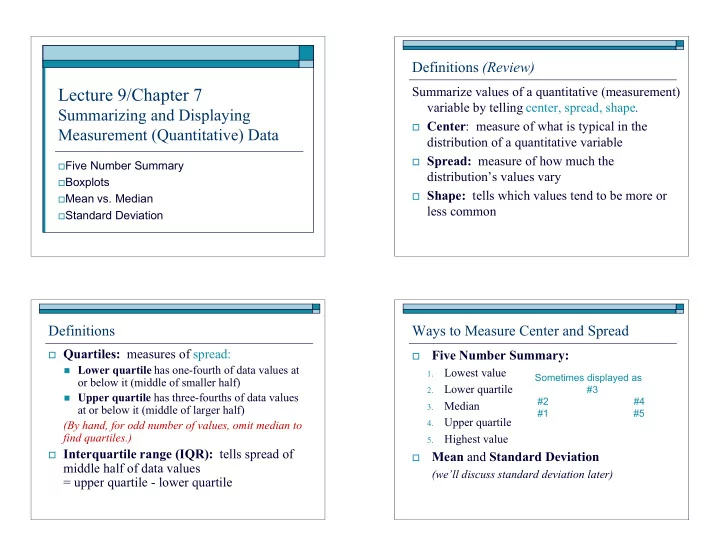
Definitions (Review)

Summarize values of a quantitative (measurement) variable by telling center, spread, shape.

Center: measure of what is typical in the

distribution of a quantitative variable

Spread: measure of how much the

distribution’s values vary

Shape: tells which values tend to be more or

less common

Definitions

Quartiles: measures of spread: Lower quartile has one-fourth of data values at

  • r below it (middle of smaller half)

Upper quartile has three-fourths of data values

at or below it (middle of larger half) (By hand, for odd number of values, omit median to find quartiles.)

Interquartile range (IQR): tells spread of

middle half of data values = upper quartile - lower quartile

Ways to Measure Center and Spread

  • Five Number Summary:

1.

Lowest value

2.

Lower quartile

3.

Median

4.

Upper quartile

5.

Highest value

  • Mean and Standard Deviation

(we’ll discuss standard deviation later)

Sometimes displayed as #3 #2 #4 #1 #5

slide-2
SLIDE 2

Definition

The 1.5-Times-IQR Rule identifies outliers:

  • below lower quartile - 1.5(IQR) called low outlier
  • above upper quartile +1.5(IQR) called high outlier

Lower quartile Upper quartile IQR 1.5IQR 1.5IQR Low outliers High outliers

Example: 5 No. Summary, IQR, Outliers

  • Background: Male earnings
  • Question: What are 5. No. Sum. & IQR? Outliers?
  • Response: ___,___,___,___,___so IQR=________

Lower quartile =___ Upper quartile =___ IQR=__ 1.5IQR=__ 1.5IQR=__ Low outliers below________ ( ) 0 2 2 3 3 3 3 4 4 5 5 5 5 5 5 6 6 6 6 7 8 8 10 10 12 15 20 25 42 High outliers above__________ ( )

Displays of a Quantitative Variable

Displays help see the shape of the distribution.

Stemplot

  • Advantage: most detail
  • Disadvantage: impractical for large data sets

Histogram

  • Advantage: works well for any size data set
  • Disadvantage: some detail lost

Boxplot

  • Advantage: shows outliers, makes comparisons
  • Disadvantage: much detail lost

Definition

A boxplot displays median, quartiles, and extreme values, with special treatment for

  • utliers:

1.

Lower whisker to lowest non-outlier

2.

Bottom of box at lower quartile

3.

Line through box at median

4.

Top of box at upper quartile

5.

Upper whisker to highest non-outlier Outliers denoted “*”.

slide-3
SLIDE 3

Example: Constructing Boxplot

  • Background: 29 male students’ earnings had 5 No.

Summary: 0, 3, 5, 9, 42 and three outliers (above 18)

  • Question: How do we sketch boxplot?
  • Response:
  • Lower whisker to __
  • Bottom of box at __
  • Line through box at __
  • Top of box at __
  • Upper whisker to __

0 2 2 3 3 3 3 4 4 5 5 5 5 5 5 6 6 6 6 7 8 8 10 10 12 15 20 25 42 40 30 20 10 * * * *

Outliers marked “*”

Example: Mean vs. Median (Symmetric)

Background: Heights of 10 female freshmen: Question: How do mean and median compare? Response:

  • Mean = ___
  • Median = ___

Mean___Median. Note that shape is _______________ 59 61 62 64 64 66 66 68 70 70

Female freshmen heights (in.)

Example: Mean vs. Median (Skewed)

Background:Earnings ($1000) of 9 female freshmen: Question: How do mean and median compare? Response:

  • Mean = ___
  • Median = ___

Mean ___Median; note that shape is ______________ 1 2 2 2 3 4 7 7 17

Mean vs. Median

Symmetric:

mean approximately equals median

Skewed left / low outliers:

mean less than median

Skewed right / high outliers:

mean greater than median

Pronounced skewness / outliers

Report median.

Otherwise, in general

Report mean (contains more information).

slide-4
SLIDE 4

Definitions (Review)

Measures of Center

mean=average= median:

the middle for odd number of values average of middle two for even number of values

mode: most common value

Measures of Spread

Range: difference between highest & lowest Standard deviation sum of values number of values

Definition/Interpretation

Standard deviation: square root of “average”

squared distance from mean.

Mean: typical value Standard deviation: typical distance of

values from their mean

Having a feel for how standard deviation measures spread is much more important than being able to calculate it by hand.

Example: Guessing Standard Deviation

  • Background: Household size in U.S. has mean

approximately 2.5 people.

  • Question: Which is the standard deviation?

(a) 0.014 (b) 0.14 (c) 1.4 (d) 14.0

  • Response: ____

Example: Calculating a Standard Deviation

  • Background: Female hts 59, 61, 62, 64, 64, 66, 66, 68, 70, 70
  • Question: What is their standard deviation?
  • Response: sq. root of “average” squared deviation from mean:

mean=65 deviations= ___,___,___,___,___,___,___,___,___,___ squared deviations= ___,___,___,___,___,___,___,___,___,___ av sq dev=(___+___+___+___+___+___+___+___+___+___)/___ =____. Standard deviation=sq. root of “average” sq. deviation =____ (This is the typical distance from the average height 65; units are inches.)

slide-5
SLIDE 5

Example: Calculating another Standard Deviation

  • Background: Female earnings 1, 2, 2, 2, 3, 4, 7, 7, 17
  • Question: What is their standard deviation?
  • Response: sq. root of “average” squared deviation from mean:

mean=5 deviations= ___,___,___,___,___,___,___,___,___ squared deviations= ___,___,___,___,___,___,___,___,___ av sq dev=(___+___+___+___+___+___+___+___+___)/_____ =_____ standard deviation=sq. root of “average” sq. deviation = ____ Is this really the typical distance from the typical earnings?

Example: Calculating another Standard Deviation

  • Response: mean=5, standard deviation=5

Is 5 thousand really typical for earnings? Is 5 thousand really typical distance of earnings from average? Two thirds earned ___K or less; all but one were within ___K of 4 K. If the outlier 17 is omitted, mean=___, sd=___. The mean and, to an even greater extent, the standard deviation are distorted by outliers or skewness in a distribution. Although they are not ideal summaries for such distributions, we will see later that the normal distribution actually applies if we take a large enough sample from a non-normal population and use inference to draw conclusions about the population mean or proportion, based on our sample mean or proportion. We will begin to study the normal curve next (Chapter 8). EXTRA CREDIT (Max. 5 pts.) Summarize data for a survey variable; include mention of center, spread, and shape, and at least 2 of the 3 displays (stemplot, histogram, boxplot). Survey data is linked from my Stat 800 website www.pitt.edu/~nancyp/stat-0800/index.html and MINITAB can be used in any Pitt computer lab to produce displays and

  • summaries. Alternatively, you can process the data by hand.