Lehmann & Romano, TSH Ch. 3 Setup: define a test function ( y ) - - PowerPoint PPT Presentation

lehmann romano tsh ch 3
SMART_READER_LITE
LIVE PREVIEW

Lehmann & Romano, TSH Ch. 3 Setup: define a test function ( y ) - - PowerPoint PPT Presentation

Lehmann & Romano, TSH Ch. 3 Setup: define a test function ( y ) from Y to [ 0 , 1 ] ( Y ) = Pr ( Y R ) if ( y ) = 1 then y R , if 0, y / R allows for the possibility of randomized tests if Y f ( y ;


slide-1
SLIDE 1

Lehmann & Romano, TSH Ch. 3

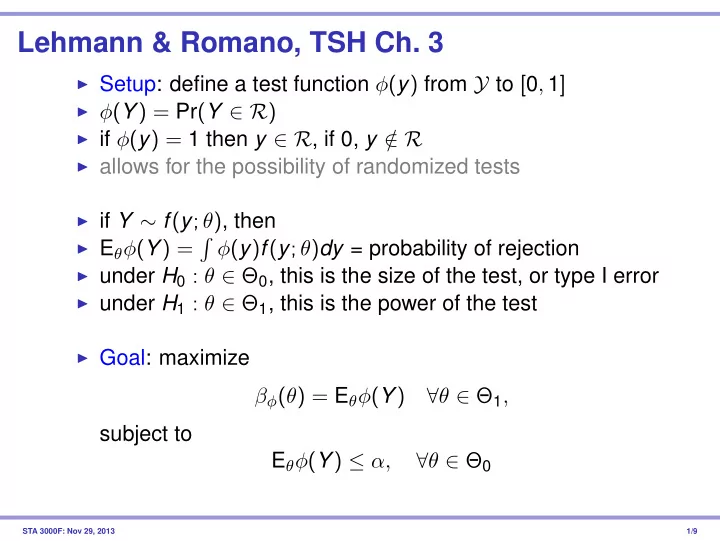
◮ Setup: define a test function φ(y) from Y to [0, 1] ◮ φ(Y) = Pr(Y ∈ R) ◮ if φ(y) = 1 then y ∈ R, if 0, y /

∈ R

◮ allows for the possibility of randomized tests ◮ if Y ∼ f(y; θ), then ◮ Eθφ(Y) =

  • φ(y)f(y; θ)dy = probability of rejection

◮ under H0 : θ ∈ Θ0, this is the size of the test, or type I error ◮ under H1 : θ ∈ Θ1, this is the power of the test ◮ Goal: maximize

βφ(θ) = Eθφ(Y) ∀θ ∈ Θ1, subject to Eθφ(Y) ≤ α, ∀θ ∈ Θ0

STA 3000F: Nov 29, 2013 1/9

slide-2
SLIDE 2

Neyman-Pearson lemma

◮ Suppose Θ0 is the point θ0, and similarly for Θ1 ◮ Assume the existence of densities f0 and f1 with respect to

the same measure µ

  • 1. Given 0 ≤ α ≤ 1, there exists a test function φ and a

constant k such that E0φ(Y) = α (1) and φ(y) = 1 when f1(y) > kf0(y), when f1(y) < kf0(y). (2)

  • 2. If a test satisfies (1) and (2) for some k, then it is most

powerful for testing f0 against f1 at level α

  • 3. If φ is most powerful at level α for testing f0 against f1, then

for some k it satisfies (2), a.e. µ, and satisfies (1) unless there exists a test of size < α and with power 1.

STA 3000F: Nov 29, 2013 2/9

slide-3
SLIDE 3

Proof 1.

◮ trivial for α = 0 and α = 1 allow k = ∞ ◮ 1. define

α(c) = Pr0{f1(Y) > cf0(Y)} = Pr{f1(Y)/f)0(Y) > c}.

◮ 1 − α(c) is a cumulative distribution function ◮ so α(c) is non-increasing, right-continuous,

α(−∞) = 1, α(∞) = 0

◮ Given 0 < α < 1, let c0 be such that α(c0) ≤ α ≤ α(c− 0 ) ◮

φ(y) =      1 when f1(y) > c0f0(y)

α−α(c0) α(c−

0 )−α(c0)

when f1(y) = c0f0(y) when f1(y) < c0f0(y)

E0φ(Y) = Pr0 f1(Y) f0(Y)

  • +

STA 3000F: Nov 29, 2013 3/9

slide-4
SLIDE 4

... proof 2.

◮ Suppose φ is a test satisfying (1) and (2), and that φ∗ is

another test with E0φ∗(Y) ≤ α.

◮ Denote by S+ and S− the sets in Y where

φ(y) − φ∗(y) > 0 and < 0.

◮ In S+, φ(y) > 0 so f1(y) ≥ kf0(y), and ◮

  • (φ − φ∗)(f1 − kf0)dµ =
  • S+∪S−(φ − φ∗)(f1 − kf0)dµ ≥ 0

◮ difference in power:

  • (φ − φ∗)f1dµ ≥ k
  • (φ − φ∗)f0dµ ≥ 0

STA 3000F: Nov 29, 2013 4/9

slide-5
SLIDE 5

... proof 3.

◮ Let φ∗ be MP level α, and φ satisfy (1) and (2) ◮ On S+ ∪ S−, φ and φ∗ differ. Let

S = S+ ∪ S− ∩ {y : f1(y) = kf0(y)}, and assume µ(S) > 0

  • S+∪S−(φ − φ∗)(f1 − kf0)dµ =
  • S

(φ − φ∗)(f1 − kf0)dµ > 0

◮ implies φ is more powerful than φ∗ ◮ contradiction, hence µ(S) = 0 ◮ if φ∗ had size < α and power < 1, could add points to

rejection region until either E0φ∗(Y) = α or E1φ∗(Y) = 1

◮ test is unique if {y : f1(y) = kf0(y)} has measure 0

STA 3000F: Nov 29, 2013 5/9

slide-6
SLIDE 6

Comments

◮ discreteness: e.g. Y ∼ Bin(n, p) ◮ MP test has rejection region R determined by {y > dα} ◮ not all values of α attainable: e.g. CH Example 4.9

Y ∼ Poisson(µ)

◮ H0 : µ = 1,

H1 : µ = µ1 > 1, MP test Y ≥ dα

Table : attained significance levels

y Pr(Y > y; µ = 1) y Pr(Y > y; µ = 1) 1 4 0.0189 1 0.632 5 0.0037 2 0.264 6 0.0006 3 0.080 . . . . . .

◮ if critical regions are nested, i.e. Rα1 ⊂ Rα2, α1 < α2, then

pobs = inf(α; yobs ∈ Rα)

◮ asymmetry:

Y ∼ N(µ, 1), H0 : µ = 0, H1 : µ = 10, yobs = 3

STA 3000F: Nov 29, 2013 6/9

slide-7
SLIDE 7

Bayesian testing

see CH Example 10.12

◮ simple H0, simple H1:

Pr(H0 | y) Pr(H1 | y) = Pr(H0) Pr(H1) f0(y) f1(y)

◮ similarly, with H1, . . . Hk potential alternatives

Pr(H0 | y) Pr(Hc

0 | y) = Pr(H0)f0(y)

ΣjPr(Hj)fj(y)

◮ sharp null hypothesis: H0 : θ = θ0,

H1 : θ = θ0 Pr(H0 | y) Pr(Hc

0 | y) =

π0 (1 − π0) f(y; θ0)

  • π1(θ)f(y; θ)dθ

◮ nuisance parameters

Pr(H0 | y) Pr(Hc

0 | y) =

π0 (1 − π0) π(λ | h0)f(y | ψ0, λ)dλ π(ψ, λ | H1)f(y | ψ, λ)dψdλ

STA 3000F: Nov 29, 2013 7/9

slide-8
SLIDE 8

... testing

◮ Bayes factor B10 = Pr(y | H1)

Pr(y | H0)

◮ typically Pr(y | hi) =

  • f(y | Hi, θi)π(θi | Hi)dθi,

i = 0, 1 SM Ch. 11.2

◮ cannot be computed with improper priors

STA 3000F: Nov 29, 2013 8/9

slide-9
SLIDE 9

Nature, PNAS, AoS articles by Johnson

◮ developed an ‘objective’ Bayesian test for comparison to

p-values

◮ “A p-value of 0.05 or less corresponds to Bayes factors of

between 3 and 5, which are consider weak evidence to support a finding”

◮ “He advocates for scientists to use more stringent p-values

  • f 0.005 or less”

◮ see also CH Example 10.12 and SM Example 11.15 ◮ emphasis on point hypotheses drives most of these

anomalous results

◮ e.g. Pr(θ > 0 | y)

STA 3000F: Nov 29, 2013 9/9