
SLIDE 1
COMP 210, Spring 2002 1
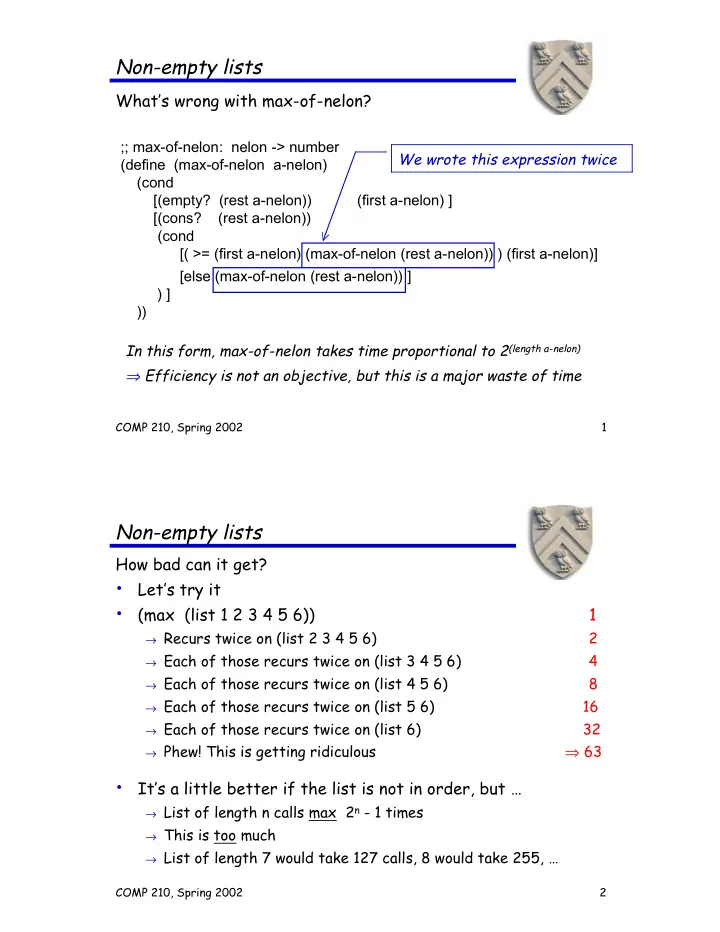
In this form, max-of-nelon takes time proportional to 2(length a-nelon) ⇒ Efficiency is not an objective, but this is a major waste of time
Non-empty lists
What’s wrong with max-of-nelon?
;; max-of-nelon: nelon -> number (define (max-of-nelon a-nelon) (cond [(empty? (rest a-nelon)) (first a-nelon) ] [(cons? (rest a-nelon)) (cond [( >= (first a-nelon) (max-of-nelon (rest a-nelon)) ) (first a-nelon)] [else (max-of-nelon (rest a-nelon)) ] ) ] )) We wrote this expression twice
COMP 210, Spring 2002 2
Non-empty lists
How bad can it get?
- Let’s try it
- (max (list 1 2 3 4 5 6))
1
→ Recurs twice on (list 2 3 4 5 6)
2
→ Each of those recurs twice on (list 3 4 5 6)
4
→ Each of those recurs twice on (list 4 5 6)
8
→ Each of those recurs twice on (list 5 6)
16
→ Each of those recurs twice on (list 6)
32
→ Phew! This is getting ridiculous
⇒ 63
- It’s a little better if the list is not in order, but …
→ List of length n calls max 2n - 1 times → This is too much → List of length 7 would take 127 calls, 8 would take 255, …