"Life is too short to occupy oneself with the slaying of the - - PowerPoint PPT Presentation

life is too short to occupy oneself with the slaying of
SMART_READER_LITE
LIVE PREVIEW

"Life is too short to occupy oneself with the slaying of the - - PowerPoint PPT Presentation

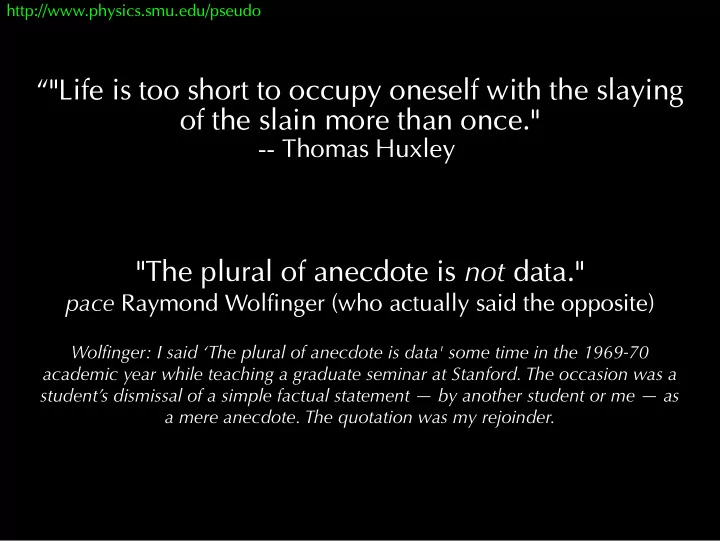
http://www.physics.smu.edu/pseudo "Life is too short to occupy oneself with the slaying of the slain more than once." -- Thomas Huxley "The plural of anecdote is not data." pace Raymond Wolfinger (who actually said the


slide-1
SLIDE 1

http://www.physics.smu.edu/pseudo

“"Life is too short to occupy oneself with the slaying

  • f the slain more than once."
  • - Thomas Huxley

"The plural of anecdote is not data."

pace Raymond Wolfinger (who actually said the opposite)

Wolfnger: I said ‘The plural of anecdote is data' some time in the 1969-70 academic year while teaching a graduate seminar at Stanford. The occasion was a student’s dismissal of a simple factual statement — by another student or me — as a mere anecdote. The quotation was my rejoinder.

slide-2
SLIDE 2

http://www.physics.smu.edu/pseudo

What is Evidence?

(Science, Pseudoscience and Evidence) Supplementary Material for CFB3333/PHY3333 Professors John Cotton and Stephen Sekula February 13, 2012 Based on the following information on the web: http://www.physics.smu.edu/pseudo/Pscience

slide-3
SLIDE 3

http://www.physics.smu.edu/pseudo

Reviewing the Examples

  • UFOs
  • lesson: just because you cannot explain an observation with

all known hypotheses doesn't allow you to jump to extreme conclusions

– e.g. a UFO cannot be explained by aircraft, satellites, astronomical

phenomena, or hallucination; it must be aliens!

  • Roswell and The Bermuda Triangle
  • lesson: look for the primary sources behind a “good story”

– e.g. how can one test the validity of the details of a story (shipping

records, weather reports, dates, times, people involved, statistics)?

– direct appeal to primary sources of information is critical

slide-4
SLIDE 4

http://www.physics.smu.edu/pseudo

The Scientific Method A Brief Review

  • Observation of a phenomenon
  • what kind of observations?
  • how reliable are the observations?
  • Formulation of an hypothesis
  • how does one begin to form a causal explanation for the phenomenon?
  • what evidence is used to generate the hypothesis?
  • how reliable is the evidence?
  • Performance of experiment
  • what means are available for testing different properties or ideas?
  • how does one setup a reliable experiment?
  • how does one gather information from the experiment?
slide-5
SLIDE 5

http://www.physics.smu.edu/pseudo

The Scientific Method A Brief Review

  • Observation of a phenomenon
  • what kind of observations?
  • how reliable are the observations?
  • Formulation of an hypothesis
  • how does one begin to form a causal explanation for the phenomenon?
  • what evidence is used to generate the hypothesis?
  • how reliable is the evidence?
  • Performance of experiment
  • what means are available for testing different properties or ideas?
  • how does one setup a reliable experiment?
  • how does one gather information from the experiment?
slide-6
SLIDE 6

http://www.physics.smu.edu/pseudo

What is Pseudoscience?

  • Definition:
  • Something that claims to be scientifjc, but is not.
  • How do you spot it?
  • Pseudoscience is EVERYWHERE
  • The best way to spot it (not always a simple thing!) is

to compare the practices involved in something claimed to be “scientific” with the actual standards and practices of science

– compare their method to the REAL scientific method

slide-7
SLIDE 7

http://www.physics.smu.edu/pseudo

Encapsulated Scientific Method

  • Remember:
  • Observe a phenomenon
  • Develop an hypothesis for it (a possible explanation)
  • Use the hypothesis to predict other phenomena
  • Check the prediction by observation or experiment
  • A process that requires CREATIVE THINKING
  • Induction: using all previous scientific training to

formulate the hypothesis

  • Deduction: using the new hypothesis to generate a

prediction

slide-8
SLIDE 8

http://www.physics.smu.edu/pseudo

QUESTION: Can the scientific process ALWAYS work this way? What are some examples where it's not possible to exactly follow these steps?

slide-9
SLIDE 9

http://www.physics.smu.edu/pseudo

Some guidelines for when you can't follow the prescription EXACTLY

  • From Schick and Vaughn:
  • From skeptic Michael Shermer:

“ . . . any procedure that serves systematically to eliminate reasonable grounds for doubt can be considered scientific.” “Scientific progress is the cumulative growth of a system of knowledge over time, in which useful features are retained and nonuseful features are abandoned, based on the rejection or confirmation of testable knowledge.”

slide-10
SLIDE 10

http://www.physics.smu.edu/pseudo

So . . . what is Pseudoscience?

  • Quick and dirty rule-of-thumb:
  • Pseudoscience is any procedure that ignores one or more of

the steps

  • But it SOUNDS like science...!
  • Pseudoscience is crafty – it uses a lot of scientific-sounding

language

  • When you get past the words and know how to look

closely, you'll see that they don't respect the METHOD.

– e.g. objective evidence is ignored or lacking

  • Real science is a process, not a result. The process

matters more than the outcome.

slide-11
SLIDE 11

http://www.physics.smu.edu/pseudo

Pseudoscience is identifiable

http://www.physics.smu.edu/pseudo/Pscience/science-pseudoscience.pdf

slide-12
SLIDE 12

http://www.physics.smu.edu/pseudo

slide-13
SLIDE 13

http://www.physics.smu.edu/pseudo

slide-14
SLIDE 14

http://www.physics.smu.edu/pseudo

Look at the list of forms of bad and good evidence available here: http://www.physics.smu.edu/pseudo/Pscience/

slide-15
SLIDE 15

http://www.physics.smu.edu/pseudo

Testimonials and Anecdotes

slide-16
SLIDE 16

http://www.physics.smu.edu/pseudo

HAIRBLAST!

(patent pending)

BEFORE HAIRBLAST (I kan haz none date!) AFTER HAIRBLAST (Alice iz in Wonderland!)

slide-17
SLIDE 17

http://www.physics.smu.edu/pseudo

Photographs

slide-18
SLIDE 18

http://www.physics.smu.edu/pseudo

The UFO!

slide-19
SLIDE 19

http://www.physics.smu.edu/pseudo

The IFO (?!)

slide-20
SLIDE 20

http://www.physics.smu.edu/pseudo

The Perpetrator!

slide-21
SLIDE 21

http://www.physics.smu.edu/pseudo

The Perpetrator!