SLIDE 1
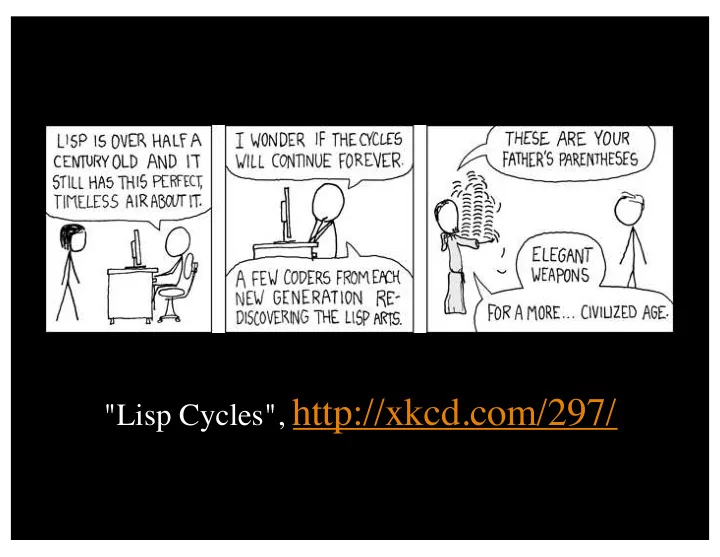
"Lisp Cycles", http://xkcd.com/297/
SLIDE 2 CS 152: Programming Language Paradigms
San José State University
Introduction to Scheme
SLIDE 3 Key traits of Scheme
- 1. Functional
- 2. Dynamically typed
- 3. Minimal
- 4. Lots of lists!
SLIDE 4
Interactive Racket
$ racket Welcome to Racket v6.0.1. > (* (+ 2 3) 2) 10 >
SLIDE 5
Running Racket from Unix Command Line
$ cat hello-world.rkt #lang racket (displayln "Hello world") $ racket hello-world.rkt Hello world $
SLIDE 6
DrRacket
SLIDE 7 Racket Simple Data Types
–(not #f) => #t –(and #t #f) => #f
–(/ 3 4) => 3/4 –(expt 2 3) => 8
SLIDE 8 Racket Compound Data Types
–(string #\S #\J #\S #\U) –"Spartans"
–(car '(1 2 3 4)) => 1 –(cdr '(1 2 3 4)) => '(2 3 4) –(cons 9 '(8 7)) => '(9 8 7)
SLIDE 9
Setting values
(define zed "Zed")
Global variables only
SLIDE 10
Setting values
(define zed "Zed") (displayln zed) {let ([z2 (string-append zed zed)] [sum (+ 1 2 3 4 5)]) (displayln z2) (displayln sum)}
SLIDE 11
Setting values
(define zed "Zed") (displayln zed) {let ([z2 (string-append zed zed)] [sum (+ 1 2 3 4 5)]) (displayln z2) (displayln sum)}
List of local variables
SLIDE 12
Setting values
(define zed "Zed") (displayln zed) {let ([z2 (string-append zed zed)] [sum (+ 1 2 3 4 5)]) (displayln z2) (displayln sum)}
Variable names
SLIDE 13
Setting values
(define zed "Zed") (displayln zed) {let ([z2 (string-append zed zed)] [sum (+ 1 2 3 4 5)]) (displayln z2) (displayln sum)}
Variable definitions
SLIDE 14
Setting values
(define zed "Zed") (displayln zed) {let ([z2 (string-append zed zed)] [sum (+ 1 2 3 4 5)]) (displayln z2) (displayln sum)}
Scope of variables
SLIDE 15
let and let* (let ([x 3] [y (* x 2)]) (displayln y)) x: unbound identifier in module in: x
SLIDE 16
let and let* (let* ([x 3] [y (* x 2)]) (displayln y)) 6
SLIDE 17
All the data types discussed so far are called s-expressions (s for symbolic). Note that programs themselves are also s-expressions. Programs are data.
SLIDE 18
Lambdas (λ)
(lambda (x) (* x x))
Also known as "functions"
SLIDE 19
Lambdas (λ)
(λ (x) (* x x))
In DrRacket, λ can be typed with Ctrl + \
SLIDE 20
Lambdas (λ)
(lambda (x) (* x x))
Parameter list
SLIDE 21
Lambdas (λ)
(lambda (x) (* x x))
Function body
SLIDE 22
Lambdas (λ)
((lambda (x) (* x x)) 3)
Evaluates to 9
SLIDE 23
Lambdas (λ)
(define square (lambda (x)(* x x))) (square 4)
SLIDE 24
Alternate Format
(define (square x) (* x x)) (square 4)
SLIDE 25
If Statements
(if (< x 0) (+ x 1) (- x 1))
SLIDE 26
If Statements
(if (< x 0) (+ x 1) (- x 1))
Condition
SLIDE 27
If Statements
(if (< x 0) (+ x 1) (- x 1))
"Then" branch
SLIDE 28
If Statements
(if (< x 0) (+ x 1) (- x 1))
"Else" branch
SLIDE 29
Cond Statements
(cond [(< x 0) "Negative"] [(> x 0) "Positive"] [else "Zero"])
SLIDE 30 Scheme does not let you reassign variables
"If you say that a is 5, you can't say it's something else later, because you just said it was 5. What are you, some kind of liar?"
SLIDE 31 Recursion
–when to stop
–calls function with a smaller version of the same problem
SLIDE 32
Algorithm to count Russian dolls
SLIDE 33 Recursive step
dolls in the inner doll
count
SLIDE 35
An iterative definition of a count-elems function
Set count to 0. For each element: Add 1 to the count. The answer is the count.
BAD!!! Not the way that functional programmers do things.
SLIDE 36
A recursive definition of a count-elems function
Base case: If a list is empty, then the answer is 0. Recursive step: Otherwise, the answer is 1 more than the size of the tail of the list.
SLIDE 37
Recursive Example
(define (count-elems lst) (cond [(= 0 (length lst)) 0] [else (+ 1 (count-elems (cdr lst)) )])) (count-elems '()) (count-elems '(1 2 3 4))
SLIDE 38
Recursive Example
(define (count-elems lst) (cond [(= 0 (length lst)) 0] [else (+ 1 (count-elems (cdr lst)) )])) (count-elems '()) (count-elems '(1 2 3 4))
Base case
SLIDE 39
Recursive Example
(define (count-elems lst) (cond [(= 0 (length lst)) 0] [else (+ 1 (count-elems (cdr lst)) )])) (count-elems '()) (count-elems '(1 2 3 4))
Recursive step
SLIDE 40
(count-elems '(1 2 3 4)) => (+ 1 (count-elems '(2 3 4))) => (+ 1 (+ 1 (count-elems '(3 4)))) => (+ 1 (+ 1 (+ 1 (count-elems '(4))))) => (+ 1 (+ 1 (+ 1 (+ 1 (count-elems '()))))) => (+ 1 (+ 1 (+ 1 (+ 1 0)))) => (+ 1 (+ 1 (+ 1 1))) => (+ 1 (+ 1 2)) => (+ 1 3) => 4
SLIDE 41
Mutual recursion
(define (is-even? n) (if (= n 0) #t (is-odd? (- n 1)))) (define (is-odd? n) (if (= n 0) #f (is-even? (- n 1))))
SLIDE 42
let* and letrec
(let* ([is-even? (lambda (n) (or (zero? n) (is-odd? (sub1 n))))] [is-odd? (lambda (n) (and (not (zero? n)) (is-even? (sub1 n))))]) (is-odd? 11)) is-odd?: unbound identifier in module in: is-odd?
SLIDE 43
let* and letrec
(letrec ([is-even? (lambda (n) (or (zero? n) (is-odd? (sub1 n))))] [is-odd? (lambda (n) (and (not (zero? n)) (is-even? (sub1 n))))]) (is-odd? 11)) #t
SLIDE 44
Text Adventure Example (in class)
SLIDE 45
Lab1
Part 1: Implement a max-num function. (Don't use the max function for this lab). Part 2: Implement the "fizzbuzz" game. sample run: > fizzbuzz 15 "1 2 fizz 4 buzz fizz 7 8 fizz buzz 11 fizz 13 14 fizzbuzz"
SLIDE 46
First homework
SLIDE 47
Java example with large num
public class Test { public void main(String[] args){ System.out.println( 999999999999999999999 * 2); } }
SLIDE 48
$ javac Test.java Test.java:3: error: integer number too large: 999999999999999999999 System.out.println(999999999 999999999999 * 2); ^ 1 error
SLIDE 49
Racket example
$ racket Welcome to Racket v6.0.1. > (* 2 999999999999999999999) 1999999999999999999998 >
SLIDE 50 HW1: implement a BigNum module
HW1 explores how you might support big numbers in Racket if it did not support them.
- Use a list of 'blocks' of digits, least
significant block first. So 9,073,201 is stored as: '(201 73 9)
- Starter code is available at on course
website.
SLIDE 51 Overview of Homework
- Grade school addition
- Big number addition
- Grade school multiplication
- Big number multiplication
SLIDE 52 Before next class
- Read chapters 3-5 of Teach Yourself Scheme.
- If you accidentally see set! in chapter 5,
pluck out your eyes lest you become impure. –Alternately, just never use set! (or get a 0 on your homework/exam).