
SLIDE 1
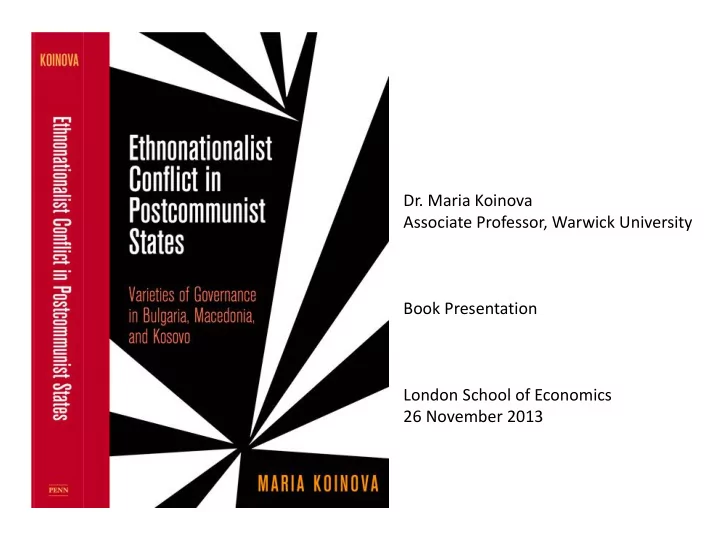
- Dr. Maria Koinova
Associate Professor, Warwick University Book Presentation London School of Economics 26 November 2013
London School of Economics 26 November 2013 Violence continues to - - PowerPoint PPT Presentation
Dr. Maria Koinova Associate Professor, Warwick University Book Presentation London School of Economics 26 November 2013 Violence continues to flare Occasional violence in Bulgaria Continuing clashes in Northern Kosovo Protests and
Associate Professor, Warwick University Book Presentation London School of Economics 26 November 2013
Continuing clashes in Northern Kosovo Protests and counter-protests related to inter-ethnic clashes in Macedonia, 2012 Occasional violence in Bulgaria
dynamics established between majorities, minorities, and international agents during a formative period at the end of communism.
contextualized links between these agents, and then became repeated by them and informally institutionalized over time.
that enable and constrain agents’ behaviors.
expectations,” “[negative] learning” and “drift” have sustained these dynamics, while “replacement” and “layering” have contributed to long- term change.
– formative periods of conflict dynamics, and especially how international agents and kin-states participate in them – impact of exogenous shocks, and – causal mechanisms of continuity and change.
– ruling out explanations at different stages of the process tracing – paying close attention to timing and sequencing – based on extensive fieldwork.
1 2 3 4 5 1989 1990 1991 1992 1993 1994 1995 1996 1997 1998 1999 2000 2001
Bulgaria Macedonia Kosovo
5- internal warfare 4 - extensive 3 - episodic 2- threatened 1 - non-violent
1 2 3 4 5 2000 2001 2002 2003 2004 2005 2006 2007 2008 2009 2010 2011
Bulgaria Macedonia Kosovo
5- internal warfare 4 - extensive 3 - episodic 2- threatened 1 - non-violent
“Hardline nationalist" Todor Petrov of the World Macedonian Congress initiated the referendum proceedings
Referendum on Decentralization, Macedonia 2004
A torn anti-referendum poster in Struga
from established rules by using the gap between rules and their minimal enforcement (M&T).
prompted the relationship between majorities, minorities, and international agents to consolidate in a realm of ‘‘normalization of corruption’’ to keep political stability intact.
majority political groups— usually outside the corrupt political order or having benefited little from it—to raise radical claims and contribute to conflict perpetuation.
2001
+ + +
2005
2009
2011
This book makes a significant contribution to the scholarship on ethnonational conflict. In a nicely written and richly conceptualized comparative study, Maria Koinova compellingly argues that periods of “critical juncture”—such as state collapse, new state formation, or major regime change—engender enduring patterns of ethnonational conflict. These patterns emerge through the interactions of majority and minority political actors and international agents that are active participants of the formative period. Zsuzsa Csergő, Queen's University This is one of the most conceptually sophisticated and empirically rich studies of ethnic conflict. Koinova uses comparative case studies of Bulgaria, Macedonia and Serbian policies toward Kosovo to explore the level and duration of violence among groups. Internal conflict dynamics are critical, especially interactions between ethnic majorities and minorities in the final days of communist rule. Sequencing is also important, making
anyone interested in the Balkans, ethnic conflict and the study of politics more generally. Ned Lebow, Dartmouth College and Kings College