Magnetic-Tower Jet Solution for Astrophysical Jets Yoshiaki Kato - - PowerPoint PPT Presentation

magnetic tower jet solution for astrophysical jets
SMART_READER_LITE
LIVE PREVIEW

Magnetic-Tower Jet Solution for Astrophysical Jets Yoshiaki Kato - - PowerPoint PPT Presentation

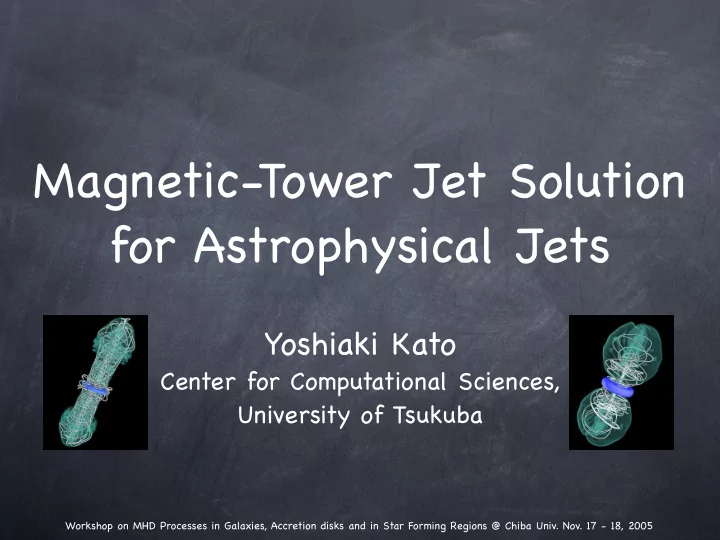
Magnetic-Tower Jet Solution for Astrophysical Jets Yoshiaki Kato Center for Computational Sciences, University of Tsukuba Workshop on MHD Processes in Galaxies, Accretion disks and in Star Forming Regions @ Chiba Univ. Nov. 17 - 18, 2005

slide-1
SLIDE 1

Magnetic-Tower Jet Solution for Astrophysical Jets

Yoshiaki Kato

Center for Computational Sciences, University of Tsukuba

Workshop on MHD Processes in Galaxies, Accretion disks and in Star Forming Regions @ Chiba Univ. Nov. 17 - 18, 2005

slide-2
SLIDE 2

Outline of my talk

Introduction

Why we study jets? Connection between accretion disks and astrophysical jets Previous studies of MHD jets and unresolved issues

A new study of MHD jets “Magnetic-Tower Jet”

Formation of magnetic-tower jets in accretion disks around black holes Formation of magnetic-tower jets in accretion disks around weakly magnetized neutron stars

Summary

Workshop on MHD Processes in Galaxies, Accretion disks and in Star Forming Regions @ Chiba Univ. Nov. 17 - 18, 2005

slide-3
SLIDE 3

Why we study jets?

The radio sky above an optical photograph of the NRAO site in Green Bank, WV Image courtesy of NRAO/AUI

~ 0.5 lys

Young stellar objects (HH30, HH34, HH47) VLA image X-ray image ~ 3 lys X-ray binaries (SS433)

Keywords: Accretion Disks B-fields

Extended radio sources are outflows/jets!

150 kpc 7 pc

VIRGO A Workshop on MHD Processes in Galaxies, Accretion disks and in Star Forming Regions @ Chiba Univ. Nov. 17 - 18, 2005

non-steady

Synchrotron=

B-fields + high energy electrons

http://archive.ncsa.uiuc.edu/Cyberia/NumRel/Movies/SupermassBlkHole.mov M87 Artistic Animation

slide-4
SLIDE 4

Accretion Disks & Astrophysical Jets

Microquasar:”small-Quasars/AGNs” X-ray Binaries

jet line

HS LS VHS/IS

Soft Hard

> 2 < 2

i ii iii

jet

Jet Lorentz factor

i ii iv iv iii

intensity hardness X

  • r

a y

Disc inner radius

no

Accretion disks are launching pads for astrophysical jets

Fender et al. 2004 Tanaka & Lewin 1995 Microquasar GRS 1915+105

Spectral Type of X-ray Binaries (XRBs)

Mirabel 2004

  • ptically thick disk
  • ptically thin disk
  • r corona

Jets

Schematics of SED in Black Hole XRBs

Workshop on MHD Processes in Galaxies, Accretion disks and in Star Forming Regions @ Chiba Univ. Nov. 17 - 18, 2005

Energy [keV] Count Rate [cm-2 s-1 keV]

thermal non-thermal

  • ptically thick disk
  • ptically thin disk
  • r corona

hardness intensity no jet relativistic subrelativistic jets

slide-5
SLIDE 5

Previous Study of MHD Jets

Large-scale ordered magnetic fields permeating the accretion disks

Magneto-centrifugally driven outflows (Blandford & Payne 1982) Magnetic-pressure driven outflows (Uchida & Shibata 1984) Both accelerations may work simultaneously along the magnetic field lines (Kudoh & Shibata 1997) Although the origin of large-scale magnetic fields is not well understood,,,,

people frame the existence of large-scale magnetic fields within a paradigm of astrophysical jets

Uchida, Nakamura, Hirose Kudoh, Shibata Magneto-centrifugally driven Magnetic-pressure driven Colors = Density

Workshop on MHD Processes in Galaxies, Accretion disks and in Star Forming Regions @ Chiba Univ. Nov. 17 - 18, 2005

slide-6
SLIDE 6

No-correlation between the direction of large-scale magnetic fields and that of the observed jets in YSOs

F . Ménard and G. Duchêne (2004)

Cumulative distribution function of the difference in polarization angles between the local B-fields and the CTTS symmetry axis. All samples Random distributions Jet Disk B-fields

The existance of large-scale magnetic fields may not be a necessary condition for launching astrophysical jets

Workshop on MHD Processes in Galaxies, Accretion disks and in Star Forming Regions @ Chiba Univ. Nov. 17 - 18, 2005

slide-7
SLIDE 7

Look at the Sun!

Sun creates large-scale magnetic fields by its magnetic activities

Solar flare and Coronal Mass Ejections (CMEs) Schematic of CMEs

What about the accretion disks?

http://svs.gsfc.nasa.gov/vis/a000000/a002500/a002509/

Workshop on MHD Processes in Galaxies, Accretion disks and in Star Forming Regions @ Chiba Univ. Nov. 17 - 18, 2005

slide-8
SLIDE 8

Initial Model

See Kato, Mineshige, Shibata 2004 for more detail A magnetized rotating torus is in equilibrium around a black hole: Isothermal, hot, low-density corona

  • utside the torus:

B-field is given by vector potential: Employ pseudo-Newtonian potential in order to take into account general relativistic gravity Absorbing boundary at R=2rs sphere

r z ! (b)

Localized Poloidal B-fields plasma-β=10, 100 BH rAφ ∝ ρ when ρ > ρc Cs,corona ≈ 0.5 − 0.9c ρc,0 = 10−5ρ0 Ψ = − GM r − rs ρ(r, z) = ρ(40rs, 0) = ρ0

Colors = density Initial torus & magnetic fields

Workshop on MHD Processes in Galaxies, Accretion disks and in Star Forming Regions @ Chiba Univ. Nov. 17 - 18, 2005

slide-9
SLIDE 9

Basic Equations

(Resistive MHD Equations)

∂ρ ∂t + ∇ · (ρv) = 0 ∂B ∂t = −c∇ × E ρdv dt = −ρ∇ψ − ∇p + J × B c ψ = − GM r − rs E = − v c

  • × B + 4πη

c2 J Γ = η|J|2 : heating term J = c 4π ∇ × B ρ = ˜ ρρ0 rs = c = 1 p = ˜ p(ρ0c2) B = ˜ B(ρ0c2)1/2 Density is a free parameter Λ = Qrad : cooling term Assumptions:

Non-relativistic MHD approximation & Using pseudo-Newtonian potential. Employ anomalous resistivity (Yokoyama & Shibata 1994): Neglect radiative cooling

ρT ds dt = Γ − Λ where s = K ln (p/ρ) η =    for vd < vcrit ηmax[(vd/vcrit) − 1]2 for vcrit < vd < 2vcrit ηmax for vd ≥ 2vcrit vd ≡ |J|/ρ ηmax = 10−3crs vcrit = 10−2c

Workshop on MHD Processes in Galaxies, Accretion disks and in Star Forming Regions @ Chiba Univ. Nov. 17 - 18, 2005

slide-10
SLIDE 10

Evolution of Magnetic Fields in the Disk and the Jet

(Magnetic Coupling between the Disk & the Jet)

10 100

  • 3
  • 2
  • 1

1 10 100

  • 2
  • 1

1 2 Initial Poloidal B-field Poloidal B-field 1 2 3 2 3 1 log10 <B2>corona / B2 log10 <B2>disk / B2 r / rs r / rs 10 100

  • 3
  • 2
  • 1

1 10 100

  • 2
  • 1

1 2 Initial Toroidal B-field Toroidal B-field 1 2 3 1 2 3 log10 <B2>corona / B2 log10 <B2>disk / B2 r / rs r / rs

Jet Disk

  • 1. Before the formation of jets
  • 2. During the formation of jets
  • 3. After the formation of jets

Workshop on MHD Processes in Galaxies, Accretion disks and in Star Forming Regions @ Chiba Univ. Nov. 17 - 18, 2005

Initial weak poloidal fields are converted into toroidal fields, and the toroidal fields injected into the jet.

slide-11
SLIDE 11

Magnetic Fields in the Accretion Disks and the Dynamo

By transferring the angular momentum between the plasma connected via magnetic field lines, MRI (Balbus & Hawley 1991) creates the radial magnetic fields, Azimuthal magnetic fields are generated by winding up the radial magnetic fields as a result of the differential rotation,,,, MRI + differential rotation = Efficient Dynamo.

Even if the initial magnetic field is weak, magnetic pressure can be comparable to gas pressure in a few dynamical time-scale.

τ S , τ MRI

τ MRI

*

τ B

Schematic evolution of magnetic fields in the accretion disk τMRI ∼ τ ∗

MRI ∼ τs = 1/Ω ∼ τK

τB ∼ H/vA = vs/(vAΩ) ∼ βτK Time-scales:

Workshop on MHD Processes in Galaxies, Accretion disks and in Star Forming Regions @ Chiba Univ. Nov. 17 - 18, 2005

slide-12
SLIDE 12

Toroidal (poloidal) fields dominates poloidal (toroidal) field at the rim (core) of the tower. Magnetic-tower is collimated by the external force = it is not collimated by itself!

Structure of Magnetic-Tower

(Collimation of Magnetic-Tower Jet)

Workshop on MHD Processes in Galaxies, Accretion disks and in Star Forming Regions @ Chiba Univ. Nov. 17 - 18, 2005

slide-13
SLIDE 13

Model dependencies

A.

Strong B-fields, Hot Corona

Strong Bφ in the inner region of the disk Transient jet / outflow

B.

Weak B-fields, Hot Corona

Filamentary strong Bφ in the disk No jet / No outflow

C.

Strong B-field, Cold Corona

Persistent strong jet / outflow ~ 0.5 c

D.

Weak B-field, Cold Corona

Persistent weak jet / outflow ~ 0.1 c

Cs=0.91c Cs=0.65c β=100 β=10 B A C D

Formation, collimation, velocity of the jets depend on the corona

Workshop on MHD Processes in Galaxies, Accretion disks and in Star Forming Regions @ Chiba Univ. Nov. 17 - 18, 2005

slide-14
SLIDE 14

Related Works in Magnetic-Tower Jet Solutions

Lynden-Bell (1996)

Proposed a solution of a magnetic-tower

Published Papers Dimension Initial Disk Initial B-fields Notes Turner et al. (1999) 2-D Axisymmetric Boundary Condition Poloidal Newtonian Li et al. (2001) 2-D Axisymmetric Boundary Condition Dipole Magneto- static solution Kudoh et al. (2003) 2-D Axisymmetric Thick Torus Poloidal Newtonian von Rekowski et al. (2003) 2-D Axisymmetric Thin Disk with Mass Supply Poloidal Newtonian α-ω Dynamo Kato et al. (2004a) 2-D Axisymmetric Thin Torus Dipole pseudo- Newtonian Kato et al (2004b) 3-D Thin Torus Poloidal pseudo- Newtonian McKinney et

  • al. (2004)

2-D Axisymmetric Thick Torus Poloidal Full General Relativistic Romanova et

  • al. (2005)

2-D Axisymmetric Thin Disk Dipole Newtonian

Workshop on MHD Processes in Galaxies, Accretion disks and in Star Forming Regions @ Chiba Univ. Nov. 17 - 18, 2005

slide-15
SLIDE 15

r z ! r z ! (a) (b)

Dipole Magnetic Field NS

Initial Model for NS

See Kato, Hayashi, Matsumoto 2004 for more detail A magnetized rotating torus is in equilibrium around a black hole: Isothermal, hot, low-density corona

  • utside the torus:

B-field is given by vector potential: Dipole Magnetic Fields Employ pseudo-Newtonian potential in order to take into account general relativistic gravity Fixed boundary at R=2rs sphere Localized Poloidal B-fields plasma-β=10, 100 BH ρc,0 = 10−5ρ0 Ψ = − GM r − rs

Initial torus & magnetic fields

Workshop on MHD Processes in Galaxies, Accretion disks and in Star Forming Regions @ Chiba Univ. Nov. 17 - 18, 2005

ρ(r, z) = ρ(13rs, 0) = ρ0 Cs,corona ≈ 10−2c

slide-16
SLIDE 16

Magnetic-Tower Jets in NS-Disk System

B-fields lines #1(r=20rs)#2(r=8rs)

Lynden-Bell 1996 40 rs

Workshop on MHD Processes in Galaxies, Accretion disks and in Star Forming Regions @ Chiba Univ. Nov. 17 - 18, 2005

slide-17
SLIDE 17

Magnetic Flares & Magnetic-Tower Jets in NS-Disk System

plasma-β

Workshop on MHD Processes in Galaxies, Accretion disks and in Star Forming Regions @ Chiba Univ. Nov. 17 - 18, 2005

Bφ Jφ

Hot plasmoids are injected into the magnetic-tower and propagate along it

slide-18
SLIDE 18

Summary of magnetic-tower jets

The magnetic-tower jets are universal mechanism which can produce jets in dynamo-active accretion disks even when strong structured magnetic fields do not exist in the system The magnetic-tower jet is a kind of process to generate large-scale structured magnetic fields

BH external coronal pressure plasma ! < 1 Bp << B"! B

p

> B

"

Magnetic Tower Jet disk corona plasma ! ~ 1 accretion flow turbulence, dynamo plasma ! > 1 Workshop on MHD Processes in Galaxies, Accretion disks and in Star Forming Regions @ Chiba Univ. Nov. 17 - 18, 2005

slide-19
SLIDE 19

A New MHD Jet Solution Magnetic-Tower Jets

Workshop on MHD Processes in Galaxies, Accretion disks and in Star Forming Regions @ Chiba Univ. Nov. 17 - 18, 2005

Magnetic-Tower Jets emerging from Quasars/AGNs in the early Universe are most promising mechanism for the origin of large- scale cosmic magnetic fields!!