
SLIDE 1
Robust Camera Pose Estimation Using 2D Fiducials Tracking for Real-Time Augmented Reality Systems
Fakhr-eddine Ababsa* Laboratoire Systèmes Complexes. CNRS FRE 2494 40, Rue du Pelvoux, 91020 Evry ,France Malik Mallem
†
Laboratoire Systèmes Complexes. CNRS FRE 2494 40, Rue du Pelvoux, 91020 Evry ,France Abstract
Augmented reality (AR) deals with the problem of dynamically and accurately align virtual objects with the real world. Among the used methods, vision-based techniques have advantages for AR applications, their registration can be very accurate, and there is no delay between the motion of real and virtual scenes. However, the downfall of these approaches is their high computational cost and lack of robustness. To address these shortcomings we propose a robust camera pose estimation method based on tracking calibrated fiducials in a known 3D environment, the camera location is dynamically computed by the Orthogonal Iteration Algorithm. Experimental results show the robustness and the effectiveness of our approach in the context of real-time AR tracking. Keywords: Augmented reality, fiducials tracking, camera pose estimation, computer vision.
1 Introduction
AR systems attempt to enhance an operator's view of the real environment by adding virtual objects, such as text, 2D images,
- r 3D models, to the display in a realistic manner. It is clear that
the sensation of realism felt by the operator in an augmented reality environment is directly related to the stability and the accuracy of the registration between the virtual and real world
- bjects, if the virtual objects shift or jitter, the effectiveness of
the augmentation is lost. Several AR systems have been developed these last years, they can be subdivided into two categories: Vision-based AR systems (indirect vision) and see-through AR systems (direct vision). Vision-based techniques have more advantages for AR
- applications. First, the same video camera used to capture real
scenes also serves as a tracking device. Second, the pose calculation is most accurate in the image plane, thereby minimizing the perceived image alignment error. Additionally, processing delays in the video and graphics subsystems can be matched, thereby eliminating dynamic alignment errors [Neumann and Cho, 1996]. Recently, several vision based methods of estimating position information from known landmarks in the real world scene have been proposed. Bajura and Neumann used LEDs as landmarks and demonstrated vision- based registration for AR systems [Bajura and Neumann, 1995]. Uenohara and Kanade used template matching for object registration [Uenohara and Kanade, 1995]. State et al. proposed a hybrid method of combining landmark tracking and magnetic tracking (they used color markers as landmarks) [State et al. 1996].
- *e-mail:ababsa@lsc.univ-evry.fr
†e-mail:mallem@lsc.univ-evry.fr
In this paper we propose a robust camera pose estimation method based on tracking calibrated 2D fiducials in a known 3D
- environment. To efficiently compute the camera pose associated
with the current image, we combine results of the fiducials tracking method with the Orthogonal Iteration (OI) Algorithm [Lu et al. 2000]. Indeed, the OI algorithm usually converges in five to ten iterations from very general geometrical
- configurations. In addition, it outperforms the Levenberg-
Marquardt method, one of the most reliable optimization methods currently in use, in terms of both accuracy against noise and robustness against outliers. Knowing the camera poses for each image frame, we can integrate virtual objects into a video segment. The remainder of this paper is organized as follows. Section 2 is devoted to the system o
- verview. Section 3 describes in details
the 2D fiducials tracking algorithm. Section 4 introduces the Orthogonal Iteration Algorithm and its adaptation to compute the camera pose. Experimental results are then presented in section 5, which show the stability, the robustness to scale, orientation, and the computational performance of our approach. Finally, section 6 provides conclusions.
2 System Overview
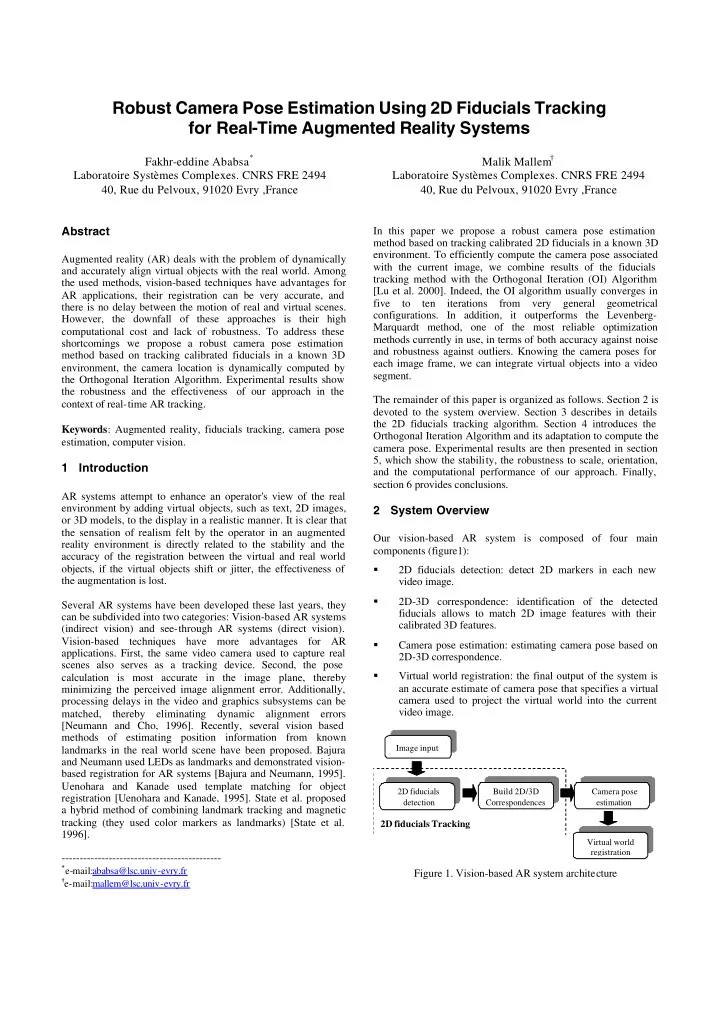
Our vision-based AR system is composed of four main components (figure1):
- 2D fiducials detection: detect 2D markers in each new
video image.
- 2D-3D correspondence: identification of the detected
fiducials allows to match 2D image features with their calibrated 3D features.
- Camera pose estimation: estimating camera pose based on
2D-3D correspondence.
- Virtual world registration: the final output of the system is
an accurate estimate of camera pose that specifies a virtual camera used to project the virtual world into the current video image.
Image input 2D fiducials detection Build 2D/3D Correspondences Camera pose estimation Virtual world registration
2D fiducials Tracking