
SLIDE 1
Margarita Safonova, Jayant Murthy, Rekhesh Mohan
Indian Institute of Astrophysics
Margarita Safonova, Jayant Murthy, Rekhesh Mohan Indian Institute of - - PowerPoint PPT Presentation
Margarita Safonova, Jayant Murthy, Rekhesh Mohan Indian Institute of Astrophysics Keyword of modern astronomy multiwavelength Universe Missions in orbit: 1 UV GALEX (+ EUV CHIPS studying the Local Bubble, Hubble) 9 IR Spitzer,
Margarita Safonova, Jayant Murthy, Rekhesh Mohan
Indian Institute of Astrophysics
Missions in orbit:
Future UV Missions:
by NASA or ESA
Russia-led WSO
Importance of UV:
The Need for UV to Understand the Chemical Evolution of the Universe, and Cosmology Wamsteker et al. 2006 UV Capabilities to Probe the Formation of Planetary Systems: From the ISM to Planets Ana Gomez de Castro et al. 2006
Airglow (important in low-orbit missions) Zodiacal light (scattered sunlight in Solar System) Cosmic background (from beyond Solar System):
* Galactic component (scattering of
sunlight off dust grains)
* Extragalactic component at the poles up to 25%? [Brosch ’98])
— usually ~5 cts/cm2
UVX spectrometer on Columbia 1986 @ 330 km [Murthy ‘10]
λ: 1200 1600 3200
Time ~20’ Orbital dawn
Instrument-specific inputs:
FOV Wavelength at which data/image to be generated Filter curves (currently old UVIT; user-uploadable) Dark count (not yet)
Background contributors:
Airglow (currently set @ 200 ph/cm2/sec/sr/Å; changeable) Zodiacal light (depends on time, date and direction of observation) Stellar contribution (now Hipparcos catalogue; will be uploadable) Galactic background (GALEX database)
A simulation of the sky is important :
GALEX and Astrosat
and solar cycle
spectral type): 250,000 stars
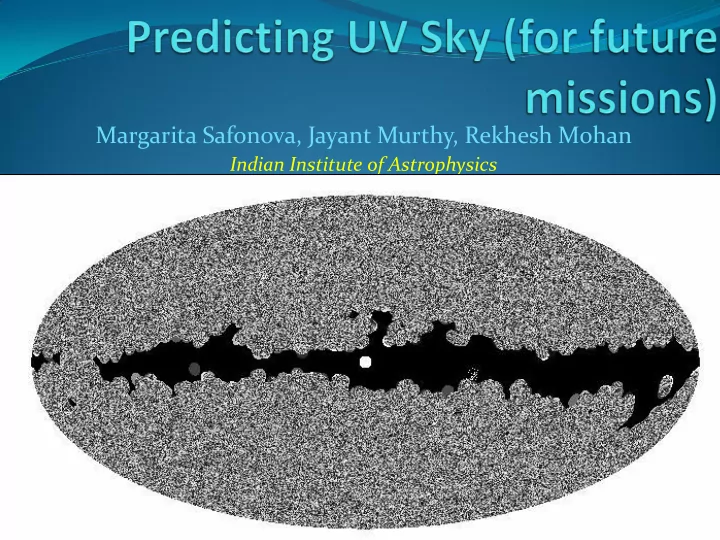
Galactic background
flux with a background at its position); download median of backgrounds
GALEX NUV b/g Galactic plane modelled by law [Murthy et al. ’11]
b cosec
Zodiacal light
Online Calculator
The online calculator is a front end to the C program. The only inputs required are the date and the
plotted as a function of wavelength. This can be integrated with the filter response function to give a count rate in each of the filters. The spectrum itself can be downloaded by clicking on the image.
Implementation
Problem Statement : In order to calculate the zodiacal light, we need:
Sun position (IDL algorithm for the Solar ephemerids converted to C code)
Zodiacal light spectrum (solar spectrum is from Colina et al. ‘96)
Zodiacal distribution (spatial dependence as a function of ecliptic coordinates from table by Leinert et al. ’98)
Input/Output
The input of the program is: day-month-year : look_ra -look_dec
The output of the program is the zodiacal light level at the specified coordinates n FOV and date in units of photons/cm2/sec and a plot of spectrum.
Can also generate all-sky distribution
F geom eff
Ref: AstroSat Handbook
BaF2 NUVB15 NUVB13 NUVB4 NUVN2 λ range 1300-1830 1900-2400 2200-2650 2445-2825 2730-2880 Δ effective 378.0 281.7 270.5 282.3 89.5 λ mean 1549.6 2435.5 2183.0 2428.0 2790.0 λ pivot 1544.6 2433.6 2181.0 2616.4 2789.7 λ effective 1232.3 2433.2 2171.0 2629.0 2792.0
d A
norm eff
) (
d A d A
norm norm mean
) ( ) (
d A d A
eff eff pivot
) ( ) (
2
d F A d F A
eff eff eff
) ( ) ( ) ( ) (
Effective bandwidth Mean (central) wavelength Pivot wavelength Effective wavelength (A1V star for BaF2; Vega for NUV filters)
Or Orion
Nebula
Or Orion
Nebula
UV background in UVIT FUV-B1
Hipparcos stars in UVIT NUVB2 Zodiacal light distribution in FUV B1 in January in ecliptic coordinates
Include user-uploadable catalogues Update new UVIT effective areas All-sky images in 5 UVIT filters for different seasons Flag for overbright areas for 5 UVIT filters (now
NUV: 50,000 cps (Fλ~3.0 x 10⁻¹¹ erg/cm2/sec/Å) FUV: 15,000 cps (Fλ~9.0 x 10⁻¹² erg/cm2/sec/Å)
Time-variability of the background for few UV