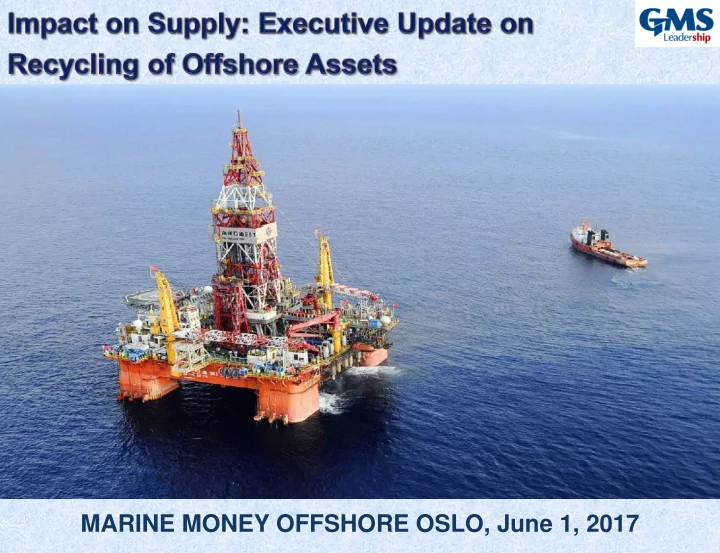
MARINE MONEY OFFSHORE OSLO, June 1, 2017 2 of 38 At the start of the - - PowerPoint PPT Presentation

marine money offshore oslo june 1 2017 2 of 38 at the
SMART_READER_LITE
LIVE PREVIEW

MARINE MONEY OFFSHORE OSLO, June 1, 2017 2 of 38 At the start of the - - PowerPoint PPT Presentation

MARINE MONEY OFFSHORE OSLO, June 1, 2017 2 of 38 At the start of the year, utilisation for mobile offshore drilling units (MODUs), the key demand driver for OSVs, was down to 21% for drill ships, 28% for semi-submersible and 51% for jack-up rigs.


slide-1
SLIDE 1

MARINE MONEY OFFSHORE OSLO, June 1, 2017

slide-2
SLIDE 2

2 of 38

slide-3
SLIDE 3

3 of 38

At the start of the year, utilisation for mobile offshore drilling units (MODUs), the key demand driver for OSVs, was down to 21% for drill ships, 28% for semi-submersible and 51% for jack-up rigs. Global utilisation for OSVs is around 40%. (Source: TradeWinds)

slide-4
SLIDE 4

4 of 38

Source: Lloyd’s List – Daily Briefing 11.05.2017 https://www.lloydslist.com/ll/daily-briefing/?issueDate=2017-05-11

slide-5
SLIDE 5

Sources:

  • 1. Jon Fredrik, Muller Rystad Energy
  • 2. Leslie Cook, Quest Offshore
  • 3. Fearnley Securities
  • 4. Tradewinds

5 of 38

Offshore Markets struggle with the same challenges that plague the shipping Industry

  • DRILLING UNITS: Global count of active offshore units continues to decline.
  • Increased Idling: In early 2016 there were 120 floating rigs2 and 170 jackups that were stacked or
  • There are currently 227 cold & warm stacked Jack Up Rigs 3
  • There are currently around 136 cold & warm stacked Ultra Deep Water, Deep Water and Mid Water

drilling units 3

  • There are currently 134 New-buildings in the above categories 3
  • Recycling undershooting need of the hour: Reuben Segal quoted: “More than 370 Rigs of various types

are stacked in warm or cold-lay-up.” 4 !!

  • OSVS:
  • Increased Idling: For “inactive” ships, as a conservative estimate, about 360 OSVs are said to be in

layup in Southeast Asia. 4

  • Increase in Supply: After 3% growth in 2016, Clarksons predicts that the PSVs fleet will increase 2.5%

this year and 3% in 2018. For anchor handlers, the estimates are for growth of 0.7% in 2017 and 1.7% in 2018.

  • Utilization rates are region 40% this year for PSV/AHTS
  • With more new buildings entering the market through 2017, which is already struggling with
  • versupply, a decrease in overall earnings and a bleak future outlook ……. RECYCLING is the

likely option. idle1

slide-6
SLIDE 6

Why massive scale of recycling has not taken place?

  • 1. LTV
  • 2. Low Residual Value
  • 3. Logistics challenges
  • 4. Relatively low stacking costs
  • 5. Awareness of recycling options
  • 6. Risks
  • Headline
  • Regulatory
  • Liability
  • Commercial (market recovery, yielding space to

competitors, etc.)

  • 7. Absence of end-to-end service providers

6 of 38

slide-7
SLIDE 7

Robust recycling leads to:

  • 1. Market equalization / balancing the world’s offshore

fleet

  • 2. Reduce losses / lay-up and stacking costs for
  • wners
  • 3. Remove old / aging fleets from service in favor of

newer ones

  • 4. Creation of secondary market for equipment
  • 5. Help the order books in the long run
  • 6. Introduce newer technologies and increase

efficiency in the offshore sector

7 of 38

slide-8
SLIDE 8

Few solutions to encourage recycling

  • 1. LTV (love thy lender)
  • 2. Low Residual Value (robust ship recycling options)
  • 3. Logistics challenges (development of low cost options)
  • 4. Relatively low stacking costs (kicking can down the road?)
  • 5. Awareness of recycling options (cash buyers)
  • 6. Risks
  • Headline (logistics, recycling options, etc.)
  • Regulatory (HKC, BASEL, EU, SOC)
  • Liability (as is where is)
  • Commercial (market recovery, yielding space to competitors,

etc.) (USD 70+ in short-medium term?)

  • 7. Absence of end-to-end service providers (GMS)

8 of 38

slide-9
SLIDE 9

The Hammonia Grenada (built 2010) was sold for scrap at an estimated $5.5m earlier this year.

slide-10
SLIDE 10

From 2013 to 2016, 2/3

  • f bulkers (or

containerships) had earnings below OPEX

10 of 38

slide-11
SLIDE 11

Overbuilding, cancellation of orders & yards going bankrupt

11 of 38

slide-12
SLIDE 12

Data Source: Clarksons Database

Offshore

New Building Scrapping

2.9m DWT (193 VSLS) 2.7m DWT (304VSLS)

Growth in Vessel No.

111

Growth Rate (DWT/TEU) In Q 1 2017

0.25%

12 of 38

slide-13
SLIDE 13

15.6 4.0 7.6 1.9 29 2.8 2 2.1 28 8.7 1.6 2.9 0.0 5.0 10.0 15.0 20.0 25.0 30.0 35.0 Bulker container Tanker Offshore

Recycling Volumes in Different Sectors (Million DWT)

2014 2015 2016

  • 3%

+211%

  • 30

%

  • 74%

+86 %

  • 20%

+11 % +38 % BRENT CRUDE

12 of 38

slide-14
SLIDE 14

Factors that Affect Asset Values (Recycling):

  • 1. Supply
  • 2. Demand
  • 3. Commodities (Steel Prices)
  • 4. Currency exchange rates
  • 5. Government Regulations
  • 6. Market Sentiment

14 of 38

slide-15
SLIDE 15

15 of 38

slide-16
SLIDE 16
slide-17
SLIDE 17

5 countries (with 80% Asian) recycle more than 95% of the world’s fleet Number of yards in each Country:

Indian sub-continent

  • India: about 170 yards
  • Bangladesh : about 70 yards
  • Pakistan: about 120 yards

China: about 22 yards

Turkey: about 20 yards * Note: all figures are approximates

17 of 38

slide-18
SLIDE 18

Electrical Cables Chilling Compressors Engine Furniture Kitchen Ware Steel Scrap Spare Parts Re-Rollable Steel Pipes Motors

When properly handled, recycling is, without question, a Green Industry. Resources generated by one industry can be used by several others e.g. spares, machinery and steel are used cost-effectively in several industries.

18 of 38

Waste <2-4% (only!)

slide-19
SLIDE 19

19 of 38

slide-20
SLIDE 20

20 of 38

slide-21
SLIDE 21

22 of 38

slide-22
SLIDE 22
  • Hong Kong Convention: The Hong Kong International Convention for the Safe and

Environmentally Sound Recycling of Ships, 2009 (the Hong Kong Convention), was adopted at a diplomatic conference held in Hong Kong, from 11 to 15 May 2009, which was attended by delegates from 63 countries. The Convention is aimed at ensuring that ships, when being recycled after reaching the end of their operational lives, do not pose any unnecessary risks to human health, safety and to the environment. Regulations in the new Convention cover: the design, construction, operation and preparation of ships so as to facilitate safe and environmentally sound recycling without compromising the safety and operational efficiency of ships; the operation of ship recycling facilities in a safe and environmentally sound manner; and the establishment of an appropriate enforcement mechanism for ship recycling, incorporating certification and reporting

  • requirements. (Source: www.imo.org)
  • EU Ship Recycling Regulation (EUSRR): The objective of the Regulation is to reduce the negative

impacts linked to the recycling of EU-flagged ships, especially in South Asia, without creating unnecessary economic burdens and by bringing into force, an early implementation of the requirements of the 2009 Hong Kong Convention for the Safe and Environmentally Sound Recycling of Ships, therefore contributing to its global entry into force. calling at EU port or anchorage) will be required to have on board anAccording to the new rules, the installation or use

  • f certain hazardous materials on ships will be prohibited or restricted. Additionally, each new

European ship (or a ship flying a flag of the third country inventory of hazardous materials verified by the relevant administration or authority and specifying the location and approximate quantities

  • f those materials. The ships flying the flag of an EU Member State are only recycled in ship

recycling facilities included in the European List. (Source: http://ec.europa.eu/)

22 of 38

slide-23
SLIDE 23

28 of 38

slide-24
SLIDE 24

29 of 38

HKC SOC SARVAG HKC SOC LEELA

slide-25
SLIDE 25
  • Once the IHM has been prepared, The facility will provide a Ship Recycling Plan (SRP)

to GMS who will coordinate all the necessary procedures to be followed (i.e. marking hazardous zones, extraction, removal, transportation and safe-disposal).

  • GMS will monitor the procedures undertaken by the recycling yard and will provide a bi-

weekly / monthly recycling report to Sellers (based on prior agreement). This report will describe in detail, all of the procedures that were followed from the beginning of recycling of the vessel until the week before a final report is provided at the end of the vessel's recycling procedure.

  • These include identification and generation of an Inventory of Hazardous Materials

(IHMs), safe-removal, storage, transportation, and safe-disposal, setting safety measures on recycling activities, employee rotations, overseeing of safety measures, and effective conclusion to the overall recycling of the asset.

  • At the end of the recycling procedure, a full report for the entire recycling procedure will

be prepared.

25 of 38

slide-26
SLIDE 26
  • GMS’s RSRP (Responsible Ship Recycling Program) operates under the IMO's Hong Kong

Convention guidelines, which provides for environmentally safe and sound ship recycling, and the ILO (International Labour Organisation) requirements, which address the requirements for the safety of the labour force. Under GMS's RSRP, principals of GMS nominate a recycling yard of their choice that is capable of meeting sellers, national and international requirements.

  • Dr. Nikos Mikelis who was previously with the IMO for several years and is considered as the

"Father" of the IMO's Hong Kong Convention on the Safe and Environmentally Sound Ship Recycling, is a Non-Executive director at GMS overseeing our Green Recycling program. Under his guidance, GMS is able to accurately monitor global developments in the regulatory regime that affects the ship recycling industry.

  • Dr. Anand M. Hiremath is based in Bhavnagar (India) and works closely with selected yards

to ensure compliance of the guidelines established by the Hong Kong Convention (HKC) for Safe and Responsible Recycling of Ships. In this regard he liaises closely with SRIA, GMB, Ministry of Shipping and other local organizations and governmental institutions. Additionally, he is responsible for the development and implementation of GMS Responsible Ship Recycling Program (GRSRP) and is a certified IHM Specialist with the ability to generate in- house IHMS.

26 of 38

slide-27
SLIDE 27
  • Regulatory, technical & Logistics competency from a highly knowledgeable team of experts in

the recycling of offshore units on an “AS IS” basis and the towage of assets such as: rigs, FPSOs, semi-submersibles, drilling rigs, AHTS/PSV’s, pipe layers, derrick barges and flotels.

  • Long track record of successful towage with more than 500 Trans-Atlantic, Trans-Pacific and

Far East tows.

  • Over 20 tows concluded in the last two years.
  • Strong relationships with recycling facilities from Turkey to china and the Indian

Subcontinent.

  • Safe and smooth transaction with assistance available 24/7 year round.
  • Green Recycling to meet your company’s CSR requirements to recycling at SOC certified

yards.

  • Contact us today to discuss the sale and purchase of your offshore assets with the most

flexible terms in the market.

slide-28
SLIDE 28
  • Ease (simplicity) of business transactions
  • One stop shop.
  • Think Global. Act Local. – Offices in USA, UK, Germany, Greece, UAE, Singapore,

China, S. Korea, and Japan.

  • Regulatory, Technical & Logistics Competency.
  • Upstream and Downstream expertise.
  • In-house dedicated technical, operations, green-recycling, legal and PR departments.
  • Swift Cash Payments.
  • Prompt deliveries.
  • Monitoring / Minimizing Headline Risks.
  • Corporate Social Responsibility.
  • Need/Results Based solutions
  • Technical: Strictly “AS IS WHERE IS” deliveries, Deep Sea towages, extensive

expertise with offshore assets.

  • Principals of GMS have extensive experience with HUNDREDS of safely completed
  • cean towages (touch wood), including transatlantic voyages from the Americas to the

Far East - add value in terms of bringing such experience to the table resulting in the avoidance of undesired headline risks, especially for Blue Chip Owners.

28 of 38

slide-29
SLIDE 29
  • Need/Results Based solutions (…continued)
  • End-to-End Solution providers – not only make transactions, payments and deliveries

simple, resale to recycling yards, safe deliveries, and overseeing recycling activities in line with agreement. In essence, a full service package that survives far beyond the delivery of the vessel.

  • Global relationships – taken deliveries at virtually every major port in the world having

relations with agents and port authorities globally and spanning over 25 years.

  • Protecting transactions from market fluctuations – Owners get paid as per agreements.
  • Pay the highest asset values – with the ability to resell to the major recycling

destinations, we are able to offer the industry’s HIGHEST PRICES for end-of-life assets.

  • Ability to provide the industry’s BEST Green Recycling Projects.
  • Technology
  • GMS App, GMS Website, GMS Weekly, GMS Green Ship Recycling Program (GSRP),

etc.

  • 24 x 7 x 365 Availability and accessibility

29 of 38

slide-30
SLIDE 30

 Download App;  Register After registration confirmation, just enjoy the APP.

Description The world’s leading cash buyer of vessels for recycling now brings to you a unique and innovate application to help Sellers of Ships maximize the transactional efficiency, speed up the negotiation process thereby minimizing risks due to market volatility, and ultimately, maintain absolute confidentiality of the transaction. Please for feedback and enquiries, please contact info@gmsinc.net

slide-31
SLIDE 31
  • “Cash Buyers” are not brokers.
  • Cash Buyers are Principals/Traders: They buy offshore assets (Rigs,

Semi-subs, FPSOs, FSOs, etc.) on cash basis and simple terms from

  • wners and sell them to recycling yards.
  • Cash Buyers take delivery of vessels on both, strictly “as is where is”

basis in addition to simple “delivered” terms.

  • The Hong Kong Convention (HKC) considers Cash Buyers as Owners of

the vessel.

  • We work closely with recycling facilities in ALL of the key recycling

markets (India / Bangladesh / Pakistan / China & Turkey).

31 of 38

slide-32
SLIDE 32
  • Established in U.S.A. in 1992, GMS is the LARGEST Buyer
  • f ships & Offshore Assets in the world!
  • In last few years, principals of GMS have delivered about

1/3 of the world’s fleet sold for recycling in the Indian sub- continent.

  • World's FIRST ISO 9001 certified Buyer.
  • GMS has negotiated (about):
  • 3000 ships and Offshore Assets;
  • 100,000,000 DWT;
  • 300 vessels/offshore assets in a single year (2012)
  • Concluded One of the BIGGEST deals in the history of

recycling

  • Delivered the most offshore assets recycled in the

Indian sub-continent in the last 2 years.

32 of 38

slide-33
SLIDE 33
  • Global footprint: offices across the world including U.S.A.,

Germany, Greece , U.A.E., Singapore, China, Korea, and Japan

  • Exclusive representative offices in India, Bangladesh,

Pakistan, Turkey and Romania.

  • Financial and Management capability to:
  • Buy fleets outright
  • CASH payments
  • SIMPLE "as is where is“ terms.
  • Structure Deals.

 Purchase & Layup assets  Market plays  Forward positions

33 of 38

slide-34
SLIDE 34

34 of 38

slide-35
SLIDE 35

35 of 27