
SLIDE 1
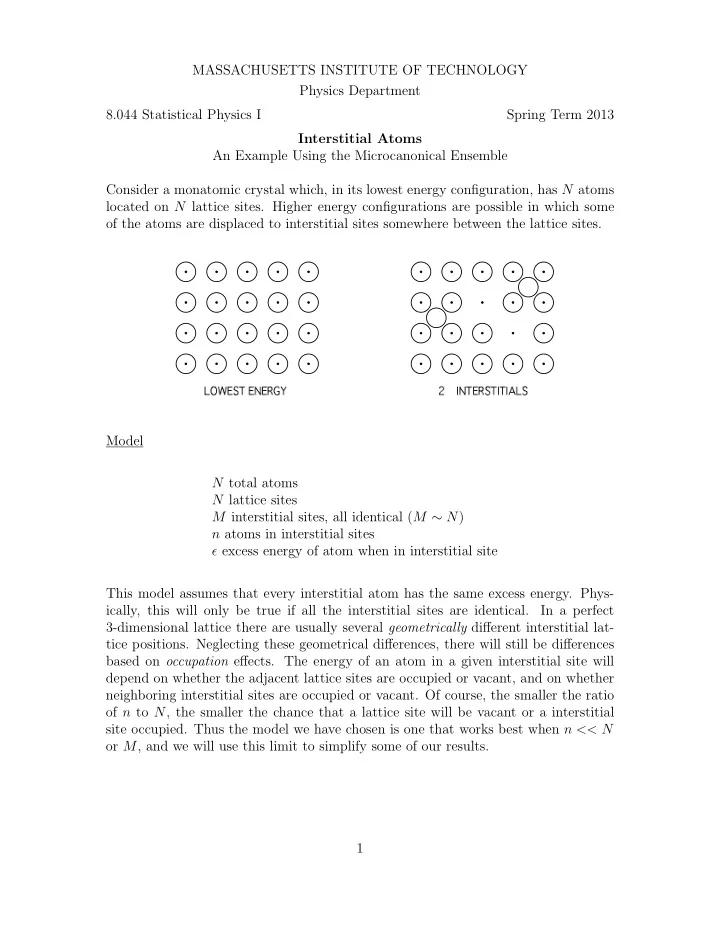
MASSACHUSETTS INSTITUTE OF TECHNOLOGY Physics Department 8.044 Statistical Physics I Spring Term 2013 Interstitial Atoms An Example Using the Microcanonical Ensemble Consider a monatomic crystal which, in its lowest energy configuration, has N atoms located on N lattice sites. Higher energy configurations are possible in which some
- f the atoms are displaced to interstitial sites somewhere between the lattice sites.
Model N total atoms N lattice sites M interstitial sites, all identical (M ∼ N) n atoms in interstitial sites ǫ excess energy of atom when in interstitial site This model assumes that every interstitial atom has the same excess energy. Phys- ically, this will only be true if all the interstitial sites are identical. In a perfect 3-dimensional lattice there are usually several geometrically different interstitial lat- tice positions. Neglecting these geometrical differences, there will still be differences based on occupation effects. The energy of an atom in a given interstitial site will depend on whether the adjacent lattice sites are occupied or vacant, and on whether neighboring interstitial sites are occupied or vacant. Of course, the smaller the ratio
- f n to N, the smaller the chance that a lattice site will be vacant or a interstitial
site occupied. Thus the model we have chosen is one that works best when n << N
- r M, and we will use this limit to simplify some of our results.