Mathematical Induction 2. Assume the statement is true for any - - PowerPoint PPT Presentation

mathematical induction
SMART_READER_LITE
LIVE PREVIEW

Mathematical Induction 2. Assume the statement is true for any - - PowerPoint PPT Presentation

Mathematical Induction http://localhost/~senning/courses/ma229/slides/induction/slide01.html Mathematical Induction http://localhost/~senning/courses/ma229/slides/induction/slide02.html Mathematical Induction prev | slides | next prev | slides


slide-1
SLIDE 1

Mathematical Induction http://localhost/~senning/courses/ma229/slides/induction/slide01.html 1 of 1 09/24/2003 07:28 AM prev | slides | next

Mathematical Induction

1 2 3 4 5 6 7 8 9

Mathematical Induction http://localhost/~senning/courses/ma229/slides/induction/slide02.html 1 of 1 09/24/2003 07:28 AM

Mathematical Induction

prev | slides | next

Using mathematical induction in the proof of a statement consists

  • f a two-step process:

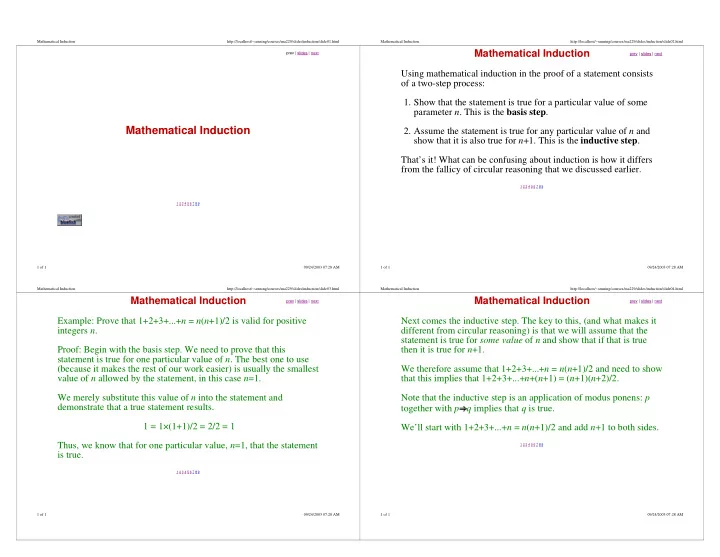
Show that the statement is true for a particular value of some parameter n. This is the basis step. 1. Assume the statement is true for any particular value of n and show that it is also true for n+1. This is the inductive step. 2. That’s it! What can be confusing about induction is how it differs from the fallicy of circular reasoning that we discussed earlier.

1 2 3 4 5 6 7 8 9

Mathematical Induction http://localhost/~senning/courses/ma229/slides/induction/slide03.html 1 of 1 09/24/2003 07:28 AM

Mathematical Induction

prev | slides | next

Example: Prove that 1+2+3+...+n = n(n+1)/2 is valid for positive integers n. Proof: Begin with the basis step. We need to prove that this statement is true for one particular value of n. The best one to use (because it makes the rest of our work easier) is usually the smallest value of n allowed by the statement, in this case n=1. We merely substitute this value of n into the statement and demonstrate that a true statement results. 1 = 1×(1+1)/2 = 2/2 = 1 Thus, we know that for one particular value, n=1, that the statement is true.

1 2 3 4 5 6 7 8 9

Mathematical Induction http://localhost/~senning/courses/ma229/slides/induction/slide04.html 1 of 1 09/24/2003 07:28 AM

Mathematical Induction

prev | slides | next

Next comes the inductive step. The key to this, (and what makes it different from circular reasoning) is that we will assume that the statement is true for some value of n and show that if that is true then it is true for n+1. We therefore assume that 1+2+3+...+n = n(n+1)/2 and need to show that this implies that 1+2+3+...+n+(n+1) = (n+1)(n+2)/2. Note that the inductive step is an application of modus ponens: p together with p q implies that q is true. We’ll start with 1+2+3+...+n = n(n+1)/2 and add n+1 to both sides.

1 2 3 4 5 6 7 8 9

slide-2
SLIDE 2

Mathematical Induction http://localhost/~senning/courses/ma229/slides/induction/slide05.html 1 of 1 09/24/2003 07:28 AM

Mathematical Induction

prev | slides | next

The changes in each line are highlighted.

1+2+3+...+n+(n+1)= n(n+1)/2+(n+1) = n(n+1)/2+2(n+1)/2 = (n+2)(n+1)/2 = (n+1)(n+2)/2

The last line represents the statement we were trying to obtain. Because of the basis step we know that the statement we are trying to prove is true for n=1. Because of the inductive step we know that it must then be true for n=2. Similarly if it’s true for n=2 then it must be true for n=3, and so

  • n... Thus we see that the statement must be true for all positive

values of n, which is the desired result.

1 2 3 4 5 6 7 8 9

Mathematical Induction http://localhost/~senning/courses/ma229/slides/induction/slide06.html 1 of 1 09/24/2003 07:28 AM

Mathematical Induction

prev | slides | next

The "statement" in a mathematical induction proof is called the inductive hypothesis. In the last example the inductive hypothesis was P(n) = 1 + 2 + 3 + ... + n = n(n + 1)/2 the rule of inference describing mathematical induction is [P(1) n (P(n) P(n+1))] n P(n) (Actually this is only correct when n is a positive integer - if n comes from another set then this would need to be modified.)

1 2 3 4 5 6 7 8 9

Mathematical Induction http://localhost/~senning/courses/ma229/slides/induction/slide07.html 1 of 1 09/24/2003 07:28 AM

Mathematical Induction

prev | slides | next

Mathematical Induction can be used on a variety of problems, including those that don’t involve the sum or product of a sequence. For example, use mathematical induction to show that 3 divides n3-n whenever n is a positive integer. Proof: The basis step requires that we show that 3 divides n3-n when n=1. Substituting 1 for n gives 13-1 = 0, which is clearly divisible by 3. The inductive hypothesis is "if 3 divides n3-n then 3 divides (n+1)3-(n+1)."

1 2 3 4 5 6 7 8 9

Mathematical Induction http://localhost/~senning/courses/ma229/slides/induction/slide08.html 1 of 1 09/24/2003 07:28 AM

Mathematical Induction

prev | slides | next

Let’s start with (n+1)3-(n+1) and see that this is divisible by 3.

(n+1)3-(n+1) = n3+3n2+3n+1-n-1 = n3-n+3n2+3n = (n3-n)+3(n2+n)

The first term here is divisible by 3 because of the induction hypothesis, and the second term is divisible by 3 since it is a multiple of 3. This completes the inductive step and also the proof.

1 2 3 4 5 6 7 8 9

slide-3
SLIDE 3

Mathematical Induction http://localhost/~senning/courses/ma229/slides/induction/slide09.html 1 of 1 09/24/2003 07:28 AM

Mathematical Induction

prev | slides | next

Problems like the following can also be solved using induction. Show that all values of postage greater than 11 cents can be

  • btained using only 4 cent and 5 cent stamps.

Basis Step: A 12 cent postage can be formed with three 4 cent stamps. Inductive Step: Assume that a postage of value n can be formed. Since n is greater than or equal to 12, there must be at least one 4 cent stamp present or at least three 5 cents stamp present. If there are at least three 5 cent stamps we can remove them and replace them with four 4 cent stamps. Otherwise, remove one 4 cent stamp and replace it with one 5 cent stamp. In this fashion we can always increase the postage by one cent.

1 2 3 4 5 6 7 8 9