
/ department of mathematics and computer science
Induction
Lecture 12 (Chapter 19) October 14, 2016
23/38 / department of mathematics and computer science
Strong induction (3)
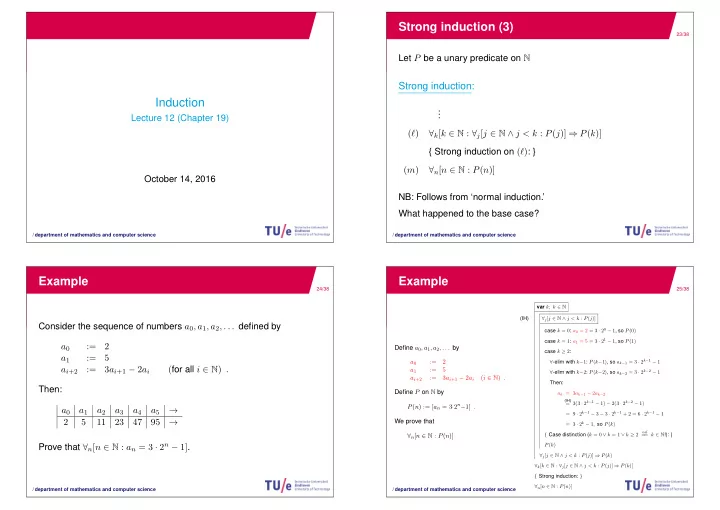
Let P be a unary predicate on N
Strong induction:
. . . (ℓ) ∀k[k ∈ N : ∀j[j ∈ N ∧ j < k : P(j)] ⇒ P(k)] { Strong induction on (ℓ): } (m) ∀n[n ∈ N : P(n)] NB: Follows from ‘normal induction.’ What happened to the base case?
24/38 / department of mathematics and computer science
Example
Consider the sequence of numbers a0, a1, a2, . . . defined by a0 := 2 a1 := 5 ai+2 := 3ai+1 − 2ai (for all i ∈ N) . Then: a0 a1 a2 a3 a4 a5 → 2 5 11 23 47 95 → Prove that ∀n[n ∈ N : an = 3 · 2n − 1].
25/38 / department of mathematics and computer science
Example
Define a0, a1, a2, . . . by a0 := 2 a1 := 5 ai+2 := 3ai+1 − 2ai (i ∈ N) . Define P on N by P(n) := [an = 3·2n−1] . We prove that ∀n[n ∈ N : P(n)]
var k; k ∈ N (IH) ∀j[j ∈ N ∧ j < k : P(j)] case k = 0: a0 = 2 = 3 · 20 − 1, so P(0) case k = 1: a1 = 5 = 3 · 21 − 1, so P(1) case k ≥ 2: ∀-elim with k−1: P(k−1), so ak−1 = 3 · 2k−1 − 1 ∀-elim with k−2: P(k−2), so ak−2 = 3 · 2k−2 − 1 Then: ak = 3ak−1 − 2ak−2
(IH)
= 3(3 · 2k−1 − 1) − 2(3 · 2k−2 − 1) = 9 · 2k−1 − 3 − 3 · 2k−1 + 2 = 6 · 2k−1 − 1 = 3 · 2k − 1, so P(k) { Case distinction (k = 0 ∨ k = 1 ∨ k ≥ 2
val
= = k ∈ N!): } P(k) ∀j[j ∈ N ∧ j < k : P(j)] ⇒ P(k) ∀k[k ∈ N : ∀j[j ∈ N ∧ j < k : P(j)] ⇒ P(k)] { Strong induction: } ∀n[n ∈ N : P(n)]