Measuring the Cost The author has no disclosures related to the - - PDF document

measuring the cost
SMART_READER_LITE
LIVE PREVIEW

Measuring the Cost The author has no disclosures related to the - - PDF document

Disclosures: Measuring the Cost The author has no disclosures related to the Effectiveness of content of this presentation. Pharmacogenomic Testing The INGENIOUS trial (NCT02297126) is sponsored by an NIH/NHGRI U01-grant (HG007762)


slide-1
SLIDE 1

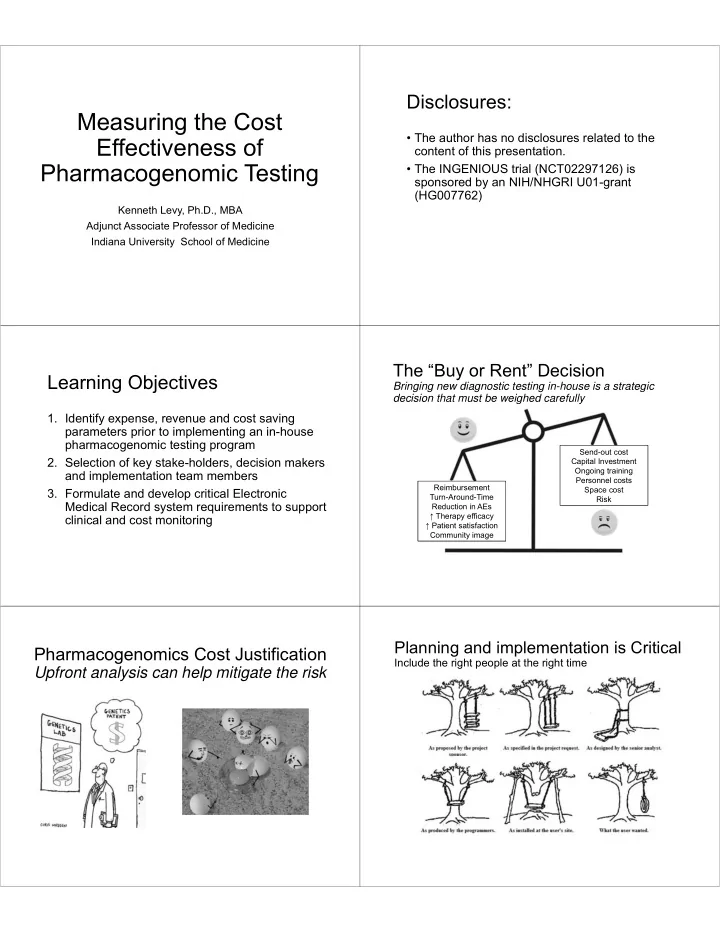
Measuring the Cost Effectiveness of Pharmacogenomic Testing

Kenneth Levy, Ph.D., MBA Adjunct Associate Professor of Medicine Indiana University School of Medicine

Disclosures:

  • The author has no disclosures related to the

content of this presentation.

  • The INGENIOUS trial (NCT02297126) is

sponsored by an NIH/NHGRI U01-grant (HG007762)

Learning Objectives

  • 1. Identify expense, revenue and cost saving

parameters prior to implementing an in-house pharmacogenomic testing program

  • 2. Selection of key stake-holders, decision makers

and implementation team members

  • 3. Formulate and develop critical Electronic

Medical Record system requirements to support clinical and cost monitoring

The “Buy or Rent” Decision

Bringing new diagnostic testing in-house is a strategic decision that must be weighed carefully

Reimbursement Turn-Around-Time Reduction in AEs ↑ Therapy efficacy ↑ Patient satisfaction Community image Send-out cost Capital Investment Ongoing training Personnel costs Space cost Risk

Pharmacogenomics Cost Justification

Upfront analysis can help mitigate the risk

Planning and implementation is Critical

Include the right people at the right time

slide-2
SLIDE 2

Cost Effectiveness and Sustainability

Keys to a successful program

  • Detailed pre-planning (with timelines and

management tools)

  • Experienced project manager
  • Alignment with key stakeholder’s needs
  • Staff training and clinical education
  • Full integration (input and output) with the

Electronic Medical Records system

  • Patient and community education

Project Planning

Understanding current and future processes

  • Identifies gaps and

risks

  • Confirms sources of

costs

  • Validates workflow
  • Builds cross-functional

alignment

Graphic example only

Project Planning and Workflow

  • Transitions workflow into tasks
  • Creates dependency relationships between tasks
  • Helps to prevent surprises and keep project on-schedule

and on-budget Graphic example only

Stakeholder Alignment

  • Senior Executive leadership (CEO/President,

CMO, CFO, Chief Legal Officer and CIO)

  • Senior Clinical leadership (clinical divisions,

nursing and pharmacy)

  • Pathology services
  • Clinical staff
  • P&T committee1
  • Third party payers
  • Patient advocates (community awareness)

1ASHP Guidelines on the Pharmacy and Therapeutics Committee and the Formulary System

Key Drivers by Stakeholder

Senior Executive leadership (CEO/President, CMO, CFO, Chief Legal Officer and CIO)

  • Impact on clinical outcomes
  • Capital budget
  • Headcount requirements
  • Standards of Care and legal liability
  • Impact on community relations/Patient advocacy groups
  • Added time and work burden for clinical staff
  • Health Economics, return on overall investment

(reimbursement vs cost)

  • Integration into LIS/HIS (time and cost)

Key Drivers by Stakeholder

Senior Clinical leadership (clinical divisions, nursing and pharmacy)

  • Technology adoption (National standards of

care)

  • Impact on malpractice liability
  • Education and training (staff turnover)
  • Impact on department headcount
  • Clinical relevance for each clinical specialty
  • Added time and work burden for clinical staff
  • Alignment with current workflow
slide-3
SLIDE 3

Key Drivers by Stakeholder

Clinical Staff (physicians, nurses and clinical pharmacists)

  • Clinical validation (Peer-reviewed articles, National

Standards)

  • Clinical Pharmacy consultation availability
  • Liability (to act or not act)
  • Education (impact on current clinical decision making)
  • Alignment with current workflow
  • Test turn-around time
  • Test reporting format
  • Patient education support

Key Drivers by Stakeholder

Third party payers

  • Clinical validation (National Standards)
  • CMS/other third-party adoption (CPT

MoPath code/tier assignment and reimbursement direction)

  • Demonstrated/documented clinical and

economic data addressing investment versus cost prevention (short and long- term plus hard and soft costs)

Key Drivers by Stakeholder

Patient advocates

  • Alignment community needs
  • Impact on patient care
  • Cost (out of pocket) to patients
  • Patient/community education programs

Implementation Team Structure Test Selection – Where to Start

  • Identify institution’s most common adverse

events associated with gene mediated drug metabolism (informatics committee)

  • Quantify frequency (12 to 24 months) of selected

adverse events within your patient population (informatics committee)

  • Obtain institutions drug volume (in and out-

patient) for selected medications (informatics committee and pharmacy benefit manager)

  • Quantify internal costs (at the patient level)

associated with each adverse event identified

Testing Choices

Key Questions/Decisions:

  • Will third party payers reimburse for PGx

tests not directly linked to an ICD-9 code (i.e panel testing)?

  • Prospective (prevention) vs. reactive (at-

risk) testing (short vs. long-term impact)

  • Individual tests versus disease or

medication oriented PGx panels

  • Turnaround time (TAT). What is needed vs

required? Cost impact linked to changes in TAT

slide-4
SLIDE 4

Nominate drug-gene pair Recommendations

Team members:

Pharmacogeneticist Clinical Pharmacologist Pharmacists CLIA lab director Physicians (representing) Nephrologist Cardiologist Gastroenterologist Infectious Disease Oncologist Pediatrician Obstetrician Geriatrician

Develop clinical action flowcharts

Input:

Peer-reviewed publications FDA labels Internal data prepublication Guidelines: CPIC Dutch PGx working group Canadian (CPNDS)

Drug Gene Selection Process

Reports and consultation services

Pharmacogenomics Laboratory

Technology my be the least challenging aspect

  • Driven by laboratory services committee
  • Space and staff requirements
  • Test selection and volume may direct choices

(automated vs. manual)

  • Equipment acquisition (buy versus lease)
  • Plan for future expansion
  • Plan for obsolescence

Electronic Medical Records

EMR is the key to a successful program

  • Driven by Informatics Committee
  • Functional specifications require input from

stakeholders

  • Lead time – planning, coding, implementing

and testing

  • Prioritization (internal and vendor)
  • Data input and data mining critical
  • User defined flexibility (change friendly)

Staff Education

It takes time to change clinical practice Clinical Training:

  • Critical for short and long-term sustainability
  • Physician, Nursing and Pharmacy teams
  • Pre and post-implementation survey (what

went well and what can be improved)

  • Training and re-training (consider turnover)
  • CME/CE

Patient Education

Demystify genetics

Supporting Patient Ownership:

  • Alignment of patient education tools and

how to deliver (clinical teams)

  • Patient education tools must simplify the

concept of pharmacogenomics

  • Educated patients are associated with

better outcomes1

1Risk Manag Healthc Policy. 2010;3:61-72. doi: 10.2147/RMHP.S7500. Epub 2010 Oct 14

Measuring Cost Effectiveness

A challenging task Hard versus Soft Costs:

  • Out of pocket costs (capital and variable

costs are straight forward measures

  • Compare your adverse event rates to

national averages

  • Benchmark costs per adverse event
  • Analyze accuracy of adverse event recording
  • Quantifying soft costs takes time (plan for it)
slide-5
SLIDE 5

And Finally the Money

Profit and Loss Analysis

  • Justification for Laboratory
  • Driven by finance committee
  • Establish metrics to achieve and

measure periodically

  • Cash flow, break-even analysis

and Net present Value (NPV)

  • Operating Profit (OP) before tax

and depreciation

  • Cumulative Income minimum of 5

years

  • Justification for Laboratory
  • Driven by finance committee
  • Establish metrics to achieve and

measure periodically

  • Cash flow, break-even analysis

and Net present Value (NPV)

  • Operating Profit (OP) before tax

and depreciation

  • Cumulative Income minimum of 5

years

Graphic example only

Summary

  • Adopting in-house pharmacogenomic testing

requires clinical and financial strategic commitments

  • Project teams require engagement from

cross-functional areas within the institution

  • EMR integration is critical for reporting and

data mining

  • Education of clinical staff and patients is

required for sustainability