MEMORANDUM TO: The Transportation Commission FROM: Karen Stuart, - - PDF document

memorandum to the transportation commission from karen
SMART_READER_LITE
LIVE PREVIEW

MEMORANDUM TO: The Transportation Commission FROM: Karen Stuart, - - PDF document

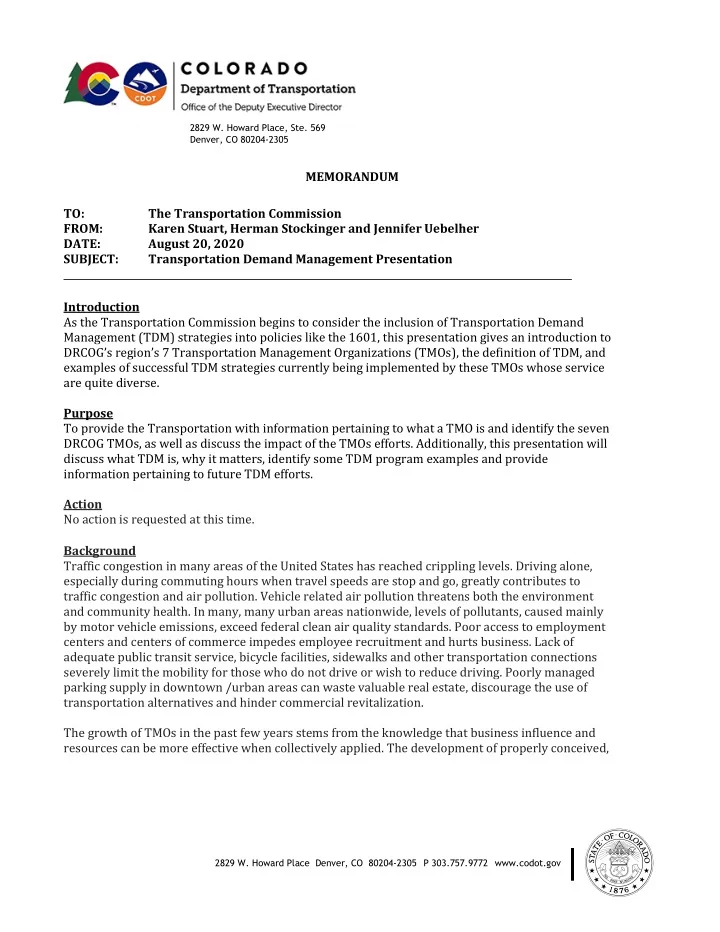
2829 W. Howard Place, Ste. 569 Denver, CO 80204-2305 MEMORANDUM TO: The Transportation Commission FROM: Karen Stuart, Herman Stockinger and Jennifer Uebelher DATE: August 20, 2020 SUBJECT: Transportation Demand Management Presentation


slide-1
SLIDE 1

2829 W. Howard Place Denver, CO 80204-2305 P 303.757.9772 www.codot.gov

MEMORANDUM TO: The Transportation Commission FROM: Karen Stuart, Herman Stockinger and Jennifer Uebelher DATE: August 20, 2020 SUBJECT: Transportation Demand Management Presentation Introduction As the Transportation Commission begins to consider the inclusion of Transportation Demand Management (TDM) strategies into policies like the 1601, this presentation gives an introduction to DRCOG’s region’s 7 Transportation Management Organizations (TMOs), the definition of TDM, and examples of successful TDM strategies currently being implemented by these TMOs whose service are quite diverse. Purpose To provide the Transportation with information pertaining to what a TMO is and identify the seven DRCOG TMOs, as well as discuss the impact of the TMOs efforts. Additionally, this presentation will discuss what TDM is, why it matters, identify some TDM program examples and provide information pertaining to future TDM efforts. Action No action is requested at this time. Background Traffic congestion in many areas of the United States has reached crippling levels. Driving alone, especially during commuting hours when travel speeds are stop and go, greatly contributes to traffic congestion and air pollution. Vehicle related air pollution threatens both the environment and community health. In many, many urban areas nationwide, levels of pollutants, caused mainly by motor vehicle emissions, exceed federal clean air quality standards. Poor access to employment centers and centers of commerce impedes employee recruitment and hurts business. Lack of adequate public transit service, bicycle facilities, sidewalks and other transportation connections severely limit the mobility for those who do not drive or wish to reduce driving. Poorly managed parking supply in downtown /urban areas can waste valuable real estate, discourage the use of transportation alternatives and hinder commercial revitalization. The growth of TMOs in the past few years stems from the knowledge that business influence and resources can be more effective when collectively applied. The development of properly conceived,

2829 W. Howard Place, Ste. 569 Denver, CO 80204-2305

slide-2
SLIDE 2

2829 W. Howard Place Denver, CO 80204-2305 P 303.757.9772 www.codot.gov

efficiently operated, and adequately funded TMOs can be important components of an area’s efforts to address a wide variety of transportation related challenges. In the early 1980’s, TMOs began to implement required TDM strategies through negotiated trip reduction agreements between a city and a developer or landowner. Some of these arrangements also required future employer tenants to participate in TDM programs. The federal Clean Air Act Amendments of 1990 adopted TDM as an instrument of area-wide pollution control and the 1991 Intermodal Surface Transportation Efficiency Act (ISTEA) embraced TDM as a tool of regional congestion management. Next Steps TMOs as a resource as CDOT begins implementation of TDM into policies. Attachment TDM Presentation

slide-3
SLIDE 3

TRANSPORTATION DEMAND MANAGEMENT IN THE DENVER METRO REGION

A national example of collaboration to maximize use of existing infrastructure

slide-4
SLIDE 4

DESIRED OUTCOMES

  • TDM Defined
  • Role of the TMAs
  • Employer Trip Reduction

Program

  • Managing transportation

demand and supply together

  • Seeking input from the

Transportation Commission

  • n Employee Trip Reduction

Program

slide-5
SLIDE 5

USING TDM TO ACHIEVE CDOT’S MISSION AND GOALS

CDOT’S Vision – “To enhance the quality of life and the environment of the citizens of Colorado by creating an integrated transportation system that focuses on safely moving people and goods by offering convenient linkages among modal choices.”

TDM actively promotes and provides options for low/no emission travel, thus positively impacting greenhouse gas reduction goals.

An integrated transportation system can only be achieved by focusing on TDM strategies.

CDOT’S Mission – “To provide the best multi-modal transportation system for Colorado that most effectively and safely moves people, goods, and information.”

CDOT’s mission directly calls out the use of a multi-modal transportation system, which TDM helps to achieve through increasing access and education about multi-modal options.

slide-6
SLIDE 6

USING TDM TO ACHIEVE THE TRANSPORTATION COMMISSION’S GUIDING PRINCIPLES

Transportation Commissions Guiding Principles:

 “ Formulating general policy with respect to the management, construction, and

maintenance of public highways and other transportation systems in the state.”

 TDM helps to reduce VMT and congestion, thus helping to reduce the need to build out

systems to accommodate increased traffic flow in the long term.

 Provides equitable travel options to all Coloradans.

 “ Advising and making recommendations to the governor and the General Assembly,

relative to transportation policy.”

 The Transportation Commission can work with TMAs to make recommendations to the

governor and state agency partners on mandatory TDM requirements for employers with

  • ver 100 employees.
slide-7
SLIDE 7

What is a TMA?

Transportation Management Association

slide-8
SLIDE 8

WHAT DOES A TMA DO?

Provide Transportation Demand Management (TDM) services to employers within a specific geographic region Coordinate multimodal transportation efforts of various stakeholders including employers, students, developers, residents and government agencies Establish policies, programs, and services to address transportation needs within our territories

slide-9
SLIDE 9

TRANSPORTATION DEMAND MANAGEMENT

Telework Bikeshare Marketing Parking Public Education Incentives Carshare Land Use

slide-10
SLIDE 10

WHY DOES TDM MATTER?

 Addresses traffic congestion  Maximizes existing infrastructure through utilizing mode, time of day, work location, etc.  Population growing, cost of living increasing, congestion worsening, economic attractiveness diminishes  Maximize travel options, provide education  Physical infrastructure naturally encourages sustainable transportation

slide-11
SLIDE 11

WHO WE ARE

DRCOG Metro Vision 2040

  • Increase non-SOV travel to work by 10%
  • Reduce VMTs (vehicle miles traveled) by 10% to 22.95%
  • Reduce per capita transportation related GHG by 60%
slide-12
SLIDE 12

Way to Go is a regional partnership between DRCOG and the 8 TMAs. Many of the TMAs have been in operation for over 20 years with a strong base of select employers interested in helping to promote a mix of transportation options for their employees.

WAY To GO PARTNERSHIP

slide-13
SLIDE 13

Transportation Management Association Service Areas

slide-14
SLIDE 14

OUR IMPACT

 In 2019, reduced more than 23.5 million vehicle miles traveled (VMT)  CO2 was reduced by 8,984 tons reduced annually  Unified service delivery for the entire Denver Region  Efficient use of federal funding  Increased community awareness of commute options

slide-15
SLIDE 15

THE PROBLEMS WE ARE SOLVING

 Traffic congestion  Limited transportation funding  Air quality & climate change  Employee productivity  Sustainable development

slide-16
SLIDE 16

PROJECT SUCCESSES

 The Quayle Zocalo Community Development  University of Denver  144th FLEX Service  US 36 Express Lanes Project

slide-17
SLIDE 17

CASE STUDY 1 – THE QUAYLE ZOCALO COMMUNITY DEVELOPMENT

  • Restored historic hotel into affordable housing

facility called the Quayle at 101 Broadway in Denver.

  • Created an aggressive TDM plan with the help of

the local TMA. The plan was designed to have

  • nly one parking space for every five dwelling

units in an area where one space per unit has been the norm

  • Themed building around cycling with large bike

room, micro-mobility options and enhanced pedestrian facilities

  • Actively promoted transportation options to

potential tenants

  • Achieved full building occupancy by the end of
  • 2019. The Quayle not only accomplished the trip

reduction goal, but they have one unleased parking space proving that a parking ratio of 0.2 parking spaces per unit is possible in a non- Central Business District area

slide-18
SLIDE 18

TDM PLANNING FOR NEW DEVELOPMENT

The Quayle at 101 Broadway

Focusing on cyclists Minimal parking (0.2 parking space per dwelling unit) Access guide for tenants Premier bike repair and storage Active promotion of transportation alternatives Located in area with high quality RTD services and bike facilities Micro-mobility options for tenants Conducting survey after full occupancy

slide-19
SLIDE 19

CASE STUDY 2 – UNIVERSITY OF DENVER

 University of Denver is using TDM to help convert the campus from auto-oriented to being more transit, bike and walk focused.  The university offers transit passes for all faculty, staff and students.  The primary obstacle was the length of the campus with the RTD Station at the north end and the southern end which is 0.8 miles.  The university invested in two services that better connected the campus to the rail station. DU launched the first bikeshare pilot in Denver with 200 bicycles that could be used from the station to all parts of the campus. The pilot achieved over 1,000 bike trips daily just prior to the bikeshare firm’s closure.  DU also invested in the first micro-transit service in Colorado. The service operates as a fixed route during peak periods and goes fully demand-responsive, route less during nonpeak and between terms. Over 1,200 faculty, staff and students are regular riders, and during the 2019/2020 Winter Break, there were 432 people who used the service as demand-responsive, and route-less.  DU complements these services with 3-4 promotional events annually such as Bike to Workday and Go-Tober. The university has also agreed to support the conversion of the RTD Station into a neighborhood mobility hub and opening the micro-transit service to the public and neighborhoods surrounding the campus.

slide-20
SLIDE 20

CASE STUDY 2 – UNIVERSITY OF DENVER

slide-21
SLIDE 21

CASE STUDY 3 – 144th FLEX SERVICE

Service Features

 New FLEX Shuttle Service  Dedicated Program Manager customer service  Customized Trip Planning & Travel Training Services  Carpool & Vanpool Programs Component  Bike & Pedestrian Programs  Mobility Fairs  Facilitate Transit Pass program discussions  Targeted Employer Meet & Greets

 Residential communities in service area  Area Hotels

Grant Funding

 DRCOG Sub-regional TDM Grant  4-year grant starting Nov. 2019 for workforce transit and mobility service at 144th & I-25  $2 million grant (80% / 20%)  $1.6 million Federal Funds  $400k in Local Match:  Cities of Thornton and Westminster  Smart Commute Metro North  Quadrant Employers

 Proposed $5K per major employer per year

 RTD  Required $25K in sales per year in transit Pass products challenge

slide-22
SLIDE 22

144th FLEX SERVICE

Scheduled Operations

 Three (3) 14 Passenger Shuttles  4 stops on quadrant with connection to

120th Wagon Road Park-n-Ride

 Initial service assumptions:  Operates Mon-Sat: 4:50 am to 10 pm  Fixed route during peak hours

w/ 20-minute frequency

 On-Demand from 8:45 am to 5:00 pm

Denver Premium Outlets

slide-23
SLIDE 23

CASE STUDY 4 - US 36 EXPRESS LANES PROJECT

As the largest construction project in the state, the $497 million US 36 Express Lanes Project created new Express Lanes, the US 36 Bikeway and Bus Rapid Transit (BRT) service from Denver to Boulder, along with other innovative investments. The project began in 2012 and was completed in 2016. Commuting Solutions was charged with reducing single occupant work trips along the corridor during and after construction. Grant funding from CDOT, CMAQ and DRCOG supported the development of a comprehensive Travel Demand Program, including Congestion Mitigation Planning and social marketing.

slide-24
SLIDE 24

TACTICS

Commuting Solutions used a variety of owned, earned and paid tactics to reach the target audience with a compelling and relevant message. The selected tactics varied by flight and were selected to deliver the most cost-efficient reach and impressions across a variety of tactics. DIGITAL  Online banner ads  Mobile advertising  Retargeted ads  Pandora radio OUT OF HOME  Bus kongs  Arista parking garage banner*  Yard signs (Arista)*  1st Bank Center digital sign*  CDOT VMS signs*  Commuter Van magnets *36CS leveraged their strong relationships with the community to help extend reach free of charge. SOCIAL MEDIA  Organic Facebook posts  Facebook advertising STAKEHOLDER/PARTNER OUTREACH  Toolkit of campaign materials for municipal and employee partners to share with their audiences.* COMMUNITY OUTREACH  PR  Email  Events MEMBER & EMPLOYER OUTREACH  Events

slide-25
SLIDE 25

PARTICIPANTS BY INCENTIVE TYPE

EcoPass, 1653 Carpool, 188 Vanpool, 58 Transit, 738

2,637 totalparticipants Results from 2014-2017

slide-26
SLIDE 26

VEHICLE MILES TRAVELED REDUCED

12,500 VMT reduced per weekday.

4,000,000 3,000,000 2,000,000 1,000,000 '- Vanpool Carpool By Incentive Type EcoPass Transit Total Reduction

slide-27
SLIDE 27

EMPLOYER TRIP REDUCTION PROGRAM

slide-28
SLIDE 28

THE OPPORTUNITY

The Regional Air Quality Council funded the first three TMAs through the State Implementation Plan (SIP) for Air Quality; with the intent to potentially expand employer participation through regulation. Air Quality in the Denver Region has

  • worsened. EPA downgraded the Denver

Region to Serious Nonattainment last year, likely further downgrading in 2021 to Severe Nonattainment which could require an employer trip reduction mandate.

slide-29
SLIDE 29

COMMUTE TRIP REDUCTION EXAMPLES

In 1991 the Washington State Legislature passed the Commute Trip Reduction Law. This law engaged many local communities and employers in efforts to address traffic congestion, air pollution and fuel consumption. Commute trip reduction laws target worksites with 100 or more full-time employees - 1,000 worksites and 550,000 commuters participate statewide. Surveys conducted every other year are used to measure vehicle miles traveled and mode choice at each worksite. In 2017-18, commuters at worksites that participated in commute trip reduction left about 34,500 cars at home every weekday; instead, they opted to commute by bus, vanpool, train, bicycle, foot or telework. These alternative mode commute trips reduced almost 13 percent of daily vehicle miles traveled per employee. This decrease in vehicle miles traveled means nearly 4 million fewer gallons of fuel used each year, saving commuters about $25 million annually. Collectively, this is an annual reduction of 75,000 metric tons in greenhouse-gas emissions – equal to the amount of carbon sequestered annually by 88,269 acres of forest.

slide-30
SLIDE 30

28

  • 1. Designate an Employee Transportation Coordinator (ETC).
  • 2. Offer employees the Pre-Tax Commuter Benefit IRC 132(f).
  • 3. Promote a suite of travel options that employees can choose

from.

  • 4. Conduct an employee commute survey every two years. Way

to Go provides surveying assistance free of charge.

  • 5. Submit a TDM Plan to maintain or achieve the trip reduction

goal within a 2-year period.

Designate Offer Promote Conduct Submit

In partnership with Way to Go, employers with 100 or more employees could be asked to:

SUGGESTED CORE ELEMENTS FOR A DENVER REGIONAL CTR PROGRAM

slide-31
SLIDE 31
  • 1. DESIGNATE

Designate an Employee Transportation Coordinator (ETC) to act as the primary contact for employees for transportation- related programs and services. It is a part-time role that often takes on average less than 2 hours per week.

  • 2. OFFER

Employers can offer pre-tax commute benefits to employees. The IRS code allows employees to use up to an annual limit ($270 in 2020) per month in pre-tax money to pay for their transit passes, vanpool fares or parking. Employers save by not having to pay payroll tax of 7.65% on pre-tax funds.

slide-32
SLIDE 32
  • 3. PROMOTE

Employers offer local transit schedules, bike maps and ride- matching information. Employers can consider participating in one

  • r more of the region’s seasonal campaigns such as Bike to Work

and Go-Tober.

  • 4. CONDUCT

An employee commute survey can be conducted once every two years using the FREE Way to Go surveying

  • services. It can be as simple for an employer as

forwarding a survey link to employees and Way to Go does the rest.

slide-33
SLIDE 33

TDM PLANS INCLUDE

Worksite analysis of the location of bus stops, bike lanes and other worksite amenities that help employees use a mix of transportation options Mode share and mode share target Description of TDM strategies and why they were chosen for their worksite Commuter survey results

  • 5. SUBMIT

TDM Plans could be submitted using a simple to use online template.

slide-34
SLIDE 34

SOV RATE

EXAMPLE

A method for defining program goals is using a single occupant vehicle (SOV) mode share rate. Determining the goals by area includes a review of existing mode share along with availability of transit and support infrastructure (i.e., bike path) that create a mix of travel

  • ptions.

NEXT STEPS:

RAQC created Employer Trip Reduction Working Group. Developing recommended approach to trip reduction for the Denver region. Potential adoption in 2022 pending results of 2020 Summer Ozone season.

slide-35
SLIDE 35

NEXT STEPS

  • TMAs as a resource as CDOT considers TDM

inclusion

  • Assess demand management strategies before or

in addition to supply-side management (i.e., T- REX)

  • Including TDM strategies as a required element of

major construction projects (ex. US36)

  • Add TDM to a major construction project are I-25

(north, south, and central)

  • ETRP support
  • Better align with future transportation bill (i.e.,

INVEST in America ACT)

  • Coordinate and combine efforts between local

and state government for mode shift goals and Climate Change Initiatives

slide-36
SLIDE 36

CONTACT INFORMATION

Audrey DeBarros Executive Director Commuting Solutions audrey@commutingsolutions.org Stuart Anderson Executive Director Transportation Solutions Stuart@transolutions.org