Mod odelin ing of of se second har armonic generation in in Ga - - PowerPoint PPT Presentation

mod odelin ing of of se second har armonic generation in
SMART_READER_LITE
LIVE PREVIEW

Mod odelin ing of of se second har armonic generation in in Ga - - PowerPoint PPT Presentation

Mod odelin ing of of se second har armonic generation in in Ga GaP nan anowir ires Olga Sergaeva, Kristina Frizyuk, and Mihail Petrov Department of Physics and Engineering, ITMO University, St. Petersburg, 197101, Russia Conclusions


slide-1
SLIDE 1
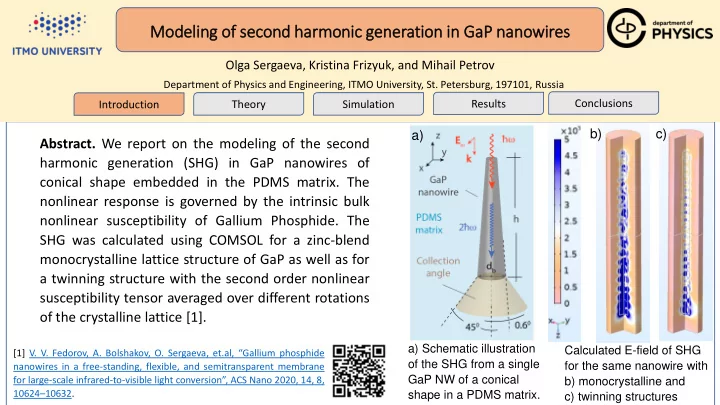
  • Abstract. We report on the modeling of the second

harmonic generation (SHG) in GaP nanowires of conical shape embedded in the PDMS matrix. The nonlinear response is governed by the intrinsic bulk nonlinear susceptibility of Gallium Phosphide. The SHG was calculated using COMSOL for a zinc-blend monocrystalline lattice structure of GaP as well as for a twinning structure with the second order nonlinear susceptibility tensor averaged over different rotations

  • f the crystalline lattice [1].

Olga Sergaeva, Kristina Frizyuk, and Mihail Petrov

Mod

  • delin

ing of

  • f se

second har armonic generation in in Ga GaP nan anowir ires

Department of Physics and Engineering, ITMO University, St. Petersburg, 197101, Russia

Introduction Theory Simulation Results

[1] V. V. Fedorov, A. Bolshakov, O. Sergaeva, et.al, “Gallium phosphide nanowires in a free-standing, flexible, and semitransparent membrane for large-scale infrared-to-visible light conversion”, ACS Nano 2020, 14, 8, 10624–10632.

Calculated E-field of SHG for the same nanowire with b) monocrystalline and c) twinning structures

a) b) c)

Conclusions a) Schematic illustration

  • f the SHG from a single

GaP NW of a conical shape in a PDMS matrix.

slide-2
SLIDE 2

The second order induced nonlinear polarization:

Introduction Theory Simulation Results Conclusions Mo Modelin ing g of

  • f secon
  • nd ha

harmonic ic gen eneratio ion in n GaP GaP nan nanowir ires Olga Sergaeva, Kristina Frizyuk, and Mihail Petrov

The polarization for the [100] structure: The polarization tensor for the averaged structure: The polarization tensor for the [111] twinning structure:

[1] ACS Nano 2020, 14, 8, 10624–10632. [5] Phys. Rev. B 99, 075425 (2019).

slide-3
SLIDE 3

Mo Modelin ing g of

  • f secon
  • nd ha

harmonic ic gen eneratio ion in n GaP GaP nan nanowir ires Olga Sergaeva, Kristina Frizyuk, and Mihail Petrov

We model [1] the second harmonic generation in 3 μm-long GaP nanowires of conical shape with different diameters embedded in the PDMS matrix using COMSOL

  • Multiphysics. Gallium Phosphide is a noncentrosymmetric material with second order

nonlinear susceptibility 𝝍(2) ~ 70 pm/V allowing bulk SHG; it has a high refractive index and broad transparency range [2-5]. The modeling includes the numerical simulation of the plane wave scattering at the fundamental wavelength followed by the simulation of SHG based on the calculation of induced by 𝝍(2) second-order polarization [5]. For the SHG calculation, we utilize second order nonlinear susceptibility tensor 𝝍(2) for a zinc-blend monocrystalline lattice structure of GaP as well as a twinning structure with the tensor 𝝍(2) averaged over different rotations of the crystalline lattice.

[1] V. V. Fedorov, A. Bolshakov, O. Sergaeva, et.al, “Gallium phosphide nanowires in a free-standing, flexible, and semitransparent membrane for large-scale infrared-to-visible light conversion”, ACS Nano 2020, 14, 8, 10624–10632. [2] L. Carletti, A. Locatelli, D. Neshev, and C. De Angelis, “Shaping the Radiation Pattern of Second-Harmonic Generation from AlGaAs Dielectric Nanoantennas”, ACS Photonics 3 (8), 1500-1507 (2016). [3] R. Sanatinia, M. Swillo, S. Anand, “Surface Second-Harmonic Generation from Vertical GaP Nanopillars”, Nano Lett. 12 (2), 820–826 (2012). [4] J. Cambiasso, “Bridging the gap between dielectric nanophotonics and the visible regime with effectively lossless gallium phosphide antennas”, Nano Lett. 17 (2), 1219-1225 (2017). [5] K. Frizyuk, I. Volkovskaya, D. Smirnova, A. Poddubny, and M. Petrov, “Second-harmonic generation in Mie- resonant dielectric nanoparticles made of noncentrosymmetric materials”, Phys. Rev. B 99, 075425 (2019).

Introduction Theory Simulation Results Conclusions

slide-4
SLIDE 4

a) Red line: calculated scattering efficiency for GaP nanowire tapered with an angle of 0.6°, with bottom diameter 100 nm, and height 3 μm Blue and black lines: SHG efficiency for the same nanowire with monocrystalline and twinning structures

The second harmonic resonances correspond to the resonances at the fundamental wavelength, which emerge due to the excitation and constructive interference of the Fabry-Perot modes propagating along the nanowire. Also, the SHG is modulated by the phase-matching conditions. Both monocrystalline and twinning structured Gallium Phosphide single nanowires demonstrate high second harmonic generation efficiency (see Fig.). The arrays of such GaP nanowires embedded in PDMS membrane allow very efficient second harmonic generation, which was explored experimentally [1].

[1] V. V. Fedorov, A. Bolshakov, O. Sergaeva, et. al, ACS Nano 2020, 14, 8, 10624–10632.

b) c) a)

Introduction Theory Simulation Results Conclusions Mo Modelin ing g of

  • f secon
  • nd ha

harmonic ic gen eneratio ion in n GaP GaP nan nanowir ires Olga Sergaeva, Kristina Frizyuk, and Mihail Petrov

Calculated E-field of SHG for the same nanowire with b) monocrystalline and c) twinning structures (b) (c)

slide-5
SLIDE 5

ACS Nano 2020, 14, 8, 10624–10632.

Introduction Theory Simulation Results Conclusions Mo Modelin ing g of

  • f secon
  • nd ha

harmonic ic gen eneratio ion in n GaP GaP nan nanowir ires Olga Sergaeva, Kristina Frizyuk, and Mihail Petrov

ACS Nano 2020, 14, 8, 10624–10632. Contacts E-mail: o.sergayeva@metalab.ifmo.ru

We report on the efficient second-harmonic generation in a free-standing GaP nanowire array encapsulated in a PDMS membrane. Light coupling with optical resonances and field confinement in the nanowires together with high nonlinearity of GaP material yield a strong second-harmonic signal and efficient near-infrared (800-1200 nm) to visible upconversion.

slide-6
SLIDE 6

Contacts E-mail: o.sergayeva@metalab.ifmo.ru ACS Nano 2020, 14, 8, 10624–10632.

Introduction Theory Simulation Results Conclusions Mo Modelin ing g of

  • f secon
  • nd ha

harmonic ic gen eneratio ion in n GaP GaP nan nanowir ires Olga Sergaeva, Kristina Frizyuk, and Mihail Petrov

ACS Nano 2020, 14, 8, 10624–10632.

Aknowledgments The work is supported by the President of Russian Federation Grant

  • No. МК-2360.2020.2.