MUL TI -DISC IPLINARY RISK IDENTIFIC ATION AND EVALUATION FOR THE - - PowerPoint PPT Presentation

mul ti disc iplinary risk identific ation and evaluation
SMART_READER_LITE
LIVE PREVIEW

MUL TI -DISC IPLINARY RISK IDENTIFIC ATION AND EVALUATION FOR THE - - PowerPoint PPT Presentation

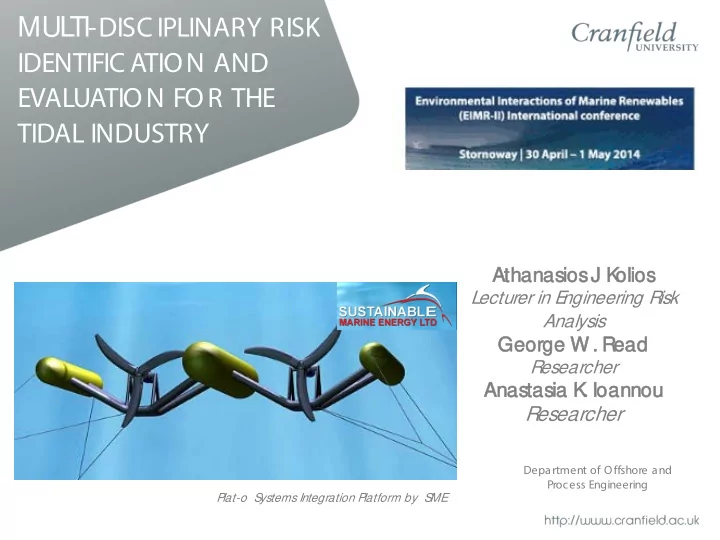
MUL TI -DISC IPLINARY RISK IDENTIFIC ATION AND EVALUATION FOR THE TIDAL INDUSTRY Athanasi sios s J K olios Lecturer in E ngineering Risk Analysis Geo eorge W . Rea ead Researcher Anas astas asia a K . Io Ioannou Researcher


slide-1
SLIDE 1

MUL TI-DISC IPLINARY RISK IDENTIFIC ATION AND EVALUATION FOR THE TIDAL INDUSTRY

Department of Offshore and Process Engineering

Athanasi sios s J K

  • lios

Lecturer in E ngineering Risk Analysis

Geo eorge W . Rea ead

Researcher

Anas astas asia a K . Io Ioannou Researcher

P lat-o S ystems Integration P latform by S ME

slide-2
SLIDE 2

Introduction/Ove vervi view

  • Aim of the study
  • Methodology
  • P

E S TLE analysis

  • S

takeholder identification

  • Risk identification
  • Multidisciplinary risk assessment
  • Results
  • Conclusions
  • F

uture work

2

slide-3
SLIDE 3

Aim of

  • f the study

dy

  • Id

Identify stakeholders and risks of in- stream tidal industry, based on a P E S E S TLE segmentation analysis

  • P

rio iorit itise risks through establishing a generic multi-disciplinary analysis framework

  • Highlight key risk

sks s that should be mitig igated towards further development

  • f the industry

3

slide-4
SLIDE 4

P E S TLE approach

4

  • Despite there being numerous

reports focusing on individual or just a few aspects of risk, there is a lack k

  • f a compreh

ehensive e risk register er covering all of the P E S TLE factors.

  • S

imilar approaches have been compiled for competing industries

  • A thorough P

E S TLE analysis allows the grea eater er picture (macro- environmental) to be looked at instead of focusing on certain aspects of projects

slide-5
SLIDE 5

S takeholder ident ntification ( n (cont nt.)

5

  • P
  • litical stakeholders: International,

E uropean and UK national

  • E

conomic S takeholders: P ublic, private sector, investors etc

  • S
  • cial S

takeholders: Communities, fishing, shipping etc

  • T

echnological S takeholders: Developers and researchers

  • L

egal S takeholders: National and E U level directives

  • E

nvironmental S takeholders: Government departments, charities etc

slide-6
SLIDE 6

S takeholder i identif ific icatio ion

6

POLITICAL ECONOMIC SOCIAL ACER Competing conventional energy RNLI Department of Energy Northern Ireland CORDIS Commercial Shipping EU-Ocean Energy Association DOENI Dredging Communities European Commission Energy Technologies Inst. Emergency Services International Energy Agency European Commission Fishing Communities IRENA Green Investment Bank Local Communities Local Councils Insurers National Support RenewableUK Market Competition Royal Yaught Association Scottish Government Other Public Investors Tourism Scottish Ministers (W&T) Private Banks Surfers The Carbon Trust Private Investors The Energy Community Scottish Ministers UK Government - DECC Technology Strategy Board UNESCO The Carbon Trust United Nations - DESA The Crown Estates Welsh Assembly Government UK Government - DECC TECHNOLOGICAL LEGAL ENVIRONMENTAL CORDIS DEFRA CEFAS Classification e.g. Lloyd's Register & DNV European Commission DEFRA ICEPT/UKERC Marine licensing Scotland Environment Agency Manufacturers Marine Licensing Wales Environment and Countryside Dpt. Marine Installation & Commissioners Marine Management Org. EU-OEA National Grid National Grid European Commission Other Industries e.g. Offshore Wind Renewable Energy Lawyers JNCC RenewableUK The Crown Estates Marine Management Org Suppliers & Supply Chain UK Government Natural England Technology Strategy Board United Nations (Law of the Sea) RAFTS Test Sites e.g. EMEC & Wavehub RSPB UK Tidal Developers* Scottish Heritage UK Research Organisations e.g. Universities WWF

slide-7
SLIDE 7

Risk Identif ific icatio ion

7 POLITICAL

European level politics Environmental related politics UN not supporting future renewable energy developments Politicians may focus on proven renewable energy sources National level politics – insecurity of part in power Government cut backs in spending for renewables Difference in regional political support within the UK

ECONOMIC

Securing (private) capital investment Financing through banking system High cost of technology at current True cost of tidal developments (CAPEX & OPEX) Unit and array deployment Current projection for investment pay off Global recession and uncertainty of future economy Public sector investment/involvement including R&D funding Cost of electricity from tidal energy Government incentives (subsidies) Competing renewable technologies Competing conventional technologies Insurer risk Cost effective technology

SOCIAL

Social groups being ignored/not being involved Social groups delaying/stopping a project Local scale opposition National level opposition Public acceptance Public support Awareness of technology Fishing communities – incentive schemes Commercial and recreational boating Emergency services Tourism Resistance of existing technology
slide-8
SLIDE 8

Risk Identif ific icatio ion (cont.) .)

8 TECHNOLOGICAL

Maturity of technology Understanding the engineering of the technology Engineering design uncertainty Engineering design of components Supply chain Reliability (component & system) Effective power output Fragmented industry (no widely accepted configuration) Support methods Anchoring & mooring Design variability based on depth and conditions Restriction in prototyping and lack of numerical tools System efficiency on array scale development Availability of design standards and certification guidelines Installation & commissioning Grid connection Maintenance Removal and decommissioning Transferability of knowledge from similar industries

LEGAL

Changes in legislation Complicated legislation Commitment to legally bound renewable targets Strategic Environmental Assessments Environmental Impact Assessments Difference in legislation between different countries Overlooking details of legislation Planning permission Licensing Intellectual property Costs associated with legal battles

ENVIRONMENTAL

Carbon footprint and lifecycle assessment Short term Environmental damage Long term environmental damage Unknown environmental impacts Environmentalists causing delays Indirect environmental damage Collision risk Sound and light emissions Farm scale impact

slide-9
SLIDE 9

S takehold lder s sur urvey

  • W eb

eb-ba based d survey with anonymity of responses

  • Limited num

umber of que uestions and LIK E R E RT scale

  • Input requested:
  • Evaluate risks (list of 72 risks)
  • Provide category of activity
  • Perceived level of importance of each category
  • Perceived level of expertise
  • In total 68

68 responses; 30 industrial and 38 academics stakeholders

  • Resp

sponse se rate above 1 5 1 5% across both categories

  • Industry had a very effective spread of resu

sults s across the PESTLE categories with the exception of legal stakeholders

  • Majority of academic resp

sponses s were technological, with sufficient responses in environmental and economic

9

slide-10
SLIDE 10

Multid idis isciplin inary risk asse ssessm ssment

  • MCDM

DM methods are widely applied in decision making for ranking of different

  • ptions subject to different criteria

ia

  • In this instance criteria are considered

the cumulative scores of each risk from each category of stakeholders

  • T

echnique for Order of P reference by S imilarity to Ideal S

  • lution (T

OP S IS ) has been selected here, normalising the results and ranking them based on their relative distance from a theo eoretical idea eal positive and negative ideal solutions

1

slide-11
SLIDE 11

Indus ustry S ur urvey R Result ults

  • Risk analysis ranked ‘private

e inves estmen ent’, ‘inves estment pay off period’ and ‘reli liabili lity’ as the most critical risks in the sector.

  • T
  • T
  • p 1

0 of risks comprised of 4 economic, 5 technological and 1 political risk.

  • No legal or so

social issu ssues were regarded as critical risks (top 1 0) with the majority of these three categories of risk featuring in the bottom half of the ranking.

  • The current average of P

E S TLE sectors weighting factors marked polit itic ical as 25%, economic ic 26%, social 6%, technolo logical l 26% and environmental 1 3%.

1 1

slide-12
SLIDE 12

Indus ustry S ur urvey R Result ults (cont.) .)

  • P
  • litical stakeholders identified ‘grid

d connection

  • n’ as most critical, as

well as ‘public acceptance’ and ’support’ alongside technological and economic risks.

  • E

conomic stakeholders identified ‘UN su support’ as most critical.

  • S
  • cial stakeholders identified legal, social and environmental risks as

the most critical. The most critical risks were ‘internat ational al legi gislat ation’.

  • ‘S

upport struc uctur ure’ was the critical risks for technological stakeholders with technological, economic and political factors making up the remaining top 1 0 risks.

  • E

nvironmental stakeholders ranked ‘Internat ational al legi gislat ation’ as the most critical risk.

  • The legal stakeholder group were omitted from this part of the

analysis as there were only 2 responses from this stakeholders’ group.

1 2

slide-13
SLIDE 13

Result ults for Academics

  • Analysis ranked ‘c

‘cut backs in spending’, ‘m ‘maintenance’ ’ and ‘t ‘true cost’ ’ highest with 5 economic risks, 4 technological risks and 1 environmental on the top 1 0.

  • Due to the majority of the responses coming from technological

academics, it was not possible to conduct a valid analysis for each individual category.

  • This lack of participation of different stakeholder groups was down to

the fact that the majority of

  • f academic wor
  • rk in the tidal energy

industry is foc

  • cusing

g on

  • n technologi

gical aspects (with a number of environmental also), with many engineers currently working with tidal energy developers and not many having expertise in the other sectors.

1 3

slide-14
SLIDE 14

Resu sults/Obse servations

  • Ove

verall economic and technological risks are deemed most critical

  • ver both of academic and industrial results, with the academics

placing more emphasis on economic risks.

  • B
  • th ranked political risks third,

d, environ

  • nmental fourth and

d social and d legal gal risks the leas ast critical al.

  • The average industry exper

ertise e score e stood at 5.2, perhaps not reflecting the true knowledge and expertise of the stakeholders who participated, as this type of self-assessment remains subjective.

  • It is interesting to note that the highest expertise weighting group
  • verall were the technological stakeholders, with the lowest

comprising of the social and legal stakeholders.

  • The corresponding overall average

ge weigh ghting g for

  • r academics was

lower than that of industry at only 4.0.

1 4

slide-15
SLIDE 15

Conclus lusions

  • This study has looked into the stakeholder perception of risks that the

in –stream tidal industry faces

  • Through a survey risks

ks were ranke ked based on their respective criticality as well as the importance of each sector.

  • T

OP S IS multi-criteria analysis revealed overall the econ

  • nomic and

d technol

  • log
  • gical factor
  • rs to be the highest priority for both academics

and industry.

  • W ithin the industrial

l stakehold lders, individual analysis revealed that 4

  • f the 6 groups agree with the overall critical risks.
  • The biggest difference between industry and academic stakeholders

was that academics gave more of an overall score to the environmental, social and legal risks.

1 5

slide-16
SLIDE 16

Curre rrent/F uture W ork rk

  • E

x E xpand the survey in other renewable energy technologies as well as the industry as a whole

  • Introduce interviews (2 st

stage data collection) on ranking and assessing the critical risks

  • Analyse

se critical risks and potentially suggest analytical approached to ranking their criticality

  • W orks

kshop

1 6

slide-17
SLIDE 17

Quest stions… s…

Thank nk y you v u very m muc uch f for your ur attention

a.kol

  • lios
  • s@

cranfield. d.ac.uk