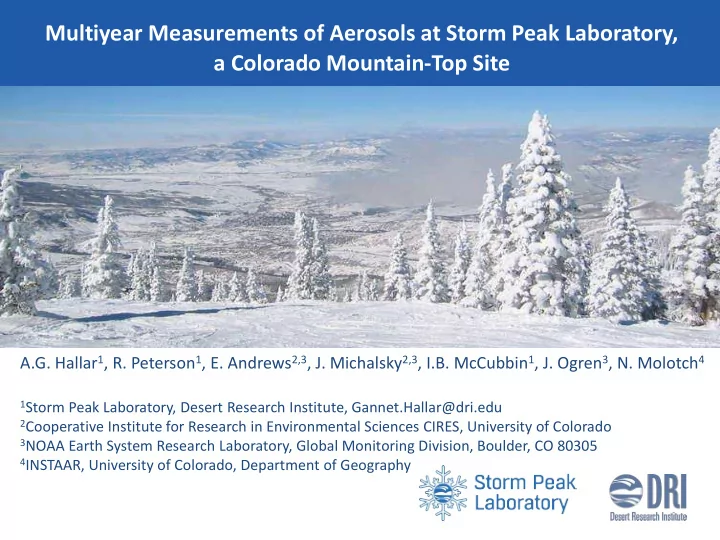
Multiyear Measurements of Aerosols at Storm Peak Laboratory, a - - PowerPoint PPT Presentation

multiyear measurements of aerosols at storm peak
SMART_READER_LITE
LIVE PREVIEW

Multiyear Measurements of Aerosols at Storm Peak Laboratory, a - - PowerPoint PPT Presentation

Storm Peak Laboratory | Desert Research Institute Multiyear Measurements of Aerosols at Storm Peak Laboratory, a Colorado Mountain-Top Site A.G. Hallar 1 , R. Peterson 1 , E. Andrews 2,3 , J. Michalsky 2,3 , I.B. McCubbin 1 , J. Ogren 3 , N.


slide-1
SLIDE 1

Storm Peak Laboratory | Desert Research Institute

Multiyear Measurements of Aerosols at Storm Peak Laboratory, a Colorado Mountain-Top Site

A.G. Hallar1, R. Peterson1, E. Andrews2,3, J. Michalsky2,3, I.B. McCubbin1, J. Ogren3, N. Molotch4

1Storm Peak Laboratory, Desert Research Institute, Gannet.Hallar@dri.edu 2Cooperative Institute for Research in Environmental Sciences CIRES, University of Colorado 3NOAA Earth System Research Laboratory, Global Monitoring Division, Boulder, CO 80305 4INSTAAR, University of Colorado, Department of Geography

slide-2
SLIDE 2

Located on Steamboat Springs Ski Resort Elevation: 3220 m (10,530 ft) Pressure: ~ 690 mb In cloud ~25% of time in winter Mixed Phase Clouds 9 Person Bunkhouse Full Kitchen, Running Water Facility and Guest Instruments Wet Chemistry Lab

Aerosol, Cloud, and Trace Gases Research and Education Facility

Storm Peak Laboratory | Desert Research Institute

slide-3
SLIDE 3

Climate Emission Drivers

Emitted Compound Radiative Forcing by Emissions and Drivers Level of Confidence CO2 Very High CH4 High Aerosols and precursors

Mineral Dust Sulphate Nitrate Organic Carbon Black Carbon

High Cloud adjustments due to aerosols Low Man’s impact relative to the year 1750 High High Medium

Radiative Forcing relative to 1750 (W m2) 1950 1980 2011

  • 1

1 2 3

Storm Peak Laboratory | Desert Research Institute

slide-4
SLIDE 4

Storm Peak Laboratory | Desert Research Institute

Climate Change Water (Drought) Dust Events Wildfires Aerosols

Framework

slide-5
SLIDE 5

Increasing Wildfires in Western U.S.

Number of fires increasing Fire size is increasing

Source: Dennison et al., GRL, 2014 .

Wildfire activity strongly associated with spring snowmelt timing, which is sensitive to changes in temperature.

Source: Westerling et al., Science 2006

Storm Peak Laboratory | Desert Research Institute

slide-6
SLIDE 6

Increasing Dust in Western U.S.

Neff et al., 2008; Nature Geoscience “dust load levels increased by 500% above the late Holocene average following the increased western settlement of the U.S. during the 19th century. …caused by the expansion of livestock grazing in the early 20th century.” Painter et al., 2007, Nature Frequency of dust deposition and radiative forcing doubled when the Colorado Plateau experienced intense drought.

Phoenix, AZ dust storm in July 2012.

Photograph by Ross D. Franklin, AP Source: Center for Snow & Avalanche Studies

Storm Peak Laboratory | Desert Research Institute

slide-7
SLIDE 7

Instrument at Storm Peak Laboratory

Visible Multifilter Rotating Shadowband Radiometer (vis-MFRSR) USDA monitoring network Data from 1999-2013 Calibrated using Langley plots (Michalsky et al. 2001) Cloud screening (Michalsky et al., 2013) Daily AOD calculated from measurements that passed cloud screening TSI integrating nephelometer (Model 3563, St. Paul, Minnesota) Data from 2011-2014 Calibrated with particle-free air and CO2 Zero checks on filtered air were performed hourly Ångström Exponent αInst = ln(฀

sp,฀ 2/฀ sp,฀ 1)/ln(฀

1/฀ 2) MFRSR ฀ 1=500 nm, ฀ 2=870 nm; Nephelometer ฀ 1=450 nm, ฀ 2=700 nm.

Storm Peak Laboratory | Desert Research Institute

slide-8
SLIDE 8

Seasonality of AOD at Storm Peak Laboratory 1999-2013

Storm Peak Laboratory | Desert Research Institute

slide-9
SLIDE 9

Fires observed at Storm Peak Laboratory

Identified by MODIS - Val Martin et al., ACP, 2013

Storm Peak Laboratory | Desert Research Institute

slide-10
SLIDE 10

Observation of Fires at Storm Peak Laboratory 1999-2013

Decreasing Particle Size

Storm Peak Laboratory | Desert Research Institute

slide-11
SLIDE 11

Observation of Fires at Storm Peak Laboratory 2011-2013

Angstrom Exponent (450nm/700nm) Scattering (550 nm)

Storm Peak Laboratory | Desert Research Institute

slide-12
SLIDE 12

Dust observed at Storm Peak Laboratory

* Average of 3 consecutive dust events at CSAS

Storm Peak Laboratory | Desert Research Institute

slide-13
SLIDE 13

Observation of Dust at Storm Peak Laboratory 1999-2013

Storm Peak Laboratory | Desert Research Institute

slide-14
SLIDE 14

Observation of Dust at Storm Peak Laboratory 2011-2013

Storm Peak Laboratory | Desert Research Institute

slide-15
SLIDE 15

Storm Peak Laboratory | Desert Research Institute

Summary

Dataset highlights wide scale implications of a warmer drier climate on aerosol loading in the Western U.S. Spring AOD is dominated by dust aerosols Summer AOD dominated by aerosols associated with biomass-burning Supported with nephelometer measurements at surface Median contribution to spring and summer AOD by dust and biomass-burning is comparable. Summer AOD correlates with large scale aridity

slide-16
SLIDE 16

Acknowledgements

Storm Peak Laboratory/Desert Research Institute:

  • Dr. Melanie Wetzel, Dr. Doug Lowenthal, P.

Tyson Atkins, Dr. Randy Borys

References: Livneh et al., 2013: A Long-Term Hydrologically Based Dataset of Land Surface Fluxes and States for the Conterminous United States: Update and Extensions. J. Climate, 26, 9384– 9392. Michalsky, J. J., et al.: Multiyear measurements of aerosol optical depth in the Atmospheric Radiation Measurement and Quantitative Links programs. Journal of Geophysical Research: Atmospheres 106.D11 (2001): 12099-12107. Michalsky, J., and B. LeBaron (2013), Fifteen-year aerosol optical depth climatology for Salt Lake City, J. Geophys. Res. Atmos., 118, 3271–3277, doi: 10.1002/jgrd.50329 Val Martin, M., et al. "A decadal satellite analysis of the origins and impacts of smoke in Colorado." Atmospheric Chemistry and Physics 13.15 (2013): 7429-7439

Storm Peak Laboratory | Desert Research Institute