N LO an d H e lic i ty Am p l i t u d es i n VIN C IA P e t e r - - PowerPoint PPT Presentation

n lo an d h e lic i ty am p l i t u d es i n vin c ia
SMART_READER_LITE
LIVE PREVIEW

N LO an d H e lic i ty Am p l i t u d es i n VIN C IA P e t e r - - PowerPoint PPT Presentation

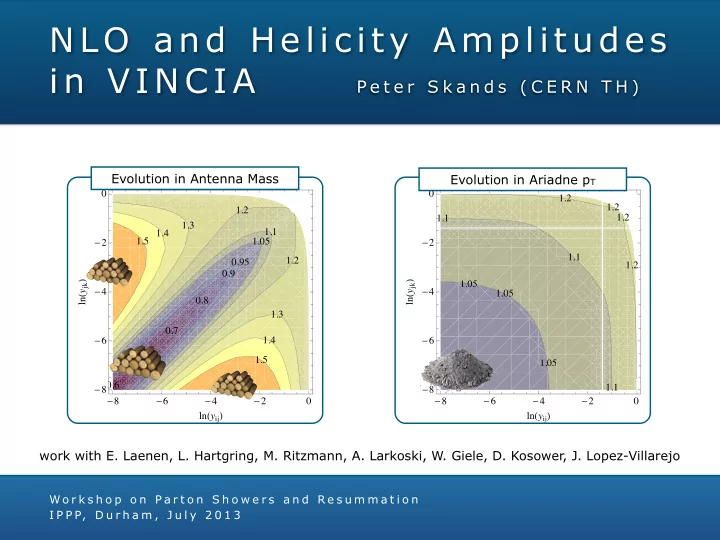
N LO an d H e lic i ty Am p l i t u d es i n VIN C IA P e t e r S k a n d s ( C E R N T H ) Evolution in Antenna Mass Evolution in Ariadne p T Q E = m D H strong L Q E = 2 p T H strong L 0 0 1.2 1.2 1.2 1.2 1.1 1.3 1.1 1.4 1.5


slide-1
SLIDE 1

P e t e r S k a n d s ( C E R N T H )

N LO an d H e lic i ty Am p l i t u d es i n VIN C IA

W o r k s h o p o n P a r t o n S h o w e r s a n d R e s u m m a t i o n I P P P, D u r h a m , J u l y 2 0 1 3

0.6 0.7 0.8 0.9 0.95 1.05 1.1 1.2 1.2 1.3 1.3 1.4 1.4 1.5 1.5

  • 8
  • 6
  • 4
  • 2
  • 8
  • 6
  • 4
  • 2

lnHyijL lnHyjkL

QE=mD HstrongL

Evolution in Antenna Mass

1.05 1.1 1.1 1.1 1.2 1.2 1.2 1.2

  • 8
  • 6
  • 4
  • 2
  • 8
  • 6
  • 4
  • 2

lnHyijL lnHyjkL

QE=2pT HstrongL

1.05 1.05

Evolution in Ariadne pT work with E. Laenen, L. Hartgring, M. Ritzmann, A. Larkoski, W. Giele, D. Kosower, J. Lopez-Villarejo

slide-2
SLIDE 2
  • P. S k a n d s

1 1 i j k I i j k I m+1 m+1 K K

VINCIA

2

Giele, Kosower, Skands, PRD 78 (2008) 014026, PRD 84 (2011) 054003 Gehrmann-de Ridder, Ritzmann, Skands, PRD 85 (2012) 014013

Written as a Plug-in to PYTHIA 8 Current Version: VINCIA 1.1.00 C++ (~20,000 lines)

Based on antenna factorization

  • of Amplitudes (exact in both soft and collinear limits)
  • of Phase Space (LIPS : 2 on-shell → 3 on-shell partons, with (E,p) cons)

Resolution Time

Infinite family of continuously deformable QE Special cases: transverse momentum, dipole mass, energy

Radiation functions

Arbitrary non-singular coefficients, anti + Massive antenna functions for massive fermions (c,b,t)

Kinematics maps

Formalism derived for arbitrary 2→3 recoil maps, κ3→2 Default: massive generalization of Kosower’s antenna maps

0.2 0.2 0.4 0.4 0.6 0.6 0.8 0.8 0.0 0.2 0.4 0.6 0.8 1.0 0.0 0.2 0.4 0.6 0.8 1.0 yij yjk ⌦ ↵ 0.2 0.4 0.6 0.8 0.0 0.2 0.4 0.6 0.8 1.0 0.0 0.2 0.4 0.6 0.8 1.0 yij yjk (c) 2 ∗√ 0.2 0.4 0.6 0.8 0.0 0.2 0.4 0.6 0.8 1.0 0.0 0.2 0.4 0.6 0.8 1.0 yij yjk

pT mD Eg vincia.hepforge.org

Virtual Numerical Collider with Interleaved Antennae

slide-3
SLIDE 3
  • P. S k a n d s

Standard Paradigm:

Have ME for X, X+1,…, X+n; Want to combine and add showers → “The Soft Stuff”

Works pretty well at low multiplicities

Still, only corrected for “hard” scales; Soft still pure LL.

At high multiplicities:

Efficiency problems: slowdown from need to compute and generate phase space from dσX+n, and from accept/reject/ reweighting/unweighting steps Scale hierarchies: smaller single-scale phase-space region Powers of alphaS pile up

Better Starting Point: a QCD fractal?

Matrix-Element Matching

3

Double counting, IR divergences, multiscale logs |MX|2 |MX+1|2 |MX+2|2

Matching Scheme

Qcut

Showers

“Fake Sudakovs” from Clusterings or Pseudoshowers dσX+n from Reweightings or Subtractions

slide-4
SLIDE 4
  • P. S k a n d s

Standard Paradigm:

Have ME for X, X+1,…, X+n; Want to combine and add showers → “The Soft Stuff”

Works pretty well at low multiplicities

Still, only corrected for “hard” scales; Soft still pure LL.

Matrix-Element Matching

4

Double counting, IR divergences, multiscale logs

slide-5
SLIDE 5
  • P. S k a n d s

Standard Paradigm:

Have ME for X, X+1,…, X+n; Want to combine and add showers → “The Soft Stuff”

Works pretty well at low multiplicities

Still, only corrected for “hard” scales; Soft still pure LL.

At high multiplicities:

Efficiency problems: slowdown from need to compute and generate phase space from dσX+n, and from unweighting Scale hierarchies: smaller single-scale phase-space region Powers of alphaS pile up

Matrix-Element Matching

4

Double counting, IR divergences, multiscale logs

slide-6
SLIDE 6
  • P. S k a n d s

Standard Paradigm:

Have ME for X, X+1,…, X+n; Want to combine and add showers → “The Soft Stuff”

Works pretty well at low multiplicities

Still, only corrected for “hard” scales; Soft still pure LL.

At high multiplicities:

Efficiency problems: slowdown from need to compute and generate phase space from dσX+n, and from unweighting Scale hierarchies: smaller single-scale phase-space region Powers of alphaS pile up

Better Starting Point: a QCD fractal?

Matrix-Element Matching

4

Double counting, IR divergences, multiscale logs

slide-7
SLIDE 7
  • P. S k a n d s

Interleaved Paradigm:

Have shower; want to improve it using ME for X, X+1, …, X+n.

Matrix-Element Corrections

5

slide-8
SLIDE 8
  • P. S k a n d s

Interleaved Paradigm:

Have shower; want to improve it using ME for X, X+1, …, X+n.

Interpret all-orders shower structure as a trial distribution

Quasi-scale-invariant: intrinsically multi-scale (resums logs) Unitary: automatically unweighted (& IR divergences → multiplicities) More precise expressions imprinted via veto algorithm: ME corrections at LO, NLO, and more? → soft and hard No additional phase-space generator or σX+n calculations → fast

Matrix-Element Corrections

5

slide-9
SLIDE 9
  • P. S k a n d s

Interleaved Paradigm:

Have shower; want to improve it using ME for X, X+1, …, X+n.

Interpret all-orders shower structure as a trial distribution

Quasi-scale-invariant: intrinsically multi-scale (resums logs) Unitary: automatically unweighted (& IR divergences → multiplicities) More precise expressions imprinted via veto algorithm: ME corrections at LO, NLO, and more? → soft and hard No additional phase-space generator or σX+n calculations → fast

Existing Approaches:

First Order: PYTHIA and POWHEG Beyond First Order: PYTHIA → too complicated. POWHEG → very active, still mostly in framework of standard paradigm. GENEVA?

Interleaved Paradigm:

Have shower; want to improve it using ME for X, X+1, …, X+n.

Interpret all-orders shower structure as a trial distribution

Quasi-scale-invariant: intrinsically multi-scale (resums logs) Unitary: automatically unweighted (& IR divergences → multiplicities) More precise expressions imprinted via veto algorithm: ME corrections at LO, NLO, and more? → soft and hard No additional phase-space generator or σX+n calculations → fast

Existing Approaches:

First Order: PYTHIA and POWHEG Beyond First Order: PYTHIA → too complicated. POWHEG → very active, still mostly in framework of standard paradigm. GENEVA?

Matrix-Element Corrections

5

slide-10
SLIDE 10
  • P. S k a n d s

Problems:

Traditional parton showers are history-dependent (non-Markovian) → Number of generated terms (possible clustering histories) grows like 2NN! + Complicated kinematics + Dead zones

Solutions: Markovian Evolution, Matched Antenna Showers, and Smooth Ordering

No need to ever cluster back more than one step → Number of generated terms grows like N + Simple expansions + Dead zones merely suppressed

Markov is Crucial

6

LO: Giele, Kosower, Skands, PRD 84 (2011) 054003 NLO: Hartgring, Laenen, Skands, arXiv:1303.4974

Parton- (or Catani-Seymour) Shower:

After 2 branchings: 8 terms After 3 branchings: 48 terms After 4 branchings: 384 terms

slide-11
SLIDE 11
  • P. S k a n d s

Problems:

Traditional parton showers are history-dependent (non-Markovian) → Number of generated terms (possible clustering histories) grows like 2NN! + Complicated kinematics + Dead zones

Solutions: Markovian Evolution, Matched Antenna Showers, and Smooth Ordering

No need to ever cluster back more than one step → Number of generated terms grows like N + Simple expansions + Dead zones merely suppressed

Markov is Crucial

6

LO: Giele, Kosower, Skands, PRD 84 (2011) 054003 NLO: Hartgring, Laenen, Skands, arXiv:1303.4974

Parton- (or Catani-Seymour) Shower:

After 2 branchings: 8 terms After 3 branchings: 48 terms After 4 branchings: 384 terms

slide-12
SLIDE 12
  • P. S k a n d s

Problems:

Traditional parton showers are history-dependent (non-Markovian) → Number of generated terms (possible clustering histories) grows like 2NN! + Complicated kinematics + Dead zones

Solutions: Markovian Evolution, Matched Antenna Showers, and Smooth Ordering

No need to ever cluster back more than one step → Number of generated terms grows like N + Simple expansions + Dead zones merely suppressed

Markov is Crucial

7

LO: Giele, Kosower, Skands, PRD 84 (2011) 054003 NLO: Hartgring, Laenen, Skands, arXiv:1303.4974

Parton- (or Catani-Seymour) Shower:

After 2 branchings: 8 terms After 3 branchings: 48 terms After 4 branchings: 384 terms

Markovian Antenna Shower:

After 2 branchings: 2 terms After 3 branchings: 3 terms After 4 branchings: 4 terms

slide-13
SLIDE 13
  • P. S k a n d s

What is Smooth Ordering?

8

2 Z /m 2 T1 4p ln
  • 5
  • 4
  • 3
  • 2
  • 1
2 T1 /p 2 T2 p ln
  • 5
  • 4
  • 3
  • 2
  • 1
1 2 3 4 5 6

q qgg → Z

VINCIA 1.025 ANT = DEF AR ψ KIN = ORD = PHASESPACE

>

4

<R

→ Ordered | 2nd | Unordered ← → Soft | 1st Branching | Hard ← 2 Z /m 2 T1 4p ln
  • 5
  • 4
  • 3
  • 2
  • 1
2 T1 /p 2 T2 p ln
  • 5
  • 4
  • 3
  • 2
  • 1
1 2 3 4 5 6

q qgg → Z

VINCIA 1.025 ANT = DEF AR ψ KIN = (strong) T 2 ORD = p

>

4

<R

→ Ordered | 2nd | Unordered ← → Soft | 1st Branching | Hard ← 2 Z /m 2 4p ln
  • 5
  • 4
  • 3
  • 2
  • 1
2 T1 /p 2 T2 p ln
  • 5
  • 4
  • 3
  • 2
  • 1
1 2 3 4 5 6

q qgg → Z

VINCIA 1.025 ANT = DEF AR ψ KIN = (smooth) T 2 ORD = p

>

4

<R

→ Ordered | 2nd | Unordered ← → Soft | 1st Branching | Hard ←

Ln(r2→3) Ln(r3→4) Ordered Unordered

Dead Zone

Phase Space Only Strong Ordering Smooth Ordering

Ln(r2→3) Ln(r2→3) Ln(r3→4)

Strongly Ordered Strongly Ordered Strongly Ordered

r = q2 ˆ q2

0.1 0.2 0.5 1.0 2.0 5.0 10.0 0.01 0.02 0.05 0.10 0.20 0.50 1.00 HQêQ ` L2 Pimp 0.1 0.2 0.5 1.0 2.0 5.0 10.0 0.01 0.02 0.05 0.10 0.20 0.50 1.00 HQêQ ` L2 Pimp

Strong Ordering Smooth Ordering

Pstrong = Θ

  • ˆ

p2

⊥ − p2 ⊥

  • Psmooth =

ˆ p2

ˆ p2

⊥ + p2 ⊥

1 p2

✓ 1 − O ✓p2

ˆ p2

◆◆ ˆ p2

p4

✓ 1 − O ✓ ˆ p2

p2

◆◆ ⊗ 1 p2

Strongly Ordered Limit Strongly Unordered

A2→3 Giele, Kosower, Skands, PRD 84 (2011) 054003 NB: Antenna Phase Spaces still nested (antenna masses strongly ordered and decreasing)

slide-14
SLIDE 14
  • P. S k a n d s

New: Markovian pQCD

9

Legs Loops +0 +1 +2 +0 +1 +2 +3

|MF|2

The VINCIA Code PYTHIA 8

+

“Higher-Order Corrections To Timelike Jets” GeeKS: Giele, Kosower, Skands, PRD 84 (2011) 054003

Start at Born level

NLO: Hartgring, Laenen, Skands, arXiv:1303.4974 HEL: Larkoski, Lopez-Villarejo, Skands, PRD 87 (2013) 054033

slide-15
SLIDE 15
  • P. S k a n d s

New: Markovian pQCD

9

Legs Loops +0 +1 +2 +0 +1 +2 +3

|MF|2

Generate “shower” emission

|MF+1|2 LL ∼ X

i∈ant

ai |MF|2

The VINCIA Code PYTHIA 8

+

“Higher-Order Corrections To Timelike Jets” GeeKS: Giele, Kosower, Skands, PRD 84 (2011) 054003

Start at Born level

NLO: Hartgring, Laenen, Skands, arXiv:1303.4974 HEL: Larkoski, Lopez-Villarejo, Skands, PRD 87 (2013) 054033

slide-16
SLIDE 16
  • P. S k a n d s

New: Markovian pQCD

9

Legs Loops +0 +1 +2 +0 +1 +2 +3

|MF|2

Generate “shower” emission

|MF+1|2 LL ∼ X

i∈ant

ai |MF|2

Correct to Matrix Element

The VINCIA Code

X

ai → |MF+1|2 P ai|MF|2 ai →

PYTHIA 8

+

“Higher-Order Corrections To Timelike Jets” GeeKS: Giele, Kosower, Skands, PRD 84 (2011) 054003

Start at Born level

NLO: Hartgring, Laenen, Skands, arXiv:1303.4974 HEL: Larkoski, Lopez-Villarejo, Skands, PRD 87 (2013) 054033

slide-17
SLIDE 17
  • P. S k a n d s

New: Markovian pQCD

9

Legs Loops +0 +1 +2 +0 +1 +2 +3

|MF|2

Generate “shower” emission

|MF+1|2 LL ∼ X

i∈ant

ai |MF|2

Correct to Matrix Element Unitarity of Shower

P | | Virtual = − Z Real

The VINCIA Code

X

ai → |MF+1|2 P ai|MF|2 ai →

PYTHIA 8

+

“Higher-Order Corrections To Timelike Jets” GeeKS: Giele, Kosower, Skands, PRD 84 (2011) 054003

Start at Born level

NLO: Hartgring, Laenen, Skands, arXiv:1303.4974 HEL: Larkoski, Lopez-Villarejo, Skands, PRD 87 (2013) 054033

slide-18
SLIDE 18
  • P. S k a n d s

New: Markovian pQCD

9

Legs Loops +0 +1 +2 +0 +1 +2 +3

|MF|2

Generate “shower” emission

|MF+1|2 LL ∼ X

i∈ant

ai |MF|2

Correct to Matrix Element Unitarity of Shower

P | | Virtual = − Z Real

Correct to Matrix Element

Z |MF|2 → |MF|2 + 2Re[M 1

FM 0 F] +

Z Real

The VINCIA Code

X

ai → |MF+1|2 P ai|MF|2 ai →

PYTHIA 8

+

“Higher-Order Corrections To Timelike Jets” GeeKS: Giele, Kosower, Skands, PRD 84 (2011) 054003

Start at Born level

NLO: Hartgring, Laenen, Skands, arXiv:1303.4974 HEL: Larkoski, Lopez-Villarejo, Skands, PRD 87 (2013) 054033

slide-19
SLIDE 19
  • P. S k a n d s

New: Markovian pQCD

9

Legs Loops +0 +1 +2 +0 +1 +2 +3

|MF|2

Generate “shower” emission

|MF+1|2 LL ∼ X

i∈ant

ai |MF|2

Correct to Matrix Element Unitarity of Shower

P | | Virtual = − Z Real

Correct to Matrix Element

Z |MF|2 → |MF|2 + 2Re[M 1

FM 0 F] +

Z Real

The VINCIA Code

X

ai → |MF+1|2 P ai|MF|2 ai →

PYTHIA 8

+

“Higher-Order Corrections To Timelike Jets” GeeKS: Giele, Kosower, Skands, PRD 84 (2011) 054003

Start at Born level M a r k

  • v

i a n R e p e a t

NLO: Hartgring, Laenen, Skands, arXiv:1303.4974 HEL: Larkoski, Lopez-Villarejo, Skands, PRD 87 (2013) 054033

slide-20
SLIDE 20
  • P. S k a n d s

New: Markovian pQCD

9

Legs Loops +0 +1 +2 +0 +1 +2 +3

|MF|2

Generate “shower” emission

|MF+1|2 LL ∼ X

i∈ant

ai |MF|2

Correct to Matrix Element Unitarity of Shower

P | | Virtual = − Z Real

Correct to Matrix Element

Z |MF|2 → |MF|2 + 2Re[M 1

FM 0 F] +

Z Real

The VINCIA Code

X

ai → |MF+1|2 P ai|MF|2 ai →

PYTHIA 8

+

“Higher-Order Corrections To Timelike Jets” GeeKS: Giele, Kosower, Skands, PRD 84 (2011) 054003

Start at Born level M a r k

  • v

i a n R e p e a t

NLO: Hartgring, Laenen, Skands, arXiv:1303.4974 HEL: Larkoski, Lopez-Villarejo, Skands, PRD 87 (2013) 054033

slide-21
SLIDE 21
  • P. S k a n d s

New: Markovian pQCD

9

Legs Loops +0 +1 +2 +0 +1 +2 +3

|MF|2

Generate “shower” emission

|MF+1|2 LL ∼ X

i∈ant

ai |MF|2

Correct to Matrix Element Unitarity of Shower

P | | Virtual = − Z Real

Correct to Matrix Element

Z |MF|2 → |MF|2 + 2Re[M 1

FM 0 F] +

Z Real

The VINCIA Code

X

ai → |MF+1|2 P ai|MF|2 ai →

PYTHIA 8

+

“Higher-Order Corrections To Timelike Jets” GeeKS: Giele, Kosower, Skands, PRD 84 (2011) 054003

Start at Born level M a r k

  • v

i a n R e p e a t

NLO: Hartgring, Laenen, Skands, arXiv:1303.4974 HEL: Larkoski, Lopez-Villarejo, Skands, PRD 87 (2013) 054033

slide-22
SLIDE 22
  • P. S k a n d s

New: Markovian pQCD

9

Legs Loops +0 +1 +2 +0 +1 +2 +3

|MF|2

Generate “shower” emission

|MF+1|2 LL ∼ X

i∈ant

ai |MF|2

Correct to Matrix Element Unitarity of Shower

P | | Virtual = − Z Real

Correct to Matrix Element

Z |MF|2 → |MF|2 + 2Re[M 1

FM 0 F] +

Z Real

The VINCIA Code

X

ai → |MF+1|2 P ai|MF|2 ai →

PYTHIA 8

+

“Higher-Order Corrections To Timelike Jets” GeeKS: Giele, Kosower, Skands, PRD 84 (2011) 054003

Start at Born level M a r k

  • v

i a n R e p e a t

NLO: Hartgring, Laenen, Skands, arXiv:1303.4974 HEL: Larkoski, Lopez-Villarejo, Skands, PRD 87 (2013) 054033

slide-23
SLIDE 23
  • P. S k a n d s

New: Markovian pQCD

9

Legs Loops +0 +1 +2 +0 +1 +2 +3

|MF|2

Generate “shower” emission

|MF+1|2 LL ∼ X

i∈ant

ai |MF|2

Correct to Matrix Element Unitarity of Shower

P | | Virtual = − Z Real

Correct to Matrix Element

Z |MF|2 → |MF|2 + 2Re[M 1

FM 0 F] +

Z Real

The VINCIA Code

X

ai → |MF+1|2 P ai|MF|2 ai →

Cutting Edge: Embedding virtual amplitudes = Next Perturbative Order → Precision Monte Carlos

PYTHIA 8

+

“Higher-Order Corrections To Timelike Jets” GeeKS: Giele, Kosower, Skands, PRD 84 (2011) 054003

Start at Born level M a r k

  • v

i a n R e p e a t

NLO: Hartgring, Laenen, Skands, arXiv:1303.4974 HEL: Larkoski, Lopez-Villarejo, Skands, PRD 87 (2013) 054033

slide-24
SLIDE 24
  • P. S k a n d s

New: Markovian pQCD

9

Legs Loops +0 +1 +2 +0 +1 +2 +3

|MF|2

Generate “shower” emission

|MF+1|2 LL ∼ X

i∈ant

ai |MF|2

Correct to Matrix Element Unitarity of Shower

P | | Virtual = − Z Real

Correct to Matrix Element

Z |MF|2 → |MF|2 + 2Re[M 1

FM 0 F] +

Z Real

The VINCIA Code

X

ai → |MF+1|2 P ai|MF|2 ai →

Cutting Edge: Embedding virtual amplitudes = Next Perturbative Order → Precision Monte Carlos

PYTHIA 8

+

“Higher-Order Corrections To Timelike Jets” GeeKS: Giele, Kosower, Skands, PRD 84 (2011) 054003

Start at Born level M a r k

  • v

i a n R e p e a t

NLO: Hartgring, Laenen, Skands, arXiv:1303.4974 HEL: Larkoski, Lopez-Villarejo, Skands, PRD 87 (2013) 054033

slide-25
SLIDE 25
  • P. S k a n d s

Helicities

Traditional parton showers use the standard Altarelli-Parisi kernels, P(z) = helicity sums/averages over:

10

Larkoski, Peskin, PRD 81 (2010) 054010 Larkoski, Lopez-Villarejo, Skands, PRD 87 (2013) 054033

++ −+ +− −− g+ → gg : 1/z(1 − z) (1 − z)3/z z3/(1 − z) g+ → q¯ q :

  • (1 − z)2

z2

  • q+ → qg :

1/(1 − z)

  • z2/(1 − z)
  • q+ → gq :

1/z (1 − z)2/z

  • Helicity-dependent Altarelli-Parisi splitting functions

for splittings

Generalize these objects to dipole-antennae

MHV NMHV P-wave P-wave

→ Can match to individual helicity amplitudes rather than helicity sum → Fast! (gets rid of another factor 2N) → Can trace helicities through shower → Eliminates contribution from unphysical helicity configurations

P(z) a b c

1

  • z

z

a→bc

E.g.,

q¯ q → qg¯ q ++ → + + + ++ → + − + +− → + + − +− → + − −

αs 2π P(z)

slide-26
SLIDE 26
  • P. S k a n d s

Time to generate 1000 showers (seconds) 0.1 1 10 100 1000 10000 2 3 4 5 6 Z→n : Number of Matched Legs Initialization Time (seconds) 0.1 1 10 100 1000 2 3 4 5 6 Z→n : Number of Matched Legs

Hadronization Time (LEP)

Global Sector SHERPA Old Global Old Sector SHERPA 1.4.0 VINCIA 1.029

Z→udscb ; Hadronization OFF ; ISR OFF ; udsc MASSLESS ; b MASSIVE ; ECM = 91.2 GeV ; Qmatch = 5 GeV SHERPA 1.4.0 (+COMIX) ; PYTHIA 8.1.65 ; VINCIA 1.0.29 + MADGRAPH 4.4.26 ; gcc/gfortran v 4.7.1 -O2 ; single 3.06 GHz core (4GB RAM)

Speed

11

  • 1. Initialization time

(to pre-compute cross sections and warm up phase-space grids)

SHERPA+COMIX PYTHIA+VINCIA

  • 2. Time to generate 1000 events

(Z → partons, fully showered &

  • matched. No hadronization.)

VINCIA (GKS)

(example of state of the art)

Larkoski, Lopez-Villarejo, Skands, PRD 87 (2013) 054033

seconds

SHERPA (CKKW-L)

polarized unpolarized

1000 SHOWERS

sector global

slide-27
SLIDE 27
  • P. S k a n d s

Loop Corrections

Getting Serious: 2nd order (1st order ~ POWHEG)

12

QE mZ ∆qg(Q2

R, 0)

∆g¯

q(Q2 R, 0)

∆q¯

q(m2 Z, Q2 E)

ag/q¯

q

QR

dσq¯

q

Approximate → (1 + V0) |M0

1 |2 ∆2(m2 Z, Q2 1) ∆3(Q2 R1, Q2 had) ,

Fixed Order: Exclusive 3-jet rate (3 and only 3 jets), at Q = Qhad

V0 = αs/π

2→3 Evolution 3→4 Evolution 2→3 Evolution Step 3→4 Evolution Step

Exact → |M0

1 |2 + 2 Re[M0 1 M1∗ 1 ] +

Z Q2

had

dΦ2 dΦ1 |M0

2 |2

Born Virtual Unresolved Real

Vincia:

µR

Hartgring, Laenen, Skands, arXiv:1303.4974

slide-28
SLIDE 28
  • P. S k a n d s

Loop Corrections

NLO Correction: Subtract and correct by difference

13

V1Z(q, g, ¯ q) = 2 Re[M0

1 M1⇤ 1 ]

|M0

1 |2

LC − ↵s ⇡ − ↵s 2⇡ ✓11NC − 2nF 6 ◆ ln ✓µ2

ME

µ2

PS

◆ + ↵sCA 2⇡ " − 2I(1)

qg (✏, µ2/sqg) − 2I(1) qg (✏, µ2/sg¯ q) + 34

3 # + ↵snF 2⇡ " − 2I(1)

qg,F (✏, µ2/sqg) − 2I(1) g¯ q,F (✏, µ2/sqg) − 1

# + ↵sCA 2⇡ " 8⇡2 Z m2

Z

Q2

1

dΦant Astd

g/q¯ q + 8⇡2

Z m2

Z

Q2

1

dΦant Ag/q¯

q

2

X

j=1

8⇡2 Z sj dΦant (1 − OEj) Astd

g/qg + 2

X

j=1

8⇡2 Z sj dΦant Ag/qg # + ↵snF 2⇡ " −

2

X

j=1

8⇡2 Z sj dΦant(1 − OSj) PAj Astd

¯ q/qg + 2

X

j=1

8⇡2 Z sj dΦant A¯

q/qg

−1 6 sqg − sg¯

q

sqg + sg¯

q

ln ✓sqg sg¯

q

◆ # , (72)

OEj = Gluon-Emission Ordering Function Q1 = 3-parton Resolution Scale OSj = Gluon-Splitting Ordering Function

Hartgring, Laenen, Skands, arXiv:1303.4974

The “Ariadne” Log

slide-29
SLIDE 29
  • P. S k a n d s

Loop Corrections

NLO Correction: Subtract and correct by difference

13

V1Z(q, g, ¯ q) = 2 Re[M0

1 M1⇤ 1 ]

|M0

1 |2

LC − ↵s ⇡ − ↵s 2⇡ ✓11NC − 2nF 6 ◆ ln ✓µ2

ME

µ2

PS

◆ + ↵sCA 2⇡ " − 2I(1)

qg (✏, µ2/sqg) − 2I(1) qg (✏, µ2/sg¯ q) + 34

3 # + ↵snF 2⇡ " − 2I(1)

qg,F (✏, µ2/sqg) − 2I(1) g¯ q,F (✏, µ2/sqg) − 1

# + ↵sCA 2⇡ " 8⇡2 Z m2

Z

Q2

1

dΦant Astd

g/q¯ q + 8⇡2

Z m2

Z

Q2

1

dΦant Ag/q¯

q

2

X

j=1

8⇡2 Z sj dΦant (1 − OEj) Astd

g/qg + 2

X

j=1

8⇡2 Z sj dΦant Ag/qg # + ↵snF 2⇡ " −

2

X

j=1

8⇡2 Z sj dΦant(1 − OSj) PAj Astd

¯ q/qg + 2

X

j=1

8⇡2 Z sj dΦant A¯

q/qg

−1 6 sqg − sg¯

q

sqg + sg¯

q

ln ✓sqg sg¯

q

◆ # , (72)

V0

OEj = Gluon-Emission Ordering Function Q1 = 3-parton Resolution Scale OSj = Gluon-Splitting Ordering Function

Hartgring, Laenen, Skands, arXiv:1303.4974

The “Ariadne” Log

slide-30
SLIDE 30
  • P. S k a n d s

Loop Corrections

NLO Correction: Subtract and correct by difference

13

V1Z(q, g, ¯ q) = 2 Re[M0

1 M1⇤ 1 ]

|M0

1 |2

LC − ↵s ⇡ − ↵s 2⇡ ✓11NC − 2nF 6 ◆ ln ✓µ2

ME

µ2

PS

◆ + ↵sCA 2⇡ " − 2I(1)

qg (✏, µ2/sqg) − 2I(1) qg (✏, µ2/sg¯ q) + 34

3 # + ↵snF 2⇡ " − 2I(1)

qg,F (✏, µ2/sqg) − 2I(1) g¯ q,F (✏, µ2/sqg) − 1

# + ↵sCA 2⇡ " 8⇡2 Z m2

Z

Q2

1

dΦant Astd

g/q¯ q + 8⇡2

Z m2

Z

Q2

1

dΦant Ag/q¯

q

2

X

j=1

8⇡2 Z sj dΦant (1 − OEj) Astd

g/qg + 2

X

j=1

8⇡2 Z sj dΦant Ag/qg # + ↵snF 2⇡ " −

2

X

j=1

8⇡2 Z sj dΦant(1 − OSj) PAj Astd

¯ q/qg + 2

X

j=1

8⇡2 Z sj dΦant A¯

q/qg

−1 6 sqg − sg¯

q

sqg + sg¯

q

ln ✓sqg sg¯

q

◆ # , (72)

V0

OEj = Gluon-Emission Ordering Function Q1 = 3-parton Resolution Scale OSj = Gluon-Splitting Ordering Function

Hartgring, Laenen, Skands, arXiv:1303.4974

The “Ariadne” Log

µR

slide-31
SLIDE 31
  • P. S k a n d s

Gluon Emission IR Singularity (std antenna integral) Gluon Splitting IR Singularity (std antenna integral)

Loop Corrections

NLO Correction: Subtract and correct by difference

13

V1Z(q, g, ¯ q) = 2 Re[M0

1 M1⇤ 1 ]

|M0

1 |2

LC − ↵s ⇡ − ↵s 2⇡ ✓11NC − 2nF 6 ◆ ln ✓µ2

ME

µ2

PS

◆ + ↵sCA 2⇡ " − 2I(1)

qg (✏, µ2/sqg) − 2I(1) qg (✏, µ2/sg¯ q) + 34

3 # + ↵snF 2⇡ " − 2I(1)

qg,F (✏, µ2/sqg) − 2I(1) g¯ q,F (✏, µ2/sqg) − 1

# + ↵sCA 2⇡ " 8⇡2 Z m2

Z

Q2

1

dΦant Astd

g/q¯ q + 8⇡2

Z m2

Z

Q2

1

dΦant Ag/q¯

q

2

X

j=1

8⇡2 Z sj dΦant (1 − OEj) Astd

g/qg + 2

X

j=1

8⇡2 Z sj dΦant Ag/qg # + ↵snF 2⇡ " −

2

X

j=1

8⇡2 Z sj dΦant(1 − OSj) PAj Astd

¯ q/qg + 2

X

j=1

8⇡2 Z sj dΦant A¯

q/qg

−1 6 sqg − sg¯

q

sqg + sg¯

q

ln ✓sqg sg¯

q

◆ # , (72)

V0

OEj = Gluon-Emission Ordering Function Q1 = 3-parton Resolution Scale OSj = Gluon-Splitting Ordering Function

Hartgring, Laenen, Skands, arXiv:1303.4974

The “Ariadne” Log

µR

slide-32
SLIDE 32
  • P. S k a n d s

Gluon Emission IR Singularity (std antenna integral) Gluon Splitting IR Singularity (std antenna integral)

Loop Corrections

NLO Correction: Subtract and correct by difference

13

V1Z(q, g, ¯ q) = 2 Re[M0

1 M1⇤ 1 ]

|M0

1 |2

LC − ↵s ⇡ − ↵s 2⇡ ✓11NC − 2nF 6 ◆ ln ✓µ2

ME

µ2

PS

◆ + ↵sCA 2⇡ " − 2I(1)

qg (✏, µ2/sqg) − 2I(1) qg (✏, µ2/sg¯ q) + 34

3 # + ↵snF 2⇡ " − 2I(1)

qg,F (✏, µ2/sqg) − 2I(1) g¯ q,F (✏, µ2/sqg) − 1

# + ↵sCA 2⇡ " 8⇡2 Z m2

Z

Q2

1

dΦant Astd

g/q¯ q + 8⇡2

Z m2

Z

Q2

1

dΦant Ag/q¯

q

2

X

j=1

8⇡2 Z sj dΦant (1 − OEj) Astd

g/qg + 2

X

j=1

8⇡2 Z sj dΦant Ag/qg # + ↵snF 2⇡ " −

2

X

j=1

8⇡2 Z sj dΦant(1 − OSj) PAj Astd

¯ q/qg + 2

X

j=1

8⇡2 Z sj dΦant A¯

q/qg

−1 6 sqg − sg¯

q

sqg + sg¯

q

ln ✓sqg sg¯

q

◆ # , (72)

V0 Standard (universal) 2→3 Sudakov Logs

OEj = Gluon-Emission Ordering Function Q1 = 3-parton Resolution Scale OSj = Gluon-Splitting Ordering Function

Hartgring, Laenen, Skands, arXiv:1303.4974

The “Ariadne” Log

µR

slide-33
SLIDE 33
  • P. S k a n d s

Gluon Emission IR Singularity (std antenna integral) Gluon Splitting IR Singularity (std antenna integral) Standard (universal) 3→4 Sudakov Logs: CA

Loop Corrections

NLO Correction: Subtract and correct by difference

13

V1Z(q, g, ¯ q) = 2 Re[M0

1 M1⇤ 1 ]

|M0

1 |2

LC − ↵s ⇡ − ↵s 2⇡ ✓11NC − 2nF 6 ◆ ln ✓µ2

ME

µ2

PS

◆ + ↵sCA 2⇡ " − 2I(1)

qg (✏, µ2/sqg) − 2I(1) qg (✏, µ2/sg¯ q) + 34

3 # + ↵snF 2⇡ " − 2I(1)

qg,F (✏, µ2/sqg) − 2I(1) g¯ q,F (✏, µ2/sqg) − 1

# + ↵sCA 2⇡ " 8⇡2 Z m2

Z

Q2

1

dΦant Astd

g/q¯ q + 8⇡2

Z m2

Z

Q2

1

dΦant Ag/q¯

q

2

X

j=1

8⇡2 Z sj dΦant (1 − OEj) Astd

g/qg + 2

X

j=1

8⇡2 Z sj dΦant Ag/qg # + ↵snF 2⇡ " −

2

X

j=1

8⇡2 Z sj dΦant(1 − OSj) PAj Astd

¯ q/qg + 2

X

j=1

8⇡2 Z sj dΦant A¯

q/qg

−1 6 sqg − sg¯

q

sqg + sg¯

q

ln ✓sqg sg¯

q

◆ # , (72)

V0 Standard (universal) 2→3 Sudakov Logs

OEj = Gluon-Emission Ordering Function Q1 = 3-parton Resolution Scale OSj = Gluon-Splitting Ordering Function

Hartgring, Laenen, Skands, arXiv:1303.4974

The “Ariadne” Log

µR

slide-34
SLIDE 34
  • P. S k a n d s

Gluon Emission IR Singularity (std antenna integral) Gluon Splitting IR Singularity (std antenna integral) Standard (universal) 3→4 Sudakov Logs: CA

Loop Corrections

NLO Correction: Subtract and correct by difference

13

V1Z(q, g, ¯ q) = 2 Re[M0

1 M1⇤ 1 ]

|M0

1 |2

LC − ↵s ⇡ − ↵s 2⇡ ✓11NC − 2nF 6 ◆ ln ✓µ2

ME

µ2

PS

◆ + ↵sCA 2⇡ " − 2I(1)

qg (✏, µ2/sqg) − 2I(1) qg (✏, µ2/sg¯ q) + 34

3 # + ↵snF 2⇡ " − 2I(1)

qg,F (✏, µ2/sqg) − 2I(1) g¯ q,F (✏, µ2/sqg) − 1

# + ↵sCA 2⇡ " 8⇡2 Z m2

Z

Q2

1

dΦant Astd

g/q¯ q + 8⇡2

Z m2

Z

Q2

1

dΦant Ag/q¯

q

2

X

j=1

8⇡2 Z sj dΦant (1 − OEj) Astd

g/qg + 2

X

j=1

8⇡2 Z sj dΦant Ag/qg # + ↵snF 2⇡ " −

2

X

j=1

8⇡2 Z sj dΦant(1 − OSj) PAj Astd

¯ q/qg + 2

X

j=1

8⇡2 Z sj dΦant A¯

q/qg

−1 6 sqg − sg¯

q

sqg + sg¯

q

ln ✓sqg sg¯

q

◆ # , (72)

V0 Standard (universal) 2→3 Sudakov Logs

OEj = Gluon-Emission Ordering Function Q1 = 3-parton Resolution Scale OSj = Gluon-Splitting Ordering Function

Hartgring, Laenen, Skands, arXiv:1303.4974

The “Ariadne” Log

Standard (universal) 3→4 Sudakov Logs: nF µR

appendix of our paper + functions in the code

slide-35
SLIDE 35
  • P. S k a n d s

Gluon Emission IR Singularity (std antenna integral) Gluon Splitting IR Singularity (std antenna integral) Standard (universal) 3→4 Sudakov Logs: CA δA: Integrals over ME/PS corrections Done numerically

Loop Corrections

NLO Correction: Subtract and correct by difference

13

V1Z(q, g, ¯ q) = 2 Re[M0

1 M1⇤ 1 ]

|M0

1 |2

LC − ↵s ⇡ − ↵s 2⇡ ✓11NC − 2nF 6 ◆ ln ✓µ2

ME

µ2

PS

◆ + ↵sCA 2⇡ " − 2I(1)

qg (✏, µ2/sqg) − 2I(1) qg (✏, µ2/sg¯ q) + 34

3 # + ↵snF 2⇡ " − 2I(1)

qg,F (✏, µ2/sqg) − 2I(1) g¯ q,F (✏, µ2/sqg) − 1

# + ↵sCA 2⇡ " 8⇡2 Z m2

Z

Q2

1

dΦant Astd

g/q¯ q + 8⇡2

Z m2

Z

Q2

1

dΦant Ag/q¯

q

2

X

j=1

8⇡2 Z sj dΦant (1 − OEj) Astd

g/qg + 2

X

j=1

8⇡2 Z sj dΦant Ag/qg # + ↵snF 2⇡ " −

2

X

j=1

8⇡2 Z sj dΦant(1 − OSj) PAj Astd

¯ q/qg + 2

X

j=1

8⇡2 Z sj dΦant A¯

q/qg

−1 6 sqg − sg¯

q

sqg + sg¯

q

ln ✓sqg sg¯

q

◆ # , (72)

V0 Standard (universal) 2→3 Sudakov Logs

OEj = Gluon-Emission Ordering Function Q1 = 3-parton Resolution Scale OSj = Gluon-Splitting Ordering Function

Hartgring, Laenen, Skands, arXiv:1303.4974

The “Ariadne” Log

Standard (universal) 3→4 Sudakov Logs: nF µR

appendix of our paper + functions in the code

slide-36
SLIDE 36
  • P. S k a n d s

1) IR Limits

14

SVirtual soft ⇣ −L2 − 10

3 L − π2 6

⌘ CA + 1

3nF L

hard collinear − 5

3LCA + 1 6nF L

Pole-subtracted one-loop matrix element

SVirtual = 2 Re[M0

3 M1⇤ 3 ]

|M0

3 |2

LC + ↵sCA 2⇡ " − 2I(1)

qg (✏, µ2/sqg) − 2I(1) qg (✏, µ2/sg¯ q) + 34

3 # + ↵snF 2⇡ " − 2I(1)

qg,F (✏, µ2/sqg) − 2I(1) g¯ q,F (✏, µ2/sqg) − 1

#

strong smooth V3Z p⊥ soft ⇣ L2 − 1

3L + π2 6

⌘ CA + 1

3nF L

⇣ L2 − 1

3L − π2 6

⌘ CA + 1

3nF L

−β0L hard collinear − 1

6LCA + 1 6nF L

⇣ − 1

6L − π2 6

⌘ CA + 1

6nF L

− 1

2β0L

mD soft ⇣ L2 + 3

2L − π2 6

⌘ CA ⇣ L2 + 3

2L − π2 6

⌘ CA − 1

2β0L

hard collinear − 1

6LCA + 1 6nF L

⇣ − 1

6L − π2 3

⌘ CA + 1

6nF L

− 1

2β0L

Second-Order Antenna Shower Expansion:

sqg = sg¯

q = y → 0

sqg = y → 0, sg¯

q → s

Hartgring, Laenen, Skands, arXiv:1303.4974

slide-37
SLIDE 37
  • P. S k a n d s

1.05 1.1 1.1 1.1 1.2 1.2 1.2 1.2

  • 8
  • 6
  • 4
  • 2
  • 8
  • 6
  • 4
  • 2

Hy L H L

QE=2pT HstrongL

2) NLO Evolution

15

Z → Jets (NLO2,3 + LO2,3,4,5 + Shower)

αS(MZ) = 0.12

Soft Antiquark-Collinear Quark-Collinear Hard Resolved Size of NLO Correction:

  • ver 3-parton

Phase Space

→ 0 when i || j & when Ej → 0

Scaled Invariants

Hartgring, Laenen, Skands, arXiv:1303.4974

NLO 3-jet Correction Factor

yij = 2(pi · pj) M 2

Z

q(pi) g(pj)

Evolution in Ariadne pT µR = pT

¯ q(pk)

ln(yij) = ln(1 − xk) ln(yjk) = ln(1 − xi)

With CMW factor

slide-38
SLIDE 38
  • P. S k a n d s

1.05 1.1 1.1 1.1 1.2 1.2 1.2 1.2

  • 8
  • 6
  • 4
  • 2
  • 8
  • 6
  • 4
  • 2

Hy L H L

QE=2pT HstrongL 0.6 0.7 0.8 0.9 0.95 1.05 1.1 1.2 1.3 1.3 1.4 1.4 1.5 1.5 1.75 1.75

  • 8
  • 6
  • 4
  • 2
  • 8
  • 6
  • 4
  • 2

lnHyijL H L

QE=mD HstrongL

Evolution Variable

The choice of evolution variable (Q)

16 Missing Sudakov Suppression in Soft Region Too much Sudakov Suppression in Collinear Region Small Corrections Everywhere (Same as on previous slide)

Parameters: αS(MZ) = 0.12, µR = pTg

0.2 0.4 0.6 0.8 0.0 0.2 0.4 0.6 0.8 1.0 0.0 0.2 0.4 0.6 0.8 1.0 yij yjk

pT

0.2 0.2 0.4 0.4 0.6 0.6 0.8 0.8 0.0 0.2 0.4 0.6 0.8 1.0 0.0 0.2 0.4 0.6 0.8 1.0 yij yjk

mD

Hartgring, Laenen, Skands, arXiv:1303.4974

Evolution in Antenna Mass Evolution in Ariadne pT

slide-39
SLIDE 39
  • P. S k a n d s

0.9 0.95 1.05 1.1 1.2 1.2

  • 8
  • 6
  • 4
  • 2
  • 8
  • 6
  • 4
  • 2

lnHyijL lnHyjkL

QE=2pT HsmoothL

1.3 1.3 1.3 1.3 1.3 1.3 1.4 1.4 1.5 1.5

  • 8
  • 6
  • 4
  • 2
  • 8
  • 6
  • 4
  • 2

lnHyijL lnHyjkL

QE=2pT HstrongL

Further Examples

17

1.2 1.3 1.3 1.4 1.4 1.5 1.5 1.75 1.75 2 2

  • 8
  • 6
  • 4
  • 2
  • 8
  • 6
  • 4
  • 2

lnHyijL lnHyjkL

QE=mD HstrongL

Evolution: Antenna Mass (strong) µR = Antenna Mass

0.9 0.9 0.95 0.95 1.05 1.05 1.05 1.1 1.1 1.1 1.2 1.2 1.3 1.3 1.4 1.4 1.5 1.5

  • 8
  • 6
  • 4
  • 2
  • 8
  • 6
  • 4
  • 2

lnHyijL lnHyjkL

QE=2pT HsmoothL

Evolution: Antenna Mass (smooth) µR = Antenna Mass Evolution: pT (strong) µR = Antenna Mass Evolution: pT (smooth) µR = pT All plots use: αS = 0.12 Evolution & Renormalization

slide-40
SLIDE 40
  • P. S k a n d s

The proof of the pudding

18

⌦ χ2↵ Shapes T C D BW BT

PYTHIA 8

0.4 0.4 0.6 0.3 0.2

VINCIA (LO)

0.2 0.4 0.4 0.3 0.3

VINCIA (NLO)

0.2 0.2 0.6 0.3 0.2 ⌦ χ2↵ Frag Nch x Mesons Baryons

PYTHIA 8

0.8 0.4 0.9 1.2

VINCIA (LO)

0.0 0.5 0.3 0.6

VINCIA (NLO)

0.1 0.7 0.2 0.6 ⌦ χ2↵ Jets rexc

1j

ln(y12) rexc

2j

ln(y23) rexc

3j

ln(y34) rexc

4j

ln(y45) rexc

5j

ln(y56) rinc

6j

PYTHIA 8

0.1 0.2 0.1 0.2 0.1 0.3 0.2 0.3 0.2 0.4 0.3

VINCIA (LO)

0.1 0.2 0.1 0.2 0.0 0.2 0.3 0.1 0.1 0.0 0.0

VINCIA (NLO)

0.2 0.4 0.1 0.3 0.1 0.3 0.2 0.2 0.1 0.2 0.1

⌦ ↵

0.1 0.2 0.3 0.4 0.5

1/N dN/d(1-T)

  • 3

10

  • 2

10

  • 1

10 1 10

2

10 1-Thrust (udsc)

Vincia 1.030 + MadGraph 4.426 + Pythia 8.175 Data from Phys.Rept. 399 (2004) 71 L3 Vincia (NLO) Vincia (NLO off) Vincia (LO tune) V I N C I A R O O T 1-T (udsc)

0.1 0.2 0.3 0.4 0.5

Theory/Data 0.6 0.8 1 1.2 1.4

0.2 0.4 0.6 0.8 1

1/N dN/dC

  • 3

10

  • 2

10

  • 1

10 1 10

2

10 C Parameter (udsc)

Vincia 1.030 + MadGraph 4.426 + Pythia 8.175 Data from Phys.Rept. 399 (2004) 71 L3 Vincia (NLO) Vincia (NLO off) Vincia (LO tune) V I N C I A R O O T C (udsc)

0.2 0.4 0.6 0.8 1

Theory/Data 0.6 0.8 1 1.2 1.4

0.2 0.4 0.6 0.8

1/N dN/dD

  • 3

10

  • 2

10

  • 1

10 1 10 D Parameter (udsc)

Vincia 1.030 + MadGraph 4.426 + Pythia 8.175 Data from Phys.Rept. 399 (2004) 71 L3 Vincia (NLO) Vincia (NLO off) Vincia (LO tune) V I N C I A R O O T D (udsc)

0.2 0.4 0.6 0.8

Theory/Data 0.6 0.8 1 1.2 1.4

LO Tunes

(both VINCIA and PYTHIA)

αs(MZ)MSbar ~ 0.139

(LO matrix elements give similar values, and also LO PDFs)

New VINCIA NLO Tune αs(MZ)CMW = 0.122

(with 2-loop running) Hartgring, Laenen, Skands, arXiv:1303.4974

slide-41
SLIDE 41

Outback

Oct 2014 → Monash University Melbourne, Australia

Outlook

p p

+ From smooth ord to 2→4 2nd order showers NLO for initial state NLO automation Interleaved showers & decays

Fish

slide-42
SLIDE 42

Outback

Oct 2014 → Monash University Melbourne, Australia

Outlook

p p

+ From smooth ord to 2→4 2nd order showers NLO for initial state NLO automation Interleaved showers & decays

Fish

slide-43
SLIDE 43

Outback

Oct 2014 → Monash University Melbourne, Australia

Outlook

p p

+ From smooth ord to 2→4 2nd order showers NLO for initial state NLO automation Interleaved showers & decays

Fish

slide-44
SLIDE 44
  • P. S k a n d s

What we need

At NLO:

Functions, not events. Colour-ordered helicity amplitudes (preferably already interfered with Born, but not essential; also |Born|2 can be useful eg for normalization & convention checks) Return: µR , coeffs of 1/ε2 and 1/ε poles , finite piece (the latter preferably separated into a few pieces of different transcendentalities → eg can do analytic subtraction of ln2 piece, good for numerical stability) → Binoth Accord (though we’d still have to agree on specifications of colour order and helicity)

At NNLO (?):

2-loop interfered with Born and 1-loop × 1-loop Return: µR , coeffs of 1/εn , finite piece

20

slide-45
SLIDE 45
  • P. S k a n d s

Shower Types

21

HI IK KL H I K L Coll(I) Soft(IK)

Parton Shower (DGLAP)

aI aI + aK

Coherent Parton Shower (HERWIG [12,40], PYTHIA6 [11])

ΘIaI ΘIaI + ΘKaK

Global Dipole-Antenna (ARIADNE [17], GGG [36], WK [32], VINCIA)

aIK + aHI aIK

Sector Dipole-Antenna (LP [41], VINCIA)

ΘIKaIK + ΘHIaHI aIK

Partitioned-Dipole Shower (SK [23], NS [42], DTW [24], PYTHIA8 [38], SHERPA)

aI,K + aI,H aI,K + aK,I Figure 2: Schematic overview of how the full collinear singularity of parton I and the soft singularity

  • f the IK pair, respectively, originate in different shower types. (ΘI and ΘK represent angular vetos

with respect to partons I and K, respectively, and ΘIK represents a sector phase-space veto, see text.)

Traditional vs Coherent vs Global vs Sector vs Dipole

slide-46
SLIDE 46
  • P. S k a n d s

Sector Antennae

22 ¯ asct

j/IK(yij, yjk) = ¯

agl

j/IK(yij, yjk)

+ δIgδHKHk ( δHIHiδHIHj 1 + yjk + y2

jk

yij ! + δHIHj 1 yij(1 − yjk) − 1 + yjk + y2

jk

yij !) + δKgδHIHi ( δHIHjδHKHk 1 + yij + y2

ij

yjk ! + δHKHj 1 yjk(1 − yij) − 1 + yij + y2

ij

yjk !)

Sector j j radiated by i,k 0.0 0.2 0.4 0.6 0.8 1.0 0.0 0.2 0.4 0.6 0.8 1.0 yij sijsijk 1xk yjk sjksijk 1xi

Sector populated by IKijk

Sector k k radiated by j,i 0.0 0.2 0.4 0.6 0.8 1.0 0.0 0.2 0.4 0.6 0.8 1.0 yij sijsijk 1xk yjk sjksijk 1xi

Sector populated by JIjki

Sector i i radiated by k,j 0.0 0.2 0.4 0.6 0.8 1.0 0.0 0.2 0.4 0.6 0.8 1.0 yij sijsijk 1xk yjk sjksijk 1xi

Sector populated by KJkij

¯ agl

g/qg(pi, pj, pk) sjk→0

− → 1 sjk ✓ Pgg→G(z) − 2z 1 − z − z(1 − z) ◆

→ P(z) = Sum over two neigboring antennae

Global Sector

Only a single term in each phase space point → Full P(z) must be contained in every antenna Sector = Global + additional collinear terms (from “neighboring” antenna)

slide-47
SLIDE 47
  • P. S k a n d s

) The Denominator v

23

In a traditional parton shower, you would face the following problem:

Existing parton showers are not really Markov Chains

Further evolution (restart scale) depends on which branching happened last → proliferation of terms

Number of histories contributing to nth branching ∝ 2nn!

~

+ + +

j = 2 → 4 terms j = 1 → 2 terms

(

~ +

Parton- (or Catani-Seymour) Shower:

After 2 branchings: 8 terms After 3 branchings: 48 terms After 4 branchings: 384 terms

X

ai → |MF+1|2 P ai|MF|2

(+ parton showers have complicated and/or frame-dependent phase-space mappings, especially at the multi-parton level)

slide-48
SLIDE 48
  • P. S k a n d s

Matched Markovian Antenna Showers

+ Change “shower restart” to Markov criterion:

Given an n-parton configuration, “ordering” scale is Qord = min(QE1,QE2,...,QEn)

Unique restart scale, independently of how it was produced

+ Matching: n! → n

Given an n-parton configuration, its phase space weight is: |Mn|2 : Unique weight, independently of how it was produced

24

Matched Markovian Antenna Shower:

After 2 branchings: 2 terms After 3 branchings: 3 terms After 4 branchings: 4 terms

Parton- (or Catani-Seymour) Shower:

After 2 branchings: 8 terms After 3 branchings: 48 terms After 4 branchings: 384 terms

+ Sector antennae → 1 term at any order

(+ generic Lorentz- invariant and on-shell phase-space factorization)

Antenna showers: one term per parton pair

2nn! → n!

Larkosi, Peskin,Phys.Rev. D81 (2010) 054010 Lopez-Villarejo, Skands, JHEP 1111 (2011) 150 Giele, Kosower, Skands, PRD 84 (2011) 054003

slide-49
SLIDE 49
  • P. S k a n d s

Approximations

25

(PS/ME)

10

log

  • 2
  • 1.5
  • 1
  • 0.5

0.5 Fraction of Phase Space

  • 4

10

  • 3

10

  • 2

10

  • 1

10 1

4 → Z

Vincia 1.025 + MadGraph 4.426

Strong Ordering 3 → Matched to Z GGG

PS

ψ

  • ord
D

m ARI

(PS/ME)

10

log

  • 2
  • 1.5
  • 1
  • 0.5

0.5

  • 4
  • 3
  • 2
  • 1

10 1

5 → Z

Vincia 1.025 + MadGraph 4.426

Strong Ordering 3 → Matched to Z

(PS/ME)

10

log

  • 2
  • 1.5
  • 1
  • 0.5

0.5

  • 4

10

  • 3

10

  • 2

10

  • 1

10 1

6 → Z

Vincia 1.025 + MadGraph 4.426

Strong Ordering 3 → Matched to Z

S T RO N G O R D E R I N G

Q: How well do showers do? Exp: Compare to data. Difficult to interpret; all-orders cocktail including hadronization, tuning, uncertainties, etc Th: Compare products of splitting functions to full tree-level matrix elements Plot distribution of Log10(PS/ME)

(fourth order) (third order) (second order)

Dead Zone: 1-2% of phase space have no strongly ordered paths leading there*

*fine from strict LL point of view: those points correspond to

“unordered” non-log-enhanced configurations

slide-50
SLIDE 50
  • P. S k a n d s

2→4

Generate Branchings without imposing strong

  • rdering

At each step, each dipole allowed to fill its entire phase space

Overcounting removed by matching + smooth ordering beyond matched multiplicities

26

2 Z

/m

2 T1

4p ln

  • 5
  • 4
  • 3
  • 2
  • 1

2 T1

/p

2 T2

p ln

  • 5
  • 4
  • 3
  • 2
  • 1

1 2 3 4 5 6

q qgg → Z

VINCIA 1.025 ANT = DEF

AR

ψ KIN = (smooth)

T 2

ORD = p

>

4

<R

→ Ordered | 2nd | Unordered ← → Soft | 1st Branching | Hard ←

2 Z

/m

2 T1

4p ln

  • 5
  • 4
  • 3
  • 2
  • 1
2 T1

/p

2 T2

p ln

  • 5
  • 4
  • 3
  • 2
  • 1

1 2 3 4 5 6

q qgg → Z

VINCIA 1.025 ANT = DEF

AR

ψ KIN = (strong)

T 2

ORD = p

>

4

<R

→ Ordered | 2nd | Unordered ← → Soft | 1st Branching | Hard ←

Dead Zone Smooth Ordering

= ˆ p2

ˆ p2

⊥ + p2 ⊥

PLL d parton triplets in = ˆ p2

⊥ last branching ⊥

+ p2

  • n triplets

current branching

slide-51
SLIDE 51
  • P. S k a n d s

→ Better Approximations

27

(PS/ME)

10

log

  • 2
  • 1.5
  • 1
  • 0.5

0.5 Fraction of Phase Space

  • 4

10

  • 3

10

  • 2

10

  • 1

10 1

4 → Z

Vincia 1.025 + MadGraph 4.426

Smooth Ordering 3 → Matched to Z

AR

ψ GGG,

PS

ψ GGG,

KS

ψ GGG, (qg & gg)

AR

ψ ARI,

(PS/ME)

10

log

  • 2
  • 1.5
  • 1
  • 0.5

0.5

  • 4
  • 3
  • 2
  • 1

10 1

5 → Z

Vincia 1.025 + MadGraph 4.426

Smooth Ordering 3 → Matched to Z

(PS/ME)

10

log

  • 2
  • 1.5
  • 1
  • 0.5

0.5

  • 4

10

  • 3

10

  • 2

10

  • 1

10 1

6 → Z

Vincia 1.025 + MadGraph 4.426

Smooth Ordering 3 → Matched to Z

(PS/ME)

10

log

  • 2
  • 1.5
  • 1
  • 0.5

0.5 Fraction of Phase Space

  • 4

10

  • 3

10

  • 2

10

  • 1

10 1

4 → Z

Vincia 1.025 + MadGraph 4.426

Strong Ordering 3 → Matched to Z GGG

PS

ψ

  • ord
D

m ARI

(PS/ME)

10

log

  • 2
  • 1.5
  • 1
  • 0.5

0.5

  • 4
  • 3
  • 2
  • 1

10 1

5 → Z

Vincia 1.025 + MadGraph 4.426

Strong Ordering 3 → Matched to Z

(PS/ME)

10

log

  • 2
  • 1.5
  • 1
  • 0.5

0.5

  • 4

10

  • 3

10

  • 2

10

  • 1

10 1

6 → Z

Vincia 1.025 + MadGraph 4.426

Strong Ordering 3 → Matched to Z

S T RO N G O R D E R I N G S M O OT H M A R KOV

Distribution of Log10(PSLO/MELO) (inverse ~ matching coefficient)

Leading Order, Leading Color, Flat phase-space scan, over all of phase space (no matching scale)

No dead zone

slide-52
SLIDE 52
  • P. S k a n d s

+ Matching (+ full colour)

28

(PS/ME)

10

log

  • 2
  • 1.5
  • 1
  • 0.5

0.5 Fraction of Phase Space

  • 4

10

  • 3

10

  • 2

10

  • 1

10 1

5 → Z

Vincia 1.025 + MadGraph 4.426

Color-summed (NLC) 4 → Matched to Z

AR

ψ GGG,

PS

ψ GGG,

KS

ψ GGG, (qg & gg)

AR

ψ ARI,

(PS/ME)

10

log

  • 2
  • 1.5
  • 1
  • 0.5

0.5

  • 4

10

  • 3

10

  • 2

10

  • 1

10 1

6 → Z

Vincia 1.025 + MadGraph 4.426

Color-summed (NLC) 5 → Matched to Z

Remaining matching corrections are small

(fourth order) (third order)

M AT C H E D M A R KOV

(PS/ME)

10

log

  • 2
  • 1.5
  • 1
  • 0.5

0.5 Fraction of Phase Space

  • 4

10

  • 3

10

  • 2

10

  • 1

10 1

4 → Z

Vincia 1.025 + MadGraph 4.426

Smooth Ordering 3 → Matched to Z

AR

ψ GGG,

PS

ψ GGG,

KS

ψ GGG, (qg & gg)

AR

ψ ARI,

(PS/ME)

10

log

  • 2
  • 1.5
  • 1
  • 0.5

0.5

  • 4
  • 3
  • 2
  • 1

10 1

5 → Z

Vincia 1.025 + MadGraph 4.426

Smooth Ordering 3 → Matched to Z

(PS/ME)

10

log

  • 2
  • 1.5
  • 1
  • 0.5

0.5

  • 4

10

  • 3

10

  • 2

10

  • 1

10 1

6 → Z

Vincia 1.025 + MadGraph 4.426

Smooth Ordering 3 → Matched to Z

S M O OT H M A R KOV

→ A very good all-orders starting point

slide-53
SLIDE 53
  • P. S k a n d s

Helicity Contributions

29

))

i

/ sum(x

i

(x

10

log

  • 4
  • 3
  • 2
  • 1

Fraction of Phase Space

  • 4

10

  • 3

10

  • 2

10

  • 1

10 1 10

q q g → H

Vincia 1.029

spin configuration weights global

  • 1,-1,-1 (MHV)
  • 1,1,-1 (NMHV)

))

i

/ sum(x

i

(x

10

log

  • 4
  • 3
  • 2
  • 1
  • 4
  • 3
  • 2
  • 1

10 1 10

q q g g → H

Vincia 1.029

spin configuration weights global

  • 1,-1,-1,-1 (MHV)
  • 1,-1,1,-1 (NMHV)
  • 1,1,1,-1 (NNMHV)

))

i

/ sum(x

i

(x

10

log

  • 4
  • 3
  • 2
  • 1
  • 4
  • 3
  • 2
  • 1

10 1 10

q q g g g → H

Vincia 1.029

spin configuration weights global

  • 1,-1,-1,-1,-1 (MHV)
  • 1,1,-1,-1,-1 (NMHV)
  • 1,1,1,-1,-1 (NNMHV)

Flat phase-space scan. H0 → qq + ng. Size of helicity contributions. 1g

Fixed Order

2g 3g

Larkoski, Lopez-Villarejo, Skands, PRD 87 (2013) 054033

NMHV MHV NMHV NNMHV MHV MHV NMHV N N M H V

slide-54
SLIDE 54
  • P. S k a n d s

Helicity Contributions

29

))

i

/ sum(x

i

(x

10

log

  • 4
  • 3
  • 2
  • 1

Fraction of Phase Space

  • 4

10

  • 3

10

  • 2

10

  • 1

10 1 10

q q g → H

Vincia 1.029

spin configuration weights global

  • 1,-1,-1 (MHV)
  • 1,1,-1 (NMHV)

))

i

/ sum(x

i

(x

10

log

  • 4
  • 3
  • 2
  • 1
  • 4
  • 3
  • 2
  • 1

10 1 10

q q g g → H

Vincia 1.029

spin configuration weights global

  • 1,-1,-1,-1 (MHV)
  • 1,-1,1,-1 (NMHV)
  • 1,1,1,-1 (NNMHV)

))

i

/ sum(x

i

(x

10

log

  • 4
  • 3
  • 2
  • 1
  • 4
  • 3
  • 2
  • 1

10 1 10

q q g g g → H

Vincia 1.029

spin configuration weights global

  • 1,-1,-1,-1,-1 (MHV)
  • 1,1,-1,-1,-1 (NMHV)
  • 1,1,1,-1,-1 (NNMHV)

Flat phase-space scan. H0 → qq + ng. Size of helicity contributions. 1g

Fixed Order

2g 3g

(PS/ME)

10

log

  • 2
  • 1

1 Fraction of Phase Space

  • 4

10

  • 3

10

  • 2

10

  • 1

10 1 10

q q g g → H

Vincia 1.029

Finite terms variation

3 → global, matched to H

CENTRAL MAX MIN

(PS/ME)

10

log

  • 2
  • 1

1

  • 4
  • 3
  • 2
  • 1

10 1 10

q q g g → H

Vincia 1.029

Finite terms variation

3 → sector, matched to H

CENTRAL MAX MIN
  • 2
  • 4
  • 3
  • 2
  • 1

10 1 10

H

LO Shower Expansion / ME

2g 3g

Distribution of PS/ME ratio (summed over helicities) Vincia shower already quite close to ME → small corrections

Note: precision not greatly improved by helicity dependence Larkoski, Lopez-Villarejo, Skands, PRD 87 (2013) 054033

NMHV MHV NMHV NNMHV MHV MHV NMHV N N M H V

slide-55
SLIDE 55
  • P. S k a n d s

Helicity Contributions

29

))

i

/ sum(x

i

(x

10

log

  • 4
  • 3
  • 2
  • 1

Fraction of Phase Space

  • 4

10

  • 3

10

  • 2

10

  • 1

10 1 10

q q g → H

Vincia 1.029

spin configuration weights global

  • 1,-1,-1 (MHV)
  • 1,1,-1 (NMHV)

))

i

/ sum(x

i

(x

10

log

  • 4
  • 3
  • 2
  • 1
  • 4
  • 3
  • 2
  • 1

10 1 10

q q g g → H

Vincia 1.029

spin configuration weights global

  • 1,-1,-1,-1 (MHV)
  • 1,-1,1,-1 (NMHV)
  • 1,1,1,-1 (NNMHV)

))

i

/ sum(x

i

(x

10

log

  • 4
  • 3
  • 2
  • 1
  • 4
  • 3
  • 2
  • 1

10 1 10

q q g g g → H

Vincia 1.029

spin configuration weights global

  • 1,-1,-1,-1,-1 (MHV)
  • 1,1,-1,-1,-1 (NMHV)
  • 1,1,1,-1,-1 (NNMHV)

Flat phase-space scan. H0 → qq + ng. Size of helicity contributions. 1g

Fixed Order

2g 3g

(PS/ME)

10

log

  • 2
  • 1

1 Fraction of Phase Space

  • 4

10

  • 3

10

  • 2

10

  • 1

10 1 10

q q g g → H

Vincia 1.029

Finite terms variation

3 → global, matched to H

CENTRAL MAX MIN

(PS/ME)

10

log

  • 2
  • 1

1

  • 4
  • 3
  • 2
  • 1

10 1 10

q q g g → H

Vincia 1.029

Finite terms variation

3 → sector, matched to H

CENTRAL MAX MIN
  • 2
  • 4
  • 3
  • 2
  • 1

10 1 10

H

LO Shower Expansion / ME

2g 3g

Distribution of PS/ME ratio (summed over helicities) Vincia shower already quite close to ME → small corrections

Note: precision not greatly improved by helicity dependence Larkoski, Lopez-Villarejo, Skands, PRD 87 (2013) 054033

NMHV MHV NMHV NNMHV MHV MHV NMHV N N M H V

(PS/ME)

10

log

  • 2
  • 1

1 Fraction of restricted Phase Space

  • 4

10

  • 3

10

  • 2

10

  • 1

10 1 10

q q g g ! H

Vincia 1.029

Spin-summed vs. Unpolarized

3 ! global, matched to H (y<0.01)

Spin-summed Unpolarized

(PS/ME)

10

log

  • 2
  • 1

1

  • 4
  • 3
  • 2
  • 1

10 1 10

q q g g g ! H

Vincia 1.029

Spin-summed vs. Unpolarized

3 ! global, matched to H (y<0.01)

Spin-summed Unpolarized
  • 2
  • 4
  • 3
  • 2
  • 1

10 1 10

H

slide-56
SLIDE 56
  • P. S k a n d s

Sudakov Integrals

30 0.2 0.4 0.6 0.8 0.0 0.2 0.4 0.6 0.8 1.0 0.0 0.2 0.4 0.6 0.8 1.0 yij yjk

Q2

E = 4p2 ⊥ = 4sijsjk

sijk

→ g2

sCA s

Z

Q2

3

a0

3 dΦant = αsCA

2π 5 X

i=1

KiIi(s, Q2

3)

!

2→3: a0

3 = 1

s ✓ 2yik yijyjk + yij yjk + yjk yij ◆

I1 = " −Li2 ✓1 2 ✓ 1 + q 1 − y2

3

◆◆ + Li2 ✓1 2 ✓ 1 − q 1 − y2

3

◆◆ − 1 2 ln ✓ 4 y2

3

◆ ln 1 − p 1 − y2

3

1 + p 1 − y2

3

!# I2 = " −2 q 1 − y2

3 + ln

1 + p 1 − y2

3

1 − p 1 − y2

3

!# I3 = " −1 2 q 1 − y2

3 + 1

4 ln 1 + p 1 − y2

3

1 − p 1 − y2

3

!# I4 = " −13 p 1 − y2

3

36 + 1 36y2

3

q 1 − y2

3 + 1

3 ln  1 + q 1 − y2

3
  • − ln
  • y2
3
  • 6

# I5 = 1 24 " 2 3C00 − (C01 + C10)(−1 + y2

3)

q 1 − y2

3 − 3 C00 y2 3 ln

1 + p 1 − y2

3

1 − p 1 − y2

3

!!# .

K1 = 1 , K2 = −2 K3 = 2, K4 = −δIg − δKg, K5 = 1.

→ −g2

s 2

X

j=1

CA Z sj (1−OEj) d0

3dΦant = −αsCA

2π 5 X

i=1

KiIi(sqg, Q2

3)

! − αsCA 2π 5 X

i=1

KiIi(sg¯

q, Q2 3)

! (104)

3→4: CA piece (for strong ordering) (example)

slide-57
SLIDE 57
  • P. S k a n d s

The δA Terms - Speed

31

0.1 0.2 0.3 0.4 0.5 0.6 0.7

  • 0.1
  • 0.08 -0.06 -0.04 -0.02

0.02 0.04 0.06 0.08 0.1 Rate DeltaA Default Settings 1e-05 0.0001 0.001 0.01 0.1 1

  • 0.1 -0.08 -0.06 -0.04 -0.02

0.02 0.04 0.06 0.08 0.1 Rate DeltaA nMC = 100 nMC = 400 nMC = 1600

Figure 14: Distribution of the size of the δA terms (normalized so the LO result is unity) in actual VIN-

CIA runs. Left: linear scale, default settings. Right: logarithmic scale, with variations on the minimum

number of MC points used for the integrations (default is 100).

Hartgring, Laenen, Skands, arXiv:1303.4974 LO level NLO level Time / Event Speed relative to PYTHIA Z → Z → [milliseconds]

1 Time / PYTHIA 8

PYTHIA 8

2, 3 2 0.4 1

VINCIA (NLO off)

2, 3, 4, 5 2 2.2 ∼ 1/5

VINCIA (NLO on)

2, 3, 4, 5 2, 3 3.0 ∼ 1/7

Speed:

OK

slide-58
SLIDE 58
  • P. S k a n d s

Loop Corrections

Pedagogical Example: Z→qq First Order (~POWHEG)

32

Giele, Kosower, Skands, Phys.Rev. D78 (2008) 014026 Hartgring, Laenen, Skands, arXiv:1303.4974

Fixed Order: Exclusive 2-jet rate (2 and only 2 jets), at Q = Qhad

∗] = |M0 0 |2

1 + 2 Re[M0

0 M1 ∗]

|M0

0 |2

+ Z Q2

had

dΦant g2

s C Ag/q¯ q

!

Born Virtual Unresolved Real

¯ q = |M0 1 |2

|M0

0 |2

Z0 → q¯ q

slide-59
SLIDE 59
  • P. S k a n d s

Loop Corrections

Pedagogical Example: Z→qq First Order (~POWHEG)

32

Giele, Kosower, Skands, Phys.Rev. D78 (2008) 014026 Hartgring, Laenen, Skands, arXiv:1303.4974

Fixed Order: Exclusive 2-jet rate (2 and only 2 jets), at Q = Qhad

∗] = |M0 0 |2

1 + 2 Re[M0

0 M1 ∗]

|M0

0 |2

+ Z Q2

had

dΦant g2

s C Ag/q¯ q

!

Born Virtual Unresolved Real

¯ q = |M0 1 |2

|M0

0 |2

LO Vincia: Exclusive 2-jet rate (2 and only 2 jets), at Q = Qhad

|M0

0 |2 ∆(s, Q2 had) = |M0 0 |2

1 − Z s

Q2

had

dΦant g2

s C Ag/q¯ q + O(α2 s)

!

Born Sudakov Approximate Virtual + Unresolved Real

Z0 → q¯ q

slide-60
SLIDE 60
  • P. S k a n d s

Loop Corrections

Pedagogical Example: Z→qq First Order (~POWHEG)

32

Giele, Kosower, Skands, Phys.Rev. D78 (2008) 014026 Hartgring, Laenen, Skands, arXiv:1303.4974

Fixed Order: Exclusive 2-jet rate (2 and only 2 jets), at Q = Qhad

∗] = |M0 0 |2

1 + 2 Re[M0

0 M1 ∗]

|M0

0 |2

+ Z Q2

had

dΦant g2

s C Ag/q¯ q

!

Born Virtual Unresolved Real

¯ q = |M0 1 |2

|M0

0 |2

LO Vincia: Exclusive 2-jet rate (2 and only 2 jets), at Q = Qhad

|M0

0 |2 ∆(s, Q2 had) = |M0 0 |2

1 − Z s

Q2

had

dΦant g2

s C Ag/q¯ q + O(α2 s)

!

Born Sudakov Approximate Virtual + Unresolved Real

NLO Correction: Subtract and correct by difference Z s dΦant 2CF g2

s Ag/q¯ q = ↵s

2⇡ 2CF ✓ −2Iq¯

q(✏, µ2/m2 Z) + 19

4 ◆

2 Re[M0

0 M1 ∗]

|M0

0 |2

= ↵s 2⇡ 2CF

  • 2Iq¯

q(✏, µ2/m2 Z) − 4

  • |M 0

0 |2 →

⇣ 1 + αs π ⌘ |M 0

0 |2

IR Singularity Operator

)

Z0 → q¯ q

slide-61
SLIDE 61
  • P. S k a n d s

IR Singularity Operators

33

I(1)

q¯ q

  • ✏, µ2/sq¯

q

  • = −

e✏ 2Γ (1 − ✏)  1 ✏2 + 3 2✏

  • Re

✓ − µ2 sq¯

q

◆✏ I(1)

qg

  • ✏, µ2/sqg
  • = −

e✏ 2Γ (1 − ✏)  1 ✏2 + 5 3✏

  • Re

✓ − µ2 sqg ◆✏ I(1)

qg,F

  • ✏, µ2/sqg
  • =

e✏ 2Γ (1 − ✏) 1 6✏ Re ✓ − µ2 sqg ◆✏

A0

3(1q, 3g, 2¯ q) =

1 s123 s13 s23 + s23 s13 + 2s12s123 s13s23

q → qg¯ q antenna function

Poles

  • A0

3(s123)

  • = −2I(1)

q¯ q (, s123)

Finite

  • A0

3(s123)

  • = 19

4 .

Integrated antenna Singularity Operators for qg→qgg for qg→qq’q’

Gehrmann, Gehrmann-de Ridder, Glover, JHEP 0509 (2005) 056

X0

ijk = Sijk,IK

|M0

ijk|2

|M0

IK|2 2

X 0

ijk(sijk) =

  • 8π2 (4π)− eγ

dΦXijk X0

ijk.

s performed analytically in d dimensions to ma

slide-62
SLIDE 62
  • P. S k a n d s

Renormalization: 1) Choose µR ~ pTjet (absorbs universal β-dependent terms) 2) Translate from MSbar to CMW scheme (ΛCMW ~ 1.6 ΛMSbar for coherent showers)

Choice of µR

34

1.05 1.1 1.1 1.1 1.2 1.2 1.2 1.2

  • 8
  • 6
  • 4
  • 2
  • 8
  • 6
  • 4
  • 2

lnHyijL lnHyjkL

QE=2pT HstrongL

1.4 1.5 1.5 1.5 1.75 1.75 1.75 2

  • 8
  • 6
  • 4
  • 2
  • 8
  • 6
  • 4
  • 2

lnHyijL lnHyjkL

QE=2pT HstrongL

Markov Evolution in: Transverse Momentum, αS(MZ) = 0.12 µR = mZ ΛQCD = ΛMSbar µR = pTg ΛQCD = ΛCMW