Nan Yang 1 , K. Zhang 1 , J.H Ran 1 , H. Lloyd 2 & B.S Yue 1 1 - - PowerPoint PPT Presentation

nan yang 1 k zhang 1 j h
SMART_READER_LITE
LIVE PREVIEW

Nan Yang 1 , K. Zhang 1 , J.H Ran 1 , H. Lloyd 2 & B.S Yue 1 1 - - PowerPoint PPT Presentation

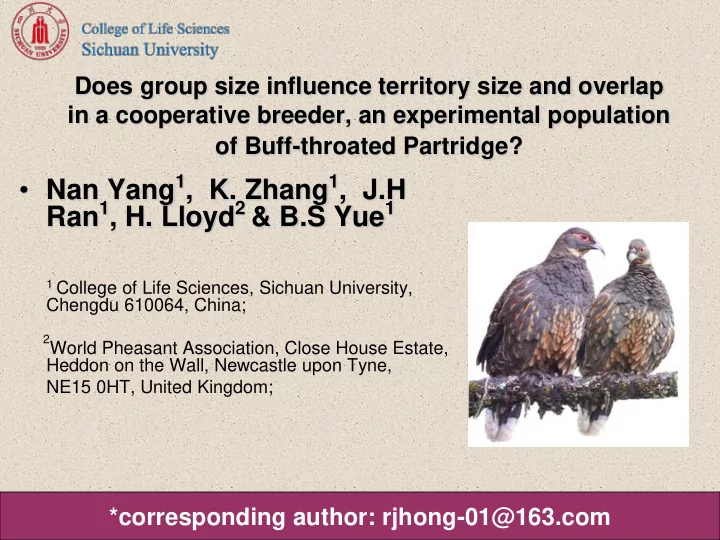
Does group size influence territory size and overlap in a cooperative breeder, an experimental population of Buff-throated Partridge? Nan Yang 1 , K. Zhang 1 , J.H Ran 1 , H. Lloyd 2 & B.S Yue 1 1 College of Life Sciences, Sichuan


slide-1
SLIDE 1

Does group size influence territory size and overlap in a cooperative breeder, an experimental population

  • f Buff-throated Partridge?
  • Nan Yang1, K. Zhang1, J.H

Ran1, H. Lloyd2 & B.S Yue1

1 College of Life Sciences, Sichuan University,

Chengdu 610064, China;

2World Pheasant Association, Close House Estate,

Heddon on the Wall, Newcastle upon Tyne, NE15 0HT, United Kingdom;

*corresponding author: rjhong-01@163.com

slide-2
SLIDE 2

Medium-sized Endemic to China Vulnerable

Buff-throated Partridge (BTPA) Tetraophasis szechenyii

slide-3
SLIDE 3

Distribution areas

Mainly distributed in high altitude habitats in Western China. southwest Sichuan south Qinghai northwest Yunnan and southeast Tibet

slide-4
SLIDE 4

The typical habitat of BTPA is mixed conifer forests, alpine shrub and tundra above the tree-line at the altitude between 3300 to 5000 m.

slide-5
SLIDE 5
  • Little is known about mating system, according to

previous observations it is presumed to be a monogamous or polygynous species, but our study suggested this species turn out to be a COOPERATIVE BREEDING species.

slide-6
SLIDE 6

Cooperative behavior

  • Living in family groups, roost together
  • Group size: 2.81 ± 0.09 (n = 68)
  • 65% (44/68) breeding pairs have up to three helpers
  • Don’t form big winter flock
  • All helpers exhibited brooding, vigilance and territorial

display

3♂1♀, +3Juveniles 3♂2♀, lasted ≧2 years.

slide-7
SLIDE 7

Cooperative breeding

Environmental constraints Cooperative breeding Arise Rare in Galliformes Larger groups Better & high-quality territory Greater reproduction Conflict of interest between group size & composition Exist Inhabit Little know ledge exist Year-round residents

slide-8
SLIDE 8

Objectives

  • Determine seasonal territory size and degree
  • f overlap between neighbors
  • Identify relationship between group size and

territory size and overlap

  • Using an experimental population, partially

habituated through supplemental feeding

  • Implications for studying ‘truly wild’

populations

slide-9
SLIDE 9

Study area and habitat types

Pam uling Tibetan Monastery

  • Pamuling Mountains in southwest of

Sichuan from 2006 to 2009 Ranged:3900-4200 Snow covered: November to April

slide-10
SLIDE 10

The main habitat types

Characterized by a series of dark coniferous forest, oak thickets, rhododendron shrubs and meadow.

Hollyleaf alpine Oak Forest

Alpine Meadow Flaky Fir Forest Violet-purple Rhododendron Shrub Pamuling Monastery

slide-11
SLIDE 11

Territory size

We defined territories as the area that the BTPA occupy and defend against other groups for the purpose of reproduction, and providing foraging resources for all breeding individuals, nestlings, and other members.

slide-12
SLIDE 12

Methods

  • Locating groups and data collections: direct tracking of

colour-marked individuals

  • Data analysis: using SPSS for windows release 11.0; All tests

were two-tailed (α =0.05). Mean values are given ± the standard error (SE)

  • Seasonal divisions: breeding season and non-breeding

season

  • Territory size and overlap: BIOTAS software v.2.0 with

100% Minimum Convex Polygon

slide-13
SLIDE 13

Results

Table 1. Territory size (100% Minimum Convex Polygon ) for a experimental population of BTPA direct tracked from March 2007 to July 2009.

slide-14
SLIDE 14
  • Territory size was independent of group size in

breeding season and non-breeding season ( F3,17=0.1, P=0.96; F2,11=2.5, P=0.132).

  • All territory sizes did not vary during the duration of

study (F2,17=1.7, P=0.22; F1,11=4.3, P=0.07, respectively).

slide-15
SLIDE 15

Table 2. Percentage overlap in 100% Minimum Convex Polygon territory for neighboring groups in BTPA.

slide-16
SLIDE 16
  • The difference in territory overlap between breeding pairs with and

without helpers was significant in the breeding season (ANOVA, F3,17=4.2, P=0.024).

  • But group size did not affect territory overlap in the non-breeding

season (ANOVA, F3,24=0.8, P=0.516).

slide-17
SLIDE 17

Discussion

  • Main factors associated with cooperative breeding in

BTPA: Severe/harsh climate (unpredictable weather)? Direct benefits (e.g. increase food access and survival, enhanced breeding experience)? Lack of breeding habitat or vacant territories?

1 5 days 3 days

slide-18
SLIDE 18
  • Possible factors constraining ranging behaviors in

BTPA:

  • Forage and roost together, take active care and guard

the nest and chicks

  • Predation and neighbor competition pressure?
slide-19
SLIDE 19

We found that:

  • Group size does not affect territory size in this

experimental population

  • Food not limited?
  • Effect of supplementary feeding?
  • Currently examining correlations between territories,

home range, roost sites and supplemental feeding

slide-20
SLIDE 20

Other studies:

  • Breeding Pied Wagtails permit ‘satellite’ (non-breeding)

wagtails to share and defend territory when food is abundant

  • Direct tracking data of Tibetan Eared-pheasant

Crossoptilon harmani showed that spatial location of foraging and roosting sites were only determinant of home range size

  • Food availability at roosting sites (on the ground) for

Tibetan Eared-Pheasant was lower than at foraging sites.

slide-21
SLIDE 21
  • Cooperative groups had smaller territory
  • verlap than pairs without helpers in

breeding season:

  • Energy and nutrient requirements?
  • Reduce predation risk and competition?
  • Larger territory overlap in non-breeding

season:

  • Increase encounter rate and reduce inbreeding?
slide-22
SLIDE 22

Acknowledgements

  • Dr. Philip McGowan Dr. Ying Wang
  • Dr. Siegfried Klaus Wangqing Li

Pamuling Monastery Forestry Bureau of Yajiang County

slide-23
SLIDE 23

Thank you!!!