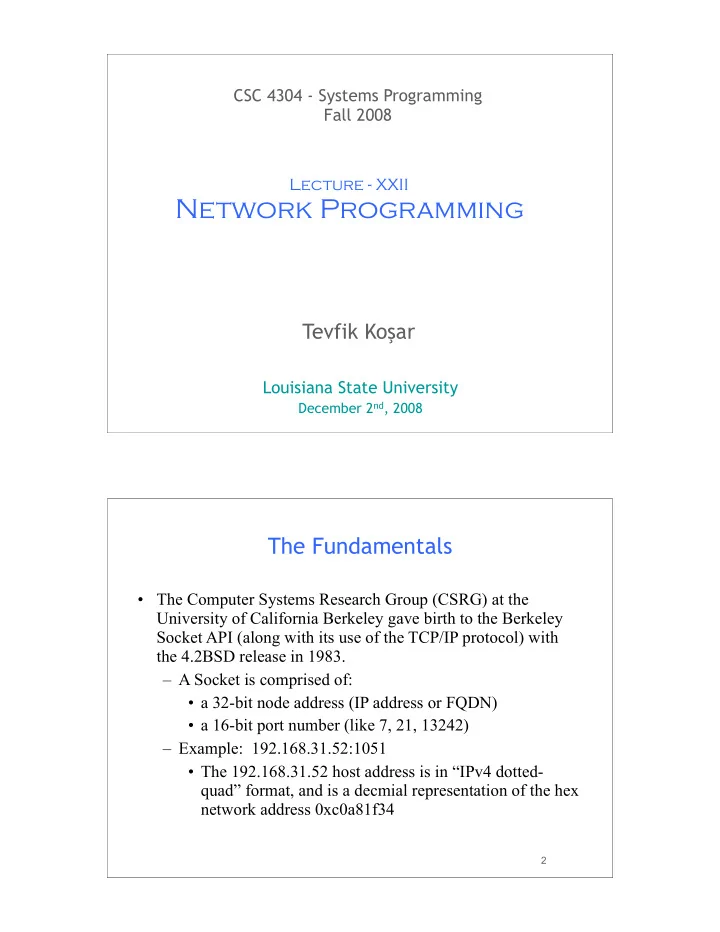
Network Programming Tevfik Ko ar Louisiana State University - - PDF document

network programming
SMART_READER_LITE
LIVE PREVIEW

Network Programming Tevfik Ko ar Louisiana State University - - PDF document

CSC 4304 - Systems Programming Fall 2008 Lecture - XXII Network Programming Tevfik Ko ar Louisiana State University December 2 nd , 2008 1 The Fundamentals The Computer Systems Research Group (CSRG) at the University of California


slide-1
SLIDE 1

1

CSC 4304 - Systems Programming Fall 2008

Tevfik Koar

Louisiana State University

December 2nd, 2008

Lecture - XXII

Network Programming

The Fundamentals

  • The Computer Systems Research Group (CSRG) at the

University of California Berkeley gave birth to the Berkeley Socket API (along with its use of the TCP/IP protocol) with the 4.2BSD release in 1983. – A Socket is comprised of:

  • a 32-bit node address (IP address or FQDN)
  • a 16-bit port number (like 7, 21, 13242)

– Example: 192.168.31.52:1051

  • The 192.168.31.52 host address is in “IPv4 dotted-

quad” format, and is a decmial representation of the hex network address 0xc0a81f34

2

slide-2
SLIDE 2

Port Assignments

  • Ports 0 through 1023 are reserved, privileged ports,

defined by TCP and UDP well known port assignments

  • Ports 1024 through 49151 are ports registered by the

IANA (Internet Assigned Numbers Authority), and represent second tier common ports (socks (1080), WINS (1512), kermit (1649))

  • Ports 49152 through 65535 are ephemeral ports,

available for temporary client usage

3

Common Protocols

4

slide-3
SLIDE 3

Protocol Communication

5

Data Encapsulation

  • Application puts data out through a socket
  • Each successive layer wraps the received data with its
  • wn header:

6

slide-4
SLIDE 4

The Hardware (Ethernet) Layer

  • Responsible for transferring frames (units of data)

between machines on the same physical network

7

The IP Layer

  • The IP layer allows packets to be sent over gateways to

machines not on the physical network

  • Addresses used are IP addresses, 32-bit numbers divided into a

network address (used for routing) and a host address

  • The IP protocol is connectionless, implying:

– gateways route discrete packets independently and irrespective of other packets – packets from one host to another may be routed differently (and may arrive at different times) – non-guaranteed delivery

8

slide-5
SLIDE 5

IP Datagram Format

  • Packets may be broken up, or fragmented, if original

data is too large for a single packet (Maximum Transmission Unit is currently 12k bits, or 1500 Bytes)

  • Packets have a Time To Live, number of seconds/

rounds it can bounce around aimlessly among routers until it’s killed

9

The Transport Layer

  • Unix has two common transports

– User Datagram Protocol (UDP)

  • record protocol
  • connectionless, broadcast
  • Metaphor: Postal Service

– Transmission Control Protocol (TCP)

  • byte stream protocol
  • direct connection-oriented

10

slide-6
SLIDE 6

Transport Layer: UDP

  • Connectionless, in that no long term connection exists

between the client and server. A connection exists

  • nly long enough to deliver a single packet and then

the connection is severed.

  • No guaranteed delivery (“best effort”)
  • Fixed size boundaries, sent as a single “fire and forget

message”. Think announcement.

  • No built-in acknowledgement of receipt

11

Transport Layer: UDP

  • No built-in order of delivery, random delivery
  • Unreliable, since there is no acknowledgement of

receipt, there is no way to know to resend a lost packet

  • Does provide checksum to guarantee integrity of

packet data

  • Fast and Efficient

12

slide-7
SLIDE 7

Transport Layer: TCP

  • TCP guarantees delivery of packets in order of

transmission by offering acknowledgement and retransmission: it will automatically resend after a certain time if it does not receive an ACK

  • TCP promises sequenced delivery to the application

layer, by adding a sequence number to every packet. Packets are reordered by the receiving TCP layer before handing off to the application layer. This also aides in handling “duplicate” packets.

13

Transport Layer: TCP

  • Pure stream-oriented connection, it does not care

about message boundaries

  • A TCP connection is full duplex (bidirectional), so

the same socket can be read and written to (cf. half duplex pipes)

  • Provides a checksum that guarantees packet integrity

14

slide-8
SLIDE 8

TCP’s Positive Acknowledgement with Retransmission

  • TCP offers acknowledgement and retransmission: it will automatically

resend after a certain time if it does not receive an ACK

  • TCP offers flow control, which uses a “sliding window” (in the TCP

header) will allow a limited number of non-ACKs on the net during a given interval of time. This increases the overall bandwidth efficiency. This window is dynamically managed by the recipient TCP layer.

15

Reusing Addresses

  • Local ports are locked from rebinding for a period of time (usually a couple
  • f minutes based on the TIME_WAIT state) after a process closes them.

This is to ensure that a temporarily “lost” packet does not reappear, and then be delivered to a reincarnation of a listening server. But when coding and debugging a client server app, this is bothersome. The following code will turn this feature off: int yes = 1;

  • server = socket(AF_INET, SOCK_STREAM, 0);
  • if (setsockopt(server, SOL_SOCKET,

SO_REUSEADDR, &yes, sizeof(int)) < 0) { perror(“setsockopt SO_REUSEADDR"); exit(1); }

16

slide-9
SLIDE 9

TCP Header Format

  • Source and Destination addresses
  • Sequence Number tells what byte offset within the
  • verall data stream this segment applies
  • Acknowledgement number lets the recipient set what

packet in the sequence was received OK.

17

Creating a Socket

#include <sys/types.h> #include <sys/socket.h> int socket(int domain, int type, int protocol);

  • domain is one of the Address Families (AF_INET,

AF_UNIX, etc.)

  • type defines the communication protocol semantics,

usually defines either:

– SOCK_STREAM: connection-oriented stream (TCP) – SOCK_DGRAM: connectionless, unreliable (UDP)

  • protocol specifies a particular protocol, just set this to

0 to accept the default (PF_INET, PF_UNIX) based

  • n the domain

18

slide-10
SLIDE 10

UDP Clients and Servers

  • Connectionless clients and servers create a socket using

SOCK_DGRAM instead of SOCK_STREAM

  • Connectionless servers do not call listen() or accept(), and

usually do not call connect()

  • Since connectionless communications lack a sustained

connection, several methods are available that allow you to specify a destination address with every call:

– sendto(sock, buffer, buflen, flags, to_addr, tolen); – recvfrom(sock, buffer, buflen, flags, from_addr, fromlen);

  • Examples: daytimeclient.c, mytalkserver.c, mytalkclient.c

19

  • TCP Client-Server view
  • Connection-oriented

socket connections

20

slide-11
SLIDE 11

UDP Socket Functions

21

Creating UDP Sockets

22

slide-12
SLIDE 12

Sending a UDP Datagram

23

sendto () example

24

slide-13
SLIDE 13

Receiving a UDP Datagram

25

recvfrom() example

26

slide-14
SLIDE 14

How to handle timeouts?

27

select()

28

slide-15
SLIDE 15

select() example

29 30

Acknowledgments

  • Advanced Programming in the Unix Environment by R.

Stevens

  • The C Programming Language by B. Kernighan and D.

Ritchie

  • Understanding Unix/Linux Programming by B. Molay
  • Lecture notes from B. Molay (Harvard), T

. Kuo (UT- Austin), G. Pierre (Vrije), M. Matthews (SC), B. Knicki (WPI), M. Shacklette (UChicago), J.Kim (KAIST), and J. Schaumann (SIT).