Neuromuscular Junction Paralysis in the Surgical Patient: Too Much - - PDF document

neuromuscular junction paralysis in the surgical patient
SMART_READER_LITE
LIVE PREVIEW

Neuromuscular Junction Paralysis in the Surgical Patient: Too Much - - PDF document

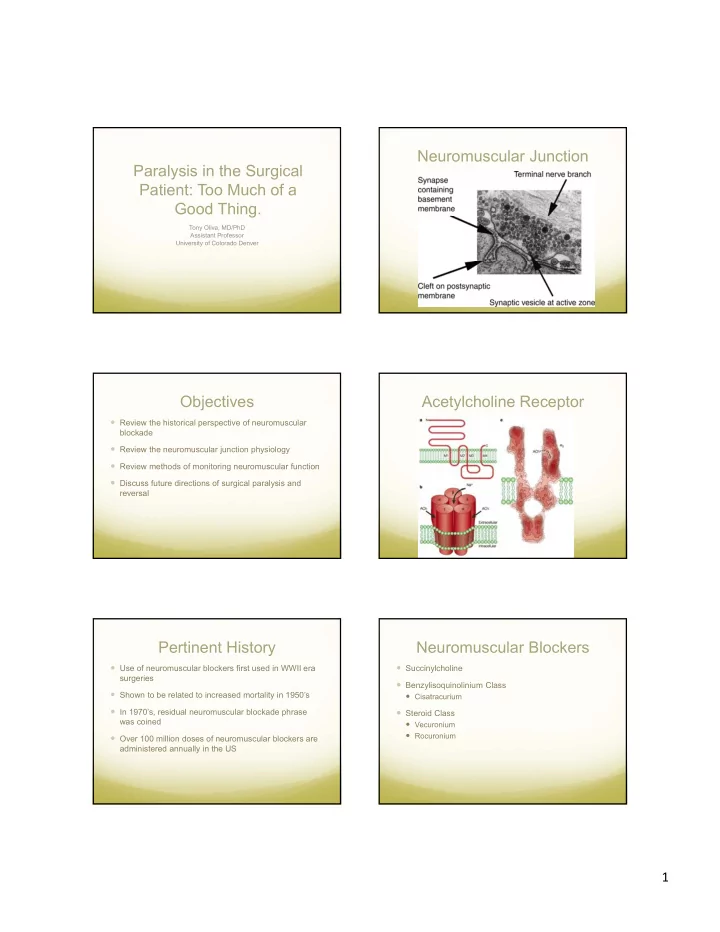
Neuromuscular Junction Paralysis in the Surgical Patient: Too Much of a Good Thing. Tony Oliva, MD/PhD Assistant Professor University of Colorado Denver Objectives Acetylcholine Receptor Review the historical perspective of neuromuscular

slide-1
SLIDE 1

1

Paralysis in the Surgical Patient: Too Much of a Good Thing.

Tony Oliva, MD/PhD Assistant Professor University of Colorado Denver

Objectives

 Review the historical perspective of neuromuscular

blockade

 Review the neuromuscular junction physiology  Review methods of monitoring neuromuscular function  Discuss future directions of surgical paralysis and

reversal

Pertinent History

 Use of neuromuscular blockers first used in WWII era

surgeries

 Shown to be related to increased mortality in 1950’s  In 1970’s, residual neuromuscular blockade phrase

was coined

 Over 100 million doses of neuromuscular blockers are

administered annually in the US

Neuromuscular Junction Acetylcholine Receptor Neuromuscular Blockers

 Succinylcholine  Benzylisoquinolinium Class

 Cisatracurium

 Steroid Class

 Vecuronium  Rocuronium

slide-2
SLIDE 2

2

Residual Neuromuscular Blockade (RNMB)

 Is it a problem?

 Yes

 How do you define the problem?

 Train of four (TOF) ratio <0.9

 How big of a problem is it?

 Upward of 40% of patients in PACU are affected  Increased risk of airway obstruction, aspiration,

hypoxemia, reintubation.

RNMB continued

 Why is it a problem?

 Surgeon request for deeper blockade  No reversal dose given  Inappropriate reversal dose given  No use of muscle twitch device  Incomplete understanding of how to use and interpret

twitch devices

 Reliance on clinical signs for adequate strength

 What are solutions to the problem?

 Appropriate neuromuscular function monitoring  Appropriate dose of reversal agents

Neuromuscular Function Monitoring

 Quantitative nerve monitor

 Gold standard  Provides a measured TOF ratio  Monitors the ulnar nerve and adductor pollicis brevis

 Qualitative nerve monitor

 Various modes: TOF, double burst stimulation (DBS),

tetanus, post-tetanic count (PTC)

 Most commonly used monitor  Monitors the ulnar nerve, facial nerve, and posterior tibial

nerve

Quantitative Monitors

 Despite being gold standard, it is not often available or used  Optimal use requires calibration and normalization  Limitations:

 Requires a freely moving thumb  Is not fail-safe in residual weakness prevention

Qualitative Monitor Modes

 TOF

 Most common mode used  Interpret number of twitches (0-4) and presence of fade

 DBS

 Occasionally used  Interpret number of twitches (0-2) and presence of fade

 Tetanus

 Commonly used  Interpret presence of fade either at 50 or 100 Hz for 5 seconds

 PTC

 Rarely used  Interpret number of twitches after 5 second tetanus

Monitoring Site

 Site matters  Ulnar nerve is most studied site

 Quantitative monitors use this site  Level of blockade correlates to oropharyngeal blockade

 Facial nerve is most convenient site

 Level of blockade correlates to diaphragm blockade

 Posterior tibial nerve is an occasional site

 Does not correlate well to ulnar nerve

slide-3
SLIDE 3

3

Neostigmine Reversal

 Mainstay of neuromuscular blockade reversal for

decades by inhibiting acetylcholinesterase

 Highly variable time to completely reverse

neuromuscular blockade

 Associated with numerous muscarinic side effects:

bradycardia, hypotension, bronchoconstriction, and excessive secretions. These are usually treated by concurrent administration of glycopyrrolate.

Sugammadex Reversal

 FDA approved in December 2015  Currently used in ~70 countries with ~12 million

patients receiving drug by mid 2015

 Poised to become the predominant reversal agent  Studies for sugammadex have provided excellent data

for neostigmine as well

Sugammadex Pharmacology

 Molecule is a cyclodextrin with a center cavity

containing anionic character to bind and encapsulate steroid NMBs that have cationic character via their quaternary amine group

 1:1 binding  Not metabolized  Renal excretion  Elimination half life is ~2 hours

Sugammadex Dosing

 Shallow to moderate blockade

 2 mg/kg

 Profound blockade

 4 mg/kg

 Immediate reversal following RSI dose

 16 mg/kg

Moderate Blockade Profound Blockade

slide-4
SLIDE 4

4

Immediate Reversal Sugammadex Adverse Events

 Hypersensitivity ~0.25%

 Cutaneous manifestations  Sneezing  Rhinorrhea  Nausea/Vomiting

 Anaphylaxis <0.1%