Spasticity Spasticity Definition Treatments Velocity dependent - - PDF document

spasticity spasticity
SMART_READER_LITE
LIVE PREVIEW

Spasticity Spasticity Definition Treatments Velocity dependent - - PDF document

3/10/2012 Overview Medication Management of Definition of Spasticity Spasticity in the Traumatic Brain Oral Medications Injured Patient Central acting Peripheral acting Dosage, Mechanism of Action, Side effects Chad Walters,


slide-1
SLIDE 1

3/10/2012 1 Medication Management of Spasticity in the Traumatic Brain Injured Patient

Chad Walters, D.O. Medical Director Radical Rehab Solutions

6th Annual Northern Kentucky TBI Conference March 23, 2012 www.bridgesnky.org

Overview

  • Definition of Spasticity
  • Oral Medications

– Central acting – Peripheral acting

  • Dosage, Mechanism of Action, Side effects
  • Local treatments

– Botulinum toxin – Phenol

  • Mechanism of Action, Side effects
  • Intrathecal Baclofen

– Mechanism of action, side effects

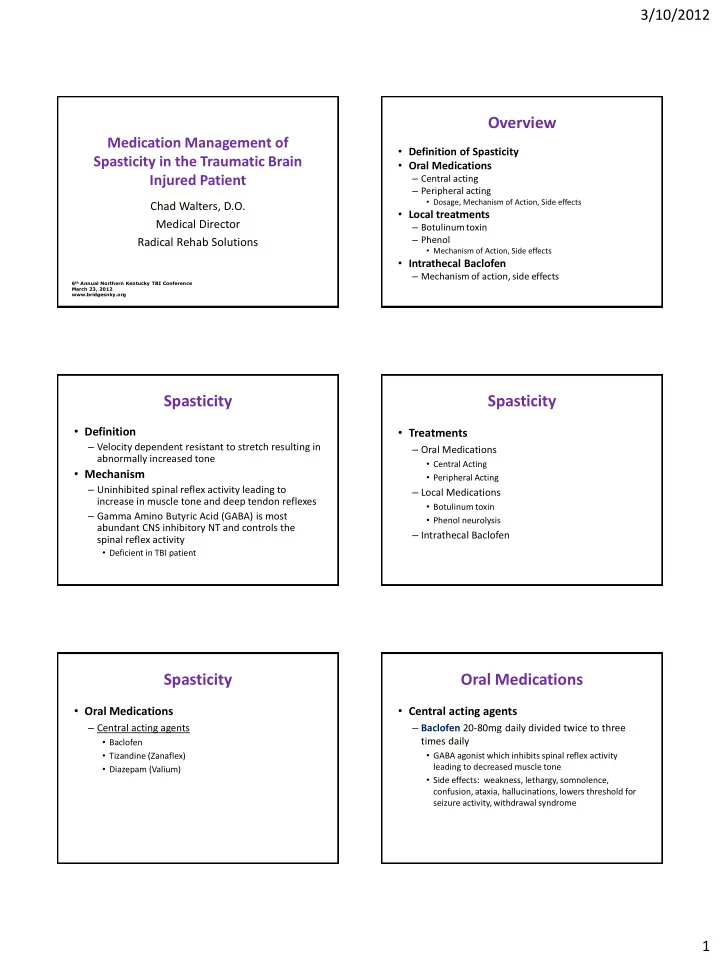
Spasticity

  • Definition

– Velocity dependent resistant to stretch resulting in abnormally increased tone

  • Mechanism

– Uninhibited spinal reflex activity leading to increase in muscle tone and deep tendon reflexes – Gamma Amino Butyric Acid (GABA) is most abundant CNS inhibitory NT and controls the spinal reflex activity

  • Deficient in TBI patient

Spasticity

  • Treatments

– Oral Medications

  • Central Acting
  • Peripheral Acting

– Local Medications

  • Botulinum toxin
  • Phenol neurolysis

– Intrathecal Baclofen

Spasticity

  • Oral Medications

– Central acting agents

  • Baclofen
  • Tizandine (Zanaflex)
  • Diazepam (Valium)

Oral Medications

  • Central acting agents

– Baclofen 20-80mg daily divided twice to three times daily

  • GABA agonist which inhibits spinal reflex activity

leading to decreased muscle tone

  • Side effects: weakness, lethargy, somnolence,

confusion, ataxia, hallucinations, lowers threshold for seizure activity, withdrawal syndrome

slide-2
SLIDE 2

3/10/2012 2

Oral Medications

  • Central acting agents

– Tizanidine 6-36mg daily divided three times per day

  • Alpha adrenergic agonist which binds to spinal cord

receptors inhibiting spinal cord reflexes

  • Side effects: weakness, sedation, dizziness, dry mouth,

hypotension

Oral Medications

  • Central acting agents

– Benzodiazepines

– Diazepam (Valium) 2-10mg BID to TID – Clonazepam 0.5-2mg BID to TID

  • Enhances affinity for GABA in the CNS (brain > SC)
  • Enhances pre and post synaptic inhibition at the SC
  • Side effects: Sedation, fatigue, habituation, impairment
  • f motor recovery
  • Should only be used in severe cases

Oral Medications

  • Peripheral acting agents

– Dantrolene 50-300mg daily divided BID to QID

  • Inhibits Ca release from the sarcoplasmic reticulum

which is required for muscle contraction

  • Side effects: weakness, dizziness, drowsiness,

hepatotoxicity

Local Treatments

  • Botulinum toxin

– Type A and B

  • Phenol

Local Treatments

  • Botulinum toxin

– Chemical neurotoxin produced by Clostridium botulinum bacterium – Type A (Botox) inhibits release of acetylcholine by binding to SNAP-25 receptor on presynaptic membrane – Type B (Myobloc) inhibits release of acetylcholine by binding to synaptobrevin receptor on presynaptic membrane

Local Treatments

  • Botulinum toxin

– Onset within 12-72 hours – Duration ~ 3 months – Best results if localization techniques used

  • EMG guidance
  • Ultrasound
  • Electrical stimulation

– Dosage differs between Type A and B and is physician dependent

slide-3
SLIDE 3

3/10/2012 3

Local Treatments

  • Phenol

– Chemically destroys the nerve at the neuromuscular junction – Non-selective – Causes muscle tissue destruction and atrophy

Local Treatments

  • Phenol

– More challenging than botulinum toxin injections – Lower cost – Technical issues – Used for large muscle groups only – Onset: Immediate – Duration: 1-36 months – Side effects: Dysesthesias, Marked muscle pain, peripheral edema, extensive motor weakness

Intrathecal Baclofen

  • GABA agonist

– Decreases neural activity at the spinal cord level

  • Surgically implanted pump in the

subcutaneous tissue in lower abdomen

  • Rubber catheter that runs from pump to CSF

at the spinal cord

Intrathecal Baclofen

  • Pros:

– Flexibility in dosing to allow tailoring to patient’s needs – Beneficial for UE and LE, large and small muscle groups – Rarely leads to weakness in unaffected muscles

  • Cons:

– Surgical procedure – Patient selection must be a careful process – Overdose and Withdrawal syndromes

Intrathecal Baclofen

  • Side effects:

– Hypotonia – Somnolence – Nausea/vomiting – Dizziness – Urine retention – Constipation – Withdrawal – Overdose

Baclofen Overdose

  • Causes

– Programming errors

  • Incorrect concentration used
  • Large dose increases
  • Switching from continuous to bolus dosing

– Failure to wean oral medications with increases in pump dosage

slide-4
SLIDE 4

3/10/2012 4

Baclofen Overdose

  • Hypotension
  • Hypotonia

– Increased weakness from baseline

  • Significant somnolence
  • Respiratory depression
  • Death

Baclofen Overdose

  • Treatment

– Emergency – call 911 – Respiratory support – Determine cause and reverse

Baclofen Withdrawal

  • Causes

– Empty pump – Pump failure

  • Battery expires (5-7 years from implant)
  • Motor malfunction

– Catheter problems

  • Kinking
  • Breakage
  • Separation from pump
  • Occlusion
  • Migration from CSF space

Baclofen Withdrawal

  • Rigidity/Clonus
  • Itching without presence of a rash
  • Hallucinations
  • Seizures
  • Fever/Malignant Hyperthermia

– Temperatures often > 106 degrees

Baclofen Withdrawal

  • Treatment

– IV Benzodiazepines

  • Valium 10mg

– Cooling blankets – Dantrolene for malignant hyperthermia

Summary

  • Treatment of spasticity requires multidisciplinary

approach including PT, OT and medications

  • Selection of medications should be patient

specific depending on co-morbidities and deficits

  • Oral medications should be attempted prior to

local or invasive treatments

  • Good practice to know what medications are

used for spasticity, their dosages, mechanisms of action and side effects

slide-5
SLIDE 5

3/10/2012 5

References

  • Braddom, et al. Physical Medicine and
  • Rehabilitation. 3rd Edition. pp 651-662
  • Zafonte, et al. Brain Injury Medicine. pp 615-

651