New Jersey Center for Teaching and Learning AP Chemistry - - PDF document

new jersey center for teaching and learning ap chemistry
SMART_READER_LITE
LIVE PREVIEW

New Jersey Center for Teaching and Learning AP Chemistry - - PDF document

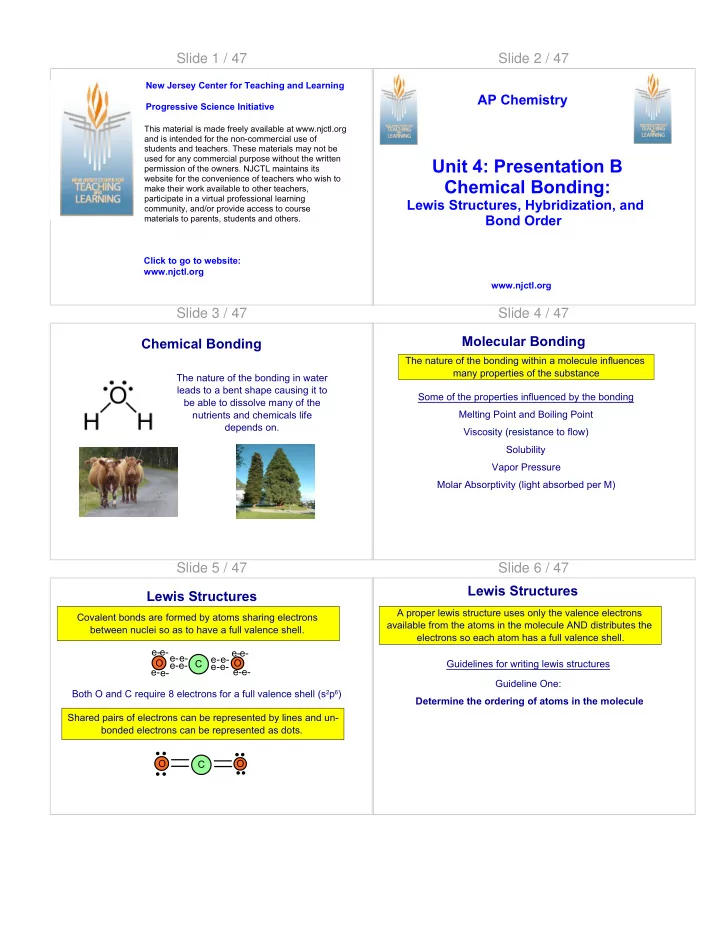
Slide 1 / 47 Slide 2 / 47 New Jersey Center for Teaching and Learning AP Chemistry Progressive Science Initiative This material is made freely available at www.njctl.org and is intended for the non-commercial use of students and teachers.


slide-1
SLIDE 1

Slide 1 / 47

This material is made freely available at www.njctl.org and is intended for the non-commercial use of students and teachers. These materials may not be used for any commercial purpose without the written permission of the owners. NJCTL maintains its website for the convenience of teachers who wish to make their work available to other teachers, participate in a virtual professional learning community, and/or provide access to course materials to parents, students and others.

Click to go to website: www.njctl.org New Jersey Center for Teaching and Learning Progressive Science Initiative

Slide 2 / 47

www.njctl.org

Unit 4: Presentation B Chemical Bonding:

Lewis Structures, Hybridization, and Bond Order AP Chemistry Slide 3 / 47 Chemical Bonding

The nature of the bonding in water leads to a bent shape causing it to be able to dissolve many of the nutrients and chemicals life depends on.

Slide 4 / 47 Molecular Bonding

The nature of the bonding within a molecule influences many properties of the substance Some of the properties influenced by the bonding Melting Point and Boiling Point Viscosity (resistance to flow) Solubility Vapor Pressure Molar Absorptivity (light absorbed per M)

Slide 5 / 47 Lewis Structures

Shared pairs of electrons can be represented by lines and un- bonded electrons can be represented as dots. Covalent bonds are formed by atoms sharing electrons between nuclei so as to have a full valence shell. e- e-e- e- e- e-e- e- e-e- e-e- e-e- e-e- O C O Both O and C require 8 electrons for a full valence shell (s2p6) O C O

Slide 6 / 47 Lewis Structures

A proper lewis structure uses only the valence electrons available from the atoms in the molecule AND distributes the electrons so each atom has a full valence shell. Guidelines for writing lewis structures Guideline One: Determine the ordering of atoms in the molecule

slide-2
SLIDE 2

Slide 7 / 47 Lewis Structures

Guideline One: Determine the ordering of atoms in the molecule Typically, the least electronegative atom is the central atom. CCl4 Cl C Cl SO2 O S O But not always... often it's the less abundant atom H2O H O H NH3 H N H In hydrocarbons, the carbon atoms will form a congo line

  • r chain...

Cl Cl H CH3CH2CH2OH C C C O H

Slide 8 / 47 Lewis Structures

Guidelines for writing lewis structures Guideline Two: Determine the number of valence electrons in the molecule NH3 = 8 CCl3H = 26 If the molecules is an ion, one must either subtract or add electrons to the valence electron count. NO3- = 23 +1 = 24 NH4+ = 9-1 = 8

Slide 9 / 47 Lewis Structures

Guidelines for writing lewis structures Guideline Three: Form a single bond (2 shared electrons) between all elements and then distribute electrons such that all atoms have a full valence shell, saving the central atom for last. Example: H2O (8 ve) Example: CO2 (16 ve) H - O - H O - C - O Notice H needs only 2 electrons for a full valence shell. Notice that C does not have a full valence shell and therefore adjustments will need to be made to this structure

Slide 10 / 47 Lewis Structures: Octet Rule

The "Octet Rule" refers to the fact that a full valence shell for most elements is a full outer s and p orbital or 8 electrons. Some elements do not follow this as shown below. H = 2 Be = 4 B = 6 In addition, elements in period 3 or below can have expanded

  • ctets or more than 8 valence electrons.

Slide 11 / 47 Lewis Structures

Guidelines for writing lewis structures Guideline Four: If an atom is short of an octet, additional electrons must be shared between the nuclei forming "Pi" bonds. O - C - O O C O Pi bonds Note: Pi bonds are formed from valence electrons in "p"

  • rbitals.

Slide 12 / 47 Lewis Structures

Guidelines for writing lewis structures Guideline Five: If all atoms have a full valence shell but valence electrons remain, they are to be added to the central atom in pairs. S F F F F 34 valence electrons Extra pair of un-bonded electrons is added to central

  • atom. As we will see shortly, these extra electrons

influence the properties of the molecule significantly

slide-3
SLIDE 3

Slide 13 / 47

1 Which of the following molecules would have 10 valence electrons in the lewis structure? A NH4+ B CN- C H2O D NO2- E N2O

Slide 13 (Answer) / 47

1 Which of the following molecules would have 10 valence electrons in the lewis structure? A NH4+ B CN- C H2O D NO2- E N2O

[This object is a pull tab]

Answer B

Slide 14 / 47

2 How many valence electrons can be used in the lewis structure for NO+? A 6 B 8 C 10 D 12 E None of these

Slide 14 (Answer) / 47

2 How many valence electrons can be used in the lewis structure for NO+? A 6 B 8 C 10 D 12 E None of these

[This object is a pull tab]

Answer C

Slide 15 / 47

3 Which of the following molecules has a central atom with an expanded octet? A SO2 B SCl2 C PF3 D XeF2 E CO32-

Slide 15 (Answer) / 47

3 Which of the following molecules has a central atom with an expanded octet? A SO2 B SCl2 C PF3 D XeF2 E CO32-

[This object is a pull tab]

Answer D

slide-4
SLIDE 4

Slide 16 / 47

4 Which of the following molecules would require Pi bonds in the lewis structure? A I only B II only C III only D I and II only E I, II, and III

  • I. NO3-
  • II. CO32-
  • III. HCN

Slide 16 (Answer) / 47

4 Which of the following molecules would require Pi bonds in the lewis structure? A I only B II only C III only D I and II only E I, II, and III

  • I. NO3-
  • II. CO32-
  • III. HCN

[This object is a pull tab]

Answer E

Slide 17 / 47

5 How many unbounded pairs of electrons are on the central atom in ClO3-? A 1 B 2 C 3 D 4 E None of these

Slide 17 (Answer) / 47

5 How many unbounded pairs of electrons are on the central atom in ClO3-? A 1 B 2 C 3 D 4 E None of these

[This object is a pull tab]

Answer A

Slide 18 / 47

6 Which of the following molecules would have a lewis structure most similar to CO2? A SO2 B CS2 C NO2- D CO32- E H2O

Slide 18 (Answer) / 47

6 Which of the following molecules would have a lewis structure most similar to CO2? A SO2 B CS2 C NO2- D CO32- E H2O

[This object is a pull tab]

Answer B

slide-5
SLIDE 5

Slide 19 / 47

7 Below is a skeleton for the lewis structure for alphaketoglutarate, a kreb's cycle intermediate. After finishing the lewis structure, how many Pi bond are needed to complete the structure? A 0 B 1 C 2 D 3 E 4

C - C - C - C - C H H H H O O O O O

Slide 19 (Answer) / 47

7 Below is a skeleton for the lewis structure for alphaketoglutarate, a kreb's cycle intermediate. After finishing the lewis structure, how many Pi bond are needed to complete the structure? A 0 B 1 C 2 D 3 E 4

C - C - C - C - C H H H H O O O O O

[This object is a pull tab]

Answer D

Slide 20 / 47

8 Which of the following would contain the largest number

  • f Pi bonds?

A CH4 B CO32- C C2H2 D SF6 E C3H6

Slide 20 (Answer) / 47

8 Which of the following would contain the largest number

  • f Pi bonds?

A CH4 B CO32- C C2H2 D SF6 E C3H6

[This object is a pull tab]

Answer C

Slide 21 / 47 Resonance Structures

When "Pi" bonds can be formed in more than one location, the electrons are thought to be shared across all of the possible

  • locations. This is shown by writing resonance structures.

N O O O One pi bond is needed but could be formed from electrons shared by any of three oxygens. Resonance structures N O O O N O O O N O O O

Slide 22 / 47 Resonance Structures

The bonds involved in resonance are equivalent in strength and in length. In essence, the pi bond electrons are shared across all of the bonds in which we find resonance.

N O O O N O O O N O O O

EQUALS N O O O Pi bond electrons shared across all three bonds.

slide-6
SLIDE 6

Slide 23 / 47

9 Which of the following molecules demonstrate resonance structures? A I only B II only C III only D I and II only E I, II, and III

  • I. NO2-
  • II. CH3COO- (both O attached to C)
  • III. CH3CH2OH

Slide 23 (Answer) / 47

9 Which of the following molecules demonstrate resonance structures? A I only B II only C III only D I and II only E I, II, and III

  • I. NO2-
  • II. CH3COO- (both O attached to C)
  • III. CH3CH2OH

[This object is a pull tab]

Answer D

Slide 24 / 47

10 How many resonance structures would be needed to represent SO3? A 0 B 1 C 2 D 3

Slide 24 (Answer) / 47

10 How many resonance structures would be needed to represent SO3? A 0 B 1 C 2 D 3

[This object is a pull tab]

Answer D

Slide 25 / 47

11 All bonds that demonstrate resonance are equal in length but not in strength. True False

Slide 25 (Answer) / 47

11 All bonds that demonstrate resonance are equal in length but not in strength. True False

[This object is a pull tab]

Answer False

slide-7
SLIDE 7

Slide 26 / 47

12 The C-O bonds in the carbonate ion (CO32-) would consist of … A 3 single bonds B 2 single bonds of longer length and 1 double bond

  • f shorter length

C 3 double bonds D 3 bonds equal in length but shorter than a single bond E 3 bonds equal in length but longer than a single bond

Slide 26 (Answer) / 47

12 The C-O bonds in the carbonate ion (CO32-) would consist of … A 3 single bonds B 2 single bonds of longer length and 1 double bond

  • f shorter length

C 3 double bonds D 3 bonds equal in length but shorter than a single bond E 3 bonds equal in length but longer than a single bond

[This object is a pull tab]

Answer D

Slide 27 / 47

13 Which of the following require no resonance structures to represent? A NO+ B SO2 C CH3COOH (both O attached to C) D NO3- E All require resonance structures

Slide 27 (Answer) / 47

13 Which of the following require no resonance structures to represent? A NO+ B SO2 C CH3COOH (both O attached to C) D NO3- E All require resonance structures

[This object is a pull tab]

Answer A

Slide 28 / 47 Bond Order

The bond order refers to the number of bonds between two atoms in a molecule. It is calculated by adding up the bonds attached to the atom divided by the number of atoms attached to that atom. N O O O Bond order of N-O bonds = 4/3 = 1.33 N N Bond order of N-N bond = 3/1 = 3 Note: The higher the bond order, the stronger and shorter the bond.

Slide 29 / 47

14 Which of the following contains bonds of the lowest order? A N2 B SO2 C SO3 D CF4 E All have the same bond order

slide-8
SLIDE 8

Slide 29 (Answer) / 47

14 Which of the following contains bonds of the lowest order? A N2 B SO2 C SO3 D CF4 E All have the same bond order

[This object is a pull tab]

Answer D

Slide 30 / 47

15 Which of the following would have a bond order of 1.5? A CO32- B NO2- C CO2 D CS2 E NH3

Slide 30 (Answer) / 47

15 Which of the following would have a bond order of 1.5? A CO32- B NO2- C CO2 D CS2 E NH3

[This object is a pull tab]

Answer B

Slide 31 / 47

16 Which of the following is true regarding bond order? A The higher the bond order the longer and weaker the bond B The higher the bond order the longer and stronger the bond C The higher the bond order the shorter and stronger the bond D The higher the bond order the shorter and weaker the bond

Slide 31 (Answer) / 47

16 Which of the following is true regarding bond order? A The higher the bond order the longer and weaker the bond B The higher the bond order the longer and stronger the bond C The higher the bond order the shorter and stronger the bond D The higher the bond order the shorter and weaker the bond

[This object is a pull tab]

Answer C

Slide 32 / 47

17 Which of the following carbon molecules would have the shortest C-O bond lengths? A CO2 B CO32- C CH3OH D CO E All have the same bond lengths

slide-9
SLIDE 9

Slide 32 (Answer) / 47

17 Which of the following carbon molecules would have the shortest C-O bond lengths? A CO2 B CO32- C CH3OH D CO E All have the same bond lengths

[This object is a pull tab]

Answer D

Slide 33 / 47 Hybridization

In order to explain observations in molecular bonding, it has been proposed that atoms will hybridize s and p orbitals to create new

  • rbitals of equal energy which are then involved in bonding.

Carbon is known in nature to form compounds in which it must form 4 bonds. However, it's electron configuration suggests it could only share 2 electrons resulting in just 2 bonds. [Ne] __ ___ ___ ___ 2s 2p If the s and p orbitals were hybridized, four degenerate orbitals would be formed each with an electron that could be shared. [Ne] __ __ __ __ (sp3 hybrid orbitals)

Slide 34 / 47 Hybridization

The number of p orbitals that must be hybridized with the s orbital depends on the number of orbitals needed for all shared and unshared pairs of electrons. N H H H 4 orbitals required (3 for shared pairs, 1 for unshared pair) Requires "s" and all 3 "p" orbitals for hybridization. [Ne] __ __ __ __ N = unbonded pair form bonds with hydrogen sp3 hybridized

Slide 35 / 47 Hybridization, Sigma, and Pi Bonds

Bonds made from hybridized orbitals are called sigma bonds while those of un-hybridized p orbitals are called pi bonds. N O O O Here, there are only 3 sigma bonds so

  • nly 2 "p" orbitals are needed to

hybridize with the "s" orbital so this N atom is sp2 hybridized. H - C C - H Here, each carbon has only 2 sigma bonds attached to each, so only 1 "p"

  • rbital is needed to hybridize with the

"s" orbital so each C is sp hybridized.

Slide 36 / 47

18 Which of the following would the central atom be sp hybridized? A I only B II only C III only D I and II only E I, II, and III

  • I. CO2
  • II. HCN
  • III. PH3

Slide 36 (Answer) / 47

18 Which of the following would the central atom be sp hybridized? A I only B II only C III only D I and II only E I, II, and III

  • I. CO2
  • II. HCN
  • III. PH3

[This object is a pull tab]

Answer D

slide-10
SLIDE 10

Slide 37 / 47

19 Which of the following molecules would have an sp2 hybridized atom? A C2H2 B CO32- C BeCl2 D CO2 E OF2

Slide 37 (Answer) / 47

19 Which of the following molecules would have an sp2 hybridized atom? A C2H2 B CO32- C BeCl2 D CO2 E OF2

[This object is a pull tab]

Answer B

Slide 38 / 47

20 Which of the following is correct regarding the number of sigma and pi bonds in the molecule below (Note: only the skeleton is written - you must finish the lewis structure)? A 4 sigma 5 pi B 7 sigma 2 pi C 6 sigma 3 pi D 9 sigma 2 pi E 9 sigma 1 pi

C - C - N - H O O O H H H

Slide 38 (Answer) / 47

20 Which of the following is correct regarding the number of sigma and pi bonds in the molecule below (Note: only the skeleton is written - you must finish the lewis structure)? A 4 sigma 5 pi B 7 sigma 2 pi C 6 sigma 3 pi D 9 sigma 2 pi E 9 sigma 1 pi

C - C - N - H O O O H H H

[This object is a pull tab]

Answer E

Slide 39 / 47

21 What kind of hybridizations are found on the C atoms in the molecule below? (Note: the correct lewis structure should be written on the previous slide) A sp and sp3 B sp2 and sp3 C sp and sp2 D sp, sp2, and sp3 E None of these

C - C - N - H O O O H H H

Slide 39 (Answer) / 47

21 What kind of hybridizations are found on the C atoms in the molecule below? (Note: the correct lewis structure should be written on the previous slide) A sp and sp3 B sp2 and sp3 C sp and sp2 D sp, sp2, and sp3 E None of these

C - C - N - H O O O H H H

[This object is a pull tab]

Answer B

slide-11
SLIDE 11

Slide 40 / 47

22 What is the hybridization of the oxygen atom in water? A sp B sp2 C sp3 D It is not hybridized

Slide 40 (Answer) / 47

22 What is the hybridization of the oxygen atom in water? A sp B sp2 C sp3 D It is not hybridized

[This object is a pull tab]

Answer C

Slide 41 / 47 Formal Charge

The formal charge on an atom is calculated by determining the difference between the valence electrons an atom has compared to how many electrons the atom possesses in the molecule. N O O O To see how many electrons an atom possesses in the molecule, sum all un-bonded electrons on that atom with number of electrons contributed to each bond (1 for each bond). FC = 6-6 = 0 FC = 5-4 = 1 FC = 6-7 = -1

Note: The sum of the formal charges will always equal the charge on the molecule.

Slide 42 / 47

23 What is the formal charge on the S atom in the molecule depicted below? A 0 B 1 C 2 D -1 E -2

Slide 42 (Answer) / 47

23 What is the formal charge on the S atom in the molecule depicted below? A 0 B 1 C 2 D -1 E -2

[This object is a pull tab]

Answer C

Slide 43 / 47

24 What is the formal charge on each O atom in the molecule below? A 0 B 1 C -1 D 2 E -2

slide-12
SLIDE 12

Slide 43 (Answer) / 47

24 What is the formal charge on each O atom in the molecule below? A 0 B 1 C -1 D 2 E -2

[This object is a pull tab]

Answer C

Slide 44 / 47

25 What is the formal charge on the sulfur atom in the molecule below? A 0 B 1 C -1 D 2 E -2

Slide 44 (Answer) / 47

25 What is the formal charge on the sulfur atom in the molecule below? A 0 B 1 C -1 D 2 E -2

[This object is a pull tab]

Answer A

Slide 45 / 47

26 What is the formal charge on the indicated N atom in the molecule below? A 0 B -3 C 1 D -1 E -2

N N N

Note: When multiple resonance structures can be written, the structure with the formal charges closest to zero is most stable.

Slide 45 (Answer) / 47

26 What is the formal charge on the indicated N atom in the molecule below? A 0 B -3 C 1 D -1 E -2

N N N

Note: When multiple resonance structures can be written, the structure with the formal charges closest to zero is most stable.

[This object is a pull tab]

Answer E

Slide 46 / 47

In the next notebook in this unit, we will examine the role that the lewis structure plays in determining the shape, polarity, and properties of a molecule.

slide-13
SLIDE 13

Slide 47 / 47