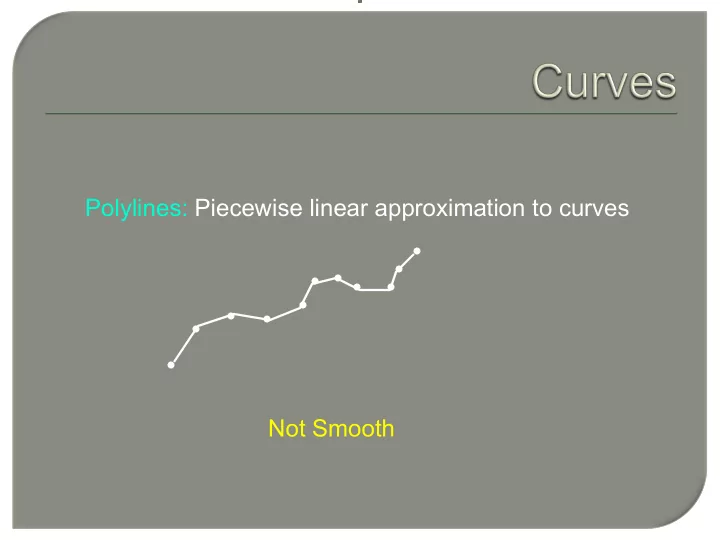
Not Smooth High degree approximation Explicit y=f(x) Implicit - - PowerPoint PPT Presentation
Polylines: Piecewise linear approximation to curves Not Smooth High degree approximation Explicit y=f(x) Implicit f(x,y)=0 Parametric x=x(t), y=y(t) Explicit Representation y = f ( x ) Essentially a function plot over some
High degree approximation
- Explicit
y=f(x)
- Implicit
f(x,y)=0
- Parametric
x=x(t), y=y(t)
Explicit Representation
- Essentially a function plot over some interval
x ∈ a,b
[ ]
y = f (x)
- Simple to compute and plot
- Simple to check whether point lies on curve
- Cannot represent closed and multi-value curves
Implicit Representation
- Define curves implicitly as solution of equation
system !Straight line in 2D: ax + by +c = 0
! Circle of radius R in 2D: x2 + y2 − R2 = 0 ! Conic Section: Ax2 + 2Bxy +Cy2 + 2Dx + 2Ey + F = 0
- Simple to check whether point lies on curve
- Can represent closed and multi-value curves
Parametric Curves
- Describe position on the curve by a parameter
u ∈ R
⇒ 2D Curve c(u) = {x(u), y(u)} e.g.,line :c(u) = (1−u)a +ub
a b 1 u
- Hard to check whether point lies on curve
- Simple to render
- Can represent closed and multi-value curves
Parametric Curves
Parametric curves form a rich variety of free form smooth curves They are modeled as piecewise polynomials and have two aspects:
- Interpolation
- Approximation
“Splines”
Parametric Curves
Splines
Parametric Curves
Cubic Splines
∑
= −
= ≤ ≤ + + + =
4 1 1 2 1 3 4 2 3 2 1
) (
i i it
B t t t t B t B t B B t P
∑ ∑
= − = −
= =
4 1 1 4 1 1
) ( ) (
i i iy i i ix
t B t y t B t x
∑
= −
+ + = − =
4 1 2 4 1 3 2 2
3 2 ) 1 ( ) ( '
i i i
t B t B B t i B t P
Parametric Curves
P1 t1 P1’ P2’ P2 t2
Let t1=0 P(0)=P1, P(t2)=P2 P'(0)=P1’, P’(t2)=P2’
Cubic Splines
Parametric Curves
P1 t1 P1’ P2’ P2 t2 Cubic Splines
' 3 2 ) 1 ( ) ( ' ' ) 1 ( ) ( ' ) ( ) (
2 2 2 4 1 2 3 2 4 1 2 2 1 2 4 1 2 2 3 2 4 2 2 3 1 2 2 1 4 1 1 2 1 1
2 2
P t B t B B t i B t P P B t i B P P t B t B t B B t B t P P B P
t t i i i t i i i t t i i i
= + + = − = = = − = = + + + = = = =
= = − = = − = = −
∑ ∑ ∑
Parametric Curves
Cubic Splines
2 2 ' 2 2 2 ' 1 3 2 2 1 4 2 ' 2 2 ' 1 2 2 1 2 3 ' 1 2 1 1 4 3 2 1
t P t P t ) P
- 2(P
B t P
- t
2P
- t
) P
- 3(P
B , P B , P B B and B B B for Solving + + = = = =
Here P1 and P2 give the position of the endpoints and P1’ and P2’ give the direction of the tangent vectors.
P1 t1 P1’ P2’ P2 t2
Parametric Curves
3 2 2 2 2 2 1 3 2 2 1 2 2 2 2 1 2 2 1 2 1 1
' ' ) ( 2 ' ' 2 ) ( 3 ' ) ( t t P t P t P P t t P t P t P P t P P t P ⎟ ⎟ ⎠ ⎞ ⎜ ⎜ ⎝ ⎛ + + − + ⎟ ⎟ ⎠ ⎞ ⎜ ⎜ ⎝ ⎛ − − − + + =
Thus, given the two end-points and the tangent vectors
- ne can compute the cubic spline.
Cubic Splines P1 t1 P1’ P2’ P2 t2
Parametric Curves
Joining of Segments 2 SEGMENTS: P1 P2 P3 (Points) P1’ P2’ P3’ (Tangents) P2’ is determined through the continuity condition
t1 t2 t3 Cubic Splines
Parametric Curves
Piecewise Spline of degree k has continuity
- f order (k-1) at the internal joints.
Thus Cubic Splines have second order continuity i.e. P2”(t) is continuous over the joint
t1 t2 t3 Cubic Splines
Parametric Curves
t1 t2 t3 Cubic Splines
( ) ( )
2 3 1 3 2 4 3 3 2 4 2 4 1 2 1 3
2 2 6 , 2 2 6 ) 2 )( 1 ( ) ( ' '
seg seg ' ' ' ' i i i
B B t B So B P segment Second B t B P segment First t t at t t t t B i i t P = + = + = = ≤ ≤ − − = ∑
= −
Substitute the expressions for B4 and B3
Parametric Curves
t1 t2 t3 Cubic Splines
( )
[ ]
( )
) ( ) ( 3 ' ' ' ) ( 2 ) ( ) ( 3 ' ' ) ( 2 '
1 2 2 3 2 3 2 2 3 2 3 2 1 2 2 3 3 1 2 2 3 2 3 2 2 3 2 3 2 2 2 3 1 3
P P t P P t t t P P P t t t t P P t P P t t t P t P t t P t − + − = ⎥ ⎥ ⎥ ⎦ ⎤ ⎢ ⎢ ⎢ ⎣ ⎡ + − + − = + + +
Parametric Curves
In general, for the kth and (k+1)th segment (1≤k≤n-2)
[ ]
( )
) ( ) ( 3 ' ' ' ) ( 2
1 2 2 1 2 2 1 2 1 2 1 1 2 1 2 k k k k k k k k k k k k k k k
P P t P P t t t P P P t t t t − + − = ⎥ ⎥ ⎥ ⎦ ⎤ ⎢ ⎢ ⎢ ⎣ ⎡ +
+ + + + + + + + + + + + +
Set of n-2 equations form a linear system for the tangent vectors Pk’
Cubic Splines
Parametric Curves
Cubic Splines ( ) ( ) ( )⎥
⎥ ⎥ ⎥ ⎥ ⎥ ⎥ ⎦ ⎤ ⎢ ⎢ ⎢ ⎢ ⎢ ⎢ ⎢ ⎣ ⎡ − + − − + − − + − = ⎥ ⎥ ⎥ ⎥ ⎦ ⎤ ⎢ ⎢ ⎢ ⎢ ⎣ ⎡ ⎥ ⎥ ⎥ ⎥ ⎦ ⎤ ⎢ ⎢ ⎢ ⎢ ⎣ ⎡ + + +
− − − − − − −
) ( ) ( 3 ) ( ) ( 3 ) ( ) ( 3 ' ' ' ) ( 2 ) ( 2 ) ( 2
2 1 2 1 2 1 1 2 3 2 4 3 4 2 3 4 3 1 2 2 3 2 3 2 2 3 2 2 1 1 1 3 4 3 4 2 3 2 3 n n n n n n n n n n n n n
P P t P P t t t P P t P P t t t P P t P P t t t P P P t t t t t t t t t t t t
- …
… …
- …
Parametric Curves
Cubic Splines
( ) ( )
⎥ ⎥ ⎥ ⎥ ⎥ ⎥ ⎥ ⎥ ⎥ ⎦ ⎤ ⎢ ⎢ ⎢ ⎢ ⎢ ⎢ ⎢ ⎢ ⎢ ⎣ ⎡ − + − − + − = ⎥ ⎥ ⎥ ⎥ ⎥ ⎥ ⎥ ⎦ ⎤ ⎢ ⎢ ⎢ ⎢ ⎢ ⎢ ⎢ ⎣ ⎡ ⎥ ⎥ ⎥ ⎥ ⎥ ⎥ ⎥ ⎦ ⎤ ⎢ ⎢ ⎢ ⎢ ⎢ ⎢ ⎢ ⎣ ⎡ + + +
− − − − − − − −
' ) ( ) ( 3 ) ( ) ( 3 ' ' ' ' ' 1 ) ( 2 ) ( 2 ) ( 2 1
2 1 2 1 2 1 1 1 2 2 3 2 3 2 2 3 2 1 1 2 1 1 1 3 4 3 4 2 3 2 3 n n n n n n n n n n n n n n n
P P P t P P t t t P P t P P t t t P P P P P t t t t t t t t t t t t
Parametric Curves
2 1 k ' 1 k 2 1 k ' k 3 1 k 1 k k 4k 1 k ' 1 k 1 k ' k 2 1 k k 1 k 3k ' k 2k k 1k 4 3 2 1
t P t P t ) P
- 2(P
B t P
- t
2P
- t
) P
- 3(P
B , P B , P B B and B B B for Solving
+ + + + + + + + + +
+ + = = = =
Cubic Splines
Parametric Curves
⎥ ⎥ ⎥ ⎥ ⎦ ⎤ ⎢ ⎢ ⎢ ⎢ ⎣ ⎡ ⎥ ⎥ ⎥ ⎥ ⎦ ⎤ ⎢ ⎢ ⎢ ⎢ ⎣ ⎡ − − − − = ⎥ ⎥ ⎥ ⎥ ⎦ ⎤ ⎢ ⎢ ⎢ ⎢ ⎣ ⎡
+ + + + + + + + + +
' ' / 1 / 2 / 1 / 2 / 1 / 3 / 2 / 3 1 1
1 1 2 1 3 1 2 1 3 1 1 2 1 1 2 1 4 3 2 1 k k k k k k k k k k k k k k k k
P P P P t t t t t t t t B B B B
Cubic Splines
[ ] [
]
T k k k k k i i ik k
B B B B t t t n k t t t B t P
4 3 2 1 3 2 1 4 1 1
1 1 1 ) ( = − ≤ ≤ ≤ ≤ =
+ = −
∑
Parametric Curves
[ ] [ ] [
]
T k k k k k k k k k k k k k k k k k k k k k k k k k
P P P P t t t t t t t t t t t t t t t t t P P P P t t t t t t t t t t t t P ' ' ) / / ( ) / 2 / 3 ( ) / / 2 ( ) / 2 / 3 1 ( ' ' / 1 / 2 / 1 / 2 / 1 / 3 / 2 / 3 1 1 1 ) (
1 1 1 2 3 1 3 3 1 3 2 1 2 3 1 3 1 2 3 1 3 2 1 2 1 1 2 1 3 1 2 1 3 1 1 2 1 1 2 1 3 2 + + + + + + + + + + + + + + + + + + + +
− − + − + − = ⎥ ⎥ ⎥ ⎥ ⎦ ⎤ ⎢ ⎢ ⎢ ⎢ ⎣ ⎡ ⎥ ⎥ ⎥ ⎥ ⎦ ⎤ ⎢ ⎢ ⎢ ⎢ ⎣ ⎡ − − − − =
Cubic Splines
Parametric Curves
Substituting u=t/tk+1 rearranging [ ] [ ]
1 2 4 1 2 3 2 3 2 2 3 1 1 1 4 3 2 1
) ( ) ( ) 1 2 ( ) ( 3 2 ) ( 1 3 2 ) ( 1 1 1 ' ' ) ( ) ( ) ( ) ( ) (
+ + + +
− = + − = + − = + − = − ≤ ≤ ≤ ≤ =
k k T k k k k k
t u u u u F t u u u u F u u u F u u u F n k u P P P P u F u F u F u F u P
F1 ,F2 ,F3 ,F4 are called the Blending Functions Cubic Splines
Parametric Curves
Pk(u)=[F][G]
Where F is the Blending function matrix and G Is the geometric information.
Cubic Splines
Parametric Curves
t=0 t=1 1 F1 F2 F3 F4
- F1(0)=1,F2(0)=0,F3(0)=0,F4(0)=0
curve passes P1
- F1(1)=0,F2(1)=1,F3(1)=0,F4(1)=0
curve passes P2
- F2=1-F1,F4=1-F3
- Relative magnitudes of F1,F2 > F3,F4
Cubic Splines
Parametric Curves
Piecewise Cubic Splines are determined by position vectors, tangent vectors and parameter value tk . The value of tk can be chosen using either Chord Length parameterization or Uniform Parameterization. If tk=1 for all k then the Spline is called Normalized Spline.
Cubic Splines
Parametric Curves
Normalized Cubic Splines: tk=1 for all segments The blending functions thus become F1(t) = 2t3-3t2+1, F2(t) = -2t3+3t2 F3(t) = t3-2t2+t , F4(t) = t3-t2 These are called Hermite Polynomial Blending functions
[ ]
⎥ ⎥ ⎥ ⎥ ⎦ ⎤ ⎢ ⎢ ⎢ ⎢ ⎣ ⎡ − − − − = ⎥ ⎥ ⎥ ⎥ ⎦ ⎤ ⎢ ⎢ ⎢ ⎢ ⎣ ⎡ 1 1 1 2 3 3 1 1 2 2 1 ) ( ) ( ) ( ) (
2 3 4 3 2 1
t t t t F t F t F t F
Cubic Splines
Parametric Curves
The tridiagonal system for getting P’ becomes
( ) ( )
⎥ ⎥ ⎥ ⎥ ⎥ ⎥ ⎥ ⎦ ⎤ ⎢ ⎢ ⎢ ⎢ ⎢ ⎢ ⎢ ⎣ ⎡ − + − − + − = ⎥ ⎥ ⎥ ⎥ ⎥ ⎥ ⎥ ⎦ ⎤ ⎢ ⎢ ⎢ ⎢ ⎢ ⎢ ⎢ ⎣ ⎡ ⎥ ⎥ ⎥ ⎥ ⎥ ⎥ ⎥ ⎦ ⎤ ⎢ ⎢ ⎢ ⎢ ⎢ ⎢ ⎢ ⎣ ⎡
− − − −
' ) ( ) ( 3 ) ( ) ( 3 ' ' ' ' ' 1 1 4 1 1 4 1 1 4 1 1
2 1 1 1 2 2 3 1 1 2 1 n n n n n n n
P P P P P P P P P P P P P P
- Cubic Splines
Parametric Curves
End Conditions as:
- Clamped: P1’,Pn’ known
- Relaxed/Natural: P”(0) = 0
P”(tn)=0
- Cyclic: P1’(0)=Pn’(tn)
P1”(0)=Pn”(tn)
- Anticyclic: P1’(0) = -Pn’(tn)