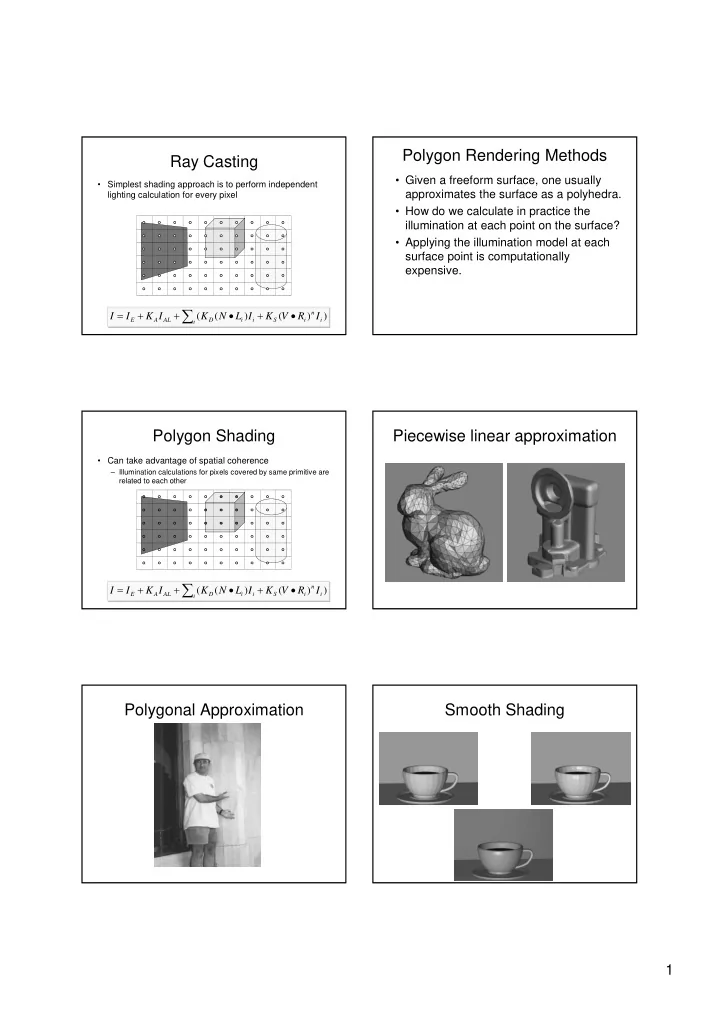
Polygon Rendering Methods Ray Casting Given a freeform surface, - - PDF document

polygon rendering methods ray casting
SMART_READER_LITE
LIVE PREVIEW

Polygon Rendering Methods Ray Casting Given a freeform surface, - - PDF document

Polygon Rendering Methods Ray Casting Given a freeform surface, one usually Simplest shading approach is to perform independent approximates the surface as a polyhedra. lighting calculation for every pixel How do we calculate in


slide-1
SLIDE 1

1

Ray Casting

  • Simplest shading approach is to perform independent

lighting calculation for every pixel

) ) ( ) ( (

  • +
  • +

+ =

i i n i S i i D AL A E

I R V K I L N K I K I I

Polygon Rendering Methods

  • Given a freeform surface, one usually

approximates the surface as a polyhedra.

  • How do we calculate in practice the

illumination at each point on the surface?

  • Applying the illumination model at each

surface point is computationally expensive.

Polygon Shading

  • Can take advantage of spatial coherence

– Illumination calculations for pixels covered by same primitive are related to each other

) ) ( ) ( (

  • +
  • +

+ =

i i n i S i i D AL A E

I R V K I L N K I K I I

Piecewise linear approximation Polygonal Approximation Smooth Shading

slide-2
SLIDE 2

2

Polygon Shading Algorithms

Gouraud Phong Wireframe Flat

Watt Plate 7

Flat Shading

What if a faceted object is illuminated only by directional light sources and is either diffuse or viewed from infinitely far away One illumination calculation per polygon Assign all pixels inside each polygon the same color

Flat Shading

  • A fast and simple method.
  • Gives reasonable result only if all of the following assumptions are

valid: – The object is really a polyhedron. – Light source is far away from the surface so that N•L is constant over each polygon. – Viewing position is far away from the surface so that V•R is constant over each polygon.

Flat Shading

Objects look like they are composed of polygons

OK for polyhedral objects Not so good for ones with smooth surfaces

Gouraud Shading

  • Produces smoothly shaded polygonal mesh

– Piecewise linear approximation – Need fine mesh to capture subtle lighting effects Gouraud Shading Flat Shading

Polygon Smooth Shading

slide-3
SLIDE 3

3

Gouraud Shading

  • What if smooth surface is represented by

polygonal mesh with a normal at each vertex?

) ) ( ) ( (

  • +
  • +

+ =

i i n i S i i D AL A E

I R V K I L N K I K I I

Watt Plate 7

Gouraud Shading

  • Smooth shading over adjacent polygons

– Curved surfaces

  • Renders the polygon surface by linearly interpolating

intensity values across the surface. Mesh with shared normals at vertices

Watt Plate 7

Gouraud Shading

  • One lighting calculation per vertex

– Assign pixels inside polygon by interpolating colors computed at vertices

Gouraud Shading

  • 1. Determine the average unit normal at

each polygon vertex.

  • 2. Apply an illumination model to each

vertex to calculate the vertex intensity.

  • 3. Linearly interpolate the vertex

intensities over the surface polygon.

The normal vector at a vertex

The normal Nv of a vertex is an average of all neighboring normals:

∑ ∑

=

k k k k v

N N N | |

=

k k v

N N

Which is simply the following normalized vector:

Bilinear Interpolation

  • Bilinearly interpolate colors at vertices

down and across scan lines

slide-4
SLIDE 4

4

Linear Interpolation

1

w

2

w I

a

I

b

I

b a

I w I w I

1 2

+ =

b a

I w I w I ) 1 (

2 2

− + =

b b a

I I I w I + − = ) (

2 a

I

b

I

1

w

2

w

Bilinear by three linear interpolations

y

I1 I2 I3

scan line

x

IP

Two linear interpolations along the y-axis, and one along the x-axis.

Bilinear Interpolation

  • Ia = (Ys - Y2) / (Y1 - Y2) * I1 + (Y1 - Ys) / (Y1 - Y2) * I2

Ib = (Ys - Y3) / (Y1 - Y3) * I1 + (Y1 - Ys) / (Y1 - Y3) * I3 Ip = (Xb - Xp) / (Xb - Xa) * Ia + (Xp - Xa) / (Xb - Xa) * Ib

Gouraud Shading of a sphere

Phong Shading

A more accurate method for rendering a polygon surface is to interpolate normal vectors, and then apply the illumination model to each surface point.

Flat Gouraud Phong

slide-5
SLIDE 5

5

Phong Shading

  • 1. Determine the average unit normal at

each polygon vertex.

  • 2. Linearly interpolate the vertex normals
  • ver the surface polygon.
  • 3. Apply the illumination model along each

scan line to calculate pixel intensities for each surface point.

Phong Shading

  • What if polygonal mesh is too coarse to capture illumination effects

in polygon interiors?

) ) ( ) ( (

  • +
  • +

+ =

i i n i S i i D AL A E

I R V K I L N K I K I I

Phong Shading

One lighting calculation per pixel; Approximate surface normals for points inside polygons by bilinear interpolation of normals from vertices

Phong Shading

  • Bilinearly interpolate surface normals at vertices down

and across scan lines Flat Shading Gouraud Shading Phong Shading

Diffuse surface With additional specular component

slide-6
SLIDE 6

6

Polygon Shading Algorithms

Gouraud Phong Wireframe Flat

Watt Plate 7

Shading Issues

  • Problems with interpolated

shading:

– Polygonal silhouettes – Perspective distortion – Orientation dependence (due to bilinear interpolation) – Problems at T-vertices – Problems computing shared vertex normals

One shade or color for the entire object, e.g., there really is no shading being done A Pixar Shutterbug example image with faceted shading. A Pixar Shutterbug example image with Gouraud shading and no specular highlights. A Pixar Shutterbug example image with faceted shading. A Pixar Shutterbug example image with Gouraud shading and no specular highlights. A Pixar Shutterbug example image with Gouraud shading and specular highlights.

Summary

  • 2D polygon scan conversion with a

sweep-line algorithm

– Flat – Gouraud – Phong

Less expensive More accurate

slide-7
SLIDE 7

7

Ambient Occlusion

  • Full GI still too expensive for full feature

film.

  • Ambient Occlusion is used in most modern

films to simulate indirect lighting in an

  • vercast day.
  • Usually, rendered separately and ‘baked’

as texture or 3D data that modifies values

  • f direct lighting.

AO - advantages

  • Much cheaper than GI.
  • Usually does not depend on lighting, looks
  • k with most light settings.
  • Can be computed once for each scene

and reused for every frame.

slide-8
SLIDE 8

8

slide-9
SLIDE 9

9

Three Point Lighting

  • Basic and commonly used lighting

technique

  • Key light
  • Fill light
  • Back light

Key light

  • Creates the subject's main illumination, and

defines the most visible lighting and shadows.

  • Simulates main source of illumination

Fill light

  • Softens and extends the illumination, simulates

secondary light sources

  • At most, half as bright as your key light,
  • usually, casts no shadow

Back light

  • creates a "defining edge" to help visually

separate the subject from the background