Oakridge Redevelopment: New Park Concept Overview and Phase 1 - - PowerPoint PPT Presentation

oakridge redevelopment new park concept
SMART_READER_LITE
LIVE PREVIEW

Oakridge Redevelopment: New Park Concept Overview and Phase 1 - - PowerPoint PPT Presentation

Oakridge Redevelopment: New Park Concept Overview and Phase 1 Engagement Results REPORT REFERENCE Regular Park Board Meeting Monday, February 19, 2018 Purpose of Presentation To provide the Board with an overview of the park design process,


slide-1
SLIDE 1

Regular Park Board Meeting

Overview and Phase 1 Engagement Results

Monday, February 19, 2018 REPORT REFERENCE

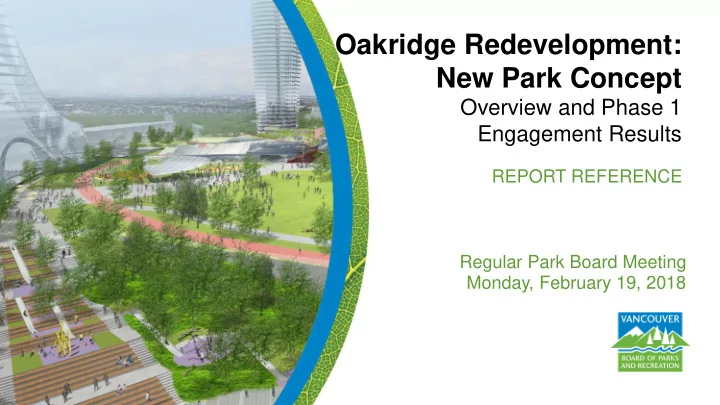
Oakridge Redevelopment: New Park Concept
slide-2
SLIDE 2

To provide the Board with an overview of the park design process, Phase 1 public engagement results and next steps.

2

Purpose of Presentation

slide-3
SLIDE 3

Background

3

slide-4
SLIDE 4
  • 1956: Developed as first

auto-oriented shopping centre in Vancouver.

  • 2007: Policy Statement

for redevelopment of Oakridge Centre with greater intensity of housing, retail and

  • ffice to take advantage
  • f transit.

4

Background

slide-5
SLIDE 5
  • 2014: City Council approved in principle the rezoning

including 2,914 residential units, retail, offices, a new 9-acre park and Civic Centre.

  • The nine-acre park built over the proposed building and

stipulated that park planning would follow a Park Board- led public consultation process, and that the design be approved by the Park Board.

  • The park would be maintained by the Oakridge Centre

property owner to the Park Board’s standards.

5

Background

slide-6
SLIDE 6
  • 2015: the applicants decided not to seek enactment of the

bylaw, due to a series of significant construction challenges.

  • 2016: Information provided to Park Board Commissioners in a

memo detailing the process.

  • 2017: Oakridge Centre was purchased by QuadReal Property

Group, intending to follow through with enactment of the 2014 rezoning, with some revisions. Westbank Corporation is continuing on as the developer of the project.

6

Background

slide-7
SLIDE 7

Current Redevelopment Overview

7

slide-8
SLIDE 8

8

Site Context

  • Cambie Corridor will be a major area of

growth over the next 30 years.

  • Proposed densification in the Municipal Town

Centre (MTC) around Oakridge Centre will consist of townhouses through higher density affordable housing, up to 18 storeys.

  • The new park at Oakridge will help to address

growing demand for park space in the Cambie Corridor.

slide-9
SLIDE 9

9

Site Context: Municipal Town Centre (MTC)

Oakridge Centre

slide-10
SLIDE 10
  • The current layout includes two key park and community

centre improvements over the design from the 2014 rezoning:

10

Park and Community Centre Changes

slide-11
SLIDE 11

Process

11

slide-12
SLIDE 12
  • Park Board staff are involved in three parallel processes:
  • Leading a Park Board-led park design and public

engagement process.

  • Working closely with City staff and the applicant as the

project moves through the City’s Pre-Development Permit application and rezoning enactment processes.

  • Park and recreation staff are closely involved in the

planning of the civic centre, managed by REFM.

12

Process

slide-13
SLIDE 13
  • The new community centre will be co-located with a library

and childcare facility.

  • The community centre will include a fitness centre,

gymnasium, seniors centre with kitchen, youth centre, performance space and multi-use spaces.

13

Process

slide-14
SLIDE 14

14

Project Process: Park Planning

slide-15
SLIDE 15

15

Phase 1 Public Engagement: December 2017

  • 2 Open House Events
  • 1 Month TalkVancouver Survey (694 completed)
slide-16
SLIDE 16

Initial Design and Consultation Feedback

16

slide-17
SLIDE 17
  • Unique opportunity for a new 9 acre park in a densifying

neighbourhood.

  • Largest on-structure park to date in Vancouver.
  • New kind of partnership:
  • Governed, programmed and owned by the Park Board,
  • Operated and maintained to Park Board standards by

Westbank/Quadreal.

17

What makes this park different?

slide-18
SLIDE 18

18

New 9 Acre Park

New Park 9 acres David Lam Park 8.8 acres

slide-19
SLIDE 19

19

New 9 Acre Park

New Park 9 acres CRAB Park 7.4 acres

slide-20
SLIDE 20

20

Site Analysis: Park Levels

slide-21
SLIDE 21

21

Site Analysis: Park Levels

slide-22
SLIDE 22

22

Site Analysis: Land Use Context

slide-23
SLIDE 23

23

Site Analysis: Primary Pedestrian Circulation

slide-24
SLIDE 24

24

Phase 1 Public Engagement: Draft Design Principles

Innovative

  • Produce a destination park that redefines what is

possible in a landscape over a building.

  • Deliver the services that the public needs in new and

engaging ways.

Safe and Connected

  • Ensure the park is a safe environment and is perceived as

such.

  • Connect and animate park spaces and movement routes.
  • Optimize views into the park and between park spaces.
slide-25
SLIDE 25

25

Phase 1 Public Engagement: Draft Design Principles

Accessible and Inviting

  • Accommodate all ages and levels of fitness and ability.
  • Invite the public to the park, with minimum of six highly visible and

easily accessed entry points from the street, transit station and mall.

  • Ensure the park is publicly accessible during standard park hours,

regardless of whether the mall is open

  • Ensure universal access to all areas of the park.
  • Provide easy wayfinding from space to space and entry to exit.
  • Clearly delineate public and private spaces.
  • Extend the park to the entry points through design and programming.
slide-26
SLIDE 26

26

Phase 1 Public Engagement: Draft Design Principles

One Park, Many Parts

  • Weave together a series of unique but interconnected

spaces into a coherent whole, more than the sum of its parts.

  • Use site design, views and programming to unify the park.

Lively Spaces and Edges

  • Create strong indoor – outdoor relationships between

public amenities, including the Civic Centre, and the park.

  • Animate places in the park by taking advantage of

compatible commercial uses.

slide-27
SLIDE 27

27

Phase 1 Public Engagement: Draft Design Principles

A Lush and Diverse Landscape

  • Create a biodiverse, lush urban forest and connection to

nature.

  • Ensure large canopy trees will thrive on all levels of the park.
  • Harness, use and celebrate rainwater.

Light and Shade

  • Locate activities that benefit from sunshine in sunny areas.
  • Design a landscape that responds to varying sun and shade

patterns.

slide-28
SLIDE 28

28

Phase 1 Public Engagement: Draft Design Principles

Resilient

  • Ensure the park allows for a wide range of things to do,

from social, active and fitness focused to calm, peaceful and restorative.

  • Design a park that can both host special events and

support everyday neighbourhood use.

  • Design a park that can adapt to demographic trends and

activity changes over time.

slide-29
SLIDE 29

29

Phase 1 Public Engagement: Draft Design Principles

  • Draft Principles were all well supported. The strongest support

was for:

  • Accessible and Inviting
  • A Lush and Diverse Landscape
  • Safe and Connected
  • Light and Shade
slide-30
SLIDE 30

30

Phase 1 Public Engagement: Draft Programming Ideas

slide-31
SLIDE 31

31

Phase 1 Public Engagement: Draft Programming Ideas

slide-32
SLIDE 32

32

Phase 1 Public Engagement: Draft Programming Ideas

slide-33
SLIDE 33

33

Phase 1 Public Engagement: Draft Programming Ideas

  • Lush plantings and large trees (90%)
  • Pathways throughout (90%)
  • Habitat for birds and pollinators (89%)
  • Multi-use passive space (87%)
  • Natural play elements (78%)
slide-34
SLIDE 34

34

Phase 1 Public Engagement: Draft Programming Ideas

  • Event spaces for small events (73%)
  • Large lawn for pick up sports (69%)
  • Pavilion/covered area (67%)
  • Running/walking track (67%)
slide-35
SLIDE 35

35

Phase 1 Public Engagement: Key Themes

nature

inclusive

community hub

iconic accessible fun destination tranquil

inviting sustainable

useable lush

  • pen

diversity

slide-36
SLIDE 36

36

Phase 1 Public Engagement: Preliminary Design Ideas

Connected Park Zones

Large park with distinct areas established through grade changes, adjacent uses, skylights etc.

slide-37
SLIDE 37

37

Phase 1 Public Engagement: Preliminary Design Ideas

Connected Park Zones Park Areas

slide-38
SLIDE 38

38

Phase 1 Public Engagement: Overall Park Proposal

  • The engagement focused
  • n ideas for park areas,

rather than full park plans.

  • Overall, 82% were either

very or somewhat satisfied with the

  • proposal. 11% were

somewhat or very dissatisfied.

slide-39
SLIDE 39

39

Phase 1 Public Engagement: Park Area Ideas

  • Most supported ideas: Woodland and Meadow Gardens.
  • Comments included: make these areas more natural, make

the Woodland bigger.

slide-40
SLIDE 40

Next Steps

40

slide-41
SLIDE 41

41

Next Steps, Prior to Phase 2 Public Engagement

Draft Preferred Concept

Incorporate Phase 1 public input Develop vision and “big ideas” Refine design ideas

slide-42
SLIDE 42

42

Next Steps

  • Feb – Apr: Develop draft preferred concept; Board workshop
  • May: Second round of Public Engagement
  • Jul: Returning to Board for decision.
slide-43
SLIDE 43