Object Oriented Programming Objects and Classes Methods - - PDF document

object oriented programming
SMART_READER_LITE
LIVE PREVIEW

Object Oriented Programming Objects and Classes Methods - - PDF document

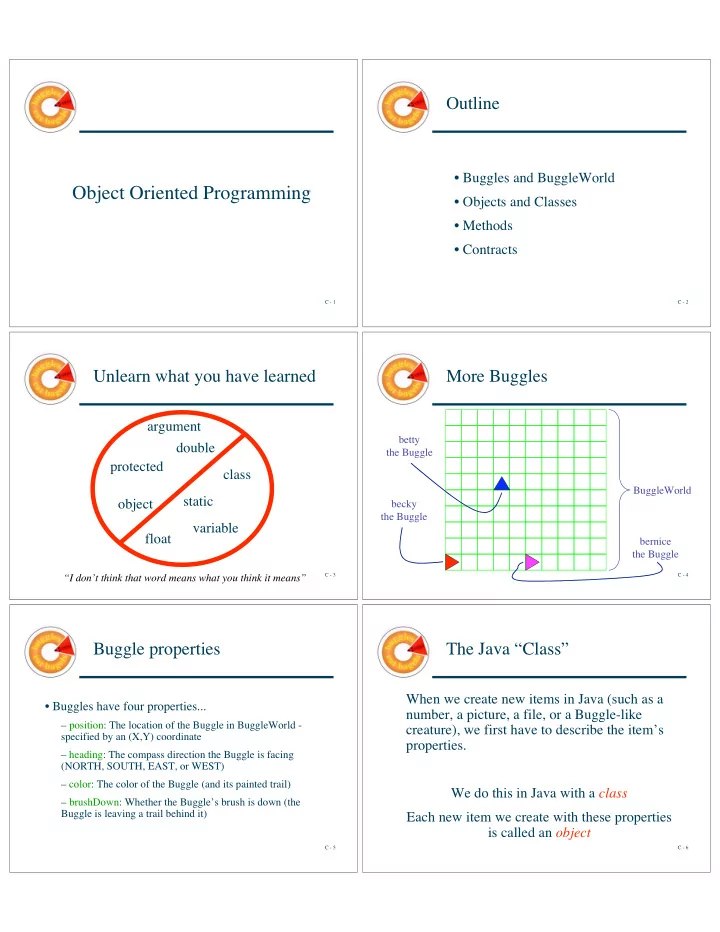
Outline Buggles and BuggleWorld Object Oriented Programming Objects and Classes Methods Contracts C - 1 C - 2 Unlearn what you have learned More Buggles argument betty double the Buggle protected class BuggleWorld


slide-1
SLIDE 1

C - 1

Object Oriented Programming

C - 2

Outline

  • Buggles and BuggleWorld
  • Objects and Classes
  • Methods
  • Contracts

C - 3

Unlearn what you have learned

class

  • bject

variable

“I don’t think that word means what you think it means”

double float static protected argument

C - 4

More Buggles

becky the Buggle BuggleWorld betty the Buggle bernice the Buggle

C - 5

Buggle properties

  • Buggles have four properties...

– position: The location of the Buggle in BuggleWorld - specified by an (X,Y) coordinate – heading: The compass direction the Buggle is facing (NORTH, SOUTH, EAST, or WEST) – color: The color of the Buggle (and its painted trail) – brushDown: Whether the Buggle’s brush is down (the Buggle is leaving a trail behind it)

C - 6

The Java “Class”

When we create new items in Java (such as a number, a picture, a file, or a Buggle-like creature), we first have to describe the item’s properties. We do this in Java with a class Each new item we create with these properties is called an object

slide-2
SLIDE 2

C - 7

Buggles as Objects

  • A class can be thought of as a template, or a mold, for

creating an object

  • Every object is a member of a class
  • Objects are also called instances - each object is a

specific instance of its class

  • We created 3 Buggles. Buggles are objects belonging

to the Buggle class

  • Each of our 3 Buggle objects has the properties

described by the Buggle class

C - 8

What is a Class?

A class is described by:

  • instance variables - Instance variables

describe the properties of each class instance (each object of the class).

C - 9

Buggle Objects

  • In the Buggle class, every Buggle object has 4

properties (instance variables)

  • So becky, betty, and bernice each have the same

4 properties, but they may have different states, i.e., the value of the properties may differ for each

  • f our Buggles
  • becky: (1,1); EAST; red; true
  • betty: (4,6); NORTH; blue; true
  • bernice: (6,1); EAST; magenta; false

C - 10

More Buggles

becky the Buggle BuggleWorld betty the Buggle bernice the Buggle

C - 11

Changing Instance Variables

  • How do we change the state of an object

(such as a Buggle)? In other words, how do we change the value of an instance variable?

  • We send the object a message
  • Messages you can send Buggles include

forward, backward, left, and right becky.forward(); becky.left();

C - 12

Go, becky, Go!

becky.forward(); becky.forward(); becky.left(); betty.backward(); bernice.forward(); bernice.forward();

slide-3
SLIDE 3

C - 13

What is a Class?

A class is described by:

  • instance variables - Instance variables describe

the properties of each class instance (each object

  • f the class).
  • instance methods - Instance methods are the

messages an instance of the class can respond to.

C - 14

Instance Methods

becky.forward(); becky.left();

The statements above send messages to becky. When an object receives a message, it executes a set of instructions called a method. The general form of invoking a method is

  • bject.method();

C - 15

Methods with Arguments (aren’t we sassy?)

  • Some methods require additional information

when they are invoked

  • The additional information you provide is

called an argument Examples: becky.setColor(Color.yellow); becky.forward(5); becky.backward(3);

C - 16

Contracts

  • Every class has a contract that specifies the behavior
  • f its methods, i.e., how instances of the class respond

to messages

  • Any user of a class can expect that objects will behave

as described in the contract

  • Any implementer of the class must ensure that objects

fulfill the contract

C - 17

A Class as a Black Box

Class Black Box

Lyn You

Implementer / Designer User / Client

Contract

C - 18

It’s deja vu all over again

  • Remember abstraction and interfaces?
  • Recall: Once you learn how to drive,

you can drive any car - they all have common features (a common interface) such as steering, gas, and breaking). Once you learn these, you can use any car.

slide-4
SLIDE 4

C - 19

Let’s review...

  • becky is an object. What kind of object? A Buggle.

She is a member of the Buggle class.

  • She (as a Buggle) has certain properties (instance

variables): position, heading, color, and brushDown.

  • To change her properties (instance variables), we send

her a message (we invoke a method)... becky.backward(7);

  • The set of messages we can send her is specified in the

contract.

C - 20

What is a Class?

A class is described by:

  • instance variables - Instance variables describe

the properties of each class instance (each object

  • f the class).
  • instance methods - Instance methods are the

messages an instance of the class can respond to.

  • constructor - The constructor is a special

method which helps create new instance of the class.

C - 21

Constructor

  • Every class has a special method (or methods)

called a constructor

  • A constructor helps create new instances of

the class

  • The constructor is invoked by using the new
  • perator and the name of the class

Buggle becky = new Buggle();

C - 22

Buggle Class

Buggle Class position heading color brushDown Buggle() forward() backward() left() right() forward(int n) backward(int n) setColor(Color c) ...

instance variables constructor instance methods

C - 23

FirstBuggleExample

import java.awt.*; public class FirstBuggleExample extends BuggleWorld { public void init() { super.init(); setDimensions(9,9); } public void run () { // Create new Buggle and move her around Buggle becky = new Buggle(); becky.forward(); becky.forward(); becky.left(); becky.forward(); } }