Object Oriented Programming Procedural programming. [verb-oriented] - - PowerPoint PPT Presentation

object oriented programming
SMART_READER_LITE
LIVE PREVIEW

Object Oriented Programming Procedural programming. [verb-oriented] - - PowerPoint PPT Presentation

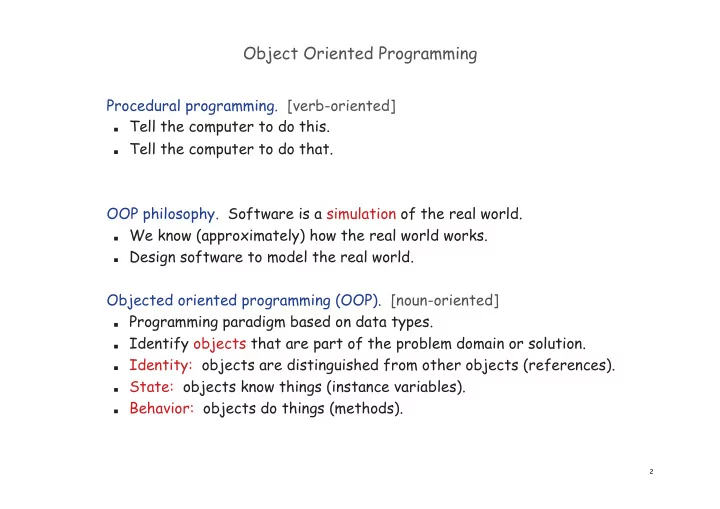
Object Oriented Programming Procedural programming. [verb-oriented] Tell the computer to do this. Tell the computer to do that. OOP philosophy. Software is a simulation of the real world. We know (approximately) how the real world


slide-1
SLIDE 1

2

Object Oriented Programming

Procedural programming. [verb-oriented]

Tell the computer to do this. Tell the computer to do that.

OOP philosophy. Software is a simulation of the real world.

We know (approximately) how the real world works. Design software to model the real world.

Objected oriented programming (OOP). [noun-oriented]

Programming paradigm based on data types. Identify objects that are part of the problem domain or solution. Identity: objects are distinguished from other objects (references). State: objects know things (instance variables). Behavior: objects do things (methods).

slide-2
SLIDE 2

3

Object Oriented Programming

slide-3
SLIDE 3

4

Alan Kay

Alan Kay. [Xerox PARC 1970s]

Invented Smalltalk programming language. Conceived Dynabook portable computer. Ideas led to: laptop, modern GUI, OOP.

Alan Kay 2003 Turing Award

“ The computer revolution hasn't started yet. ” “ The best way to predict the future is to invent it. ” “ If you don't fail at least 90 per cent of the time, you're not aiming high enough. ” — Alan Kay

slide-4
SLIDE 4

5

Encapsulation

slide-5
SLIDE 5

6

Encapsulation

Data type. Set of values and operations on those values.

  • Ex. int, String, Complex, Vector, Document, GuitarString, …

Encapsulated data type. Hide internal representation of data type. Separate implementation from design specification.

Class provides data representation and code for operations. Client uses data type as black box. API specifies contract between client and class.

Bottom line. You don't need to know how a data type is implemented in order to use it.

slide-6
SLIDE 6

7

Intuition

Client API

  • volume
  • change channel
  • adjust picture
  • decode NTSC signal

Implementation

  • cathode ray tube
  • electron gun
  • Sony Wega 36XBR250
  • 241 pounds

Implementation and client need to agree on API ahead of time.

client needs to know how to use API implementation needs to know what API to implement

slide-7
SLIDE 7

8

Intuition

API

  • volume
  • change channel
  • adjust picture
  • decode NTSC signal

Implementation

  • gas plasma monitor
  • Samsung FPT-6374
  • wall mountable
  • 4 inches deep

Can substitute better implementation without changing the client.

Client client needs to know how to use API implementation needs to know what API to implement

slide-8
SLIDE 8

12

Time Bombs

Internal representation changes.

[Y2K] Two digit years: January 1, 2000. [Y2038] 32-bit seconds since 1970: January 19, 2038.

  • Lesson. By exposing data representation to client, might need

to sift through millions of lines of code in client to update.

www.cartoonstock.com/directory/m/millenium_time-bomb.asp

slide-9
SLIDE 9

13

Encapsulated data types.

Don't touch data and do whatever you want. Instead, ask object to manipulate its data.

  • Lesson. Limiting scope makes programs easier to maintain and understand.

"Ask, don't touch."

Adele Goldberg Former president of ACM Co-developed Smalltalk

Ask, Don't Touch

"principle of least privilege"

slide-10
SLIDE 10

Immutability

slide-11
SLIDE 11

16

Immutability: Advantages and Disadvantages

Immutable data type. Object's value cannot change once constructed. Advantages.

Avoid aliasing bugs. Makes program easier to debug. Limits scope of code that can change values. Pass objects around without worrying about modification.

  • Disadvantage. New object must be created for every value.
slide-12
SLIDE 12

Spatial Vectors

slide-13
SLIDE 13

20

Vector Data Type Applications

  • Relevance. A quintessential mathematical abstraction.

Applications.

Statistics. Linear algebra. Clustering and similarity search. Force, velocity, acceleration, momentum, torque. …