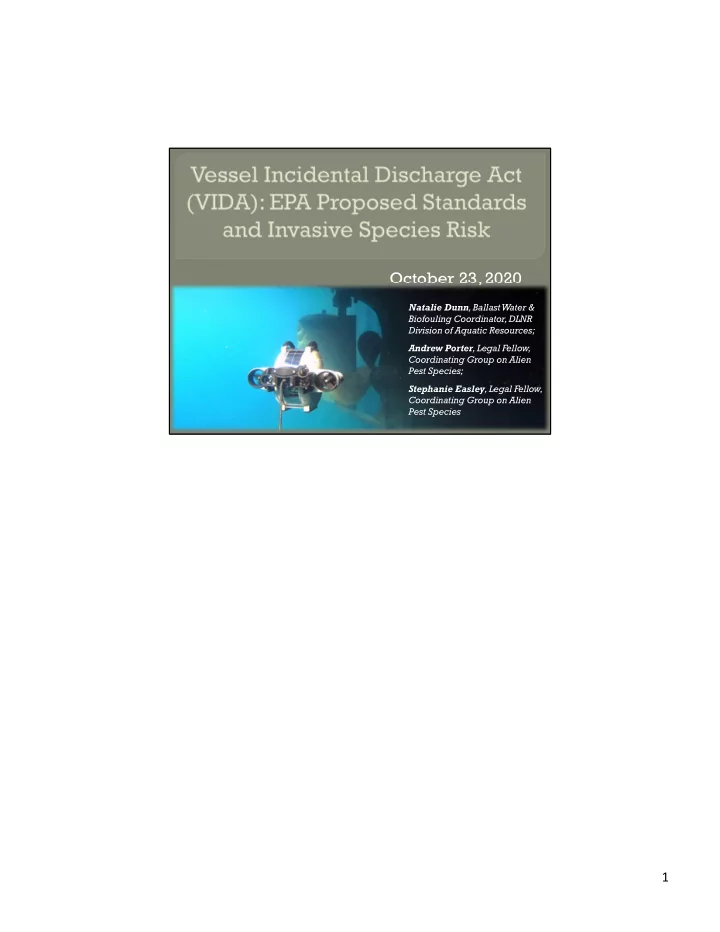
October 23, 2020 Natalie Dunn , Ballast Water & Biofouling - - PDF document
October 23, 2020 Natalie Dunn , Ballast Water & Biofouling Coordinator,DLNR Division of Aquatic Resources; Andrew Porter , Legal Fellow, Coordinating Group on Alien Pest Species; Stephanie Easley , Legal Fellow, Coordinating Group on Alien
Ballast water Biofouling Hull husbandry effluent
- From in-water cleaning of
vessel hulls
- Releases biofouling and
anti-fouling biocides
- Anti-fouling leachate (from hull
coatings)
- Chain locker effluent
- Deck washdown
- Bilgewater
- Elevator pit effluent
- Cathodic protection
- Fish hold effluent
- Graywater (except sewage)
2
VIDA is a federal statute that creates federal regulations for discharges incidental to the normal operation of vessels, and takes that authority away from states. These are examples of some of those discharges in proposed EPA regs. Our comments relate mostly to aquatic invasive species concerns associated with ballast water, biofouling, and hull husbandry effluent. 2
3
Ballast water is water that vessels uptake and discharge to maintain stability, and may contain organisms that hitchhike to another port. 3
Invasive species
transport
Fuel consumption Emissions Corrosion Safety Maneuverability
4
Organisms can also hitchhike on vessels via biofouling. Biofouling refers to organisms that are attached to underwater surfaces of vessel hulls. 4
10 20 30 40 50 60 70 80 90 100 (U.S. Navy Sea Command, 2006) 5
The U.S Navy uses a scale to rate biofouling that ranges from 0‐100 in increments of
- 10. FR‐20 is the dividing line between micro‐ and macro‐ fouling. EPA has adopted
this FR scale. (U.S Navy Sea Command, 2006) 5
FR-10 >30% cover
6
Microfouling (U.S Navy Sea Command, 2006) 6
FR-40 >30% cover
7
Macrofouling (U.S Navy Sea Command, 2006) 7
FR-100 100% cover
8
Macrofouling (U.S Navy Sea Command, 2006) 8
9
In‐water cleaning of ~FR‐80, 80% cover vs ~FR‐20, 100% cover (YouTube, Offshore Passage Opportunities) 9
(UMC International, V . Group) 10
In‐water cleaning with a capture system. (UMC International, V. Group) 10
(Adapted from: Scianni and Georgiades, 2019)
(1) Capture (2) Filter (3) Effluent
11
(Adapted from: Scianni and Georgiades, 2019) 11
Sabellastarte spectabilis & Mycale armata Acanthophora spicifera Pennaria disicha Cassiopea spp.
12
Examples of species that are thought to have been introduced to Hawaii via ballast water or biofouling. Many have known negative impacts such as outcompeting native species. (Photo credit: Casey Ching; Scott Godwin, NPS) 12
13
13
USCG – 33 CFR Ch 151 (primarily ballast
water regulation)
EPA – Clean Water Act via Vessel General
Permit (VGP)
Hawaii:
- HRS § 187A-32 – designates DLNR as lead agency
for AIS issues related to BW&HF
- HAR Ch 13-76 – Ballast Water Regulations
14
Hawaii does not currently have biofouling or in‐water cleaning regulations; however, in‐water cleaning is prohibited by the Department of Health as a violation of the Clean Water Act and state Water Quality Standards under HAR Ch. 11‐54. 14
Requires EPA to sets national standards for
discharges incidental to the normal operation of a vessel.
Creates new areas of responsibilities for USCG (e.g.
regulating in-water hull cleaning)
Preempts state regulation of discharges covered
under VIDA unless the state regulations are no more stringent than federal regulations.
It is important to note that states can enforce federal
regulations or institute state regulations that are no more stringent than federal regulations.
15
Funding for expansion of USCG authority and responsibilities under VIDA is unclear. Currently, there is no extra funding allocated for these extra responsibilities. 15
Preempts states from prohibiting or strictly
controlling in-water cleaning of biofouling.
States may not charge a fee for regulating
incidental discharges unless fee was in place on December 4, 2018.
Commercial vessels under 79 feet and all
fishing vessels are exempt from both federal and state regulation of incidental discharges except for ballast water.
16
16
Exempt: Commercial vessels < 79 feet (except ballast water) Exempt: All commercial fishing vessels Regardless of size (except ballast water) Not covered under VIDA: Recreational vessels (state retains authority to regulate)
17
- Commercial vessels < 79 feet and all fishing vessels regardless of size are exempt
from all incidental discharge standards except for ballast water. This exemption from regulation covers not only any regulation under VIDA but a blanket exemption from all federal, state, and local regulation.
- Recreational vessels are covered under another subpart in 33 USC § 1322 and are
also subject to state and local regulation. 17
Unlike the CWA, VIDA acts as a ceiling
instead of a floor.
All federally protected waters are not covered
under VIDA and can have their own regulations and prohibitions.
VIDA and EPA regulations benefits: spurring
preventative hull maintenance and development of IWCC.
Importance of shipping industry to Hawaii:
- Balancing burden on industry while maintaining
protections for state waters.
18
18
- By December 4, 2020, EPA is required to
promulgate Federal standards of performance for discharges incidental to the normal operation of a vessel.
- By December 4, 2022, USCG is required to
promulgate regs for the implementation, compliance & enforcement of the EPA standards of performance.
- Both EPA and USCG regulations come into force
when the USCG regulations are finalized (~Dec 4, 2022)
19
We are currently waiting for the draft EPA regulations to be published in the Federal Register which is set to occur on October 26th, 2020. 19
20
20
Current Language: § 139.10(c)(3) Discharge or
uptake of ballast water must be avoided in areas with coral reefs.
Propose replacing “must be avoided” with “is
prohibited”.
Add clarity that this prohibition does not apply in
designated ports or harbors with coral.
We are interested in working with other Pacific
island jurisdictions to discuss their concerns with this language.
21
21
EPA plans to discontinue some sensible and internationally accepted ballast water BMPs. Most concerning: avoidance of uptake in “areas known to have infestations or populations of harmful
- rganisms and pathogens (e.g., toxic algal blooms).”
EPA reason: a state can request an emergency order
as provided for in CWA sections 312(p)(4)(E) and (p)(6)(E). (concern: review and reply of application can take up to 6 months)
Propose: retaining all VGP ballast water BMPs in
new regulations
22
EPA’s plan to discontinue this ballast water BMP can be found on page 73 of the Supplemental Information. The anti‐backsliding provisions in VIDA require that “[e]xcept as provided in subclause (II), the Administrator shall not revise a standard of performance under this subsection to be less stringent than an applicable existing requirement.” CWA § 312 (p)(4)(D)(ii)(I). VIDA goes on to state that there are exceptions if new information becomes available that (1) was not reasonably available when the VGP was promulgated, or (2) would have justified the application
- f a less‐stringent standard of performance at the time of promulgation. CWA § 312
(p)(4)(D)(ii)(II). There is also an exception for a material technical mistake or misinterpretation of law that occurred when promulgating the VGP. CGAPS believes that the EPA’s explanation that “[t]he proposed deletion is based on the finding that such measures are not practical to implement” because “[t]hese conditions are usually beyond the control of the vessel operator during the uptake and discharge of ballast water and thus it is not an available measure or practice to minimize or avoid uptake of ballast water in those areas and situations” does not meet any of the anti‐ backsliding exceptions listed above. 22
§ 139.5 Biofouling Management. There are no enforceable standards in the
biofouling management plan (only requires a biofouling management plan) & it is not clear how this will impact State ability to enforce biofouling standards.
Propose adding language that an FR of 30 or
above is a violation of vessel’s requirement to follow the biofouling management plan.
23
Proposed Language: (c) The accumulation of a fouling rating of FR30 or above gives rise to a rebuttable presumption that the biofouling management plan did not meet the standards required in paragraph (b) or that the vessel owner or operator failed to ensure that the biofouling management plan was correctly followed by the crew of the vessel. 23
Main Concern: Lack of clarity for in-water
cleaning standards
§ 139.22 Hulls and Associated Niche Areas.
Cleaning
(4) In-water cleaning of biofouling that
exceeds a fouling rating of FR-20 is prohibited unless one or more of the following conditions are met:
- Fouling is “local in origin”, or
- Use of in-water cleaning and capture system
(IWCC).
24
24
Proposed language: The term “local in
- rigin” be defined as “fouling
accumulated on the hull of a vessel within a defined harbor or port if the vessel hull had been cleaned within seventy-two (72) hours prior to departure from its last port of departure.”
25
The Supplementary Information (p. 205) provides that “fouling is considered to be local if a vessel follows a ‘clean‐before‐you‐go’ strategy, whereby in‐water cleaning is conducted prior to leaving a port on fouling accumulated in that port.” 25
Complete lack of effluent standards for in-
water cleaning with capture (IWCC) systems
EPA only requires an IWCC system to be
“designed and operated” to:
- (A) capture coatings and biofouling organisms;
- (B) filter biofouling organisms from the effluent; and
- (C) minimize the release of biocides.
Propose adding 3 numeric effluent standards:
- Effective capture percentage,
- Post-filtration effluent standards
- Upper limit on FR scale of when in-water cleaning is
prohibited even with IWCC.
26
- 1. The effective capture percentage should be in the high nineties because it only
takes the release of a few organisms to establish a viable ANS community that can reproduce and populate the receiving waters.
- 2. Without the EPA providing a numeric effluent standard there is no possibility of
the USCG establishing a type approval process because there is no standard for the systems to meet.
- 3. Propose adding requirement that any vessel with non‐local biofouling over an FR
70 be prohibited from cleaning in water and must be drydocked for cleaning.
- 4. The proposed effluent standards mentioned above only take into consideration
issues involving aquatic invasive species, effluent standards need to be reviewed by other state agencies for compliance with water quality standards for released biocides and other contaminates released from hull paint during the cleaning process. 26
Addition of more detailed information provided in the
supplementary information into the actual regulations.
Conform language in regulations with language in the
VIDA statute
Suggested language to emphasize State statutory
authority to enforce the Federal Law and have equivalent State laws
Correct technical errors Correct technical error for Hawaii-specific ballast
water exchange regulations re: inter-county voyages in the Hawaiian islands.
27
- 1. An example of adding information from the Supplemental Material into the actual
language is in § 139.10 Ballast Tanks: (c)(1)(i) Ballast tanks must be periodically flushed and cleaned thoroughly not less frequently than at every scheduled drydock to remove sediment and biofouling organisms;
- 2. An example of a mistake in technical language is to correct the ballast water
standard from 1 living organism per 100 milliliters to 1 living organism per 10 milliliters to meet the statutory standard.
- 3. Special ballast water provisions for Hawaii require ballast water Exchange 50nm
from shore unless voyaging: (6) between ports or places of destination in different counties of the State of Hawaii, if the vessel conducts a complete ballast water exchange in waters that are more than 10 NM from shore and at least 200 meters deep; or (7) between ports or places of destination within the same county of the State
- f Hawaii, [if the vessel does not transit outside state marine waters during
the voyage.] (note: Congress added the strikeout language, we requested a technical correction, 27
FYI) * This section only applies to vessels conducting ballast water exchange between the counties and exemptions for safety, sealed tanks, use of ballast water management system, etc. still apply to this section. 27
- EPA is required to accept & consider comments
from all interested parties, including agencies, industry, NGOs, individuals
- No set format for the submission of comments
- Regulations.gov
- Docket No. EPA-HQ-OW-2019-0482
- Comments get concerns on the record; ensure
diversity of review; ensure fairness; develop evidence in the record for possible judicial or
- ther review; & for 5 year EPA review
- 30-day comment period: Oct 26 to Nov 25
28
28
VIDA provides a unique process for a Governor to formally
- bject to a proposed national standard of performance
Must be signed and submitted by the Governor - not by a
State agency
Requires a detailed objection to the proposed standard,
including the scientific, technical, or operational factors that:
- form the basis of the objection, and
- indicate what alternative technology should be used.
EPA is required to provide the Governor a written response
before finalizing that standard of performance
Submitted within 60 days of the published Notice of
Proposed Rulemaking
29
29
A State may submit a petition:
(1) for the issuance of an emergency order
(180 day review period); and
(2) for review any standard of performance,
regulation, or policy promulgated under VIDA based on new information (1 year review period + rulemaking)
(3) no discharge zones for one or more of
the incidental discharges
30
Submitting comments on
EPA regulations
Governor’s objections Regional meetings 31
31
Africa <1% North America 46% Central America Asia 19% Oceania 7% South America Hawaii 26%
Vessel Arrivals (2019)
n= 932 vessels
32
32
33
33
F I G U R E 1 Records of primary detections of ANS between 1965 and 2015 in each of 49 coastal marine, estuarine and freshwater ecosystems. […] total number of detections. F I G U R E 2 Chronology of primary detection events
- f ANS across 49 coastal marine, estuarine and
freshwater ecosystems during 1965–2015 […] the number of primary detection events of ANS by pathway, for the top six pathways (96% of records).
(Bailey et al., 2020) 34
Bailey et al., 2020 34
35