Ohio Department of Transportation Research Results In Action - - PDF document

ohio department of transportation research results in
SMART_READER_LITE
LIVE PREVIEW

Ohio Department of Transportation Research Results In Action - - PDF document

Ohio Department of Transportation Research Results In Action Pavement Forecasting Models The Ohio DOT spends several hundred million dollars each year on pavement reconstruction and rehabilitation. Allocating the available budget to various


slide-1
SLIDE 1

Ohio Department of Transportation Research Results In Action

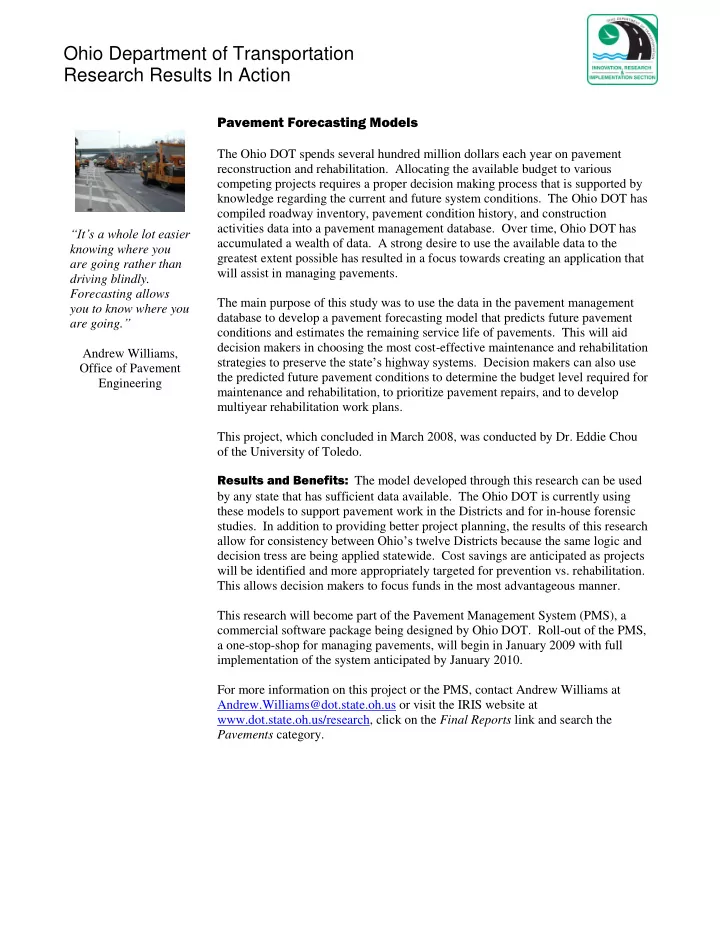
“It’s a whole lot easier knowing where you are going rather than driving blindly. Forecasting allows you to know where you are going.” Andrew Williams, Office of Pavement Engineering Pavement Forecasting Models The Ohio DOT spends several hundred million dollars each year on pavement reconstruction and rehabilitation. Allocating the available budget to various competing projects requires a proper decision making process that is supported by knowledge regarding the current and future system conditions. The Ohio DOT has compiled roadway inventory, pavement condition history, and construction activities data into a pavement management database. Over time, Ohio DOT has accumulated a wealth of data. A strong desire to use the available data to the greatest extent possible has resulted in a focus towards creating an application that will assist in managing pavements. The main purpose of this study was to use the data in the pavement management database to develop a pavement forecasting model that predicts future pavement conditions and estimates the remaining service life of pavements. This will aid decision makers in choosing the most cost-effective maintenance and rehabilitation strategies to preserve the state’s highway systems. Decision makers can also use the predicted future pavement conditions to determine the budget level required for maintenance and rehabilitation, to prioritize pavement repairs, and to develop multiyear rehabilitation work plans. This project, which concluded in March 2008, was conducted by Dr. Eddie Chou

  • f the University of Toledo.

Results and Benefits: The model developed through this research can be used by any state that has sufficient data available. The Ohio DOT is currently using these models to support pavement work in the Districts and for in-house forensic

  • studies. In addition to providing better project planning, the results of this research

allow for consistency between Ohio’s twelve Districts because the same logic and decision tress are being applied statewide. Cost savings are anticipated as projects will be identified and more appropriately targeted for prevention vs. rehabilitation. This allows decision makers to focus funds in the most advantageous manner. This research will become part of the Pavement Management System (PMS), a commercial software package being designed by Ohio DOT. Roll-out of the PMS, a one-stop-shop for managing pavements, will begin in January 2009 with full implementation of the system anticipated by January 2010. For more information on this project or the PMS, contact Andrew Williams at Andrew.Williams@dot.state.oh.us or visit the IRIS website at www.dot.state.oh.us/research, click on the Final Reports link and search the Pavements category.

slide-2
SLIDE 2

Ohio Department of Transportation Research Results In Action

Design of Rock Socketed Drilled Shafts

Drilled shafts are used to support lateral loads such as wind, flowing water in channels, soil, and expansion-contraction forces of a bridge. Drilled shafts are the preferred foundation type for lighting towers, noise walls, landslide repairs, retaining walls, and most major bridges. Since a limited number of lateral load tests have been performed in the past to measure and document the actual strength of underground rock layers as it relates to the rock layers’ ability to support lateral loads, engineers tend to provide drilled shaft designs that are excessively conservative and consequently much more expensive than necessary. Obtaining more accurate field data would enable designers to reduce the size of many drilled shafts resulting in tremendous cost savings. This project consisted of evaluating and developing design criteria for drilled shafts socketed in rock and subject to lateral loads. The most widely accepted validation method for laterally loaded drilled shafts is the lateral force-deflection (p-y) analysis; however, rock has been given little attention in the p-y method. This research proposed a complete solution for the design of rock socketed drilled shafts. The research findings address the preliminary design of shafts under service loads, develop a computer program to provide an adequate margin

  • f safety for design, and propose hyperbolic p-y curves. The Ohio DOT is

investigating the proposed solutions further in an on-going study, “Verification and Calibration of the Design Methods for Rock Stocketed Drilled Shafts for Lateral Loads,” which is anticipated to conclude in August 2010. This project, which concluded in October 2006, was conducted by Dr. Jamal Nusairat of E.L. Robinson Engineering of Ohio, Co. Results and Benefits: This research has provided a better understanding of the behavior of shafts in weak rock. The findings have lead to an improved design for rock-socketed drilled shafts that is more cost effective than previous

  • designs. It is anticipated that the DOT can experience a 20-30% cost savings

from more appropriately designed shaft diameters and proper depth placement in the rock. As the nation shifts to Load and Resistance Factor Design (LRFD), it is anticipated that the results from this research combined with the on-going study may result in a modification to resistance factors that is based on actual test data. For more information on this project, please contact Jawdat Siddiqi at Jawdat.Siddiqi@dot.state.oh.us or visit the IRIS website at www.dot.state.oh.us/research, click on the Final Reports link and search the Structures category. “The study currently underway is expected to have a direct impact on the AASHTO LRFD Bridge Design Specifications specifically in regards to the lateral load analysis

  • f rock socketed drilled

shafts when the p-y method of analysis is used.” Jawdat Siddiqi, Office of Structural Engineering

slide-3
SLIDE 3

Ohio Department of Transportation Research Results In Action

“Implementation of this research project will be

  • ur first step toward

effective and proactive management of geological hazards across the state.” Kirk Beach, Office of Geotechnical Engineering Landslide Hazard Rating Matrix and Database The Ohio DOT has embarked on a broad based and far-reaching plan to develop a comprehensive Geological Hazard Management System (GHMS) to better manage data and activities related to planning, design, construction, and maintenance of both existing and new highway infrastructures that may be affected by the known geological hazards in Ohio. Geologic hazards include landslides, rockfalls, abandoned underground mines, karst, and shoreline erosion. The components of the GHMS include, but are not limited to: inventory, monitoring schedule, hazard rating matrix, cost benefit analysis, prioritization and decision making, new construction support, preservation of historical data, and efficient data exchange. To accomplish this work, various projects were initiated to develop the GHMS in

  • phases. This research study was undertaken to focus on the landslide portion of

the GHMS, specifically to develop a field validated landslide geological hazard rating matrix and develop and deploy a web-enabled, GIS-based landslide

  • database. This project, which concluded in January 2008, was conducted by Dr.

Robert Liang of the University of Akron. Results and Benefits: Benefits from the full implementation of the landslide database and hazard rating matrix include elimination of excessive paperwork, near real-time monitoring and data management, centralized information, uniform data collection and reporting, and enhanced data sharing experiences. Ultimately, this project resulted in a better management tool for decision-makers as it allows for early-stage detection and pro-active remediation measures. It aids in both long-term and short-term planning as it identifies geohazards across the state and provides a risk assessment. This allows decision makers to prioritize projects in their areas to address high and moderate risk sites appropriately, given limited available funds. Ohio DOT estimates that this research will result in a 30-40% reduction in overall costs as sites are identified and addressed appropriately. Considering that the DOT spends approximately $60,000,000 per year in geohazard remediation, the benefits of this $536,827 study will be substantial. The application developed under this study can be utilized by any state dealing with landslides. This pilot web-based GIS application will be integrated with

  • ther geohazard applications developed under separate projects dealing with rock

falls, underground mines, and cost remediation into one all-encompassing, user- friendly program. It is anticipated that the entire GHMS will be fully integrated and available for deployment in two years. For more information on this project or the GHMS, contact Kirk Beach at Kirk.Beach@dot.state.oh.us or visit the IRIS website at www.dot.state.oh.us/research, click on the Final Reports link and search the Geotechnical category.

slide-4
SLIDE 4

Ohio Department of Transportation Research Results In Action

LiDAR Innovations in Ohio

The Ohio DOT has been utilizing airborne Light Detection and Ranging (LiDAR) to generate planning and design products since implementing LiDAR technology in 2004. LiDAR, or airborne laser scanning, is a dominate player in high- precision spatial data acquisition. It is the main source of surface data at decimeter-level vertical accuracy in a more automated way. With increasing point density, new systems are able to support object extraction, such as buildings and roads, from LiDAR data. Ohio DOT sponsored three separate research projects to further our understanding and usage of LiDAR. Extensive simulations were preformed in the project “Geo- Referenced Digital Data Acquisition and Processing System Using LiDAR Technology” (completed in February 2006) to determine a favorable LiDAR- target design, including optimal target size and shape, signal response, coating pattern, and methods to accurately determine the 3-diminesional target position in the LiDAR dataset. The project “Airborne LiDAR: A New Source of Traffic Flow Data” (completed in October 2005) demonstrated that LiDAR may be used to collect significant amounts of data rich in traffic flow information at almost no additional cost. The project “Airborne LiDAR Reflective Linear Feature Extraction for Strip Adjustment and Horizontal Accuracy Determination” (concluding in June 2008) was initiated to better determine horizontal accuracy using existing linear features such as pavement lane lines. Results to date have shown much higher horizontal accuracies (within 4-inches) than previously thought possible. All three LiDAR projects were conducted by Dr. Dorota Brzezinska and Dr. Charles Toth of The Ohio State University. Results and Benefits: LiDAR has provided increased accuracy over traditional photogrammetry from a fixed wing aircraft. It allows for expedited development of highway improvement projects. Traditional aerial surveying jobs that required approximately two weeks to conduct in the past can now be accomplished in as little as four days. The Ohio DOT has experienced turn around on some emergency projects as quickly as two days. Cost savings has also been realized since a considerable amount of the process has been semi- automated using LiDAR. The Ohio DOT has calculated a savings of at least $3 million per year from LiDAR applications. While staffing remains the same, the

  • verall value of the work output through LiDAR is increased significantly.

For more information on LiDAR and its application to transportation, contact John Ray at John.Ray@dot.state.oh.us or visit the IRIS website at www.dot.state.oh.us/research, click on the Final Reports link and search the Aerial category. “LiDAR is an amazing tool if utilized appropriately.” John Ray, Office of Aerial Engineering

slide-5
SLIDE 5

Ohio Department of Transportation Research Results In Action

“In 2001 when ODOT crash tested its generic 32-inch portable concrete barrier, we also expected FHWA to grandfather our 50- inch barrier design. But when FHWA balked at approving the 50-inch barrier, ODOT was left without a suitable design. Drs. Kennedy and Plaxico understood the problem and provided a solid design which passed all crash testing criteria on the first try.” Dean Focke, Office of Roadway Engineering (Retired) Development of an NCHRP 350 TL-3 New Jersey 50-inch Portable

Concrete Barrier

A 50-inch tall work zone barrier is typically used in medians on divided highways and at other locations where geometrics or unusual sources of light would cause a glare problem for motorists. At least one of these conditions exists for roughly 95%

  • f all work zones. There are generally two design options available for this type of

barrier: a 50-inch tall portable concrete barrier (PCB) or a 32-inch tall PCB with commercially supplied glare screens (typically a series of plastic panels) attached at a slight angle on the top of the barrier. Their close proximity to traffic in work zones makes these barriers prone to being hit. Plastic glare screens are easily shattered upon impact. The subsequent debris and on site repair are potential safety concerns for motorists as well as highway workers. The lack of glare protection for motorists until the barrier can be repaired is an additional safety concern. ODOT’s 32-inch PCB with glare screens was approved by FHWA as a test level 3 (TL-3) unit in 2002, but the 50-inch PCB did not meet TL-3 crash testing criteria for use

  • n roadways designed for speeds of 45 mph or greater.

The purpose of this study was to develop a design for a 50-inch PCB for use in roadside work zone areas in which the top portion of the barrier functions as an integral glare screen. Once designed, testing of the PCB to satisfy TL-3 could

  • ccur.

This project, which concluded in June 2006, was conducted by Dr. James Kennedy and Dr. Chuck Plaxico of The Battelle Memorial Institute. Results and Benefits: This research developed a 50-inch (PCB) that satisfied all safety criteria as a TL-3 unit and was approved by the FHWA for use on the highway system in 2006. The design includes many of the standard materials already used in ODOT’s 32-inch PCB. The 50-inch PCB provides added safety to the traveling public and work-zone personnel in regards to vehicle trajectory and potential debris created upon impact. Additionally the 50-inch PCB serves as its

  • wn glare-shield, providing an effective, low maintenance solution for inhibiting

headlight glare and driver distractions in work zones. Based on 2002 data, the average cost of the 50-inch PCB was $8.96 per lineal foot while the 32-inch PCB cost $7.26 plus $12.55 for glare screens per lineal foot. Adding glare screens to existing 32-inch PCB is more than twice the cost of a 50- inch PCB. The average cost of new 32-inch PCB with glare screen already attached is $14.24, almost a 60% increase over the cost of a 50-inch PCB. For more information on this project, contact Michael Bline at Michael.Bline@dot.state.oh.us or visit the IRIS website at www.dot.state.oh.us/research, click on the Final Reports link and search the Roadway category.

slide-6
SLIDE 6

Ohio Department of Transportation Research Results In Action

Evaluation and Design of ODOT’s Type 5 Guardrail with Tubular Backup

ODOT had a somewhat generic guardrail system (GR-2.2) installed on many culverts throughout the state. This system is utilized on approximately one third of the bridges in ODOT’s inventory (roughly 3,500 structures). Starting in 1998, the required crash testing criteria for this guardrail system was modified from test level 2 to test level 3 (TL-3) by the Federal Highway Administration (FHWA). This change in standards meant that GR-2.2 could not be placed on roadways designed for speeds of 45 mph or greater. A good portion of the existing GR-2.2 systems were in locations that did not meet the new criteria. The main purpose of this study was to test and modify, if needed, the GR- 2.2 system so that it meets TL-3 criteria. The system’s history of performance in the field was very good. The overall simplicity of the design and use of off-the-shelf hardware made the GR-2.2 easy to maintain. Therefore, ODOT was also interested in testing the system for additional use as a roadside barrier using standard post mounting techniques as

  • pposed to the bridge mounting techniques currently utilized.

This project, which concluded in February 2006, was conducted by Dr. James Kennedy and Dr. Chuck Plaxico of The Battelle Memorial Institute. Results and Benefits: Based on the results of this research, the original design and modified design of GR-2.2 and its mounting apparatus have been accepted by the FHWA as a TL-3 system. Since it now meets the new crash test criteria, it can be repaired when damaged instead of being completely replaced. The research also provided an inexpensive retrofit for the guardrail to enhance crash performance. The retrofit, requiring minimal hardware change and costing approximately $7/ft, does not require removing the current system, replacing transitions, or lengthening the culverts to install. To replace the current system with concrete barrier would cost approximately $9,200 per site. To repair the system, assuming a negligible change in cost, would cost approximately $4,200 per site. For the 3,500 bridges currently in ODOT’s inventory using this system would result in a total savings of $17.5 - $36.4 million. If we conservatively estimate replacing 3% of these structures each year, this would equate to an annual savings of $525,000 - $1.09 million. This does not take into consideration the additional savings associated with repairing the numerous culvert installations already in our inventory or installing new systems on

  • culverts. This research also provided standard construction drawings for

the guardrail (GR-2.2) and transitions (GR-3.4). For additional information on this research, contact Michael Bline at Michael.Bline@dot.state.oh.us or visit the IRIS website at www.dot.state.oh.us/research, click on the Final Reports link and search the Roadway category. “Drs. Kennedy and Plaxico really came through for ODOT on this project. They were able to prove to FHWA that this existing system, only slightly modified, is still crashworthy for the current auto fleet. This was the first time FHWA had approved a system using computer simulation only expensive crash testing was not needed.” Dean Focke, Office of Roadway Engineering (Retired)