On-Field Assessment & Management of the Neurologically Injured - - PowerPoint PPT Presentation

on field assessment amp management of the neurologically
SMART_READER_LITE
LIVE PREVIEW

On-Field Assessment & Management of the Neurologically Injured - - PowerPoint PPT Presentation

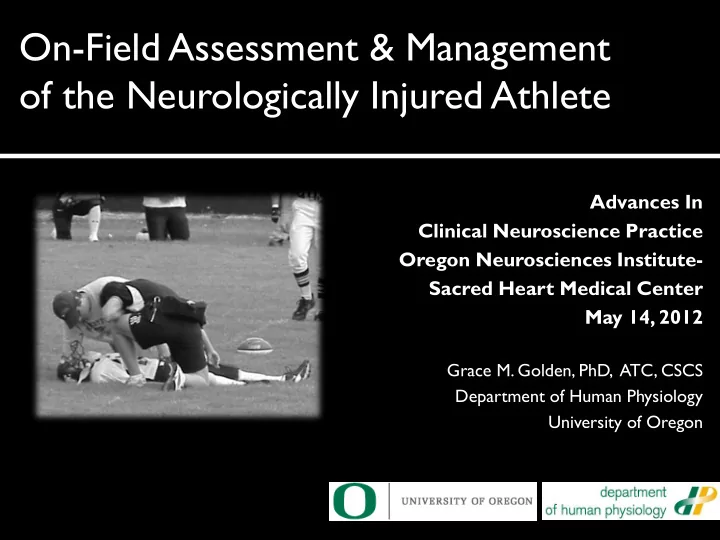
On-Field Assessment & Management of the Neurologically Injured Athlete Advances In Clinical Neuroscience Practice Oregon Neurosciences Institute- Sacred Heart Medical Center May 14, 2012 Grace M. Golden, PhD, ATC, CSCS Department of


slide-1
SLIDE 1

On-Field Assessment & Management

  • f the Neurologically Injured Athlete

Advances In Clinical Neuroscience Practice Oregon Neurosciences Institute- Sacred Heart Medical Center May 14, 2012

Grace M. Golden, PhD, ATC, CSCS Department of Human Physiology University of Oregon

slide-2
SLIDE 2

Sports-Related Concussion Sports-Related Spine Trauma

F O C U S T O D A Y

slide-3
SLIDE 3

Emergency Room

Partnerships in delivery of acute care

Athlete

Team Physician Available Athletic Medicine Team

Paramedic/ EMT

Athletic Trainer

slide-4
SLIDE 4

Partnerships in delivery of return to play decisions

Athlete

Team Physician Athletic Trainer

slide-5
SLIDE 5

Before the injury happens…..

slide-6
SLIDE 6

Plan-Prepare-Practice-Provide

Andersen et al. JAT 2002

slide-7
SLIDE 7

Prepare

Emergency Action Plan

UO Libraries Digital Collections

Golden, 2011

www.ncaa.com/news/basketball-men/2011-01-13/oregon-set-open-new-arena

CONSIDER

Venue

Sport/ Equipment Needs

Personnel

slide-8
SLIDE 8

Communicate EAP Procedures to Local Emergency Medical Personnel

PRE-SEASON PRE-GAME

Adapted; Flicker.com, seanfderry-studenna’s photostream

slide-9
SLIDE 9

Review and practice procedures relative to EAP

University of South Florida On-Field Simulation (http://hscweb3.hsc.usf.edu/health/now/?p=20647)

IDEAL SCENARIO = PRE-SEASON SIMULATION

slide-10
SLIDE 10

Educate Coaches & Players

slide-11
SLIDE 11

Implement the Emergency Action Plan

slide-12
SLIDE 12

Sports-Related Spine Trauma

slide-13
SLIDE 13

History

1998 Inter-Association Task Force for Appropriate Care of the Spine Injured Athlete

slide-14
SLIDE 14

Current Standards of Care for Athletic Trainers

Swartz et al. JAT, 2009 Casa et al. JAT, 2012

slide-15
SLIDE 15

Sideline Evaluation On-the-Field Evaluation

Differential Diagnosis Brachial Plexus Cervical Spine Trauma Differential Diagnosis (Cervical) Spine Trauma Brachial Plexus Injury Closed Head Injury

slide-16
SLIDE 16

Unconsciousness/altered consciousness Bilateral neurological findings Significant cervical spine pain (w/ with or w/o palpation) Obvious spinal column deformity

Clinical Indicators of Catastrophic Cervical Spine Injury

Swartz et al. JAT, 2009; Sanchez et al. Spin Cond., 2005

c

slide-17
SLIDE 17

Subjective Pain + Numbness Anxiety

Assessment of Cervical Spine

slide-18
SLIDE 18

Objective

Palpation (doorbell sign) *Glasgow Coma Scale < 8 Myotomes- Isometric > Isodynamic Dermatomes Deep Tendon Reflexes

Assessment of Cervical Spine

*Holly et al. J Neurosurg., 2002

slide-19
SLIDE 19

Stabilization Manual cervical immobilization Neutral Alignment Manual Re-alignment Ø Traction

Suspect Cervical Spine Injury?

Swartz et al. JAT, 2009

slide-20
SLIDE 20

Airway Easily Accessible? Yes- provision of immobilization device No- Prepare for access while maintaining stabilization

Swartz et al. JAT, 2009

Suspect Cervical Spine Injury?

slide-21
SLIDE 21

Access to airway- Equipment Considerations

3-6 Volt Reversible Cordless Drill Clip/Loop cutter (FMxtractor) Quick-release loop tool (Manufacturer specific)

Facemask removal appropriate regardless of level of consciousness

slide-22
SLIDE 22

Helmet Removal?

Football and Lacrosse Helmets are not removed for transport unless the shoulder pads must be removed. Personnel must be familiar with how to manage shoulder pad removal while maintaining spine stabilization

Improving the culture for ATCs and EMTs on-the-field

Waninger & Swartz, CSMR, 2011

slide-23
SLIDE 23

Helmet removal without shoulder pad removal influences cervical spine position

Sherbondy et al. AJSM, 2006

slide-24
SLIDE 24

Swartz et al. JAT, 2009

T

  • log roll or not log roll?
slide-25
SLIDE 25

Transfer techniques on-the-field

Log Roll

4-5 rescuers ⇑ Universal Familiarity Leads to greater axial rotation, lateral flexion in unstable spine, even with cervical collar* Only option with prone patient

Del Rossi et al., 2003, 2004, 2008; Horodyski et al. Trauma, 2011

6+ Person Lift & Slide

6-7 rescuers ⇓ Universal Familiarity Reduces cervical and thoracolumbar spine motion compared to log roll* Standard of Care for Football if Athletic Medicine Team Available Requires more practice

slide-26
SLIDE 26

6 + person lift & slide

Provision of cervical spine stabilization Bilateral position of rescuers at shoulders, hips, legs Rescuer prepared to slide spine board Command directed rescuer lift 6+ inches off ground Spine board positioned underneath athlete Command directed rescuer lowering of athlete to spine board Appropriate head stabilization and strapping, prepare for transportation

Swartz et al. JAT, 2009

slide-27
SLIDE 27

High School Small College/University Division I- Olympic Sports Collegiate/Pro Football

slide-28
SLIDE 28

Result

slide-29
SLIDE 29

Sports-Related Concussion

slide-30
SLIDE 30

Current Standards of Care for Athletic Trainers

Guskiewicz et al. JAT, 2004 McCrory et al. SAJSM, 2009

slide-31
SLIDE 31

Not ‘just’ a football injury

slide-32
SLIDE 32

Trending upward

7% average annual increase in concussions for NCAA athletes from 1998-2004 5-18% of injuries in collegiate athletes are concussions (sport dependent) 13% of high school injuries are concussions (RIO database) Improved identification of the concussed athlete and awareness of the implications of the injury

Hootman et al. JAT, 2007, Marar et al. AJSM, 2012

slide-33
SLIDE 33

Everyone treated the same!

“All athletes, regardless of level of participation should be managed using the same treatment and return-to-play paradigm.”

McCrory et al., SAJSM, 2009

slide-34
SLIDE 34

Obvious vs. Subtle Signs and Symptoms

slide-35
SLIDE 35

Sport Concussion Assessment Tool 1

McCrory et al. 2009

slide-36
SLIDE 36

Sport Concussion Assessment T

  • ol 2

Symptom Score = Yes-No /22 Symptom Severity = Symptom score x 6 Symptoms worse with physical activity? Symptoms worse with mental activity?

Headache “Pressure in head” Nausea or vomiting Dizziness Blurred vision Balance problems Sensitivity to light Sensitivity to noise Feeling slowed down Feeling like “in a fog” “Don’t feel right” Difficulty concentrating Difficulty remembering Fatigue or low energy Confusion Drowsiness Trouble falling asleep (if applicable) More emotional Irritability Sadness Nervous or anxious

slide-37
SLIDE 37

Sport Concussion Assessment T

  • ol 2

Loss of consciousness Y/N How long? Associated balance problems Y/N

Physical Signs Score

slide-38
SLIDE 38

Sport Concussion Assessment T

  • ol 2

Best Eye Response (1-4) Best Verbal Response (1-5) Best Motor Response (1-6) T

  • tal / 15

Glasgow coma scale

slide-39
SLIDE 39

Sport Concussion Assessment T

  • ol 2

“I am going to ask you a few questions, please listen carefully and give your best effort.” At what venue are we at today? Which half is it now? Who scored last in the match? What team did you play last week? Did your team win the last game?

Sideline Maddocks Score ( T

  • tal / 5)
slide-40
SLIDE 40

Sport Concussion Assessment T

  • ol 2

Cognitive Assessment

Orientation (T

  • tal/5)

What month is it? What is the date today? What is the day of the week? What year is it? What time is it right now (w/i 1 hr)? Immediate Memory (Recall) (Total/15) Elbow Apple Carpet Saddle Bubble Evaluated 3x Concentration Digits Backwards 4-9-3 3-8-1-4 6-2-9-7-1 7-1-8-4-6-2 Months in Reverse Dec-Nov-Oct-Sept……

slide-41
SLIDE 41

Modified-Customized Considerations

Balance + Rhomberg (Tandem Stance) Balance Error Scoring System (BESS) Pronator Drift Physical Exertion Agility Vestibular Challenges (up-downs)

slide-42
SLIDE 42

Suspected Concussion?

Removal from play. Medical assessment. Monitored for changes in status (deterioration?) Instructions for home care and schedule follow-up.

slide-43
SLIDE 43

Sport Concussion Assessment T

  • ol 2

Repeated Administration of Same T

  • ol

ATC/MD

  • n-the-field

Symptom Score Cognitive Assessment 24 hr f/up ATC/MD Symptom Score Cognitive Assessment 48 hr f/up ATC/MD Symptom Score Cognitive Assessment

Never ask: “Do you have a headache today?” Ask rather: “How is your headache today?”

slide-44
SLIDE 44

Symptom Score Day1 Day2 …Day n Headache “Pressure in head” Nausea or vomiting Dizziness Blurred vision Balance problems Sensitivity to light Sensitivity to noise Feeling slowed down Feeling like “in a fog” “Don’t feel right” Difficulty concentrating Difficulty remembering Fatigue or low energy Confusion Drowsiness Trouble falling asleep More emotional Irritability Sadness Nervous or anxious Word Recall Immediate 2nd 3rd Elbow Apple Carpet Saddle Bubble Word Recall Immediate 2nd 3rd Car Ball Baby Truck Pencil

Day 1 (ATC) Day 2 (MD)

Coordinated Record Keeping and Assessment is Vital!

(ATC) (MD) (ATC)

slide-45
SLIDE 45

Challenges during game-time-decisions

Pressure to make quick decisions. Coach’s bias- previous personal experience. Athlete’s bias*- fear of loss of playing time, letting down teammates, thinking it isn’t serious enough. Parent’s bias- previous personal experience. Dogma associated with ‘getting bell rung’.

*McCrea et al. CJSM, 2004

slide-46
SLIDE 46

Sum(IN)mary

slide-47
SLIDE 47

Questions? Thank you!

Contact: graceg@uoregon.edu

slide-48
SLIDE 48

Remaining slides as prep/back-up in case extra questions are asked-not for original presentation

slide-49
SLIDE 49

Traditional Style vs. Revolution Helmet

Swartz et al. JAT, 2009

slide-50
SLIDE 50

Swartz et al. JAT, 2009

slide-51
SLIDE 51

Swartz et al. JAT, 2010 FMxtractor (Sports Medicine Concepts Inc.) Cordless Screwdriver (Reversible) Quick Release Facemask Attachment (Riddell Inc.)

slide-52
SLIDE 52

Waninger & Swartz, CSMR, 2011